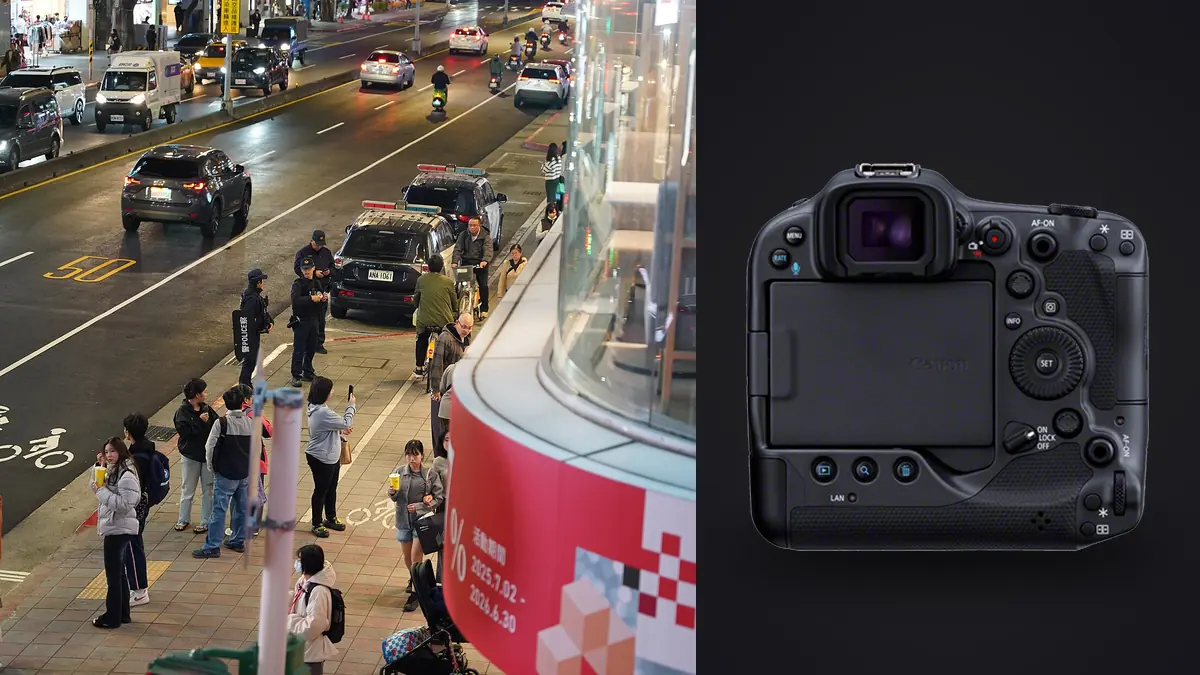
I borrowed a Canon EOS R3 for eight weeks this spring to shoot a long-form documentary project on a shuttered textile market, plus whatever street work I could grab on the walk there and back. Going in, I assumed it would feel wrong for the genre. The R3 was built and marketed as a sports and news body, the camera Canon puts in the hands of people shooting Olympic finals and Formula 1 grids. Street and documentary photography usually rewards the opposite instincts: small, quiet, unremarkable gear that lets you disappear into a scene rather than announce yourself. What follows is what I found once the honeymoon period wore off and the camera just became the thing I carried every day.
Why This Camera Even Belongs in the Conversation
The case for the R3 in this genre has nothing to do with resolution and everything to do with response time. It has a 24.1 megapixel stacked, back-illuminated sensor paired with the Digic X processor, and that combination is what makes the rest of the feature set possible: 30 frames per second with the electronic shutter, a viewfinder that does not black out between frames, and autofocus tracking that keeps working even when a subject cuts across the frame at speed. None of that matters for a posed portrait. All of it matters when you are three steps behind a moment that is about to close, which is most of what documentary work actually is.
Twenty-four megapixels is also, quietly, the right resolution for this kind of shooting. It is enough to crop a frame that was composed a beat too late, but it does not bury you in file size when you are shooting thousands of frames a day. A market day for me routinely produced 2,000 to 3,000 exposures. At 45 or 50 megapixels that number of files becomes a storage and triage problem before it becomes an editing one.
Eye Control AF: The Feature I Was Ready to Dismiss
Eye Control AF returned on the R3 after a long absence from Canon's lineup (it last appeared on film SLRs in the 1990s), and I went in skeptical. The idea is that the camera tracks where your eye is looking inside the viewfinder and moves the AF point there, so you never touch a joystick. For street work, where a scene can rearrange itself in under a second, this sounds ideal in theory.
In practice it needed real calibration time. The built-in calibration routine takes a few minutes and I had to redo it twice before tracking felt reliable, and it degrades if you shoot with sunglasses or if the eyecup shifts position, which happens constantly when a camera is slung across your body all day. Once dialed in, though, it changed how I worked a crowded frame. Picking a specific face out of a cluster of people by just looking at it, rather than nudging a joystick while people keep moving, saved real shots. I would not buy this camera for Eye Control AF alone, but after two weeks I missed it badly on the days I switched back to my R6 Mark II.
Handling the Size and Weight Question Honestly
This is where the R3 asks you to make a real trade. At 1,015 grams body only, with an integrated vertical grip that cannot be removed, it is not a discreet camera. It reads as "professional with a capital P" from thirty feet away, which changes how people react to you on a street corner. Some subjects relax because the camera looks legitimate rather than like a hobbyist's toy. Others tense up or ask what publication you're with. Neither reaction is what you want if the goal is candid, unguarded documentary frames.
I ended up shooting a lot of the project with the RF 35mm f/1.8, which is small and light enough to bring the overall package back toward reasonable, and I kept the strap short and the camera close to my body rather than swinging at hip height. It never became small. It became manageable. If your street work depends on genuinely blending in, a Fujifilm X100VI or a Ricoh GR III will do that job better than this camera ever will, no matter how you carry it.
Burst Shooting and What It Does to Your Evening
Thirty frames per second is a genuinely different way of working once you get used to it, and it changes the culling problem more than it changes the shooting problem. A single three-second burst of someone stepping off a curb into traffic produces ninety frames, and across a full day that adds up fast. I stopped trying to review everything on the rear screen at day's end and started relying on imagic to do the first pass locally on my own machine: its sharpness and focus scoring flags the handful of genuinely sharp frames inside each burst, and its duplicate and burst clustering groups near-identical sequences together instead of making me scroll past eighty variations of the same gesture one at a time. Because it processes everything on-device rather than uploading to a cloud service, I could run the cull that same night in a hotel room with no usable internet, which mattered more than once on this project. If you have not seen how automated culling actually handles a high-volume burst like this, our piece on how AI photo culling works covers the mechanics in more depth than I have room for here.
The buffer holds up well with a fast CFexpress Type B card. I never hit a hard wall shooting RAW bursts in the field, though a full day of continuous high-speed shooting will eventually outpace even a fast card if you hold the shutter down carelessly. The camera also takes a second card in a UHS-II SD slot, which I used for JPEG backups I could hand off on the spot without touching the primary RAW files.
Low Light and the Viewfinder That Doesn't Quit
Documentary work has a way of pushing you into bad light: a covered market at dusk, an interior with three working bulbs, a street scene twenty minutes after sunset. The R3's native ISO range runs 100 to 102,400, expandable further, and I stayed usable up to around ISO 12,800 for editorial purposes, with grain that read as texture rather than noise. That is not dramatically better than the R6 Mark II's sensor, which shares a lot of the same underlying DNA, but the blackout-free electronic viewfinder is the bigger win in dim conditions. When you're tracking a subject through uneven light, an EVF that keeps showing you a live, unbroken image (rather than freezing or dimming between frames) lets you anticipate a gesture instead of guessing at it.
Silent electronic shutter shooting was the other piece I leaned on constantly. Inside a quiet gallery opening or a small chapel where a mechanical shutter clack would have gotten me thrown out, being able to shoot at 30fps with genuinely zero sound was not a nice-to-have, it was the difference between getting the frame and not being allowed to try.
| Camera | Body weight | Max e-shutter fps | EVF blackout at max burst | Native ISO ceiling | Typical street price (2026) |
|---|---|---|---|---|---|
| Canon EOS R3 | 1,015 g | 30 fps | None | 102,400 | ~€5,000 used, ~€5,999 new |
| Canon EOS R6 Mark II | 588 g | 40 fps | Minimal | 102,400 | ~€2,000 |
| Fujifilm X100VI | 521 g | 20 fps | None (EVF/OVF hybrid) | 12,800 | ~€1,700 |
| Leica Q2 | 734 g | 10 fps | Noticeable | 50,000 | ~€4,500 |
Where It Genuinely Falls Short for This Genre
Battery life is not actually a weakness, the LP-E19 is enormous and I regularly shot two full days on one charge, but the size of that battery is part of why the body is so heavy to begin with. The bigger issue is discretion, which I've already covered, and the second is cost. Just under six thousand euros new is a hard number to justify for street and documentary work specifically, when a used R6 Mark II gets you 90 percent of the image quality and autofocus performance most street photographers will actually use, at a third of the price and half the weight. The R3's 30fps ceiling and Eye Control AF are real advantages, but they are advantages built for sports and wildlife shooters who need every one of those frames per second. For most documentary assignments, 12 or 15fps is already more than you need, and the money saved buys you glass or plane tickets instead.
I'd also flag that the R3's autofocus subject-detection modes (people, animals, vehicles) are tuned toward isolating a clean subject against a busier background, which is exactly the sports and wildlife use case. On a dense street corner with six people at similar distances, it sometimes locks onto the wrong face, and I found myself overriding it with Eye Control or a manual AF point more often than Canon's marketing suggested I would need to.
Settings That Actually Made a Difference
A few adjustments made the camera behave better for this specific kind of shooting, worth passing along if you're setting one up:
- Back-button focus with Eye Control assigned only to AF-point placement, not shutter release, so a stray glance never fires a frame.
- Electronic shutter set as default with mechanical held in reserve for anything shot under flickering artificial light, where rolling shutter banding shows up under the electronic shutter.
- A custom C2 mode dialed to 12fps mechanical for situations where I wanted a smaller, more curated take rather than a flood of near-duplicates to sort through later.
- Face detection prioritized over the vehicle and animal detection profiles, switched manually rather than left on auto-detect, which cut down on the wrong-subject lock-ins mentioned above.
On the processing side, once a day's take was culled down, I leaned on imagic's apply_my_style preset to carry a consistent grade across a project that spanned a bright afternoon market and a dim evening one, since matching tone by eye across six weeks of inconsistent light is its own kind of tedious work. If your workflow bottleneck lives more in the editing chair than behind the camera, our workflow tips piece has more on tightening that half of the process.
Frequently Asked Questions
Is the Canon EOS R3 too conspicuous for genuine candid street photography?
It's larger and more visually assertive than dedicated street cameras like the Fujifilm X100 series or a Ricoh GR III, and people do notice it. It works better for documentary assignments where you have some rapport with subjects, or press-style access, than for the kind of anonymous candid work where you need to look like nobody in particular. Pairing it with a small prime and keeping it close to your body helps but doesn't erase the issue.
Does Eye Control AF really work for tracking strangers in a crowd?
Yes, once properly calibrated for your eye and viewfinder position, but it takes patience to set up and can drift if your eyecup shifts or you wear glasses inconsistently. When it's dialed in, it's genuinely faster than a joystick for picking a specific face out of a moving group, which is a real advantage for candid work.
How do you realistically manage thousands of burst frames from a single day's shoot?
Manual review doesn't scale past a certain point once you're shooting at 30fps regularly. I run each day's take through imagic before touching anything manually, using its local sharpness scoring and burst clustering to surface the sharpest frame in each sequence and group the near-duplicates, all processed on my own machine rather than uploaded anywhere, which matters when you're working somewhere without reliable connectivity.
Is the R3 actually worth choosing over the cheaper R6 Mark II for documentary work?
For most documentary photographers, no. The R6 Mark II shares much of the same autofocus intelligence and low-light performance at roughly a third of the price and half the weight. The R3 earns its premium specifically through Eye Control AF, the blackout-free EVF, and 30fps capability, features that matter more for sports, wildlife, or breaking-news work where every frame per second counts, than for a slower-paced documentary project.