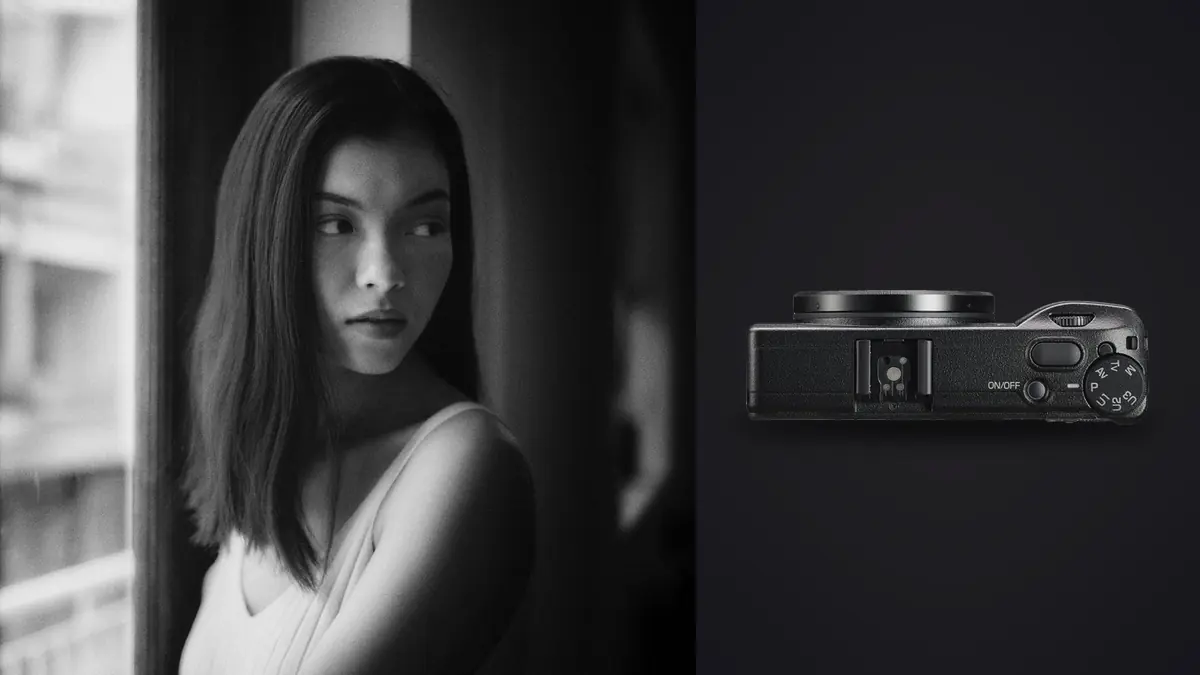
A Ricoh GR IIIx can end up at boudoir sessions almost by accident. Picture packing it as a pocket camera for scouting locations and testing light before the "real" gear comes out, and about halfway through a session in someone's bedroom realizing you haven't picked up the other body in twenty minutes. The GR IIIx wasn't a backup anymore. It had become the camera doing the work, and the reason had nothing to do with image quality charts or dynamic range numbers. It had to do with how a person in an undressed, vulnerable moment reacts to what's pointed at them.
A 40mm Lens Changes How You Work a Small Room
Boudoir happens in small rooms. Hotel rooms, guest bedrooms, the corner of an Airbnb with decent light and nowhere to back up. The GR IIIx's fixed 40mm equivalent lens (26.3mm actual, f/2.8) sits in an odd but useful spot for this. It's tighter than the 28mm on the standard GR III, which pulls in too much wall and ceiling clutter at close range, but it's still wide enough that you can shoot a reclining pose from the foot of a bed without needing three more feet of room you don't have.
The trade-off is that you can't zoom your way out of a bad angle. If a corner is tight, you back into a doorway or you shoot through it. I've knelt in bathtubs and stood on the far side of a dresser more times than I can count with this camera, because there's no other way to get the frame. That sounds like a limitation, and it is, but it also forces a kind of physical engagement with the room that a 24-70mm zoom lets you skip. You end up finding angles a zoom lens would have talked you out of finding.
At 40mm the perspective on skin and limbs close to the lens is honest without being harsh. A 35mm or wider lens used close starts to stretch whatever's nearest the frame edge, which is the last thing you want on a body at three feet. The GR IIIx's field of view lets you get intimate framing, hands, collarbones, the curve of a shoulder, without the distortion that shows up when a wider lens gets pulled in tight to compensate for not having reach.
The Camera Disappears, and That Matters More Than the Spec Sheet
Most of what makes the GR IIIx good at this genre has nothing to do with the sensor. It's the size. A body that fits in a jacket pocket doesn't read as a threat the way a full-frame mirrorless with a hooded 85mm does. Clients who are already nervous about being photographed in this context visibly relax when the thing in front of them looks more like a point-and-shoot than professional equipment. Clients sometimes ask, genuinely, whether that's "a real camera." That reaction is doing more for the shoot than any lens sharpness could.
The leaf shutter helps too. It's close to silent, especially compared to the mechanical clack of a DSLR shutter or the electronic-first-curtain thunk some mirrorless bodies still have. In a quiet bedroom with soft directional light and a client trying to hold a vulnerable pose, a loud shutter breaks the moment every single time. With the GR IIIx you can fire eight or ten frames on a held breath and the client barely notices it's happening. That matters more in this genre than in almost any other type of portrait work I shoot.
There's also a trust element that's specific to boudoir. Clients are handing you images of themselves that they may never want to exist anywhere public. A camera that looks unintimidating, paired with a photographer who isn't hiding behind a wall of gear, tends to produce more honest expressions. People stop performing for the camera faster when the camera stops looking like an event.
Where It Genuinely Falls Short for This Work
I don't want to oversell this camera. It has real problems for boudoir work, and they show up fast in practice.
The fixed rear screen is the biggest one. No tilt, no articulation. Boudoir shooting involves a lot of low-angle work from the foot of a bed or the floor, and a lot of high-angle work standing over a pose on a duvet. Composing those shots means either shooting blind and checking after, or getting your own body into an awkward crouch to see the screen straight on. I've missed compositions because I couldn't see what I was actually framing.
Close focusing is another limit. The GR IIIx isn't a macro lens. Normal autofocus gets you to roughly 20cm, and macro mode tightens that up, but it's still not built for the tight lace-and-jewelry detail shots that a lot of boudoir galleries lean on for variety. You either back off and crop in post, which costs you resolution, or you accept that detail shots aren't this camera's job on a given session.
The single SD card slot is the one that actually worries me on anything that can't be reshot. There is no in-camera backup, no dual-slot mirroring. Boudoir sessions are not reshootable the way a lot of other portrait work is. A client isn't coming back next week to redo poses she was nervous enough to do once. A corrupted card on this camera means gone, not annoying. It's worth offloading cards mid-session on anything client-facing, which slows the flow down exactly when you don't want it to.
Battery life is mediocre rather than bad, roughly 200 shots per charge in real use, and boudoir sessions with a lot of chimping and reviewing with the client burn through that faster than the number suggests. I carry two spares and have still run one down mid-session.
Settings I Actually Use, by Scenario
| Scenario | Aperture | ISO range | Shutter | Notes |
|---|---|---|---|---|
| Hotel room, single north-facing window, overcast | f/2.8 | 800-1600 | 1/60-1/125 | Widest aperture the lens has; usable but softer at edges |
| Evening, warm lamp only, no window light | f/2.8 | 1600-3200 | 1/30-1/60 | Sensor-shift stabilization helps but doesn't cover subject motion |
| Sheer curtain backlight, midday | f/4-f/5.6 | 200-400 | 1/250 | Stopping down keeps highlight rolloff on the curtain from blowing out |
| Outdoor, near-dawn silhouette or robe shots | f/5.6-f/8 | 100-200 | 1/500 | Built-in ND not needed this early; snap focus at 5m works well |
| Continuous LED softbox, indoor | f/2.8-f/4 | 400 | 1/125 | Most forgiving setup the camera sees all year |
Lighting That Suits a Fixed f/2.8
Because there's no hot shoe workflow worth relying on for this body, I plan boudoir sessions around available light almost entirely. North-facing window light is the easiest, soft and directionless enough to forgive the GR IIIx's mild edge softness wide open. Sheer curtains turn direct sun into something close to a giant diffuser, which is my go-to for backlit silhouette work.
Low-key setups, lamp only, minimal fill, are where I dial in exposure compensation on the fly rather than trusting the meter. The camera's evaluative metering tends to want to lift shadow areas that I'd rather keep dark, so I'm usually sitting at minus two-thirds to minus one stop through most of a moody indoor session. It's a small habit but it saves a lot of correction later.
Building a Workflow Around a Camera That Shoots a Lot of Near-Misses
Shooting close, wide open, on a lens with no continuous tracking autofocus worth trusting for this kind of movement, produces a specific problem: a lot of near-identical frames where only one or two out of a burst are actually sharp on the eyes. Snap focus and pre-focusing help, but at f/2.8 and close range the margin for error is thin, and a held breath still shifts a pose half an inch between frames.
That's exactly the kind of set I run through imagic rather than eyeballing on a laptop screen after a twelve-hour day. It scores sharpness locally on the actual focus point instead of a general frame average, which catches the frames where the eyelashes are crisp and the version two shots later drifted soft, something that's easy to miss scrolling through a burst at normal zoom. It also clusters the burst sequences and near-duplicate poses together instead of making me scroll past nine versions of the same shot one at a time, which on a full boudoir session can mean thousands of frames.
The privacy side matters more here than on any other genre I shoot. These are images a client trusts you not to expose to anything beyond your own machine, and processing them entirely offline, no cloud upload at any stage, is not a nice-to-have on this kind of work. It's close to a non-negotiable. I wouldn't run boudoir files through anything that touches a server I don't control, and imagic's local-first processing is the reason it's the tool I reach for on these sets specifically rather than on lower-stakes shoots where it wouldn't matter as much.
Once the culling pass is done, I lean on the apply_my_style preset trained on my own past edits to get a consistent starting point across a session that might span three lighting setups in one afternoon. It's not a finishing tool, I still hand-adjust skin tones and contrast per image, but it saves the fifteen minutes per shoot I used to spend just getting a baseline grade established before the real editing started. If you're trying to shave time out of a similarly image-heavy workflow, the breakdown at how AI photo culling actually works covers the mechanics in more depth than I have room for here, and these workflow tips cover some of the habits around it that apply well beyond this one camera.
Second Body or the Only Camera in the Bag?
I wouldn't recommend the GR IIIx as a sole camera for paid client boudoir work, mainly because of the single card slot and the lack of any real detail-shot capability. For elopement-style or purely personal intimate shoots where the stakes of a lost card are lower, it holds up fine on its own.
Where it earns its place permanently in my bag is as the second body. I keep a longer prime on the main camera for closer, more compressed portraits and detail work, and the GR IIIx stays around my neck or in a pocket for the wider environmental frames, the getting-ready moments, and the shots where pulling out a big camera would kill the mood the subject is trying to hold onto. It's the camera that gets the honest, unguarded frame because nobody in the room notices it's being used.
Frequently Asked Questions
Is the Ricoh GR IIIx sharp enough for skin detail at f/2.8?
Wide open it's sharp in the center and noticeably softer toward the edges, which in practice works in this genre's favor since you're rarely putting critical detail at the frame edge on a portrait. Stopped down to f/4 it evens out considerably. For close-up skin texture I'd rather be at f/4-f/5.6 than wide open anyway, since depth of field at f/2.8 and close range can leave an eye sharp and a nose already soft.
Can I run a full boudoir session without an external flash?
Yes, and honestly the camera almost forces you to. There's no real hot shoe workflow here worth building around, so window light, practical lamps, and continuous LED panels are the realistic options. I haven't missed flash on a single session shot with this body, but I also plan locations around available light before I book them.
How does the in-camera crop mode compare to actually having a longer lens?
The 50mm and 71mm equivalent crop modes are useful for framing on the fly but they're just center crops of the same file, so you lose resolution fast, especially at the 71mm setting. I use them for previewing a tighter composition before deciding whether to physically move closer, not as a substitute for reach I don't have.
Is the fixed lens a dealbreaker for detail shots like jewelry or lace close-ups?
It's a real limitation. The minimum focus distance isn't built for true macro work, so anything requiring extreme close focus on lace texture or small jewelry is better handled with a second camera or a dedicated macro lens. I treat the GR IIIx as the wide-and-environmental camera in the bag and let something else handle the tight detail set.