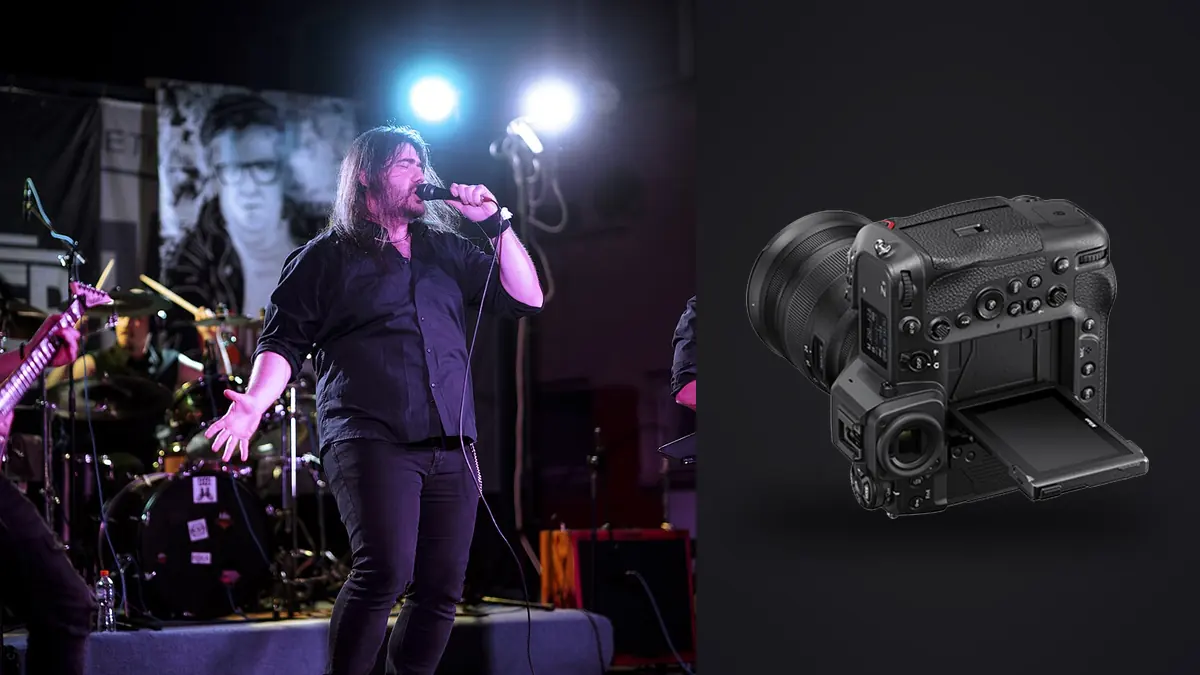
Concert shooting on a Z9 runs from a three-song photo pit pass at a 12,000-seat venue to a four-hour set for a jam band where nobody enforces a "first three songs, no flash" rule and you just keep shooting until your wrists give out. The camera gets talked about mostly in terms of stills-versus-video specs, but almost none of that chatter is written by someone who actually has to hand-hold it above their head at a barricade while a singer backlit by a single moving spot decides that's the exact moment to do a stage dive. This is the version of that conversation.
The shutter is the actual reason I moved to this body
Everyone leads with the autofocus system when they talk about the Z9 for live music, and I'll get to that, but the detail that changed how I work is that the camera has no mechanical shutter at all. There's nothing to clack, nothing to wear out, nothing to cap your frame rate when you're shooting fully silent. In a seated theater show where the promoter has told you flat out that any clicking gets you escorted out, you're not choosing between "quiet mode" and "loud mode," you're just shooting normally and it happens to be silent. I've had venue security stand two feet from me during a hushed acoustic set and never notice I was firing bursts.
The tradeoff people warn you about is rolling shutter distortion on fast-moving subjects under flickering light, and it's a real thing, not a myth. Guitar necks whipping through frame under LED wash can show a slight lean. In practice I've found it shows up rarely enough that I don't think about it except under strobing effects lighting, where I'll drop to a slower burst rate on purpose.
Autofocus when the only light source is one moving spotlight
Concert lighting is the worst-case scenario for autofocus by design. It's low, it's colored, it's moving independently of the subject, and it's often backlighting the person you're trying to track rather than lighting their face. The Z9's subject detection holds onto a human figure and finds the eye or face even when the spot has swung past and the singer is a silhouette for half a second. It doesn't always nail focus in that exact half-second, but it recovers fast once light returns, which is the part that matters. A camera that hunts for two full seconds after a strobe hit is useless in this environment; one that recovers within a frame or two is not.
For a moving frontperson I run 3D-tracking locked onto the face rather than the full auto-area mode, because auto-area will happily jump to a security guard's head at the edge of frame if the singer briefly turns away from camera. For a full band shot where I want the drummer sharp and don't care as much about exact eye placement, wide-area small with subject detection on is close enough and gives me more margin for framing on the fly.
ISO by venue, because "just shoot at 6400" isn't real advice
Every venue lights differently, and the settings that work for an arena show with haze machines will underexpose a small club with a single warm wash and blow highlights at a festival with LED video walls behind the band. This is roughly the table I actually work from, built from notes I've kept on my phone after enough shows where I guessed wrong.
| Venue / lighting scenario | ISO range I run | Shutter floor | AF area mode | What actually bites you |
|---|---|---|---|---|
| Arena, moving spotlights, haze | 3200-6400 | 1/640 | 3D-tracking on face | Haze eats almost a full stop and spot hits still clip highlights |
| Small club, fixed warm stage wash | 6400-12800 | 1/320 | 3D-tracking on face | White balance drifts orange fast; shoot RAW, correct later |
| Festival main stage, LED video wall backdrop | 1600-3200 | 1/500 | Wide-area small | Some LED walls band or flicker at certain shutter speeds, test before doors |
| Seated theater, house lighting, silent required | 2000-4000 | 1/250 | Single-point AF-C | Less motion but almost no margin for a missed exposure guess |
| Photo pit press pass, first three songs, strobes active | 3200-8000 | 1/800 | 3D-tracking on face | You get one shot at each moment, no time to chimp and adjust |
The Z9's noise at 6400 and even 12800 is genuinely usable if you expose correctly in camera rather than trying to save a dark frame afterward. Underexposed-and-pushed is where this sensor starts to look rough. I'd rather shoot at ISO 10000 with the histogram sitting where I want it than shoot at 3200 two stops under and fix it in post.
Three songs, no flash, and then four thousand frames on a card
Here's the part nobody warns you about when they're selling you on 20 frames per second: a single three-song pit set at that rate, shooting in bursts every time the lighting does something interesting, easily produces three or four thousand RAW files. Multiply that by a five-band festival day and you're staring at twenty thousand frames before midnight, most of them near-duplicates of the same beat of a song where you held the shutter down half a second too long.
Culling that by eye, at 1am, half-listening to the last band's sound check bleeding through the wall, is where most of my old workflow used to fall apart. I switched to running everything through imagic before I touch Lightroom at all. It does its sharpness and focus scoring locally on the machine, no upload, no waiting on a cloud queue at 1am on a venue's questionable wifi, which matters when I'm working from a laptop in a green room and not a studio. It also clusters the burst sequences and near-duplicates automatically, so instead of scrolling through eleven nearly identical frames of a guitarist mid-strum, I'm looking at the two or three the software flagged as actually sharp and well-timed, and I pick between those.
The other piece that's saved me real hours after a show is the apply_my_style preset feature, which trains on how I've actually edited my own concert work rather than a canned "moody stage light" look someone else built. After feeding it a batch of my previously graded show photos, it applies something close to my own color decisions to a fresh set automatically, which means the first pass on a new night's shoot already looks like my work instead of a flat RAW I still have to grade from scratch. I still go frame by frame on the keepers I want to share, but the baseline gets me there faster.
Battery life and menu setup for a run of consecutive shows
The EN-EL18d battery in this camera is built for exactly this kind of abuse. Nikon's official CIPA rating undersells it badly for how mirrorless cameras actually get used in bursts rather than single frames; I've gotten through a full festival day, several thousand frames, without swapping batteries, though I still carry a spare because "I've never needed it" is not the same as "I never will." Where I lose time isn't power, it's menu navigation mid-show, so I set up two custom banks before I ever leave the house: one tuned for a dark club (higher ISO ceiling, slower shutter floor, silent shutter forced on) and one for an outdoor festival stage (lower ISO ceiling, faster shutter, mechanical-equivalent frame rate since there's no mechanical shutter to actually toggle). Flipping between the two takes one dial turn instead of digging through six menu screens between bands.
Dual CFexpress Type B slots mean I shoot RAW to one card and a JPEG backup to the second, which has saved a set exactly once when a card started throwing write errors mid-show and I didn't notice until the next morning. That's not a hypothetical worth skipping.
Glass that actually earns a spot in the bag
A 24-70mm f/2.8 covers probably 70 percent of what I shoot from a pit, close enough for tight vocals shots and wide enough to catch the full kit when the drummer does something worth a wide frame. The 70-200mm f/2.8 comes out for anything on a big stage where the barricade puts real distance between me and the performers, arena shows especially. For genuinely dark rooms, a fast prime around 35mm or 50mm buys another stop or two over the zooms, which at ISO 6400 versus ISO 12800 is a real, visible difference in how clean the file looks. I don't bring a prime to every show. I bring it when I already know the venue lights like a cave.
Frequently Asked Questions
Is the Z9 overkill for someone shooting one local club a month?
Honestly, probably. The autofocus and silent shutter matter most when you're dealing with unpredictable lighting changes and strict noise rules, both of which show up more often at bigger, stricter venues. A club regular shooting the same room repeatedly, with a house engineer who runs consistent lighting, can get excellent results from a lot less camera. The Z9 earns its price when the environment keeps changing on you.
Does the electronic-only shutter cause banding under stage LEDs?
Occasionally, yes, particularly under cheaper LED fixtures running at lower refresh rates. It shows up as horizontal bands in a fraction of frames rather than a consistent problem. Testing a few frames during soundcheck or opener sets, before the headliner, catches it early enough to switch to a different shutter speed if needed.
How many frames per second do you actually use, not the max spec?
For most of a set I sit around 10-12 fps in a shortened burst rather than holding the shutter at the full 20fps rate, because full-rate bursts during a three-hour show produce more files than any workflow needs and burn through card space fast. I save the higher rate for genuinely unpredictable moments, like a stage dive or a pyro cue, where I don't know exactly which fraction of a second I need.
What's the fastest way to get through a night's shoot before I fall asleep?
Cull before you grade, every time, and don't do it by eye at 1am if you can avoid it. Running the night's cards through imagic first, letting the local sharpness scoring and burst clustering knock out the obvious rejects, cuts what I'm actually looking at by more than half before I open an editor. If you want a broader look at how that kind of automated first pass works, this piece on how AI photo culling works goes into more detail, and these workflow tips cover the rest of the pipeline once you're down to a shortlist.