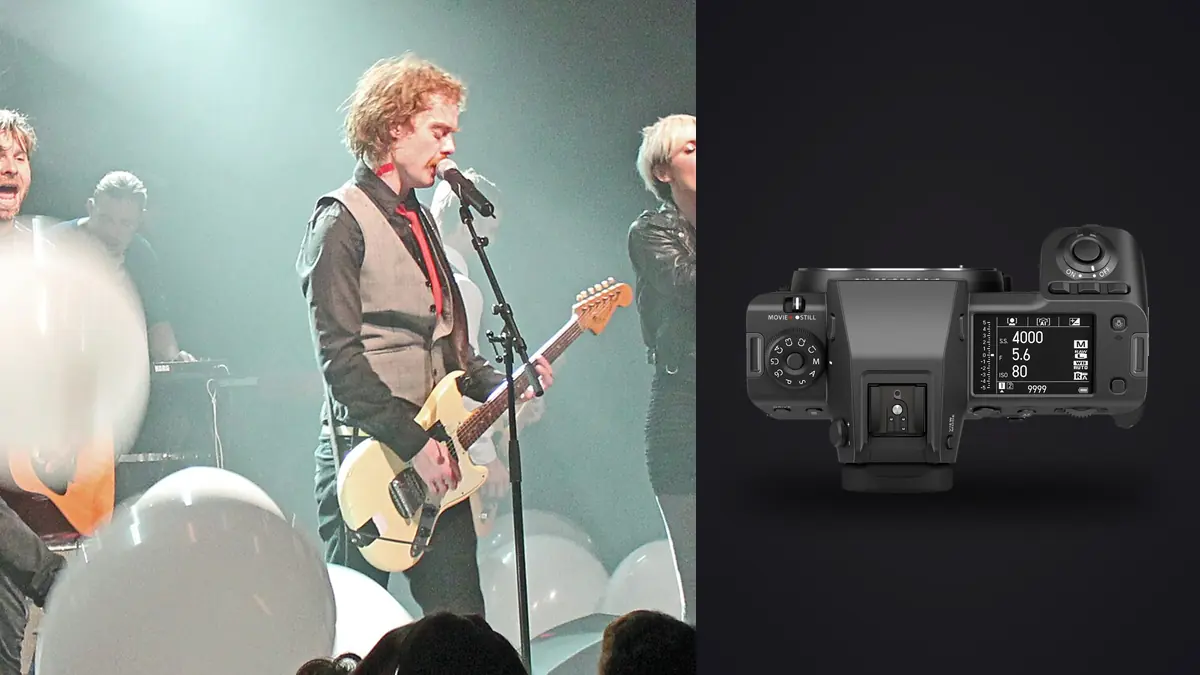
I did not expect to end up shooting a full arena tour date with a medium format camera slung around my neck, but I wanted 40-inch prints and a tight cover-style crop, and nothing in my usual full-frame bag was going to deliver that kind of detail without visible softening. So I borrowed a Fujifilm GFX 100 II for three shows over six weeks: a 4,000-capacity theater, an outdoor amphitheater, and one arena date with a full lighting rig and pyro. This is what actually happened, not the marketing version.
Why bring a 102-megapixel body into a three-song set
Most photo pits run on the same unwritten rule: first three songs, no flash, shoot from the barrier, get out. Nobody in that pit is thinking about medium format. The GFX 100 II is not built for the pit the way a Nikon Z8 or a Sony A7 IV is built for the pit. It is bigger, heavier, and its buffer runs dry faster than anything else I have used at a show. So the honest answer to "why bring it at all" is: only if the output genuinely needs the resolution.
For most club and theater gigs, a 24 or 45-megapixel file is already more resolution than any outlet, Instagram grid, or two-page magazine spread will ever use. Where the GFX 100 II earns its keep is the handful of jobs where a single frame gets blown up past poster size, cropped hard for a vertical cover, or printed at a scale where full-frame files start showing softness even from good glass. The sensor, at 43.8mm by 32.9mm, is roughly 1.7 times the area of full frame, and at low ISO the extra real estate shows up as genuinely cleaner shadow detail and more forgiving highlight recovery when a lighting designer decides to blast the crowd with a wall of white strobes mid-chorus.
The sensor readout number that actually matters
Fujifilm made a specific claim with this body: sensor readout roughly four times faster than the older GFX 100S. That figure sounds like spec-sheet noise until you shoot electronic shutter under moving stage lighting, where a slow readout turns spinning trusses and fast mic-stand grabs into visibly skewed diagonals. On the 100S I saw noticeable rolling shutter wobble on anything moving fast across the frame, a guitarist windmilling, a drummer's stick blur, that kind of thing. On the 100 II, electronic shutter got usable enough that I stopped defaulting to mechanical shutter for quieter acoustic sets, which matters because acoustic and unplugged shows are exactly the environment where a mechanical shutter's clack is loud enough for the front row to hear.
What that means when a spotlight sweeps the crowd
The other place the faster readout shows up is banding. Most modern stage lighting runs on some form of pulse-width modulation, and a sensor that reads slowly can catch a rig mid-flicker and bake in visible horizontal bands, especially under LED PAR cans set to a slower dimming curve. I still saw occasional banding at 1/500 and faster under certain LED walls, that has not gone away entirely on any mirrorless body I have used, but it happened noticeably less often on the GFX 100 II than it did on the 100S at matched shutter speeds.
Buffer math, or why I stopped shooting uncompressed RAW at shows
This is the part nobody selling you a GFX 100 II leads with. A 102-megapixel sensor produces enormous files. Uncompressed RAW lands north of 200MB per frame. Lossless compressed RAW runs somewhere between 100 and 130MB depending on the scene. Even the compressed RAW setting, which throws away some tonal precision for smaller files, still sits well above what a 24 or 45-megapixel body produces per frame.
Continuous shooting tops out around 8 frames per second in boost mode with the optional vertical battery grip attached, and drops closer to 5 or 6fps running on the internal battery alone. That is not really the problem. The problem is what happens six or seven seconds into a burst: the buffer fills, the frame rate collapses, and you are suddenly getting one frame every second or two while a guitar solo happens in front of you. I clocked it a few times at the theater date with a fast CFexpress Type B card and was landing somewhere around 40 to 55 raw frames before the slowdown, which sounds like plenty until you remember a three-song set runs roughly nine to twelve minutes and I wanted bursts through most of the big moments, not just the opening chorus.
Here is how that stacks up against the full-frame bodies most working concert photographers actually carry into a pit:
| Camera | Native ISO ceiling | Continuous shooting | Typical RAW file size | Realistic buffer before slowdown | Body weight |
|---|---|---|---|---|---|
| Fujifilm GFX 100 II | ISO 12,800 | ~8fps (boost, with grip) | 100-220MB | ~40-55 raw frames | ~1,030g |
| Nikon Z8 | ISO 25,600 | up to 20fps (e-shutter, raw) | ~55-70MB | 1,000+ raw frames | ~910g |
| Sony A7 IV | ISO 51,200 | 10fps (mechanical) | ~40-70MB | 800+ compressed raw frames | ~658g |
| Canon R6 Mark II | ISO 102,400 | 12fps mechanical / 40fps e-shutter | ~25-30MB | 1,000+ raw frames | ~588g |
The gap in buffer depth alone tells you why nobody is shooting an entire festival weekend on a GFX body. It is not built for spray-and-pray. It rewards photographers who already work deliberately, who fire short, chosen bursts instead of holding the shutter down through an entire song and sorting it out later.
The GF lenses that can actually keep up with stage light
Medium format glass has historically been slow. That changed somewhat with the GF 55mm f/1.7 R WR and GF 80mm f/1.7 R WR, the two fastest lenses Fujifilm has built for the GF mount, and both are genuinely usable for stage work. But f/1.7 on a sensor this size does not behave like f/1.7 on full frame. The GFX system's crop factor relative to full frame is roughly 0.79x, so the 55mm behaves like a 43mm in terms of field of view, and the depth of field looks closer to what an f/1.35 lens would give on full frame. What it does not do is gather light like an f/1.35 lens. Exposure is still governed by the actual f-stop, so in a dim club you are letting in less light at f/1.7 than a full-frame shooter standing next to you with an f/1.4 prime, and you make up the difference in ISO on a sensor with a lower native ceiling to begin with.
The GF 100-200mm f/5.6 R LM OIS WR, the closest thing GF has to a concert tele zoom, is fine for outdoor amphitheater shows with real stage lighting but becomes a liability fast in a dark club. I left it at home for two of the three dates and shot the 80mm almost exclusively, moving my feet instead of zooming, which is not always an option from a fixed barrier position.
Where the ISO ceiling actually bites
Native ISO tops out at 12,800, expandable to 102,400, but the extended range is genuinely rough, more useful for emergency documentation than anything I would show anyone. Compare that to a Sony A7 IV's native 51,200 or a Canon R6 Mark II's native 102,400, and the practical gap in a dark venue is real. At the theater date, house lighting was gentle enough that ISO 3200 to 6400 covered most of the set and the files looked clean. At a smaller support-act slot I shot as a favor a week later, in a converted warehouse space with maybe three usable light sources, I was pushing ISO 10,000 and 12,800 regularly, and the noise, while not ugly, was noticeably coarser than what I get from a full-frame body at the same ISO. Medium format's low-light reputation gets overstated online. Per pixel, at matched output size, a modern full-frame sensor with fewer, larger photosites is still going to out-noise a 102-megapixel sensor once you get past around ISO 6400.
So the calculus becomes simple: bright arena show with real production lighting, bring the GFX 100 II. Dim club with three practical lights and a disco ball, leave it in the bag and bring the full-frame body instead.
Autofocus: fine for a singer, harder for a mosh pit
Fujifilm added deep-learning subject detection to this body, and phase-detection coverage now stretches across nearly the whole frame, a real improvement over the GFX 100S. Tracking a vocalist who moves within a predictable radius of a mic stand worked well across all three shows, including a singer who likes to drop to his knees mid-song, exactly the kind of fast, close-range movement that used to catch an older GFX body flat-footed. Where it started to struggle was the amphitheater date, which had a rowdier crowd surging against the barrier and a drummer partially obscured by cymbals for a good chunk of the set. Subjects darting in and out of hard shadow at the edge of the stage got missed more often than I would tolerate on a full-frame flagship. It is good autofocus for a medium format body. It is not the fastest, most reliable tracking system I have used at a show, and I would not want it as my only camera for a high-motion pit like a hardcore or metal show.
Weight, grip, and the physical reality of three songs
Body alone is about 1,030 grams, which does not sound dramatic until you add the 80mm (roughly 815 grams) or the 100-200mm zoom (over a kilogram by itself) and the vertical grip needed to hit the faster burst rate. My kit for the arena date, body, grip, two batteries, and the 100-200mm, weighed noticeably more than my usual two-body full-frame setup with a 24-70 and a 70-200. Climbing over monitor wedges and squeezing along a crowded barrier with that much weight on one shoulder for three songs is manageable. Doing it for a four-band bill where I am shooting every opener too is not something I would choose to repeat.
The 4-axis tilting rear screen turned out more useful than I expected for barrier shooting. Tilting the screen up while holding the camera low over the crowd let me frame shots I would otherwise have had to guess at through the viewfinder, and the EVF itself, at just under 9.5 million dots, is sharp enough to actually judge focus by eye if the AF system loses a subject in a shadow.
What the night actually looks like after the last song
The part that catches people off guard is not the shoot, it is the two hours after. Three songs at 8fps in short bursts, plus a handful of longer sequences during a big chorus, and I walked out of the arena date with just over 1,100 raw files, each averaging around 115MB. That is close to 130GB of data off a single set. Backing that up on site, twice, before I trust the card is empty, takes longer than the actual pit access did.
This is exactly the kind of dataset where I do not want to be dragging thousands of huge RAW files through a slow cloud-based tool, waiting on an upload before I can even see which frames are sharp. I run the cull in imagic locally instead. Because the files never leave the laptop, that matters both for speed and for the fact that a tour is often sitting on unreleased setlists or a surprise guest nobody has announced yet, not something I want sitting in someone else's upload queue. Its burst clustering takes the eight or nine frames I fired off during one guitar solo and groups them into a single stack instead of making me scroll past near-duplicates one at a time, and the sharpness scoring runs against the actual full-resolution file rather than an embedded preview, the only reliable way to tell "in focus" from "close enough" once you are cropping into a 102-megapixel frame for a vertical cover.
I also trained an apply_my_style preset in imagic on close to two years of my own concert edits: crushed blacks, a slightly warm highlight rolloff, saturation pulled back a touch on reds so stage lighting does not clip into a flat magenta mess. Running the first pass through that preset instead of a generic auto-tone cuts a real chunk out of the edit, especially useful when the deadline is a next-morning post and I am staring down 1,100 files instead of the 300 or so a full-frame body would have produced from the same set. If you have not sat down and compared how different tools actually handle a genre like this, the culling software comparison is worth reading before committing a workflow to one app, and the workflow speed tips piece covers a few habits that matter even more once file sizes get this large.
Frequently Asked Questions
Is the Fujifilm GFX 100 II fast enough for a real concert photo pit?
For the standard three-song pit window at a professionally lit show, yes, as long as you shoot in short, deliberate bursts rather than holding the shutter down. The buffer runs dry in well under ten seconds of sustained 8fps shooting, so it rewards photographers who already time their bursts rather than spray continuously through a whole song.
Can it handle a small club show with minimal lighting?
You can use it, but the native ISO ceiling of 12,800 will show its limits faster than a full-frame body built for low light. I would bring the GFX 100 II for an amphitheater or arena date with real production lighting before I would bring it for a 200-capacity room lit by three practical bulbs.
Do I need the vertical battery grip to shoot bursts?
Not strictly, but without it continuous shooting drops from around 8fps to closer to 5 or 6fps, which matters during a fast passage like a drum fill or a guitarist crossing the stage. If concert work is a regular part of what the camera does, the grip earns its keep.
How do you manage the file sizes from an entire show?
Plan for it before you shoot, not after. A single three-song set at 8fps produced over a thousand raw files for me at one show, each well over 100MB. I cull locally in imagic rather than relying on a cloud upload, since nothing leaves the laptop and the burst clustering groups near-duplicate frames from the same phrase of music together instead of leaving them scattered through the timeline to sort by hand.