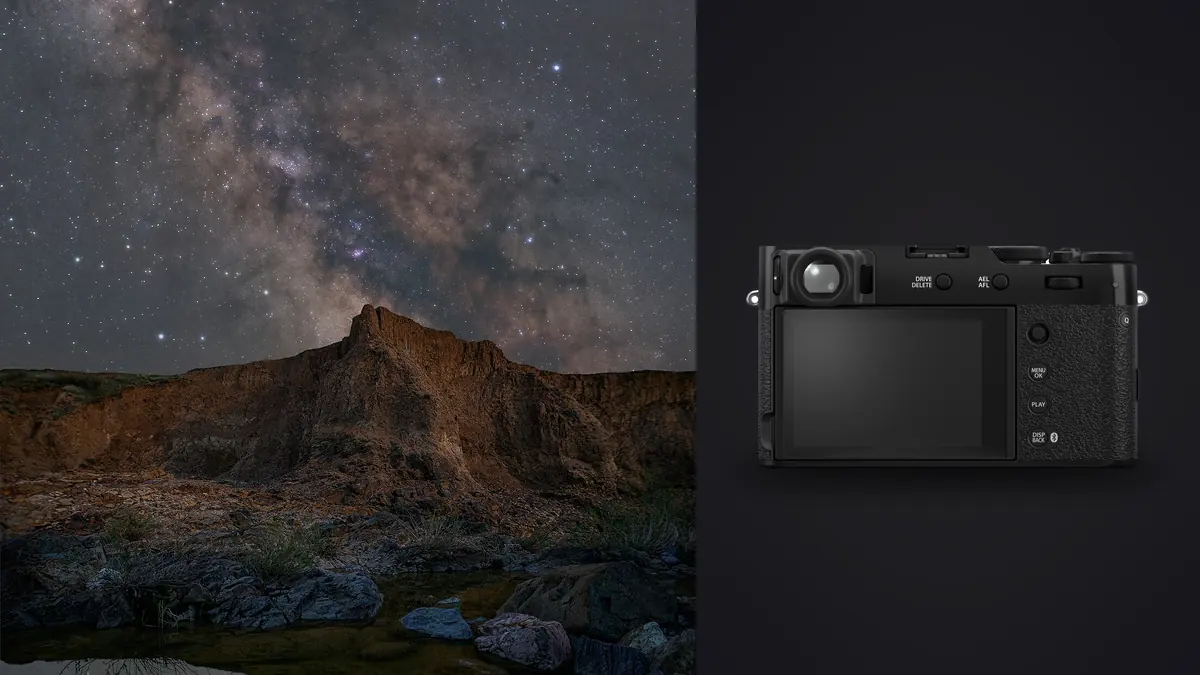
Nobody buys a Fujifilm X100VI for astrophotography. It's a 35mm-equivalent fixed lens compact built for street work and travel, not a camera anyone would spec out for the Milky Way. But I've had one in my bag for eighteen months now, and on three separate trips it ended up being the only camera I had with me when the sky cleared. What follows isn't a claim that it beats a dedicated astro rig. It's what actually happens when you point this specific camera at the night sky, run a stacking sequence, and try to get something usable out of the RAW files afterward.
Why a Fixed-Lens Compact Even Enters This Conversation
The X100VI's spec sheet has three things going for it once the sun goes down: a 40.2-megapixel BSI X-Trans sensor with genuinely low read noise for its class, in-body stabilization rated to six stops for anything that isn't a long tracked exposure, and a leaf shutter that's mechanically about as quiet and vibration-free as anything short of full electronic shutter. None of that adds up to a dedicated astro camera. But it does add up to something that can produce a clean, printable nightscape if you understand exactly where its ceiling is and stop pushing past it.
The lens is the part everyone gets wrong going in. It's a 23mm f/2 (35mm effective on the APS-C body), and there's no swapping it for something wider or faster. That single fact shapes every decision below, from composition to exposure time to how many frames you need in a stack to compensate for an aperture that's a stop and a half slower than what most people reach for on a dedicated night lens.
What the Sensor and Lens Actually Give You After Dark
At ISO 3200, X100VI RAW files hold together better than the X-Trans 4 sensor in the X100V did, mostly thanks to the BSI design pulling in slightly more light per photosite despite the pixel count climbing to 40.2MP. Past ISO 6400 the shadows start showing the kind of mottled luminance noise that no denoiser fully erases without softening star points into smudges. For single-frame shots of the Milky Way core, I treat ISO 6400 as the hard ceiling and ISO 3200-4000 as the range I actually use.
The lens itself is sharp in the center wide open at f/2, but the corners are a different story. Stars near the frame edges show visible coma, little comet-shaped smears instead of clean points, and it doesn't fully clear up until around f/2.8. That's a real cost: stopping down a stop cuts your light gathering in half, which on a fixed 23mm you can't offset by swapping to a faster prime. The workaround is stacking more frames at f/2.8 rather than fewer at f/2, which is exactly what pushed me toward stacking as the default approach rather than chasing a single hero exposure.
Manual Focus in the Dark Is the Skill That Decides Everything
Autofocus does not find stars reliably, full stop. Even with the X100VI's improved AF system, pointing it at a star field in near-total darkness gets you hunting and the occasional false lock on nothing. Every usable frame I've gotten from this camera at night came from manual focus.
The practical method: switch to manual focus, punch in digital zoom on the EVF (not the OVF, which is useless once light drops this low), find a bright star or a distant light on the horizon, and turn the focus ring until it collapses to the smallest, tightest point you can get. Focus peaking helps confirm it but I don't fully trust peaking alone at f/2 in the dark, it tends to paint a slightly wider halo than true focus. Once it's locked, I put a strip of gaffer tape across the ring so a stray bump in the dark doesn't undo twenty minutes of work. Temperature matters too. If you nail focus at dusk and the temperature drops eight or ten degrees over the next two hours, thermal contraction in the lens barrel can shift infinity focus just enough to matter at 100% crop. I recheck focus roughly every 45 minutes on longer sessions.
Exposure Math for a Fixed 23mm: How Long Before Stars Trail
The old 500 rule (500 divided by focal length) was written for full-frame film cameras and doesn't translate cleanly to a 40-megapixel APS-C sensor, where pixel density reveals trailing much sooner than the rule predicts. In practice, at 100% crop on X100VI files, star points visibly elongate past about 12-13 seconds at this focal length, well short of what the 500 rule would suggest. That single fact drives most of the settings below.
| Shooting goal | Shutter speed | ISO | Aperture | Frame count | Field note |
|---|---|---|---|---|---|
| Single-frame Milky Way core, pinpoint stars | 10-13 sec | 3200-6400 | f/2 | 1 | Past 13 sec, corner stars at 100% crop show clear elongation on this sensor |
| Stacked Milky Way (noise-reduced) | 8 sec each | 2000-3200 | f/2.8 | 20-30 | Stopping to f/2.8 clears corner coma; the stack recovers the ISO headroom you lose |
| Star trails, stack method | 20-25 sec each | 800-1600 | f/2.8 | 90-150+ | 1 second gap between frames minimum, longer gaps show as visible dashes in the trail |
| Star trails, single bulb exposure | 25-45 min | 200-400 | f/4-f/5.6 | 1 | Sensor warms measurably past 20 minutes; hot pixel count rises noticeably by frame's end |
The bulb mode on this camera goes out to 60 minutes and the T (time) setting extends further, but I stopped using single long exposures for anything beyond a quick test frame. Past 20 minutes the sensor's thermal noise becomes visible even at ISO 400, and a single dropped frame from a gust of wind or a bumped tripod leg means starting the entire exposure over. The stack method trades a more complicated capture session for a much higher success rate, since one bad frame out of 120 just gets discarded instead of ruining the shot.
Star Stacking Workflow: From Interval Timer to Blended Frames
The X100VI has a built-in interval timer under the shooting menu, and it's what makes stacking practical rather than something you do by mashing the shutter button for two hours. I set it for the frame count and interval from the table above, lock focus and exposure manually first (auto-anything will drift frame to frame and ruin the blend), and let it run. In-body stabilization gets switched off entirely once the camera is on a tripod. IBIS on a locked-down camera doesn't help and can introduce a very faint frame-to-frame micro-shift that shows up as slightly softer stars after stacking, since the system has nothing to correct against and starts hunting.
Battery life is the other practical wall. A 120-frame star trail sequence at 20-25 seconds per frame runs close to an hour, and cold weather pulls the NP-W126S pack down faster than the in-camera estimate suggests. I carry two spares on any session below 5°C and keep them in an inside jacket pocket, not the camera bag, until they're needed.
What nobody mentions about stacking sessions is the sheer number of files it leaves you with. A single evening of star trail attempts across two or three compositions can leave 300-400 RAW frames on a card, most of them near-identical to their neighbors, a handful ruined by a passing headlamp, a plane trail, or condensation creeping onto the front element. Sorting that by eye at 1am, or worse, the next morning when you've lost the mental context of which frame had the dew streak, is the part of night photography nobody warns you about before you start. This is where I actually use imagic rather than dragging every frame into a folder and squinting: its local sharpness scoring flags the handful of frames a tripod knock or a gust softened, and duplicate and burst clustering groups the redundant frames from a stacking sequence so I'm reviewing clusters instead of 400 individual thumbnails. Everything runs on the machine, no upload queue, which matters more than it sounds like it should when a night's shooting is 15-20GB of 40-megapixel RAW files and you're working off a laptop with no signal at a trailhead.
Cold Weather and Condensation Notes From the Field
The X100VI is only weather-resistant with the optional adapter ring and a protective filter installed, and the lever near the lens mount has to be in the correct position, a detail that's easy to forget after a lens change earlier in the day and one I've been caught out by. Without that setup, treat it as you would any unsealed compact: a light mist is probably fine, anything heavier isn't.
Condensation on the front element is the bigger issue on clear, cold nights, since clear skies mean radiative cooling and the glass drops below the dew point faster than you'd expect. A thin strip of hand-warmer taped around the lens barrel (not touching the glass) has saved more than one session for me. Screen brightness also matters more than people think: full brightness on the rear LCD while composing will wreck your night vision for a solid ten minutes, so I drop it to its dimmest usable setting before the sequence starts and only bump it up to check focus.
Where This Camera Loses to Purpose-Built Astro Gear
I want to be straightforward about this rather than talk the camera up. A dedicated full-frame body paired with a 14mm f/1.8 prime gathers roughly two stops more light than the X100VI's f/2 crop-sensor setup at the same ISO, which means fewer frames needed per stack, cleaner single exposures, and a genuinely wider field of view for compositions that want more foreground and sky in one frame. The X100VI's 35mm equivalent field of view is workable for Milky Way arcs over a foreground subject but it's not an ultra-wide, and there's no zooming out to compensate since the lens doesn't come off.
| Factor | Fujifilm X100VI (fixed 23mm f/2) | Full-frame body + 14mm f/1.8 prime |
|---|---|---|
| Effective field of view | 35mm equivalent | 14mm, roughly double the horizontal coverage |
| Usable single-frame ISO before stacking becomes necessary | ~3200-4000 | ~6400-8000 |
| Corner star sharpness wide open | Visible coma at f/2, clears near f/2.8 | Mild coma at f/1.8, largely clean by f/2.2 |
| Kit weight (body + lens) | Around 480g total | Often 1.2-1.6kg combined |
| Focus method at night | Manual, EVF zoom + peaking, tape the ring | Manual, usually with a dedicated focus scale or Bahtinov mask |
| Frames typically needed for a clean stack | 20-30 (wider aperture penalty) | 10-15 (faster glass, less noise per frame) |
None of that makes the X100VI a bad choice, it makes it a specific one. If the night sky is a side project on a trip where you're mainly shooting streets and portraits and don't want to carry a second body and lens, it earns its keep. If astro is the actual goal of the trip, this isn't the camera to build a plan around.
A Practical Night Session: A Ridge Line Under the Milky Way Core
The session that convinced me this was worth the effort was a ridge above a valley with almost no light pollution to the south. I set up an hour after sunset once the sky was fully dark, focused manually on a bright star near zenith with EVF zoom, then recomposed down to the ridge line silhouette. Settings landed at f/2.8, ISO 2500, 8 seconds per frame, interval timer set for 26 frames with a 2 second gap between exposures, IBIS off, tripod weighted with my bag against the wind coming up the slope.
Back at the laptop, that one composition alone produced 26 RAW files plus a handful of test frames from earlier in the setup, closer to 35 total once you count the frames I shot trying different focus points before locking in. Culling those down with imagic's sharpness scoring took a few minutes rather than the half hour of pixel-peeping I used to spend, and it caught two frames near the end of the sequence where condensation had started forming on the corner of the element, something easy to miss scrolling quickly through thumbnails at normal size. After stacking the clean frames in dedicated stacking software (the X100VI doesn't do this in-camera, so that step happens separately), I brought the blended file back through imagic's editing pass and applied the same tonal treatment I'd trained into apply_my_style from a previous night shoot, which kept the color balance between the two sessions consistent without me manually matching curves and white balance sliders again from scratch.
If you're planning a similar session and want a broader read on organizing a large RAW dump before you get to editing, our piece on how AI photo culling works covers the sharpness and clustering side in more depth than fits here, and the general pacing advice in our faster workflow guide applies just as well to a folder of 400 star-trail frames as it does to a wedding shoot.
Frequently Asked Questions
Can the Fujifilm X100VI actually capture the Milky Way in one exposure?
Yes, in dark-sky conditions, but with real limits. At f/2, ISO 3200-6400, and roughly 10-13 seconds before trailing becomes visible at full resolution, a single frame will show the core with usable detail. It won't match what a faster wide prime on a full-frame body produces at the same ISO, and shadow noise starts intruding past ISO 6400. Most nights I still prefer stacking a burst of shorter exposures over betting everything on one frame.
Does the X100VI have a built-in intervalometer for star trails and time-lapses?
Yes, it's in the shooting menu as interval timer shooting, and it's what makes multi-frame stacking practical without standing at the camera pressing the shutter for an hour. Set your frame count, interval, and starting delay, lock exposure and focus manually beforehand, and let it run. There's no separate app or accessory needed for basic interval sequences.
Should image stabilization stay on when the camera is on a tripod for stacking?
No. Turn IBIS off once the camera is locked down. With nothing to correct against, the stabilization system on a tripod-mounted camera can introduce a faint frame-to-frame shift rather than removing one, which shows up as slightly softer stars once frames are blended. This is standard advice across most stabilized cameras, not specific to Fujifilm, but it's easy to forget when the setting defaults to on.
How many exposures do you actually need for a clean star stack with this lens?
For a noise-reduced Milky Way composite I use 20-30 frames at f/2.8, which compensates for the light lost by stopping down from f/2 to control corner coma. For star trails built through stacking rather than one long bulb exposure, 90-150 frames at 20-25 seconds each gives a continuous-looking trail without the dashing that longer gaps between frames produce. Whatever the count, culling software that can flag the handful of frames a bump, a passing light, or condensation ruined saves real time versus scrolling through everything by hand before you stack.