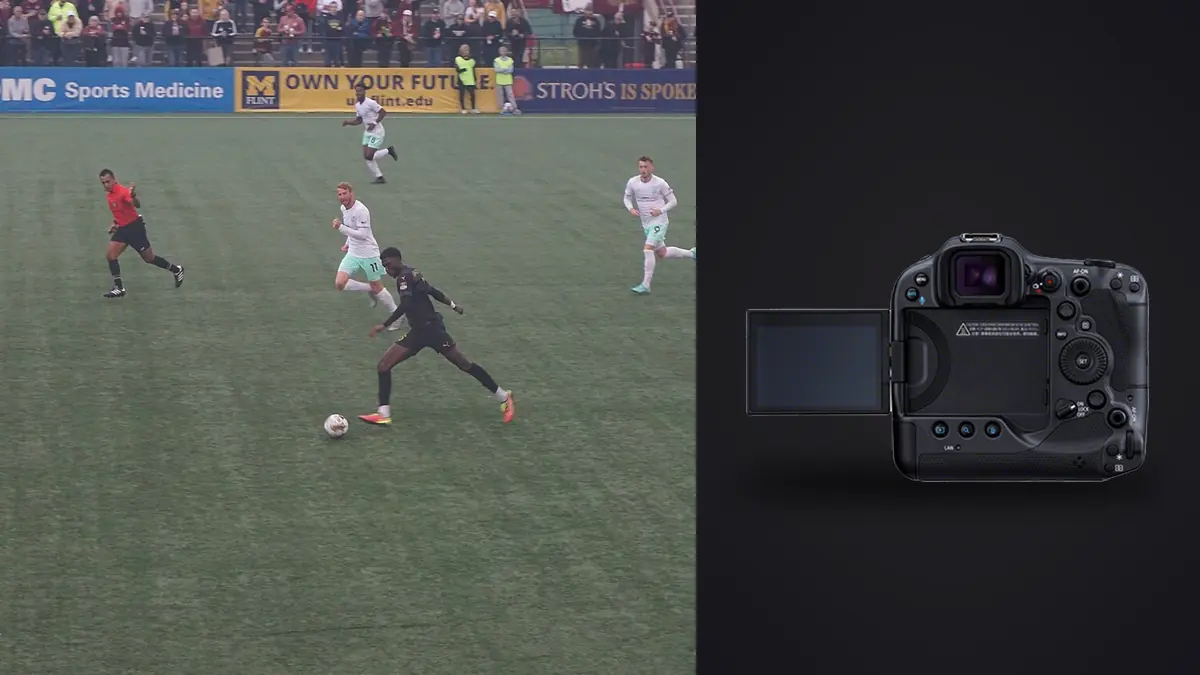
I shot my first track meet with the R3 on a cold April afternoon at a regional qualifier, mostly out of curiosity about whether the 30fps electronic shutter was going to be a gimmick or an actual advantage. Two seasons later it's the camera I reach for every time there's a track involved, but not for the reasons Canon put on the spec sheet. The frame rate matters less than people think. What matters is the stacked sensor's rolling shutter behavior and the fact that the viewfinder never blacks out while you're panning a 400m runner through the final straight.
The sensor is the story, not the frame rate
Every review of this camera leads with 30 frames per second, and it's an impressive number, but I rarely shoot at the top rate for a full event. What actually changed my results is the stacked BSI CMOS sensor's readout speed, which kills the jello-vision rolling shutter distortion that made electronic shutter unusable for panning shots on older bodies. Pan a sprinter at 1/2000s with an R5 in full electronic mode and you'll get a subtly skewed runner, legs stretched at an angle that doesn't match reality. On the R3, that artifact is close enough to gone that I stopped thinking about it after the first few meets.
That's the real unlock for track work: you get to choose electronic shutter for its silence and total blackout-free viewfinder, not because you need 30fps, and you don't pay a distortion tax for it. Silent shooting also matters more than you'd expect at track meets, particularly indoors, where a bank of mechanical shutters going off during a pole vault attempt is exactly the kind of thing meet officials complain about.
Eye Control AF: useful, but not for everything
I want to be straight about this because I've read too many glowing writeups that clearly came from a five-minute demo booth. Eye Control AF, where the camera reads where your eye is looking through the viewfinder and moves the AF point there, works genuinely well for one specific track and field scenario: panning a runner down a straightaway where your eye and the subject are moving together in a predictable line. In that situation it's faster than thumb-driving the joystick, and it feels a little uncanny the first time it works.
It falls apart in a few places. Vertical events are the big one. Try to use it on a pole vaulter's ascent or a high jumper clearing the bar and your eye darts around the frame checking the bar, the mat, the athlete's hips, and the AF point follows all of that instead of staying locked on the person. I gave up on Eye Control for jumps entirely and just preselect a single AF point hovering just above the bar. Sunglasses are the other problem, and if you shoot outdoor day meets in bright sun, plan on either going without or recalibrating a second profile without them, because the eye-tracking camera inside the viewfinder needs a clean read on your pupil.
Calibration itself takes about ten minutes the first time and briefly again if lighting conditions change a lot (indoor fluorescent to outdoor midday sun, for instance). Skip that step and you'll blame the camera for something that's actually an uncalibrated profile.
Dialing in AI Servo case settings by event
Canon's Case 1 through Case 6 AI Servo presets exist because different subjects accelerate, decelerate, and get obstructed in different ways, and a single all-purpose setting leaves keepers on the table across a full meet. Here's what I've settled on after a couple of seasons of trial and error, event by event.
| Discipline | Shutter speed | AI Servo case | Drive mode | What actually trips it up |
|---|---|---|---|---|
| 100m / 200m sprints | 1/2000s or faster | Case 1 (general purpose) | 30fps electronic | Shooting from the infield foreshortens the pack, so AF sometimes grabs the nearest runner instead of your subject in an outside lane |
| 4x100 / 4x400 relays | 1/1600 to 1/2000s | Case 2 (ignore obstacles) | 20fps mechanical near the exchange zone | The baton handoff is the one frame that matters and it happens slightly off from where you were tracking the incoming runner |
| Hurdles | 1/2500s | Case 4 (rapid accel/decel) | 30fps electronic | You want the trail leg fully extended over the barrier, but Servo can lock onto the lead leg's motion blur instead |
| High jump / pole vault | 1/1600s | Case 3 (subject speed changes) | 12fps mechanical | The bar, mat, and standards confuse both AF and Eye Control; a single fixed AF point above the bar beats tracking |
| Long / triple jump | 1/2000s | Case 1 | 30fps electronic | The approach run gives AF plenty of time, but the jump itself is under half a second, so you need to already be tracking before takeoff |
| Discus / shot put / javelin | 1/1250 to 1/1600s | Case 5 (react to sudden subjects) | 12fps mechanical | Safety cages and nets around the throwing circle pull focus if you're shooting through or beside them |
| Distance / steeplechase | 1/1000 to 1/1600s | Case 2 | 20fps mechanical | Pack running means constant partial occlusion between runners, and the water jump splash can throw off exposure metering |
None of these are gospel. They're starting points I adjust on the day depending on light and how tight the field is. But the pattern worth noting is that I drop out of 30fps electronic more often than you'd expect from the marketing. Full 30fps makes sense for sprints and jumps where the moment is fleeting and unpredictable. For throws and distance events, where the interesting frame is easier to anticipate, 12 or 20fps mechanical is plenty and it cuts the number of near-duplicate frames you have to deal with afterward by a huge margin.
Lenses that actually earn their spot in the bag
A one-day meet with multiple events happening simultaneously across a stadium is not the place for a single do-everything lens, but it's also not the place to carry five lenses and swap constantly. My realistic kit is two bodies: an RF 400mm f/2.8L IS on one for sprints, hurdles, and anything on the far side of the track, and an RF 70-200mm f/2.8L IS on the other for field events, blocks, and finish-line work close to the fence. If I'm shooting solo and can only bring one lens, the RF 100-500mm f/4.5-7.1L is the honest compromise: it loses a stop or two of light compared to the primes, which matters under stadium lights or in a dim indoor facility, but the reach flexibility means you're not stuck in one spot for an entire session.
The 1.4x and 2x extenders work fine on the 400mm optically, but I'd think twice before using the 2x for anything with erratic motion like hurdles or steeplechase, since you're giving up nearly two stops and AF acquisition noticeably slows down at the long end. For a straightforward 100m final in good light it's fine.
Cards, buffer, and not missing the exchange
The dual CFexpress Type B slots are non-negotiable for this kind of shooting, and cheap cards will bottleneck you badly at 30fps. I run Sony Tough G-series or ProGrade Cobalt cards rated for sustained write speeds well north of 1000MB/s, and even then a long burst through a full relay leg will fill the buffer faster than a slower card can clear it. Drop to a budget CFexpress card and you'll find the camera stalling mid-burst right as the baton changes hands, which is about the worst possible moment for it to happen. In RAW at full resolution the buffer with a fast card comfortably outlasts any single burst you'd realistically fire during one race, but C-RAW stretches that further if card space across a long meet day is a concern.
One thing that caught me out at an indoor meet: a lot of indoor tracks run older LED fixtures that flicker at a frequency the electronic shutter can catch as banding, especially at faster shutter speeds. Anti-flicker mode helps but isn't perfect on every fixture. If you see odd horizontal banding in indoor shots, switch to mechanical shutter before you assume it's a settings mistake on your end.
After the gun goes off for the last time: sorting the take
This is the part nobody puts in the camera review. A single day covering a multi-event meet with the R3 at mixed frame rates routinely leaves me with eight to twelve thousand frames, and a meaningful chunk of that is 30fps bursts where fifteen consecutive frames of the same stride look nearly identical to the eye. Scrubbing that by hand at a hotel desk the night before a next-day deadline is how photographers burn out on this kind of work.
I moved my track and field culling entirely into imagic a while back specifically because of this volume problem. The local sharpness and focus scoring flags the genuinely sharpest frame within each burst instead of me eyeballing fifteen near-identical stride frames trying to spot which one has the crispest foot-strike, and it runs on the actual pixel data rather than guessing from thumbnails. The duplicate and burst clustering groups those 30fps sequences together automatically so I'm reviewing one representative frame per group instead of scrolling through the raw stream frame by frame, which on a heavy sprint or hurdles session is the difference between an hour of culling and fifteen minutes. Because it all runs locally with nothing uploaded anywhere, it works fine at venues where the wifi is nonexistent or overloaded by three hundred parents trying to livestream their kid's race, which describes most youth and regional meets I've covered.
Once the take is culled down, I lean on the apply_my_style preset feature to get a consistent starting look across the whole set. It's trained on my own past edits rather than a generic filter, so a batch of 400 keepers from a meet gets a first pass that already matches how I typically grade track work (I tend to warm up the track surface slightly and keep skin tones from going flat under stadium floodlights) before I go in and do the handful of hero shots manually. It's not replacing judgment on the images that matter, it's just removing the tedious 80% so I can spend my remaining hours on the shots that are actually going to run somewhere.
If your current workflow is still built around manually paging through a folder of RAWs looking for sharp frames, it's worth reading up on how AI photo culling actually works before you write it off as unreliable, because the sharpness detection has gotten considerably better than the early tools that gave the category a bad name.
A few things that trip people up
Battery life is genuinely excellent, the LP-E19 will carry a full day of mixed stills shooting without a second thought, but if you're also pulling video clips for a highlight reel between events, keep a spare in your pocket anyway. The built-in vertical grip means there's no separate battery grip to fumble with mid-meet, which sounds minor until you've dropped one on a wet track in the rain trying to swap grips between events.
The other thing worth flagging: subject detection set to "auto" will sometimes lock onto a coach or an official standing near the track instead of the athlete, particularly in field events where there's a crowd of people around the athlete adjusting equipment. Switching subject detection off entirely and relying on a manually placed AF point with Servo tracking active gives more predictable results for anything happening in a cluttered area like the high jump apron or the shot put circle.
Frequently Asked Questions
Is the Canon EOS R3 overkill for track and field, or does the speed actually get used?
For sprints, hurdles, and jumps, yes, the speed gets used, because those events last a second or two and the frame you want could land anywhere within that window. For throws and distance running, you can drop to 12 or 20fps without losing anything meaningful, since the interesting moment is more predictable and easier to time manually.
Does Eye Control AF replace a joystick for track work?
For horizontal panning shots like sprints along a straightaway, it's genuinely faster once calibrated. For anything vertical (jumps) or cluttered with equipment and officials, it's less reliable than a manually placed AF point, and I switch it off for those events rather than fight it.
What's the minimum lens setup for shooting a full track meet solo?
A 100-400mm or 100-500mm class zoom covers most of a stadium meet reasonably well on its own. It's not as fast as a prime, which matters under dim stadium lights or indoors, but the flexibility to reframe without changing position is more valuable than an extra stop of light when you're the only shooter covering multiple simultaneous events.
How do you realistically get through thousands of frames from a single meet?
Cluster the 30fps bursts first so you're reviewing groups instead of individual frames, cull to sharpness within each group, then apply a consistent starting edit before doing manual work on the shots that matter most. Doing all three steps by hand is what turns a day of shooting into three days of desk work; automating the sorting steps with something like imagic's local culling tools is what keeps it to an evening.