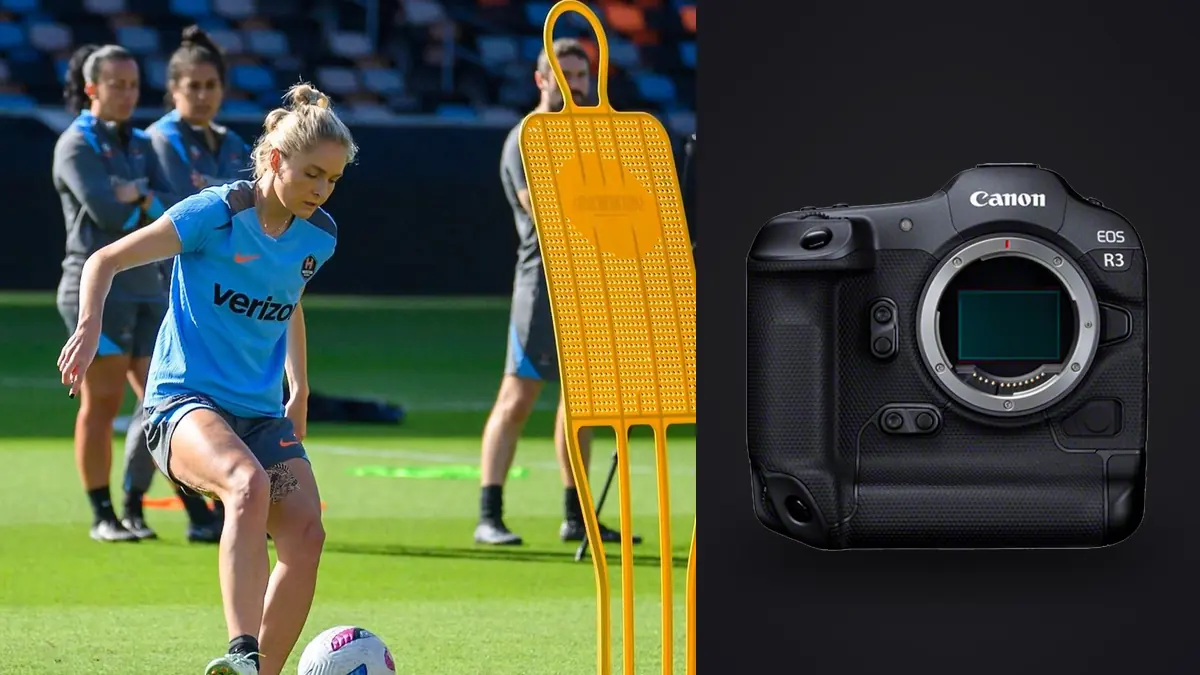
I started bringing the Canon EOS R3 to track and field meets mostly because a friend at a regional championship let me borrow one for a weekend and I never quite got over how the buffer behaved during a 4x100 relay. That's not a small thing when you shoot athletics regularly. A camera that chokes for two seconds at the exact moment a baton changes hands is a camera you stop trusting, and after that weekend I stopped trusting my old body. This piece is what I've learned running the R3 through actual meets since, sprints, throws, jumps, and the long slow grind of distance races where nothing happens for six minutes and then everything happens at once on the last lap.
Why This Body Suits a Track Meet Better Than Most
Track and field is an unusual sport to shoot because it isn't one sport, it's eight or nine happening at once across a stadium, each with its own rhythm. Sprints are over in ten seconds and demand a camera that won't miss the one frame where the lean happens. Throws have a long wind-up and a violent, brief release. Distance races are mostly waiting punctuated by a sprint finish that catches half the field off guard. Jumps require you to predict a takeoff point down to a few centimeters. No single camera solves all of that perfectly, but the R3's combination of a stacked sensor, a genuinely blackout-free viewfinder, and a buffer deep enough to survive a full relay leg gets closer than most bodies I've used, including cameras with higher resolution sensors that I liked better on paper.
The stacked, back-illuminated 24.1MP sensor is the part that changes how you shoot. Because the whole sensor reads out fast, rolling shutter distortion that plagues electronic shutter mode on older mirrorless bodies is mostly a non-issue here, even when you're panning hard on a 200m turn. I've still managed to bend a hurdle bar slightly in a frame or two when whipping the camera fast during a hurdles race, so it's not immune, just far better than what came before it.
Burst Speed, Buffer, and the Pre-Shutter Trick That Saves False Starts
30fps in full electronic shutter sounds like overkill until you're trying to catch the exact frame of a sprinter's foot leaving the blocks. At 12fps mechanical you'll get close. At 30fps you get the actual frame, and often two or three usable variations of it, which matters when you're trying to pick the shot where the face isn't scrunched into a grimace mid-exhale.
The buffer holds up for longer bursts than I expected the first time I tested it, deep enough on a fast CFexpress card to shoot through an entire 100m final without the camera stalling, and RAW capture doesn't fall over halfway through a long throw sequence the way some older bodies did. It will eventually fill if you hold the shutter down through a whole distance race, so I've learned to burst in short, deliberate bites around the moments that matter (the gun, the pass, the lean) rather than holding the trigger from gun to tape.
The feature I didn't expect to lean on this hard is pre-continuous shooting. It buffers a fraction of a second of frames before you fully press the shutter, so if you're half-pressed and waiting on the starter's gun, you actually catch the reaction rather than the half-second after it. For sprint starts specifically, this has saved me more usable frames than raw fps ever did. It's the kind of feature that sounds like a gimmick in a spec sheet and turns out to be the actual reason you stopped missing gun starts.
Eye Control AF Is Real, But Don't Expect It Everywhere
Canon brought Eye Control AF back from the old EOS-3 film body, and on the R3 it lets you move the AF point just by looking at your subject through the viewfinder. It needs a calibration pass per shooter (it took me two tries to get a profile that stuck), and it works best when you're relatively still, framing a subject that's roughly centered in your eyeline, like a sprinter coming straight down the track toward you from the blocks.
Where it gets shakier is exactly where track photography gets hardest: panning fast on a 400m turn, tracking someone moving diagonally across frame, or shooting with polarized sunglasses on a bright afternoon, which throws the eye tracking off more than Canon's marketing suggests. I've had good sessions with it for head-on sprint work and mediocre ones for anything lateral. My honest take after a season of meets is that it's a genuine tool for a specific subset of track shots, not a replacement for a well-placed AF zone and Dual Pixel subject tracking, which still does the heavier lifting for the side-on and diagonal work that makes up most of a meet.
What I Actually Set Per Event
Settings that work for a 100m final are wrong for a shot put circle, and I burned through a few meets before writing down what actually worked event by event. This is roughly my cheat sheet now.
| Event | Drive mode | AF setup | Typical lens / distance | Field note |
|---|---|---|---|---|
| 100m / 200m (blocks, head-on) | 30fps electronic, pre-continuous on | Whole area AF, People detection | 400mm f/2.8 or 300mm f/2.8, shooting from behind the blocks | Half-press early, let pre-continuous catch the gun reaction |
| 400m (turn, side-on) | 20-30fps electronic | Zone AF, manual tracking point over eye control | 500-600mm from a fixed infield position | Eye Control drifts on a fast pan, don't rely on it here |
| 4x100 / 4x400 relay exchange | 30fps, short deliberate bursts | Zone AF wide, watch for the incoming runner not the receiver | 300-400mm from the exchange zone | Focus on the baton hand, not the faces, until contact |
| Long jump / triple jump | 12fps mechanical, single deliberate bursts | Single point on the board, then track through the air | 300mm f/2.8 or 100-500mm from the side of the pit | Pre-focus on the board, recompose is too slow at this speed |
| High jump / pole vault | 20fps electronic | Zone AF on the bar | 200-400mm, low angle if the venue allows it | Bar clearance is the shot, shoot slightly before apex |
| Shot put / discus / javelin | 12fps mechanical, IBIS on | Single point, manual focus fallback for the circle fence | 70-200mm f/2.8 for the wind-up, 400mm for the release arc | Cage and fencing confuse AF, be ready to switch to manual |
| 800m and up (distance) | 8-12fps, mostly reserved for the finish | Zone AF, subject detection on lead runner | 300-400mm, track the pack loosely until the final straight | Save your buffer, most of the race isn't worth full bursts |
Lenses: What Actually Earns Its Weight on a Long Meet Day
A 600mm f/4 is glorious for isolating a single sprinter from a media stand but it's a lot of glass to carry for eight hours, and at a lot of high school and college meets you simply aren't positioned far enough back to need it. My most-used combination has ended up being a 100-500mm RF zoom for its flexibility between events, paired with a 70-200mm f/2.8 for the throws circles and any moment I'm shooting from close range, like award ceremonies or athletes warming up in the infield. If you can get accredited close to the track, a 300mm f/2.8 does most of the sprint and jump work without the bulk of the longer primes, and it focuses fast enough that you're not fighting the lens as well as the subject.
In-body stabilization helps more than I expected when you're handholding a long lens for hours without a monopod, which is often the reality at smaller meets where sideline space is tight and a tripod leg becomes a tripping hazard for other photographers.
Getting Through the Files Afterward
A full day at a big invitational with the R3 shooting bursts through sprints, jumps, and throws can leave you with several thousand frames by the end of finals, and a meaningful chunk of that is 15 to 30 nearly identical frames from a single relay pass or a single throw. Sorting that by eye at midnight in a hotel room is where a lot of the actual pain of sports photography lives, not on the track. This is the part of the workflow where I stopped trying to do everything manually and started running everything through imagic before I open a single RAW file in an editor.
It runs entirely on my laptop with no upload step, which matters more than it sounds like at a track meet where venue wifi is either terrible or nonexistent. imagic scores sharpness and focus locally on each frame in a burst, so instead of scrubbing through 25 nearly identical shots of a discus release I get the two or three that are actually in focus surfaced first. Its burst clustering groups those near-duplicate sequences together automatically rather than dumping them into the folder as one long undifferentiated scroll, which on a 30fps camera is the difference between a 20-minute cull and a two-hour one.
The other piece I've come to rely on is the apply_my_style preset, which is trained on my own past edits rather than a generic look. Track meets tend to repeat the same lighting problems, mixed stadium floodlights, harsh midday sun on one side of the track and shade on the other, and having a starting point that already reflects how I've corrected that lighting before saves a real amount of time compared to grading each meet from a blank slate.
If you're trying to figure out a faster end-to-end process for burst-heavy sports work generally, it's worth reading through how AI photo culling actually works, and separately there's a good rundown of ways to speed up the rest of the editing workflow once the culling step stops being the bottleneck.
Batteries, Cards, and Surviving a Twelve-Hour Meet
The LP-E19 battery is the same one Canon puts in its 1-series DSLRs, and it comfortably gets through a full day of meet shooting for me, though heavy pre-continuous shooting and constant EVF use will pull it down faster than casual shooting would suggest. I carry a spare regardless, mostly because a dead battery during a final is not a risk worth taking for the cost of a second one.
Card choice matters more than people expect. A fast CFexpress Type B card in the primary slot is what actually lets the buffer clear quickly enough to keep shooting through back-to-back bursts, and I use the SD slot in the second bay purely as a backup write rather than splitting RAW and JPEG across both, since that setup slows the buffer clearing down when you need it most, right in the middle of a relay.
Weather sealing on the body has held up through a rainy conference championship and a dusty outdoor throws area without issue, though I still wipe down lens mounts and card doors after anything genuinely wet, more out of habit than necessity.
Is It Still the Right Camera to Buy for This in 2026?
Canon has released newer flagship bodies since the R3 came out, and if you're buying new and money isn't a constraint, it's worth comparing against what's current. But used and refurbished R3 prices have come down enough that it's now a genuinely reasonable entry point into professional sports shooting rather than a stretch purchase, and nothing about its core burst, buffer, or AF performance has aged in a way that matters for track and field specifically. I'd rather have this camera today than a lot of newer bodies with higher resolution sensors and a shallower buffer. Resolution matters less than not missing the moment, and this camera rarely makes you miss the moment.
Frequently Asked Questions
Do I actually need 30fps for track and field, or would a 12fps body be enough?
For distance events, honestly, 12fps is plenty since most of the race doesn't need bursts at all. For sprints, relay exchanges, and the split-second of a jump takeoff, 30fps genuinely catches frames that 12fps would skip entirely, particularly the exact instant of a lean at the tape or a baton making contact. If your meet schedule leans heavily toward field events and distance races, you can get away with less. If sprints and relays are your main subject, the extra frame rate earns its keep.
Can I use flash with the R3 at an indoor track meet?
Only in mechanical shutter mode, and only up to a fairly limited sync speed. Electronic shutter, which is where most of the R3's speed advantage lives, doesn't support flash sync at all. Most indoor meets I've shot have had enough ambient light from the arena rigs that I skip flash entirely and lean on the R3's high ISO performance instead, which holds up reasonably well into the low five-digit ISO range before noise becomes a real problem.
Is Eye Control AF calibration worth the hassle for track work?
It's worth setting up once, but temper your expectations for how often you'll actually use it during a meet. It's genuinely helpful for head-on sprint starts where you're relatively stationary and your subject is coming straight at you. For panning shots on turns, diagonal movement, or anything shot in sunglasses on a bright day, I fall back to standard zone AF and manual tracking point selection, which has been more consistent for me across a full season of meets.
What's the fastest way to get through several thousand burst frames after a meet?
Cull before you edit, not during. Running everything through a local tool like imagic first, so sharpness scoring and duplicate clustering strip a 30-frame burst down to the two or three sharpest frames before you ever open an editor, cuts the worst part of the process down dramatically. Trying to eyeball every frame in Lightroom or Capture One at full resolution is where most of the wasted hours actually happen, not in the editing itself.