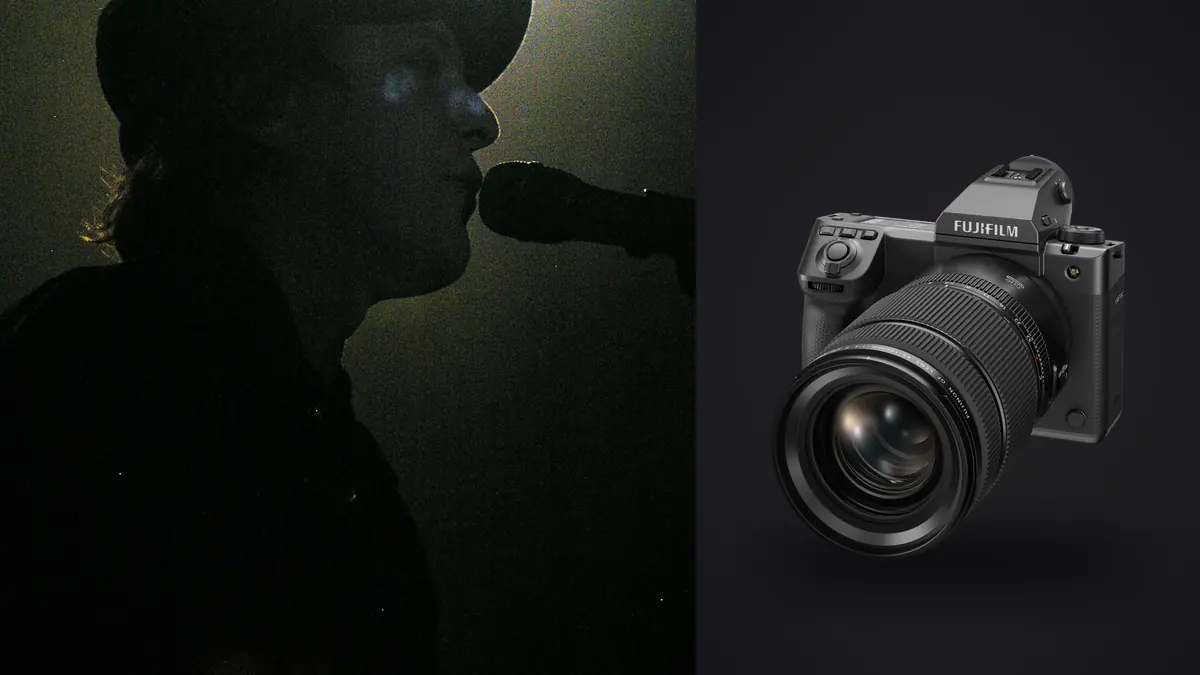
The Fujifilm GFX100 II is a 102-megapixel medium-format camera with a 43.8 x 32.9 mm sensor, in-body stabilization, phase-detection autofocus, removable high-resolution viewfinder, and CFexpress Type B plus SD card storage. It is substantially faster and more responsive than earlier GFX bodies, but concert photography is still a demanding fit test. Access, lens aperture, subject speed, LED behavior, file volume, and kit weight matter more than the appeal of maximum detail.
The camera is most coherent for controlled live sessions, rehearsals, seated performances, theater, stage portraits, and close access where deliberate frames are possible. It is less obvious for a restrictive festival pit where long lenses, rapid direction changes, and instant delivery dominate. This guide separates the situations in which the large sensor changes the picture from those in which it simply enlarges the workflow.
Troubleshoot the concert mismatch before changing bodies
Troubleshooting GFX100 II concert results starts with access and framing. A tiny performer in a large file is still a focal-length or position problem. A face that is sharp in one frame and soft in the next may reflect subject selection, movement, or insufficient depth rather than sensor resolution. Repeating bands or broken LED patterns require a shutter and light test. A buffer-heavy folder with few distinct gestures calls for shorter sequences. If the assigned position demands a lens that is too slow, too short, or impractical to carry, document that mismatch before concluding that processing can rescue it. The useful correction may be a different permitted position or complementary system.
Buy for the access distance, not the sensor size
A photographer at the side of a small stage can use a moderate GF lens to show a performer with the room and still retain substantial crop latitude. A photographer held at the soundboard may need a long, bright lens that the G mount does not offer in the same size and range as established full-frame sports systems.
List the recurring credential positions before considering the body. Note whether tight faces are mandatory, whether movement in the pit is allowed, and whether a second camera can cover focal lengths outside the GFX role. A medium-format body makes sense as a deliberate viewpoint; it should not be expected to turn inadequate reach into a complete press set.
Resolution supports reframing, but it does not change perspective or atmospheric loss. Cropping a distant performer from a broad frame does not recreate the compression and subject scale of a long lens. Haze, heat, and audience movement can reduce the practical detail long before pixels run out.
Understand what the larger sensor changes
The sensor can record very fine costume, skin, instrument, and stage detail when focus, shutter speed, and light are controlled. It also supports tonal transitions that can be useful in spotlit performances. Those benefits show most clearly in large output, close viewing, and carefully edited campaign material.
At equivalent framing and aperture relationships, medium format can create shallow depth. That can separate a quiet performer beautifully, but it narrows the focus margin when an artist leans toward the camera. Stop down when the face, microphone, and instrument must connect. Do not choose the widest available aperture merely because the venue is dark.
The 102-megapixel file reveals motion blur and focus error. In-body stabilization reduces camera movement, not a drummer, dancer, or singer crossing the stage. Shutter speed remains a subject decision, and higher ISO may be preferable to an immaculate but soft file.
Compare GF lens roles with concert reality
GF lenses are designed for the larger image circle and many are physically substantial. Build a kit around one or two clear roles. A moderate wide or normal lens can create environmental stage frames from close access. A portrait-length lens can isolate a performer from a side aisle or controlled position. A zoom adds flexibility but may be slower or heavier than a full-frame concert equivalent.
Check maximum aperture across the focal range, autofocus behavior in low contrast, balance on the body, and whether the hood fits venue restrictions. The fastest lens is not automatically the best if it creates an unmanageable front-heavy kit or lacks the needed angle.
Rent the exact lens combination at a similar venue. Practice changing orientation, reaching controls, and moving through a narrow space while wearing hearing protection. A studio handling impression does not reveal how a one-kilogram-class body and large lens behave against a crowded barrier.
Autofocus is capable, but subject choice still needs control
Phase-detection autofocus and subject detection make the GFX100 II more suitable for movement than previous generations. In a frame with several performers, microphones, and backlights, broad automatic selection can still choose the wrong face or foreground edge. Start tracking from a defined area over the intended person.
Use continuous autofocus for movement and a smaller area when faces overlap. Acquire before the gesture peaks. If strong haze or silhouette removes facial detail, focus on a contrast edge at the same distance rather than waiting for an eye box.
The camera can shoot continuous sequences, but the strongest use is a short burst around a known cue. Its improved speed does not make every concert a reason to hold the shutter. Deliberate timing protects buffer, cards, and later review.
Test electronic shutter and LEDs together
The GFX100 II sensor reads faster than earlier GFX designs, but it is not a stacked action sensor. Electronic shutter can show skew with fast movement and bands under pulsing stage fixtures. Long straight objects such as microphone stands and guitar necks make distortion easier to see.
Use the mechanical shutter as the conservative baseline for action and difficult LEDs. Test the electronic option when quiet operation matters or a specific shutter range is needed. Inspect several consecutive frames under each major lighting cue, since pulse behavior can change with dimming and color.
Flicker settings can help in supported conditions but do not guarantee clean frames from every display or fixture. Adjust shutter speed in small steps and recheck. A clean rehearsal cue does not prove the entire show will use the same lights.
Decide whether 102-megapixel files serve the output
Large campaign prints, posters, detailed tour books, and crop-heavy art direction can use the resolution. Same-night social delivery may not. If the final file is a modest web JPEG, the storage, transfer, preview, and export load should be justified by another benefit such as the camera's rendering or the need for alternate crops.
Use a tested RAW format and keep it consistent through the set. Confirm that the editing computer and backup drives have capacity before the show. Generating full previews for every burst can become the slowest part of a deadline even when the camera never hesitates.
The CFexpress Type B slot supports demanding writes, while the SD slot offers another storage path. Simultaneous recording can add redundancy, but the slower card and selected format may affect sustained behavior. Test the exact pair rather than assuming two slots perform identically.
Factor the viewfinder and handling into long sets
The removable high-resolution electronic viewfinder provides a detailed view and can accept an optional tilt adapter. That can help from low positions or a fixed side-stage angle. It also adds height and another connection to protect in a packed bag.
The body with viewfinder, battery, and card is around a kilogram before a lens. A secure strap, balanced grip, and planned rest position matter during a long show. A monopod may help from a fixed rear position when permitted, but it is usually unsuitable in a moving pit.
Check battery, card, and lens weight as a complete system. The larger body may be comfortable with a large lens but excessive beside a second camera. Buying fit includes the equipment that must be carried alongside it, not only the GFX kit in isolation.
Identify the concert jobs where it fits
| Assignment | GFX100 II fit | Reason |
|---|---|---|
| Controlled rehearsal | Strong | Access and repeatability support deliberate high-resolution frames. |
| Seated theater or classical stage | Good | Predictable movement and detailed production can suit the sensor. |
| Small club from close side access | Conditional | Lens role and body size must match the space. |
| Festival from a fixed distant pit | Limited | Reach, lens speed, and rapid coverage may favor another system. |
| Tour campaign with large output | Strong as a planned body | Resolution and tonal detail can serve designed deliverables. |
Plan a complementary backup system
A second body should cover the GFX100 II's weak side. A faster full-frame camera with a long zoom can secure tight action while the GFX makes environmental and hero frames. Duplicating two large medium-format kits may add weight without adding missing capability.
Synchronize clocks and establish a common color reference so files interleave sensibly. The two systems will not render identically, and forcing them into a single preset can create skin and stage-color differences. Build a coherent grade from each RAW starting point.
Redundancy also matters because a large-sensor body and lens represent one working path. A non-repeatable show needs a second camera that can finish the brief if either fails. Include chargers, cards, and ingest readers in that plan.
Use a deliberate local post-show workflow
Copy CFexpress and SD media into separate source folders, verify the transfer, and create a second physical copy before formatting. Group by performer, song, or lighting cue, then compare short sequences for face focus, gesture, microphone position, and LED artifacts.
imagic can group near-duplicates and assess sharpness, exposure, closed eyes, and composition locally. A singing expression or intentional blur may not fit ordinary portrait logic, so keep final judgment manual. Non-destructive edits and a learned personal style can establish a starting point before JPEG or TIFF export.
See the local desktop workflow for processing and the Camera Hardware section for related buying decisions.
Evaluate high sensitivity at the real output size
Concert buyers often compare sensors by enlarged noise samples, but the final crop and delivery matter. Make representative files at the shutter speed needed for performers, process them with restrained noise reduction, and export at the largest normal output. Compare skin, dark clothing, saturated lights, and fine instrument detail.
The larger sensor does not remove the need for sufficient exposure. Lifting a deeply underexposed 102-megapixel file can reveal color noise and uneven shadows while retaining enormous dimensions. A correctly exposed higher-ISO frame is usually more useful than a lower-ISO file that sacrificed shutter speed or highlight judgment.
Include alternate camera systems in the same output comparison. If the visible benefit disappears after cropping, resizing, and deadline processing, the GFX may still be chosen for handling or rendering, but the purchase case should not rest on pixel count alone.
Pre-purchase concert checklist
- List actual credential positions and mandatory focal lengths from recent jobs.
- Match one or two GF lenses to specific required frame roles.
- Process full-resolution RAW bursts on the intended computer and backup drives.
- Test mechanical and electronic shutter under representative LED lighting.
- Carry the complete body, lens, cards, and backup system through a realistic set.
- Compare final files at the client's output size, not only at full magnification.
- Confirm another body can finish the brief if the GFX kit is unavailable.
Frequently asked questions
Is the GFX100 II fast enough for concerts?
It can handle controlled and moderately active performance work, especially with anticipation and short sequences. Highly erratic action and restrictive long-distance coverage may favor a stacked full-frame system.
Does 102 megapixels replace a telephoto lens?
No. Cropping cannot recreate telephoto perspective, subject scale, light gathering, or clear detail lost through distance and haze. Choose reach according to the credentialed position.
Should electronic shutter be used for silent concert work?
Only after testing the performer movement and actual LEDs. The sensor is faster than earlier GFX models, but skew and banding remain possible.
Who benefits most from this camera at a show?
Photographers producing deliberate campaign, theater, rehearsal, or large-output work with close or controlled access gain the clearest benefit. Same-night high-volume press coverage is a less natural fit.