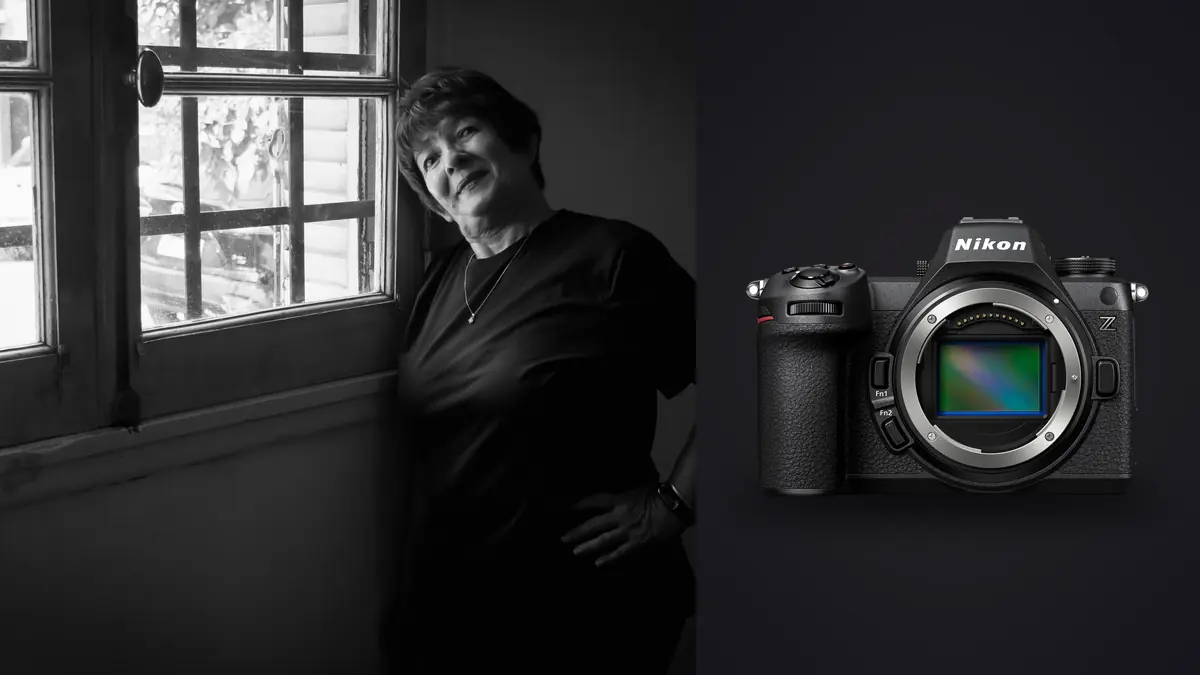
Why I Switched to the Z6 III for This Kind of Work
I shot boudoir and intimate portrait sessions on a Z6 II for almost three years before I moved to the Z6 III in early 2025. The switch wasn't about resolution or bragging rights on a spec sheet. It came down to two very specific problems: the autofocus system losing confidence in dim bedrooms and hotel suites, and an electronic viewfinder that got murky enough in low light that I stopped trusting what I saw through it. Boudoir work happens almost entirely indoors, often in a single client's bedroom with one lamp and a north-facing window doing all the work, and a camera that hunts for focus or lies to you about exposure in that environment costs you the moment. The subject isn't going to hold a pose for ten seconds while the lens racks back and forth.
The Z6 III fixed both of those specific complaints, not as marketing claims but in the way the camera actually behaves in a room with maybe 40 lux of ambient light. The partially stacked 24.5-megapixel sensor and the new EVF, rated to 4,000 nits and genuinely usable at full brightness even under a single practical lamp, changed how confidently I could shoot without chimping after every frame.
The Sensor and Why Low Light Control Actually Matters Here
Boudoir photography lives and dies by low-key lighting. Most of the sessions I shoot are underexposed on purpose, sometimes by a stop and a half, to keep skin looking sculpted rather than flat. That means the camera's usable ISO range and how gracefully it falls apart at the top end matter more here than they would for, say, a bright outdoor family session.
The Z6 III's native range runs 100 to 64,000, and I'll use the top third of that range more often in this genre than in almost any other kind of shooting I do. At ISO 6400, skin retains texture without turning waxy, and shadow noise stays fine-grained enough that it doesn't fight with the intentional grain I sometimes add in post. Push past 12,800 and you start seeing it in the darkest parts of the frame, particularly in black lingerie or dark backdrops where there's nothing but shadow detail to hold onto. I treat 12,800 as my personal ceiling for anything I'd actually share, and I'll go higher only for behind-the-scenes frames that never leave my hard drive.
Dynamic range is the other half of this. Low-key boudoir work means pulling shadow detail back in post more often than lifting highlights, and the sensor holds up well down to around three stops of shadow recovery before banding creeps in. That's enough headroom that I can expose for the highlight side of a subject's skin under a single softbox and know the shadow side of their body will still hold texture when I open it in editing.
Autofocus in a Genre That Refuses to Cooperate
Eye-detection autofocus was built and tested against faces looking mostly toward the camera in reasonably even light. Boudoir poses do the opposite on purpose: three-quarter turns, chin down, eyes closed, hair falling across half the face, a hand or a sheet covering everything but a jawline. The Z6 III's subject-detection system (I keep it set to "Auto" rather than locked to "People") handles more of this than I expected, but it isn't magic.
With eyes closed or a face turned more than about 60 degrees from the lens, the camera will often default to the nearest visible skin, which usually means a shoulder or a collarbone instead of the eye. For anything posed with the face partially obscured, I switch out of wide-area AF and drop to a single point that I place manually, then use back-button focus so a half-press of the shutter doesn't force the camera to go hunting for a face that technically isn't there. It sounds like a small workflow tweak, but it's the difference between a sharp collarbone and a sharp eye in a frame where the eye is the only thing anyone will look at.
When I turn eye-AF off entirely
For close, intimate detail shots (hands, the curve of a shoulder, a necklace against skin) I turn subject detection off completely and go back to a plain single point. The system will occasionally try to find a face in the frame even when there isn't one, and it will sometimes pull focus toward a mirror reflection or a doorway in the background of a hotel room. A single point I control myself is faster than fighting the camera's assumptions.
Shutter Sound and Why It Changes the Whole Session
This is the part that doesn't show up on a spec comparison but matters more than almost anything else on this list. A first-time boudoir client is often nervous, self-conscious, and acutely aware of every sound in the room. The mechanical shutter slap on my old D750 was loud enough that a nervous subject would visibly flinch the first few times, and that tension shows up in the photos. The Z6 III's fully silent electronic shutter mode means the only sound in the room is my voice giving direction. Clients relax faster and it shows in how naturally they hold a pose past the first few frames.
The tradeoff is one I've made peace with: electronic shutter and flash sync don't mix cleanly on this body, so on the handful of sessions where I'm using a single strobe rather than continuous LED panels, I switch back to the mechanical shutter for those specific frames. It's audible again, but by that point in the session the client has usually settled in and the sound doesn't land the same way it would at the start.
Settings I Actually Use, By Scenario
The settings below aren't theoretical. They're close to what's saved across five of my camera's custom banks for the sessions I shoot most often.
| Session Scenario | ISO Range | Aperture | Shutter Mode | AF Area Mode |
|---|---|---|---|---|
| Single north-facing window, overcast afternoon | 800-2000 | f/1.8-f/2.2 | Electronic, fully silent | Wide-area AF (S) with eye-detect |
| Hotel suite, lamp and window light after dark | 1600-6400 | f/1.4-f/2 | Electronic, fully silent | Single-point, manually placed |
| Home studio, one softbox, low-key black backdrop | 100-400 | f/2-f/2.8 | Mechanical (flash sync) | Wide-area AF (S) |
| Outdoor, golden hour, backlit sheer fabric | 100-320 | f/1.4-f/1.8 | Electronic, fully silent | Single-point, manually placed |
| Client moving through a posing sequence | 640-3200 | f/2-f/2.8 | Electronic, 14fps burst | 3D-tracking from a chosen start point |
Notice how rarely I'm above f/2.8. Boudoir work separates a subject from background clutter (a hotel headboard, a cluttered dresser) with shallow depth of field, and the Z6 III's in-body stabilization, rated to roughly 8 stops depending on the lens, lets me hold shutter speeds down around 1/60 or even 1/40 handheld at f/1.4 without motion blur creeping into static poses. That matters when I'm shooting available light only and don't want to push ISO any higher than I have to.
Lenses That Actually Earn Their Place in the Bag
I carry three lenses to a boudoir session and rarely touch a fourth. The Nikon Z 50mm f/1.2 S does most of the work: close enough for three-quarter shots in a normal bedroom, wide enough that I'm not backed into a closet trying to get a full-length frame, and the rendering wide open is soft in exactly the way that flatters skin without looking like a diffusion filter was bolted on. It's heavy (about 1,090 grams) and it shows up in every gear complaint thread about this genre of shooting, but I've never regretted carrying it.
The Z 85mm f/1.2 S comes out for tighter portrait crops and detail work, particularly in rooms with more space to work with. It's the sharpest lens I own wide open, sharp enough that at f/1.2 you can see individual eyelashes in critical focus while the tip of the nose has already started to soften. That's a look viewers respond to strongly in this genre, but it also means focus accuracy has zero margin for error, which loops back to why I trust a manually placed single point more than automatic face detection for these shots.
For cramped rooms (a lot of hotel suites are smaller than they look in the listing photos), I keep the Z 35mm f/1.4 S on standby. It isn't a flattering focal length up close, so I mostly use it for wider environmental frames, getting the whole bed and window light into a composition rather than an isolated portrait.
Getting Through the Volume Without Losing the Frame That Matters
A single pose in a boudoir session rarely produces one frame. It produces twelve, because the client shifts weight, breathes, blinks, and resettles between each shutter click, and the best expression and the sharpest eye almost never land on the same frame by chance. A 45-minute session with a cooperative subject easily produces 600 to 900 raw files, and by the third session in a week, sorting that manually stops being realistic.
This is where I lean on imagic rather than clicking through a Lightroom filmstrip one frame at a time. Its local sharpness and focus scoring flags which frame in a burst actually has the sharpest eye, not just the sharpest overall image, which matters a lot when depth of field is a few centimeters deep at f/1.2. The duplicate and burst clustering groups those twelve near-identical frames from one pose into a single stack automatically, so I'm choosing between three genuinely different options instead of scrolling past nine variations of the same expression. If you haven't looked at how that kind of automated culling actually scores an image under the hood, this breakdown of how AI photo culling works covers the mechanics better than I can in a few sentences here.
The other reason imagic fits this specific genre is more practical than technical: it processes everything locally on my machine, with nothing uploaded to a cloud service to get culled or previewed. Boudoir subjects are trusting a photographer with images they'd never want to see leak, and being able to say honestly that the sorting and editing software never sends their photos anywhere isn't a minor detail.
Color and Skin Tone Once the Shoot Is Over
Nikon's color science renders skin with a warmth that needs less correction than I expected coming from Canon bodies years ago, but I still grade every boudoir set the same way: slightly desaturated, warm shadows, a deliberate lift in the black point so nothing crushes to pure black on a dark backdrop. Doing that consistently across a full week of sessions used to mean rebuilding presets by hand every time my taste shifted slightly. Now I train imagic's apply_my_style feature on a folder of images I've already graded the way I want, and it applies that same look as a starting point across a new set before I go in and fine-tune individual frames. It isn't replacing the eye, it's just removing the fifteen minutes of "get back to my baseline" that used to happen before the real editing started.
Where the Camera Falls Short for This Genre
It isn't a perfect fit for everything about this work. Buffer depth writing to the SD UHS-II slot (I keep CFexpress in slot one for raws and SD as a JPEG backup) will bottleneck if I fire off a long burst chasing a moving pose, and I've had the buffer choke for a second or two mid-sequence more than once. The body is also not small. Paired with the 50mm f/1.2, it's a two-hand, over-the-shoulder-strap kind of setup, which gets tiring across a full day of shooting in a way a smaller APS-C body wouldn't. And the weather sealing, genuinely excellent, is mostly wasted on this genre. I have never once needed my camera to survive rain in a bedroom.
None of that changes what the camera is for me day to day: a body that lets me shoot quietly, trust the viewfinder in low light, and rely on autofocus enough that I can spend my attention on directing the subject instead of chasing focus confirmation.
Frequently Asked Questions
Does the shutter sound genuinely change how a client behaves during a session?
Yes, and more than any lighting or posing adjustment. Nervous subjects relax visibly once they realize the camera isn't making noise every time I press the shutter. I still switch to the mechanical shutter when I'm syncing a strobe, but by then the subject has usually settled into the session and the sound doesn't carry the same weight it would in the first five minutes.
Will eye-detection autofocus actually track through hair, hands, or fabric covering part of the face?
Partially, and not reliably enough to leave it running unattended. It handles a face turned slightly away or partly shadowed reasonably well. Once the eyes are closed or more than half the face is obscured, I stop trusting it and place a single AF point by hand instead. It takes longer per frame but costs far less time than deleting a stack of shots where the camera focused on a shoulder.
Is the 85mm f/1.2 S worth the extra cost over the f/1.8 version for boudoir work specifically?
If you're shooting tight portrait crops where the eyes are the entire subject of the frame, yes. The falloff from the f/1.2 is more dramatic and the rendering wide open has a quality the f/1.8 doesn't quite match. If most of your work is three-quarter or full-body framing where you're rarely shooting wider than f/2.5 anyway, the f/1.8 gets you most of the look for less than half the price and a lot less weight in the bag.
How do you avoid losing the best frame when a client shifts through a pose across a dozen shots?
By not relying on memory or a quick scroll through the filmstrip at 100 percent zoom, which is how sharp-eye frames get missed when you're tired at the end of a long shoot day. I let sharpness and focus scoring flag the frame with the cleanest eye in each burst before I even start reviewing, and I use burst clustering to collapse near-duplicate frames into one stack so I'm comparing three real options instead of twelve nearly identical ones. It's a meaningful part of how I keep session turnaround under a week without cutting corners on picking the actual best shot.