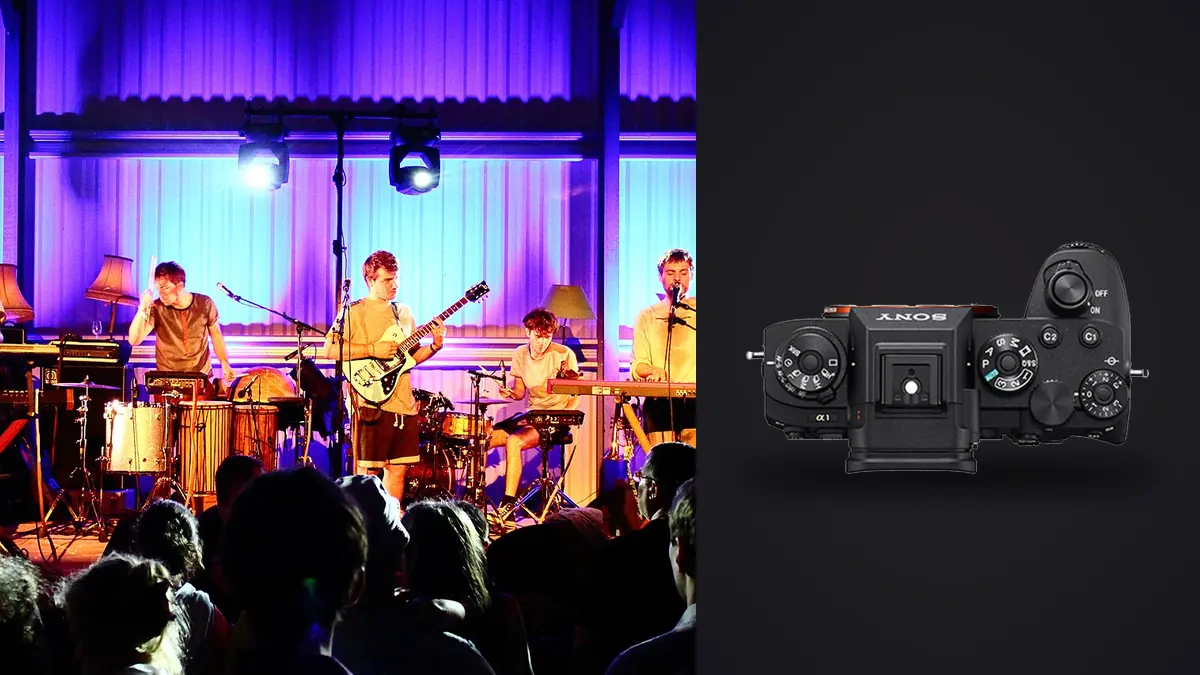
I picked up the Sony A1 two tours ago after years of running a pair of A7 III bodies, and it changed how I shoot a three-song pit set more than any lens purchase ever did. This isn't a spec sheet regurgitation. It's what actually happens when you point this camera at a strobing LED wall, a lead singer doing a stage dive, and a photo pit packed shoulder to shoulder with eleven other shooters all fighting for the same three songs of access. Some of what the marketing promises holds up. Some of it needs real caveats that nobody tells you before you drop that much money on a body.
Why This Camera Ends Up in the Pit Bag At All
Concert work asks a camera to do things that conflict with each other. You need silent operation because plenty of venues (opera houses, seated theaters, anywhere with a no-flash-no-noise policy printed on the credential) will pull your pass if your shutter clacks during a quiet acoustic number. You also need a mechanical shutter option in reserve because electronic shutters and pulsing stage lighting do not always get along. You need autofocus that won't hunt when a guitarist steps from a blacked-out stage into a single hard spotlight. And you need a buffer deep enough to survive a chorus-length burst without locking up right as the confetti drops.
The A1's 50.1MP stacked sensor reads out fast enough that most of those demands stop being contradictions. That's the honest pitch. The dishonest pitch is that it solves all of them without you having to think. It doesn't. You still have to know your venue.
The Rolling Shutter Conversation Nobody Has Until It Bites Them
Every mirrorless shooter who's worked a festival mainstage has a banding story. LED PAR cans and moving-head fixtures don't emit continuous light, they pulse at frequencies that can clash with an electronic shutter's readout speed, and the result is horizontal bands of color shift across a frame that looked perfectly fine on the back of the camera at a glance. The A1's stacked sensor reads out roughly four times faster than a conventional sensor, which is why Sony can offer full electronic shutter at up to 30fps without the shutter sound. But "faster" isn't "immune." I've still caught banding on the A1 in silent mode under certain LED washes, usually cheaper festival stage lighting running at lower refresh rates than the rig at a proper arena tour.
This is where the anti-flicker function actually earns its keep, and it's not just a marketing checkbox. It samples the light source's flicker frequency and times your exposures to land in the same phase every frame, which kills the banding and the frame-to-frame exposure drift you'd otherwise get shooting a burst under a strobing rig. The tradeoff is that it can nudge your effective frame rate down from the advertised 30fps, and on some lighting rigs it locks you out of certain shutter speeds entirely. I treat it as mandatory for arena and festival work and unnecessary for small clubs running basic tungsten or simple LED house lighting.
| Shutter Mode | Practical Top Speed | Sound | Banding Risk Under LED Rigs | Where I Actually Use It |
|---|---|---|---|---|
| Mechanical | 10 fps, 1/400s sync | Audible clack | Low | Small clubs where noise is a non-issue, or any set where I still want a flash option |
| Electronic (silent), no anti-flicker | Up to 30 fps | Silent | High on cheaper LED rigs, moderate on quality festival lighting | Only on rigs I've already tested and know are clean |
| Electronic + anti-flicker | 15 to 20 fps in practice | Silent | Low | Arena tours, festival mainstages, anything with moving-head fixtures |
ISO, Noise, and What a 50-Megapixel File Actually Looks Like at 12800
The pixel-density argument against the A1 for low light work isn't wrong, it's just overstated for how concerts actually get lit. Yes, a 50MP sensor packs more photosites into the same full-frame area than a 24MP body, and yes, that means each individual photosite gathers less light. In a dim jazz club with a single top light, you will see more visible noise at ISO 12800 on the A1 than you would on an A7S III at the same setting. What the argument leaves out is that most touring productions light performers a lot brighter than the ambient darkness of the venue suggests. A follow spot or a hard key light on the singer routinely lets me sit at ISO 3200 to 6400 even when the rest of the frame reads pitch black, and at that range the A1's files are clean enough to print large. It's the small clubs with a single warm wash and no dedicated key light where I start pushing past ISO 10000 and the extra resolution starts costing me noise I'd rather not pay for.
My practical range after two full tour cycles: ISO 800 to 3200 for well-lit arena shows, 3200 to 6400 for club shows with decent stage lighting, and I stop trusting the files much past 12800 unless I'm converting to black and white anyway, which hides luminance noise far better than a color file ever will.
Autofocus: Great for a Mosh Pit, Slightly Overkill for a Solo Cellist
Real-time Eye AF tracks a moving human face better than any camera I've used, including through a drummer's hair flying mid-hit or a singer half turned away from me mid-lyric. It rarely loses the subject once it's locked, even when a crowd surfer's arm swings across the frame between me and the stage. For anything with movement (rock, punk, hip-hop sets with a lot of stage motion) this is the single biggest reason I stopped missing shots I used to miss on older bodies.
Where it's less of a revelation: seated, still performances. A solo pianist or a string quartet doesn't need face-tracking AF that can follow a stage-diving bassist through a crowd. A well-calibrated single-point AF on a competent older body gets you the same tack-sharp result there. I mention this only because I've watched photographers assume the A1 will make every set easier, and for the quiet nights it mostly just gives you more resolution to crop into, which is its own kind of useful but isn't the autofocus story people expect.
Buffer Depth and the Three-Song Reality
Most touring photo pits give you the first three songs and then you're escorted out, no exceptions, security enforced. That's maybe ten to twelve minutes of actual shooting time, and I spend almost all of it in bursts because the difference between a usable frame and a throwaway is often a fortieth of a second: eyes open versus closed, mouth mid-word versus mid-scream, a jump caught at the peak versus on the way down. Shooting compressed RAW on a fast CFexpress Type A card, I can burn through a chorus-length burst at 20fps with anti-flicker on and not hit the buffer wall before the song ends. Switch to uncompressed RAW and the buffer fills noticeably faster, so I only shoot uncompressed for portrait-style moments between songs where I'm not bursting anyway.
The dual card slots matter more at concerts than almost any other genre I shoot, because there's no reshoot. If a card fails mid-set backing up in-camera to a second card is the difference between a disaster story and a non-event. I run CFexpress in the primary slot for speed and SD UHS-II in the second purely as a backup, since the write speed penalty on the slower card doesn't matter for a safety copy.
The Lenses I Actually Bring, and Why
Pit access rules (usually "first three songs, no flash") push you toward fast glass because you're often working from a fixed barrier distance with no ability to move closer. My kit for most tours: a 24-70mm f/2.8 GM II for wide stage shots and crowd context, a 70-200mm f/2.8 GM II for tight performer portraits from the back of the pit, and a 50mm f/1.2 GM for the darkest club dates where I need every bit of light the glass can pass. I've tried adding a 135mm prime for isolation shots on bigger stages with deeper pits, and it's beautiful glass, but it's a luxury add rather than a necessity most nights.
One practical note on the 24-70: at wider apertures on a 50MP body, focus precision matters more than it did on lower-resolution cameras, because softness that would be invisible at 24MP shows up clearly when you're viewing files at full resolution or cropping in tight on a festival poster crop. That's not a knock on the lens, it's just the tradeoff that comes with more pixels.
From Four Thousand Frames to a Delivered Gallery Before Load-Out
Here's the part that doesn't get talked about enough: shooting a 30fps-capable body at a three-song set means you can walk away with three or four thousand frames from a single act, and most of them are near-duplicates of the same three-second burst. Sorting that by eye, at full resolution, after a twelve-hour day on your feet, is where a lot of concert photographers lose the night. I run everything through imagic before I open a single file in an editor. It scores sharpness and focus locally on my laptop, which matters backstage where venue wifi is either nonexistent or something I don't trust with unreleased tour photos anyway, since nothing gets uploaded anywhere to do it. It also clusters near-identical burst frames together, so instead of clicking through forty frames of the same guitar windmill I'm looking at one representative frame per moment and picking the sharpest from a tight group instead of a haystack.
The other piece that's saved me real time on multi-city runs is the apply_my_style preset, which trains on edits I've already made rather than shipping a generic look. Once I've graded a night's photos the way I want them, I can carry that same treatment into the next city without rebuilding it from scratch, which matters when you're editing in a green room with twenty minutes before doors and a publicist waiting on three hero shots. If you're still sorting bursts manually, our piece on how AI photo culling actually works goes deeper into what's happening under the hood, and these workflow tips cover the rest of the pipeline from card dump to delivery.
What I'd Tell Someone Deciding Between This and a Cheaper Body
If you're shooting one local show a month, the A1 is overkill and the price difference buys you a lot of lenses instead. If you're touring, shooting multiple acts a week, and need a single body that handles a strobing arena show on Tuesday and a silent seated theater gig on Friday without a second camera in your bag, the versatility is the actual selling point, more than any single spec. The resolution is nice for crops and posters. The autofocus is genuinely excellent for fast-moving stage performance. But it's the combination of a fast, quiet, flicker-aware shutter system and a buffer that survives real bursts that makes this a camera built for the job rather than a camera that happens to work for it.
Frequently Asked Questions
Does the Sony A1 handle strobe-heavy EDM and hip-hop shows without banding issues?
Mostly yes, with anti-flicker turned on. Straight strobe hits (a single hard flash rather than a pulsing LED wash) tend to be less of a banding problem than continuous pulsing LED fixtures, but I still run anti-flicker as a default for any show with heavy production lighting rather than gambling on a clean take.
Is 50 megapixels actually useful for concert photography, or just extra file size to manage?
It's genuinely useful for two things: cropping into a distant stage shot to simulate a longer lens when you can't get closer, and delivering large-format prints or posters to a band's merch team. For straightforward web and social delivery, you're downsampling most of that resolution away, so it's less about every image needing 50MP and more about having the option when a client asks for something bigger.
How many shots does a typical three-song pit set produce, and how do you sort them fast enough to file same-night?
Between two and four thousand frames is normal for me across two or three acts in one pit session, more if I'm chasing a lot of movement. Same-night filing only works because the first pass is automated. I run the card through imagic to score sharpness and group burst duplicates before I touch a single frame by hand, which turns a two-hour sort into something closer to twenty minutes of picking favorites from pre-narrowed clusters.
Do I need the electronic shutter's full 30fps for concert work, or is that overkill?
For most sets I actually shoot closer to 15 to 20fps with anti-flicker engaged, since the full 30fps mode without anti-flicker is more likely to catch banding on production lighting. The headline number is impressive but it's not the setting doing most of the real work on tour.