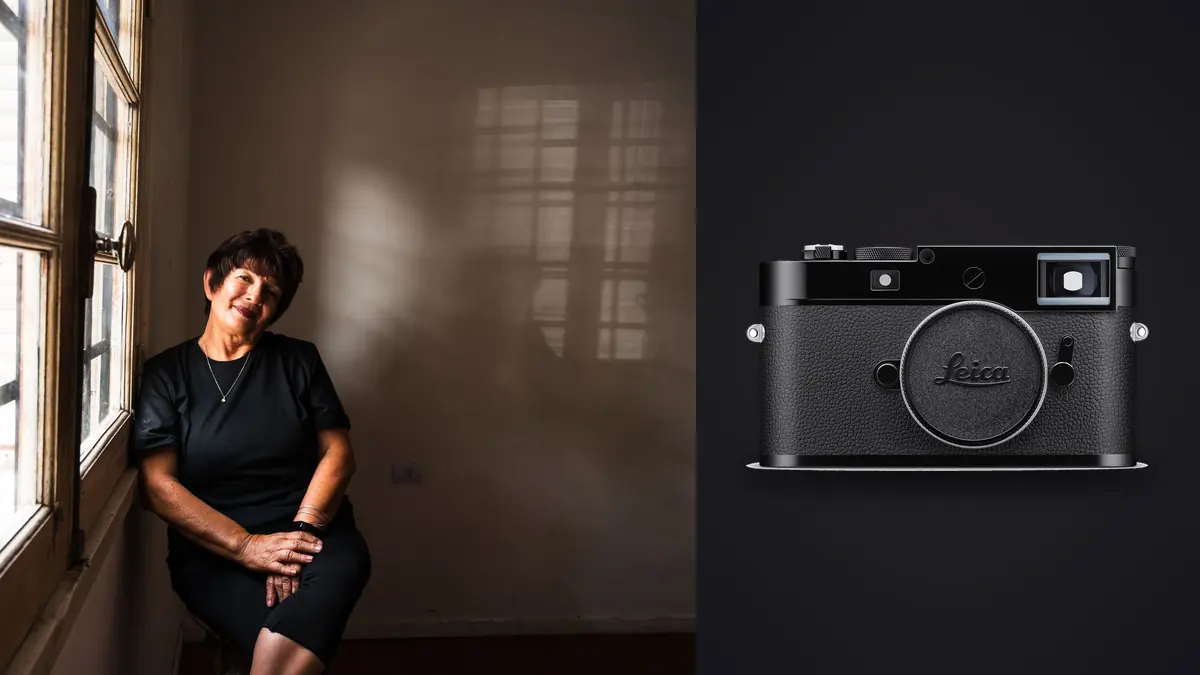
The first time I brought a Leica M11 into a boudoir session, it wasn't for the file quality. It was because the client, a first-time boudoir client who'd cancelled twice before finally showing up, kept glancing at the black barrel of the 50mm on the table like it was a loaded gun. She'd shot with a "real photographer" before, her words, someone who worked with a DSLR and a battery grip the size of a brick, and the shutter had scared her every time it fired. The M11 sits in the hand like a rangefinder always has: small, quiet, unthreatening. That single fact changed more about the session than any spec sheet ever will.
This isn't a review that treats the M11 as a generalist tool. It's notes from actually pointing one at people in various states of undress, in bedrooms, hotel suites and one memorably cramped Airbnb bathroom with good window light, over the better part of a year. Some of what makes the M11 excellent for street and documentary work is exactly what makes it a genuine liability here. Some of what people dismiss as a rangefinder quirk turns out to be the reason clients relax.
Why a Rangefinder Changes the Room
Boudoir and intimate portraiture live or die on trust in the room, not on autofocus points. A DSLR or mirrorless body with a 24-70mm f/2.8 held up to the eye puts a wall between you and the subject: a big lens barrel, a hunting AF motor, a mirror slap or a shutter clack that punctuates every frame like a countdown. None of that reads as calm.
The M11's rangefinder viewfinder is smaller and set differently than an SLR finder. You're not fully hidden behind the camera the way you are with a big zoom and an EVF eye cup; peripheral vision stays open, so the subject can see part of your face and you can keep talking, giving direction, checking in, without lowering the camera between every frame. That sounds like a small thing until you've shot four hours of a session where every pause to "check the shot" resets the subject's comfort level back to zero. With the M11 I mostly don't pause. I frame, I talk, I fire, I keep talking.
The body itself matters too. At roughly 530g without a lens, it disappears in a way a gripped mirrorless body with a 70-200 doesn't. A sitter might say, unprompted, that it "doesn't feel like being photographed by a machine." That's marketing nonsense as a sentence, but as a description of how someone's shoulders drop when the gear looks less clinical, it's accurate.
The Sensor: 60 Megapixels You Won't Always Use
The M11's 60-megapixel BSI sensor is more resolution than boudoir delivery typically needs. Most finished images in this genre are cropped tight, retouched carefully, and delivered as prints or web galleries rarely larger than 30x40cm. Where the resolution earns its keep is in post: a loose in-camera frame, shot a little wide to give breathing room for the retoucher, still holds up after a 20% crop for a tighter final composition.
What actually gets used shoot to shoot is Leica's triple-resolution DNG capture, letting you record at the full 60MP, or drop to 36MP or 18MP in-camera. For a two-hour session that might produce 700 to 900 frames once you count every micro-adjustment of pose and refocus, shooting at 36MP keeps files manageable without sacrificing anything you'd notice in a finished 16x20 print. A sensible default is 36MP for most sessions, bumping to 60MP only for a handful of hero frames you already know are going to be printed large or licensed for a client's own site.
Base ISO 64 is genuinely useful in this genre because so much boudoir work leans on available window light rather than strobes. Low ISO with good dynamic range means you can expose for the highlight side of a subject lit by a single north-facing window and still pull real detail out of the shadow side in post without banding. The lack of in-body stabilization is the tradeoff nobody mentions enough: at 1/60s and a 90mm lens, handheld, in a dim bedroom, you will get soft frames from your own hand shake, not just from missed focus. I shoot boudoir with the M11 noticeably faster shutter speeds than I would on a stabilized body, usually 1/125s minimum even with continuous light, and I lean on higher ISO rather than risk the blur.
Lens Choices for Close, Personal Work
M-mount glass for this genre isn't a settled question the way it is for street photography, where a 35mm covers most situations. Boudoir asks for a wider range of working distances in a much smaller physical space, and the rangefinder's mechanical close-focus limits actually matter here in a way they rarely do outdoors.
The 50mm as the Everyday Lens
The Summilux-M 50mm f/1.4 ASPH is what stays mounted for most of a session. It's close enough to feel intimate without distorting features the way a 35mm can on a tight three-quarter shot, and f/1.4 gives enough separation from a cluttered bedroom background (unmade sheets, a lamp, a chair with clothes on it) without needing to art-direct the whole room into a clean set. Minimum focus distance is 0.7m, which is workable for half-length and three-quarter poses but starts to feel restrictive the moment a client wants a tighter, more graphic crop on hands or collarbone.
Going Long for Compression and Distance
For genuinely intimate, close-crop work I switch to the APO-Summicron-M 90mm f/2 ASPH or, on sessions where the light is low and I want maximum separation, the Noctilux-M 75mm f/1.25 ASPH. Both let me physically back up in a small room while still filling the frame, which matters more than it sounds: standing three feet from someone with a 50mm feels very different, for both photographer and subject, than standing six or seven feet away with a 90mm. The extra distance reads as more consideration, less intrusion, and clients notice the difference even if they can't name why.
The Noctilux at f/1.25 is its own discipline. Depth of field at that aperture, at close range, is measured in millimeters, and rangefinder-coupled manual focus at f/1.25 is genuinely difficult to nail consistently even after a year of practice with the lens.
The Close-Focus Ceiling
None of the M-mount lenses above focus closer than 0.7m through the rangefinder mechanism, and that's the real constraint of shooting this genre on M-mount versus a modern AF system with a macro or close-focusing portrait lens. When a shot calls for something tighter, like a detail frame on jewelry, a hand on skin, a tattoo, I switch to the Visoflex 2 EVF and use focus peaking in live view, which lets the lens rack past its rangefinder-coupled range with the finder confirming edge contrast instead of the rangefinder patch. It works, but it's a deliberate mode switch mid-shoot, not something you do reflexively while keeping eye contact with the subject.
| Lens | Max Aperture | Min Focus | Weight | Where It Earns Its Place |
|---|---|---|---|---|
| Summicron-M 35mm f/2 ASPH | f/2 | 0.7m | ~255g | Wider environmental frames that show the room and light source |
| Summilux-M 50mm f/1.4 ASPH | f/1.4 | 0.7m | ~335g | Default lens for half and three-quarter length poses |
| Noctilux-M 75mm f/1.25 ASPH | f/1.25 | 0.85m | ~1055g | Single-feature focus in low light, maximum subject separation |
| APO-Summicron-M 90mm f/2 ASPH | f/2 | 1.0m | ~600g | Tight crops shot from a comfortable, non-intrusive distance |
Manual Focus at f/1.25: What Actually Happens
Honest numbers: on a session shot mostly wide open with the Noctilux, I'd estimate somewhere between one in five and one in four frames misses critical eye focus by enough to be unusable at full size. That's not a knock on the lens or the rangefinder mechanism, both are doing exactly what they're built to do. It's a function of shallow depth of field, a moving subject (breathing, small postural shifts, held poses that drift), and the reality that a mechanical rangefinder patch, however well calibrated, doesn't re-confirm focus the instant before the shutter fires the way continuous AF does.
The practical response is to shoot in short bursts around a pose rather than a single decisive frame, refocusing the patch between each click as the subject's position settles. That produces a lot of visually near-identical frames that differ only in which one actually landed sharp on the eye. Reviewing that by eye, frame by frame, at 100% zoom, for 800 files from a single session, is the part of this workflow nobody romanticizes. I run the take through imagic's local sharpness scoring before I open a single file in an editor, which flags which frame in each near-identical cluster actually has the eye in focus, and its burst clustering groups those manual-refocus repeats together automatically instead of leaving me to scroll past forty thumbnails that all look the same at a glance.
Shutter Sound and Why It's Not a Minor Detail Here
The M11 offers a fully silent electronic shutter alongside its mechanical one, up to 1/16000s. In most genres that's a spec you'd use for concert photography or wildlife. In a boudoir session it's the difference between a subject who flinches at every click during a vulnerable pose and one who forgets the camera is running. I shoot electronic shutter for probably 80% of a session now, saving the mechanical shutter for moments where a very slight click actually helps, cueing the subject that a frame just happened without me saying anything. It's a strange thing to have to think about, but sound design is part of directing a boudoir shoot whether you plan for it or not.
Handling Files That Are Actually Sensitive
Boudoir and intimate portrait files carry a different level of risk than a wedding gallery or a corporate headshot set. A leaked RAW folder isn't an inconvenience, it's a serious breach of trust with someone who agreed to be photographed on the understanding that the images stay controlled. That reality shapes my whole post-production chain, not just the shoot.
I don't run culling or first-pass editing through any tool that uploads files to a server, full stop, regardless of how good the AI behind it is supposed to be. This is one of the reasons I settled on imagic for the culling stage: it scores sharpness and clusters duplicates entirely on the machine, RAW files never leave the laptop, which matters a great deal when the folder you're sorting through is this personal. It's a small operational detail, but it's the one worth walking a new client through if they ask how their images are handled between the shoot and the gallery. If you're weighing culling tools against each other for any kind of sensitive shoot work, how AI photo culling actually works is worth reading before you commit to one that phones home.
Color and Skin Tone in the Edit
Boudoir grading has its own quiet conventions: warm but not orange skin, shadows that stay soft rather than crushed to black, a general avoidance of the high-contrast, heavily clarified look that reads as commercial fashion rather than intimate. The M11's color science out of camera leans slightly cool and neutral, which I actually prefer as a starting point because it gives more room to warm skin tones deliberately rather than fighting an in-camera profile that's already pushed things too far.
Once I've settled on a look for a set (and boudoir galleries often work best with a consistent, recognizable feel rather than each image edited in isolation) I use imagic's apply_my_style feature to carry that grade across the full set. It's trained on my own previously finished edits rather than a generic preset, so the starting point for a new session already leans toward the warmth and shadow handling I use for this genre specifically, and I'm hand-tuning from a much closer starting point instead of grading 200 images from a flat baseline. For the technical side of matching skin tones across mixed window and lamp light, this color grading guide covers the white balance and channel-mixing basics I lean on before any style gets applied.
A Field Kit That Actually Works
What goes in the bag for a boudoir session with the M11: the body, the 50mm Summilux mounted by default, the 90mm APO-Summicron in a side pocket for the tighter crops, two spare batteries (the M11's larger cell is a real improvement over the M10 generation but a full session with a lot of chimping and Visoflex use will still drain two), and a small reflector for filling shadow on the side away from the window when there's only one light source in the room. Strobes are only worth bringing if you want a harder, more polished commercial look; most of what makes this genre feel authentic is working with whatever light the room already has.
Card-wise, I shoot dual CFexpress and keep the second slot as an instant backup rather than overflow, given what's on the card. It's an extra $150 a year in cards I probably wouldn't spend for other genres, and I'd spend it again without hesitation.
Frequently Asked Questions
Is manual focus too much of a handicap for a fast-moving boudoir session?
It slows down the shot-to-shot pace compared to a modern AF body, and you will lose more frames to soft focus than you would with eye-tracking autofocus. What it gains back is a quieter, less mechanical presence in the room that a lot of clients respond to. Whether that trade is worth it depends more on your session pacing and client comfort priorities than on raw keeper rate.
Do I need the Visoflex EVF for this kind of work?
Not for most of a session, but it earns its place for anything closer than the 0.7m rangefinder-coupled minimum, tight detail shots especially. I keep it in the bag rather than mounted full-time, since it adds bulk and changes the profile of the camera in a way that undercuts some of the discretion that makes the rangefinder finder worth using in the first place.
What's a realistic starting lens kit if I can't afford the whole set?
The 50mm Summilux alone covers a genuine majority of usable boudoir compositions in an average bedroom-sized space. If a second lens comes next, I'd pick the 90mm APO-Summicron over the Noctilux; f/2 is far more forgiving to focus manually than f/1.25, and the extra working distance does more for sitter comfort than the extra half stop of shallow depth does for the image.
How should I be culling a session this size without spending a full day on it?
The bottleneck isn't the review itself, it's that manual focus produces so many near-duplicate frames per pose that reviewing them one at a time is where the day disappears. Grouping those bursts and surfacing which frame is actually sharp before you start looking is the difference between an hour of culling and half a day. That's the specific problem imagic's local scoring and clustering solves for this workflow, and it's worth reading through general workflow speed tactics as well if culling time is eating into your turnaround across every genre you shoot, not just this one.