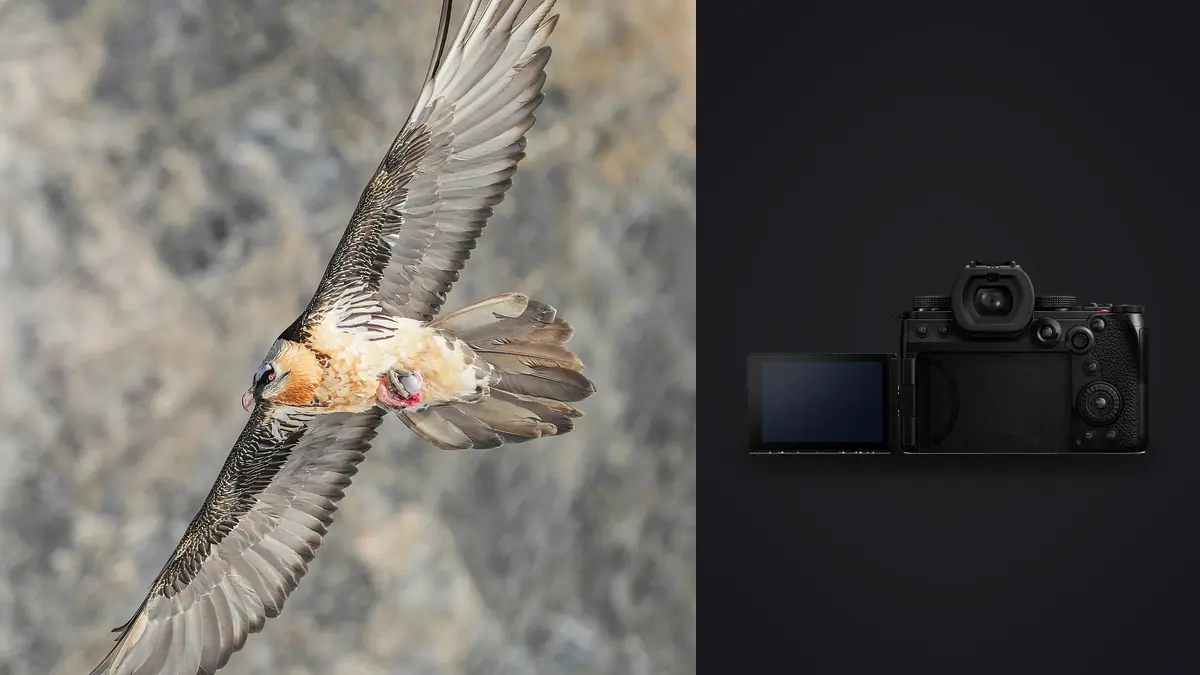
The S5IIX was the first Lumix full-frame body to ditch Panasonic's old contrast-only DFD autofocus, and that single change is the reason it's even worth discussing for bird photography. I spent the better part of a spring migration season with one, paired mostly with a 70-200mm plus teleconverter before the longer native glass arrived, then swapped onto a Sigma zoom once ospreys and herons started showing up at a local reservoir. This isn't a spec-sheet rundown. It's what actually happens when you point this camera at something moving unpredictably at 40 feet.
Why This Body Finally Makes Sense for Bird Photographers
Every Lumix full-frame camera before the S5II generation used Depth From Defocus, a contrast-detection method that estimated focus by comparing blur across two lens positions many times per second. It worked fine for portraits and landscapes and was genuinely bad at anything crossing the frame. Birds pulsing in and out of focus mid-burst was the standard complaint, and it's why a lot of wildlife shooters wrote off the S1 and original S5 without a second look.
The S5IIX replaced that with a phase-hybrid system built into a new 24.2-megapixel sensor, spreading 779 phase-detection points across most of the frame. That's not a marketing number I'm repeating blind. It's the reason a bird crossing from left to right no longer produces the rubber-banding hunt you'd get on the older sensor. The camera commits to a distance and holds it, which sounds like a small thing until you've shot both generations back to back.
Autofocus in Real Conditions
What the subject detection actually recognizes
Out of the box the S5IIX detects humans and, through a firmware update Panasonic pushed in 2024, animals including eye and body recognition for birds. In practice this means the camera will find and box a perched heron's head reliably, even against a cluttered reed background, which is where older systems tended to lock onto the nearest high-contrast edge instead. Detection is less consistent once the bird is small in the frame or partially obscured by a branch. At that point I switch to a single tracking point placed manually rather than trusting the automatic box, because a missed detection costs you the whole sequence.
The approaching-versus-retreating problem
Here's the pattern I noticed after a few dozen sessions: subjects flying toward the camera get tracked extremely well, even at the full 30fps electronic burst rate. Subjects flying away or banking hard tend to lag very slightly behind actual focus distance, enough that a shot reviewed at 100% will look a touch soft where a top-tier stacked sensor would have nailed it. It's not a dealbreaker, most of a session is spent on approach or lateral flight anyway, but it's worth knowing before you buy this camera expecting it to match an OM-1 or an a9III on erratic departing flight. It doesn't, and I'd rather say that plainly than let someone find out during a once-a-year trip.
Burst Modes and the Rolling Shutter Trade-off
The S5IIX gives you three practical options for continuous shooting, and each one trades speed against something else. This is the table I wish someone had shown me before I burned through a memory card shooting the wrong mode for a slow heron flyover.
| Mode | Max rate | AF behavior | Rolling shutter risk | Best use |
|---|---|---|---|---|
| Mechanical, AFS priority | 9 fps | Locks on first frame | None | Perched birds, static portraits |
| Mechanical, AFC | 7 fps | Continuous, refocuses between frames | None | Slow flight, walking mammals |
| Electronic, AFC | 30 fps | Continuous per frame | Noticeable on fast wingbeats or pans | Peak-action bursts, ducks and gulls on takeoff |
| Electronic, SH Pre-Burst | 30 fps buffered | Continuous, records retroactively from half-press | Same as above | Unpredictable takeoff or strike moments |
The rolling shutter column matters more than most reviews let on. At 30fps electronic the sensor readout isn't instant, so a fast-beating wing tip near the edge of frame can smear or skew slightly. On a coot or a heron with slow, deliberate wingbeats it's a non-issue. On a swallow or a tern working hard against wind, you'll see it if you pixel-peep. I default to mechanical AFC for anything under about 7fps of actual required speed and only drop to electronic when I specifically want the extra frames of a takeoff.
Pre-Burst Is the Feature I Actually Reach For
Panasonic added SH Pre-Burst shooting in a firmware update partway through the S5IIX's life, and it's changed how I shoot perched birds more than any spec on the original launch sheet. Half-press the shutter and the camera starts buffering frames at 30fps continuously. Fully press it and everything from roughly the previous second and a half gets written to the card along with what follows. For a bird that gives no warning before it launches, which is basically all of them, this closes the reaction-time gap that used to cost me the actual takeoff frame nine times out of ten. The trade-off is battery drain and a much faster-filling card, so I only leave it active when I'm actively watching a specific bird I expect to move.
Lenses Worth Pairing With the S5IIX
The L-mount telephoto lineup was thin when the S5IIX launched and has filled in considerably since. Four options cover most budgets and use cases:
The Lumix S 100-500mm f/5-7.1 O.I.S. is Panasonic's own answer to the reach problem, released well after the camera itself. It's genuinely compact for a 500mm zoom at around 1,285g, takes the 1.4x and 2x teleconverters for up to 1000mm equivalent reach, and pairs its Dual Phase Linear Motor autofocus with the S5IIX's tracking about as well as you'd expect from same-manufacturer glass. It's also the priciest route at roughly $2,100.
The Sigma 100-400mm f/5-6.3 DG DN Contemporary is the lighter, cheaper alternative most people actually end up buying. It's slower to focus in low light than the Panasonic zoom and the maximum aperture narrows quickly past 300mm, but for daytime shorebirds and raptors on a budget it's the lens I'd point a beginner toward first.
The Sigma 60-600mm f/4.5-6.3 DG DN Sports covers an unusual range, wide enough for environmental shots of a mammal in its habitat and long enough for distant birds, without a lens swap. It's heavier than either of the above and the AF hunts a bit more at the long end, but as a single do-everything lens for a hide session it earns its weight.
The Lumix S PRO 70-200mm f/2.8 O.I.S. with the 1.4x or 2x teleconverter is what I actually used before the 100-500mm existed, and it's still a reasonable choice if you already own the lens for other work. At f/5.6 effective with the 2x converter, autofocus speed drops noticeably, but for slower subjects like herons and egrets working a shoreline it's more than adequate.
Reach Without Buying Glass
The S5IIX doesn't offer a dedicated APS-C crop mode for stills the way some competitors do, but its Extended Teleconverter function reads a smaller region of the sensor at full pixel density and outputs it directly, rather than digitally zooming and interpolating. Set to 1.4x you get a 12-megapixel file with roughly 1.4x more reach; set to 2x you get 6 megapixels at roughly double the reach. I use the 1.4x setting fairly often when a bird is at the edge of what my zoom can resolve and I know I won't need to crop the file much further afterward. The 2x setting drops resolution low enough that I only use it for identification shots rather than anything I'd print.
The RAW Flood: What Happens After the Shoot
A single productive morning on the reservoir with pre-burst enabled easily produces 1,500 to 2,000 RAW frames, most of them near-duplicates from the same three or four seconds of a bird taking off. Sorting that manually used to eat an entire evening. This is the part of the workflow where I stopped fighting it and started running everything through imagic before touching a single file in an editor.
Because imagic runs entirely on the machine with no upload step, I can start the cull the moment I'm back at the truck with no signal and no waiting on a cloud queue. Its duplicate and burst clustering groups those 30fps takeoff sequences automatically, so instead of scrolling through 60 nearly identical frames of a heron unfolding its wings, I'm looking at maybe four visually distinct clusters. Within each cluster, the local sharpness scoring is what actually earns its keep given the retreating-subject softness I mentioned earlier: it flags which frame in a run of eight has the crispest eye, which matters a lot when the S5IIX's AF has drifted a fraction behind a bird banking away from you. I still make the final call by eye, but I'm making it on four candidate frames instead of two hundred.
Once the keepers are picked, imagic's apply_my_style preset (trained on my own previous edits rather than a generic filter) gets a consistent starting grade applied across the whole batch before I go in and adjust individual frames. For anyone building out a repeatable pass on high-volume wildlife takes, it's worth reading through how AI photo culling actually works before assuming any tool will handle burst-heavy RAW sets the same way a general photo cull would.
Field Settings and Handling Notes
A few practical points that don't show up on a spec sheet. Battery life is rated around 370 shots CIPA on the bundled DMW-BLK22 pack, and burst-heavy sessions with pre-burst active will chew through that faster than the number suggests; I carry two spares for a full morning. The buffer holds roughly 200 frames before it starts to slow, and because the S5IIX takes dual SD UHS-II cards rather than CFexpress, clearing that buffer back to idle takes longer than it would on a camera built around faster media. If you fire a long 30fps burst and immediately try to review images or change settings, expect a short lag while the card catches up.
At 740g body-only the camera is noticeably lighter than a lot of dedicated wildlife bodies, which matters after four hours holding a long lens up in a hide. Weather sealing has held up fine through steady rain and a couple of genuinely cold mornings near freezing, though I haven't pushed it into anything more extreme than that. In-body stabilization is strong enough that I can hand-hold the 70-200mm plus 1.4x teleconverter combination down to surprisingly slow shutter speeds for static subjects, though for anything moving I'm shooting fast enough that stabilization is irrelevant anyway.
Where It Still Falls Behind Dedicated Wildlife Cameras
I'd rather list this plainly than let the earlier praise oversell it. The AF lag on retreating subjects is real and shows up in a meaningful percentage of erratic-flight frames. The SD-only card slots mean buffer clearing is slower than a CFexpress-based competitor. There's no stacked sensor, so at 30fps electronic you're trading some image quality to rolling shutter on fast wingbeats. And full-frame sensors give up the reach-per-dollar advantage that APS-C and Micro Four Thirds wildlife bodies have simply by being cropped already; a 500mm lens on this camera doesn't reach as far as the same physical focal length on a smaller sensor body. None of that makes the S5IIX a poor choice, but anyone coming from a Micro Four Thirds wildlife setup specifically for "more reach" is going to be disappointed unless they budget for the longer glass to compensate.
Frequently Asked Questions
Can the Panasonic Lumix S5IIX actually track birds in flight, or is it better suited to perched subjects?
It handles both, with a caveat. Birds flying toward or across the frame track well thanks to the phase-hybrid AF system. Birds banking away or departing erratically show a slight focus lag compared to top-tier stacked-sensor cameras. For steady flyers like gulls, herons, and raptors riding thermals, it's dependable. For small, fast, erratic flight like swallows working a field, expect a lower keeper rate.
Is the S5IIX worth choosing over the standard S5II for wildlife work?
The autofocus, burst rates, and sensor are identical between the two. The S5IIX's extra features (internal ProRes recording, USB-SSD capture, an all-black body) are aimed at video and content work, not stills performance. If you're buying purely for bird photography and don't need the video extras, the standard S5II gets you the same wildlife capability for less money.
What's the minimum lens I'd need for serious birding with this camera?
For anything beyond backyard feeder shots, 400mm equivalent is a realistic floor. The Sigma 100-400mm covers that at a manageable price and weight. If distant raptors or shorebirds across open water are the goal, the Lumix S 100-500mm or the Sigma 60-600mm give you meaningfully more working distance, at a corresponding jump in cost and carry weight.
How do you realistically manage the number of RAW files a day of birding produces?
Volume is the real bottleneck, not the camera. A morning with pre-burst active can produce well over a thousand frames from a handful of takeoff sequences. Running the card through imagic before opening an editor groups near-duplicate burst frames automatically and scores sharpness locally on the machine, so the manual review is against a handful of clustered candidates rather than the full take. It's worth pairing with a faster overall pass; these workflow habits apply directly to high-volume wildlife sessions like this.
The S5IIX isn't the camera I'd pick if birds in flight were the only thing I ever shot. But for someone who splits time between wildlife, landscape, and paid client work on the same body, it's the first Lumix full-frame camera I'd actually trust with a bird taking off, and that's a genuinely new thing to be able to say about this lineup.