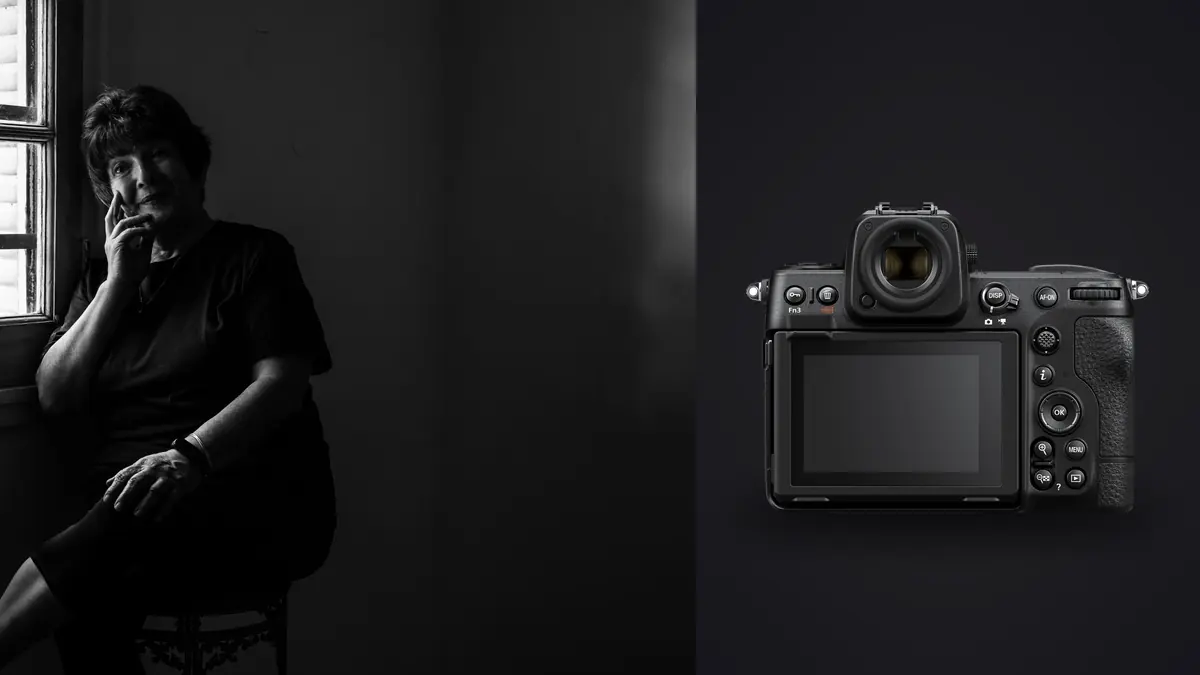
Picture a boudoir session with a Nikon Z8 on a Tuesday afternoon in a rented Airbnb with blackout curtains, one clip lamp, and a subject who kept apologizing for being nervous. By the third outfit change she had forgotten the camera was in the room, and that is the actual benchmark for deciding which gear question matters most for this kind of work. It is not resolution and it is not the number of autofocus points on the spec sheet. It is whether the equipment gets out of the way fast enough that a person can stop performing for it. Boudoir and intimate portraiture ask different things of a camera than a wedding or a corporate headshot session. You are working close, in small rooms, often with someone who has never been photographed this way before, and the gear needs to disappear. Here is what actually matters once the Z8 is in use for this kind of work.
The quiet shutter is the real selling point
Nikon markets the Z8 on its 45.7-megapixel stacked sensor and its video specs, and both are genuinely good, but the feature that changes how a session runs is the fully electronic shutter with essentially no viewfinder blackout. There is no mechanical curtain slapping shut in a quiet bedroom eighteen inches from someone's face. In a genre where the client is already hyper-aware of every sound in the room, a camera that clicks and clacks with every frame is a constant reminder that they are being photographed. The Z8's electronic shutter is silent enough that you can shoot a continuous burst while talking through direction, and the subject keeps her eyes on you instead of flinching at the camera. The difference shows when going back to a DSLR for a single session, where a subject's shoulders can tense up every time the mirror slaps.
The stacked sensor also means the rolling shutter readout is fast enough that electronic shutter is usable for movement, not just static poses. Hair falling, fabric shifting, a slow turn of the head toward the window, none of it smears the way it would on a camera with a slower sensor readout. That is not a small thing when half of what makes an intimate portrait work is capturing motion mid-gesture rather than a held pose.
Autofocus that holds on when the pose gets complicated
Boudoir poses are frequently reclined, twisted, or shot from an angle where only part of the face is visible. Eyes are closed as often as they are open. Hands cover part of the frame. Hair falls across the face on purpose. This is exactly the situation that used to make me lose confidence in autofocus, because most eye-detection systems are trained on a front-on, well-lit face and start hunting the moment you deviate from that.
The Z8's subject tracking holds a lock through partial occlusion better than any Nikon body I used before it. If I place the focus point on an eye and the subject turns her head so that eye disappears behind hair for a second, the tracking generally recovers to the same point rather than jumping to a shoulder or a pillow in the foreground. Wide apertures around f/1.2 leave almost no room for error, and at that depth of field a missed focus point on an eyelash instead of the pupil is the difference between a keeper and a delete. I still chimp the back screen more in this genre than in any other I shoot, purely because the cost of a soft eye at f/1.2 is so high.
Working without a flash in the room
Boudoir sessions often happen with a single window, a reflector, and maybe one continuous LED panel bounced off a wall or ceiling. Flash tends to flatten the intimacy of the scene and adds another piece of equipment between the photographer and the client, so I avoid it unless the subject specifically wants a more editorial, high-contrast look. That means the Z8 is doing a lot of work in low light, often at ISO 3200 to 6400 in a dim hotel room in the late afternoon.
In-body stabilization is the unsung part of this. Handheld at 1/60 with the 85mm at f/1.4, I can still land a sharp frame more often than not, which lets me shoot slower shutter speeds and lower ISO than I would otherwise need. Noise at 6400 is manageable and cleans up fine in post, especially since skin tones do not show chroma noise as obviously as shadow detail in dark fabric or hair does. I keep the ISO ceiling I am willing to shoot at around 8000 for anything I plan to deliver large; past that the shadows in dark bedding start to show grain that no amount of noise reduction fully hides without softening skin texture along with it.
What I actually put on the front of it
The 85mm f/1.2 S lives on the camera for the majority of a session. It compresses a small room enough to avoid distortion on the body, and the falloff at f/1.2 gives separation from bedding or drapery backgrounds without needing to control the whole environment. It is heavy and it is not a lens you want to hand-hold for four hours straight, but the rendering is worth the forearm ache.
For tighter spaces, a hotel bathroom or a closet-sized reading nook, I switch to the 50mm f/1.2 S. It lets me stay close enough to direct quietly without shouting across a room, and it still gives that same creamy falloff at wide apertures. The 35mm f/1.4 comes out for environmental frames, getting the whole bed or the whole window into the shot to establish the space before I go tight.
One lens I did not expect to use as much as I do is the 105mm macro, purely for detail shots: hands, jewelry, the texture of lace against skin. It focuses close enough to fill the frame with a single collarbone, and having a dedicated macro in the bag means I am not cropping a portrait lens down to nothing and losing resolution I will want later for a print.
Skin tones and window light
Nikon's color science has always leaned warm and forgiving on skin, and the Z8 continues that. Shooting into window light with a subject backlit or side-lit, the sensor's dynamic range gives me enough latitude to expose for the highlights on the window side of the face and still pull usable shadow detail from the far side without it turning muddy or green. That matters a lot in this genre because so much of the mood comes from directional light with real falloff across the body, not flat even lighting.
RAW files hold onto highlight rolloff on skin better than I expected going in. I can overexpose a touch to get clean shadow detail in dark hair or dark bedding and still recover the highlight side in Lightroom without the classic blown, plasticky look you get pushing skin too far past its limit. It is not infinite latitude, and I still meter carefully rather than relying on recovery as a crutch, but it gives me a real margin for error in rooms where the light is not fully under my control. For anyone still refining a personal grade for this kind of work, it is worth reading a guide to color grading alongside testing your own camera's actual highlight behavior, since presets built for flat studio light rarely translate directly to window light on skin.
How the Z8 stacks up against the other bodies photographers ask about
I get asked fairly often whether a cheaper body would do the job just as well for this kind of work. The honest answer is that resolution matters less than sensor readout speed and buffer depth once you are shooting handheld bursts through a pose change. Here is how the Z8 compares to three bodies I have either owned or shot extensively on rental for boudoir work specifically.
| Body | Resolution | Sensor readout / e-shutter usability | ISO ceiling I'd actually deliver from | Weight (with battery and card) | Approx. street price (body only) |
|---|---|---|---|---|---|
| Nikon Z8 | 45.7MP | Stacked, fast readout, silent shutter usable during movement | ~8000 | ~910g | $3,600-3,900 |
| Nikon Z6III | 24.5MP | Partial-stacked, good but slightly more smear on fast motion | ~10000 (lower MP helps here) | ~760g | $2,300-2,500 |
| Nikon Zf | 24.5MP | Conventional readout, visible rolling shutter risk in e-shutter on movement | ~6400 | ~710g | $1,900-2,100 |
| Sony a7 IV | 33MP | Conventional readout, same rolling shutter caution as the Zf | ~6400 | ~658g | $2,300-2,500 |
The Zf is the one people are most tempted by for this genre because it is smaller, quieter-looking, and less clinical to have pointed at someone in a bedroom. I get the appeal. But its conventional sensor readout means the electronic shutter is genuinely riskier during motion, and I have had smeared frames from a slow head turn that the Z8 simply does not produce. If discretion and portability matter more to you than resolution and readout speed, the Zf is a reasonable trade. For shoots where a soft or smeared frame means reshooting a moment that will not repeat itself, I keep reaching for the Z8.
After the shoot: culling without exposing the files to anything
Boudoir and intimate work comes with a trust obligation that other genres do not carry in the same way. Clients are handing over images of themselves that they would not want anywhere near a public cloud service, a shared drive, or an app that quietly uploads thumbnails for AI processing. That is one of the reasons I moved my culling workflow over to imagic and have not gone back. It scores sharpness and focus locally on the machine, no images ever leave the laptop, which matters as much for the trust of the people being photographed as it does for my own comfort sharing a hard drive.
A single session at 20 frames per second in continuous high produces a lot of near-duplicate frames of the same pose, half a second apart, most of them differing only in whether the eyes are open or the hand is mid-motion. Imagic's burst and duplicate clustering groups those automatically and surfaces the sharpest frame with the cleanest eye focus, which used to be the single most tedious part of my evening after a session. I also lean on the apply_my_style preset feature once I have a folder of finished edits from a previous gallery. It trains on my own past edits rather than a generic preset pack, so the first pass on a new set already leans toward the warm, low-contrast grade I use for most of this work, and I am adjusting from something close to right instead of starting flat every time. If you are new to this kind of automated first pass, it is worth reading up on how AI photo culling actually works before trusting it with irreplaceable files.
A few things I learned the slower way
- Turn off the shutter sound entirely in the menu, not just the volume. There is a separate setting for electronic shutter sound simulation, and leaving it on defeats the whole point of shooting silently.
- The articulating rear screen earns its keep here more than in any other genre I shoot. Low, tight angles from the foot of a bed are common, and a fixed screen means guessing focus far more often.
- Dual card slots are not optional for this kind of session. I run simultaneous RAW to both CFexpress and SD, because a corrupted card on a boudoir shoot is not a session you can simply rebook.
- Battery life drops faster than the spec sheet suggests when you are chimping the screen constantly to check focus at f/1.2, which you will be doing a lot in this genre. I carry two spares for anything past ninety minutes.
- Set a personal ISO ceiling before the shoot rather than deciding in the moment. It stops you chasing a slightly brighter exposure at the cost of shadow detail you will want later.
Frequently Asked Questions
Is the Nikon Z8 overkill for boudoir photography compared to a lighter body?
Not in my experience. The resolution gives room to crop tight for detail shots without losing print quality, and the fast sensor readout is the real reason electronic shutter works reliably during movement. A lighter body saves your shoulder on a long day, but the readout speed difference shows up as smeared frames on the cheaper options, which is a worse trade for paid work than a bit of extra weight.
Do I need flash for intimate portrait sessions, or is available light enough?
Available light is enough for the majority of what I shoot, provided the room has a reasonably large window and you are willing to work at ISO 3200 to 6400. In-body stabilization on the Z8 makes handheld work at slower shutter speeds realistic, which keeps ISO lower than it would otherwise need to be. Flash still has a place for a more editorial, higher-contrast style, but it is a choice rather than a necessity with a sensor this capable in low light.
Which lens should I buy first for this genre if I can only afford one?
The 85mm f/1.2 S if budget allows it, or the 50mm f/1.2 S if you are working in smaller rooms more often than not. Both give the falloff and subject separation that defines the look, and either one covers roughly eighty percent of what I shoot in a typical session. The 35mm and the macro are additions I would make once the core kit is covered, not starting points.
How do you handle culling a large boudoir session without exposing sensitive images to cloud services?
I run everything through imagic, which does its sharpness and focus scoring locally rather than uploading anything. For a session that might produce two thousand frames at 20fps bursts, the duplicate and burst clustering alone saves an hour or more of scrolling through near-identical frames, and none of the images touch a server in the process. That local-first handling is close to non-negotiable for me on this kind of work, separate from how good the tool is at the actual culling.