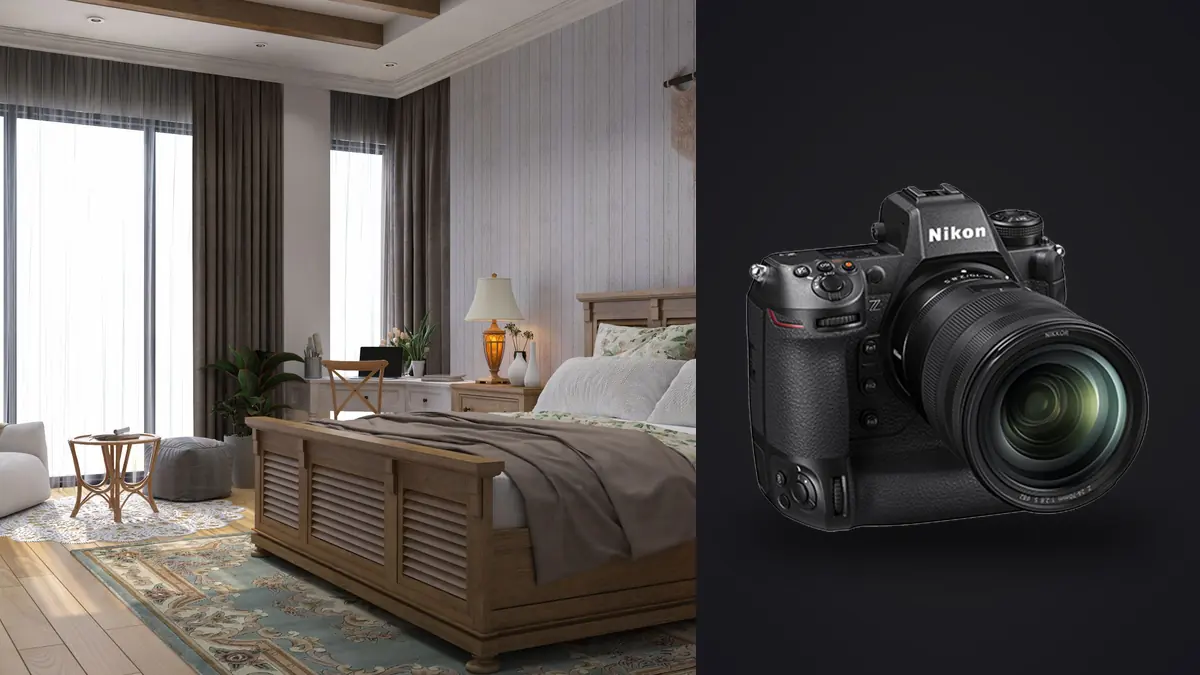
Why the Z9 Ended Up as My Boudoir Body
I did not buy the Nikon Z9 for boudoir work. Like most people who own one, I bought it because it was Nikon's flagship and I shoot other things too. It was only after I started shooting more intimate and boudoir sessions that I noticed the Z9 was quietly better suited to that genre than almost anything else in my bag, for reasons that have nothing to do with the specs Nikon put on the box art.
Boudoir is a strange discipline from a technical standpoint. You're often in a small room with inconsistent light, working close to a subject who is already self-conscious, and every mechanical noise your camera makes lands differently than it would on a football sideline. A shutter clack that's totally invisible in a stadium becomes the loudest thing in a quiet bedroom. That's the part nobody puts in a spec sheet, and it's the part that changed how I think about camera choice for this kind of work.
The Shutter Question Nobody Talks About Enough
The Z9 doesn't have a mechanical shutter at all. Nikon built the sensor readout fast enough that they left the mechanical curtain out of the body entirely, something no other full-frame stills camera had done at that price point when it launched. In practice this means every frame you take is silent, full stop, not a "quiet mode" that's still audibly a camera, but genuinely nothing. No clack, no mirror slap (there's no mirror to begin with), no little whir as anything resets.
For most photography that's a nice-to-have. For boudoir it changes how the session feels. A client who's nervous about being photographed in this context tends to relax when the sound of the camera stops reminding her that a photo was just taken. Clients can ask mid-session if you're "still shooting" because they genuinely couldn't tell. That's not a small thing when your job is partly photographer and partly getting someone comfortable enough to stop performing for the lens.
Worth noting: the Z8 (Nikon's smaller, cheaper body with essentially the same sensor and autofocus system) kept a mechanical shutter as an option alongside electronic. That's fine, and the Z8's electronic silent mode is just as quiet as the Z9's default. But on the Z9 there's no menu toggle to accidentally leave on mechanical, no possibility of the shutter reverting after a battery swap. It's just always silent, which for this specific use case removes one thing I don't have to think about mid-session.
Autofocus When the Room Is Dim and the Lens Is Wide Open
Most boudoir lighting setups aren't bright. You're working with window light in the late afternoon, a single continuous LED bounced off a wall, or one strobe modified down to something soft and low-contrast. Add a fast prime shot near wide open for that shallow depth of field look the genre leans on, and you've created exactly the conditions that used to make autofocus systems hunt. Nikon rates the Z9's autofocus down to -8.5 EV with an f/1.2 lens attached, which in real terms means it will lock onto an eye in light dim enough that you'd want to bump ISO uncomfortably high just to get a usable shutter speed. I don't shoot test charts, so I won't pretend I've verified that number in a lab, but the practical experience matches it: in rooms where I'd have expected my old camera to give up and just rack focus back and forth, the Z9 finds and holds an eye. That matters more here than in most genres, because a client shifting a shoulder or turning her head is often the actual moment you want, not a held pose, and if the AF can't track it you lose the shot to a soft frame instead of catching it.
Eye-detection also holds up reasonably well through hair, through a hand near the face, through the kind of partial obstruction that boudoir poses create constantly. It's not flawless. In genuinely dark rooms lit by a single warm practical lamp, I've had it grab the wrong eye or drift to a nearby edge once in a while. But the miss rate is low enough that I no longer manually select focus points for this work the way I used to on older bodies.
Lenses That Actually Fit the Room You're In
A lot of boudoir gear advice assumes you're shooting in a styled studio with 15 feet of working distance. Most boudoir sessions happen in hotel rooms or a client's own bedroom, where the far wall is maybe eight feet from the subject. That constraint decides your lens choice more than any aesthetic preference does.
- 50mm f/1.2 S is what stays on the camera for most of a session in a small room. It's wide enough that I'm not backed into a closet trying to get the shot, and at f/1.2 the background falls away enough to hide the fact that the room isn't a set.
- 85mm f/1.2 S comes out for anything I can shoot across the room, close crops on expression, or when there's enough space to actually use the compression. Gorgeous rendering, but it's heavy (over a kilo) and in a cramped room I'm sometimes shooting from the doorway just to fit the frame.
- 35mm f/1.4 is for the environmental frames, the ones that show the unmade sheets, the window light falling across the floor, the context that makes the tighter shots land. I probably use this lens for 15 percent of a session but it's an important 15 percent for the final gallery.
None of this is Z9-specific, any of these lenses works the same on a Z8. What is specific to the Z9 is that shooting these lenses wide open, in low light, with a moving subject, is where the autofocus system I described above actually earns its keep. A slower AF system paired with an f/1.2 lens in a dim room is a recipe for a high miss rate, and I've been on that side of it with older gear.
How the Z9 Stacks Up for This Specific Job
I get asked fairly often whether the Z9 is overkill for boudoir, usually by people comparing it to smaller mirrorless bodies that cost less. Here's how I'd actually compare the bodies I've either owned or shot alongside other photographers using, on the axes that matter for this genre specifically, not general-purpose specs.
| Camera | Mechanical shutter | Low-light AF (rated, f/1.2 lens) | Body weight | RAW buffer in practice |
|---|---|---|---|---|
| Nikon Z9 | None (electronic only, always silent) | -8.5 EV | ~1340 g | Effectively unbounded to CFexpress at working session burst rates |
| Nikon Z8 | Yes, plus electronic silent option | -8.5 EV | ~910 g | Very deep, occasionally slows on long uncompressed RAW bursts |
| Sony a7 IV | Yes, plus electronic silent option | -4 EV | ~658 g | Clears fast but fills faster on compressed RAW, noticeable mid-burst |
| Canon R6 Mark II | Yes, plus electronic silent option | -6.5 EV | ~670 g | Solid for short bursts, thins out on extended sequences |
The weight column matters more than people expect. A three-hour session with the Z9 and the 85mm hanging off it is genuinely tiring, and swapping to the 50mm for the second half of longer sessions helps save your shoulder. If your sessions run short and you're mostly shooting handheld close to the subject, the Z8 gets you nearly identical AF and image quality in a body that's almost a third of a kilo lighter, and that's a legitimate reason to pick it instead. I still reach for the Z9 because I already own it and shoot other things on the same body, not because it's strictly better for this one genre.
What the Light Actually Looks Like, and What I Set
Three lighting situations cover the large majority of boudoir sessions, and the settings that work differ enough that it's worth walking through them rather than giving one blanket recommendation.
Window light, mid-morning to early afternoon. This is the easiest and most forgiving light, soft and directional if there's a sheer curtain to diffuse it. I'm usually at f/1.8 to f/2.2 (stopped down slightly from wide open to give myself a bit more focus margin as the subject moves), 1/250s to freeze small movement, and ISO wherever it needs to land, often 800 to 3200 depending on how far the subject is from the window. The Z9's high-ISO files stay clean enough at 3200 that I don't hesitate to push there rather than drag the shutter speed down.
Single continuous LED, warm gel, bounced off a wall or ceiling. This is a go-to when the room has no usable window or the session runs into evening. Output is lower than window light so ISO climbs, commonly 4000 to 6400. This is where I've been most surprised by the Z9, files at 6400 still hold enough detail after noise reduction that I'll print them, which was not true of bodies I shot five years ago at half that ISO.
Single strobe, shoot-through umbrella, low camera-left. When I want more shaping and a lower ISO, one modified strobe does it. Here settings are more conventional, ISO 200 to 400, f/2 to f/2.8, shutter at whatever the sync speed allows. The Z9's silent shutter still matters here even though flash sync brings its own sound (the modeling light and flash pop), because between flashes the camera itself makes no noise while I'm framing and directing.
What Happens After the Shutter Clicks
A two-hour session with continuous shooting for movement sequences (a hand running through hair, fabric falling, a slow turn toward the window) generates somewhere between 900 and 1,400 frames on a body with this kind of buffer. That number used to be the part of boudoir work I dreaded most, not the shooting, the evening afterward spent scrubbing through nearly identical frames trying to find which one in a twelve-shot sequence actually has the sharpest eye and the best hand position.
This is where I stopped doing that manually. I run the card through imagic before I touch Lightroom, and the local sharpness and focus scoring flags which frame in each burst is actually the sharp one, which matters a lot in this genre because the difference between a keeper and a reject is often razor-thin focus drift during a slow pose shift, not something obvious at thumbnail size. The duplicate and burst clustering groups those twelve-frame sequences together so I'm reviewing one representative image per cluster instead of every single frame, which turns a two-hour cull into something closer to thirty minutes. If you want the mechanics of how that scoring actually works, I wrote about it separately in how AI photo culling works, and the broader session-to-delivery pipeline is covered in 10 tips for a faster photo workflow.
The other thing that matters for this genre specifically, more than almost any other kind of photography I shoot, is that the culling happens entirely on my laptop with nothing leaving the machine. Boudoir files are about as sensitive as photography gets, and I don't want a first pass through hundreds of unedited intimate images touching a cloud service before I've even looked at them myself. Processing everything locally, without an upload step, is not a minor convenience here, it's part of how you can explain to clients that their images stay contained to your system until you hand off a finished, selected gallery.
Once the cull is done, editing consistency is the other place I've saved real time. I built a look over several years of grading boudoir work, warm shadows, slightly lifted blacks, skin tones pulled a touch away from orange. Rather than re-establishing that from scratch on every new set, I use imagic's apply_my_style feature, which is trained on my own past edits rather than some generic preset pack, to get a first pass across a new gallery that already sits close to my established look before I go in and fine-tune the handful of images that need individual attention.
Keeping the Client Comfortable Matters More Than Any Setting
I want to be honest that gear is a smaller piece of a successful boudoir session than most gear-focused articles admit. A quiet camera and fast autofocus remove friction, they don't create comfort on their own. What actually gets a client to relax is talking through the whole session before you start shooting, giving her control over which poses she tries, checking in without making her feel watched between frames, and having a partner or friend in the next room if she wants one there. The Z9's silence helps that process along because it removes one more thing that reminds her a camera is present, but it doesn't replace the conversation you have to have anyway.
One practical habit: show the client two or three frames on the back of the camera early in the session, not a full review, just enough to demonstrate what the lighting and angle are actually producing. Nervous clients almost always relax once they see the first flattering frame, because most of the anxiety is about not knowing what the camera is seeing. The Z9's screen is bright and clear enough in most room lighting that this works without needing to duck into a dark corner to see it properly, which is a small thing but it keeps the session moving instead of turning into a production.
Frequently Asked Questions
Is the Nikon Z9 actually necessary for boudoir, or would a cheaper body do the job?
Necessary, no. A Z8 gets you the same sensor, the same autofocus system, and an electronic silent shutter option in a body that's noticeably lighter to hold through a long session. The Z9 makes sense if you already shoot other genres that benefit from its extra buffer depth and battery life, or if you just don't want to think about which shutter mode is active. For boudoir specifically, the Z8 is the more rational buy for most people starting out.
How do I handle focus accuracy at f/1.2 when the subject is moving slowly during a pose?
Lean on continuous AF with subject or eye tracking rather than single-shot AF, and let the camera's tracking follow the movement instead of re-acquiring focus for every frame. I also shoot in short bursts through any movement rather than single frames, because even with excellent autofocus, one frame in a sequence of six is usually noticeably sharper than the others, and you want options rather than betting everything on a single shutter press.
What's a reasonable focal length setup for shooting in a standard hotel room?
A 50mm as your primary lens, with an 85mm for anything shot across the room toward a window or from a doorway. A 35mm or 24mm is worth having for the wider environmental shots even though you'll use it less, because a gallery that's entirely tight crops starts to feel claustrophobic when a client is looking through the full set.
What should I tell clients about how their images are stored and processed after the shoot?
Be specific rather than reassuring in vague terms. Tell them where the files physically live, whether anything is backed up to a cloud service and if so which one, and how long you retain the raw files versus the final edited set. Clients in this genre ask about this far more than in most other kinds of shoot, and a clear, concrete answer (including that culling and initial editing happen locally on your machine rather than through an online service) tends to do more for booking confidence than any portfolio image will.