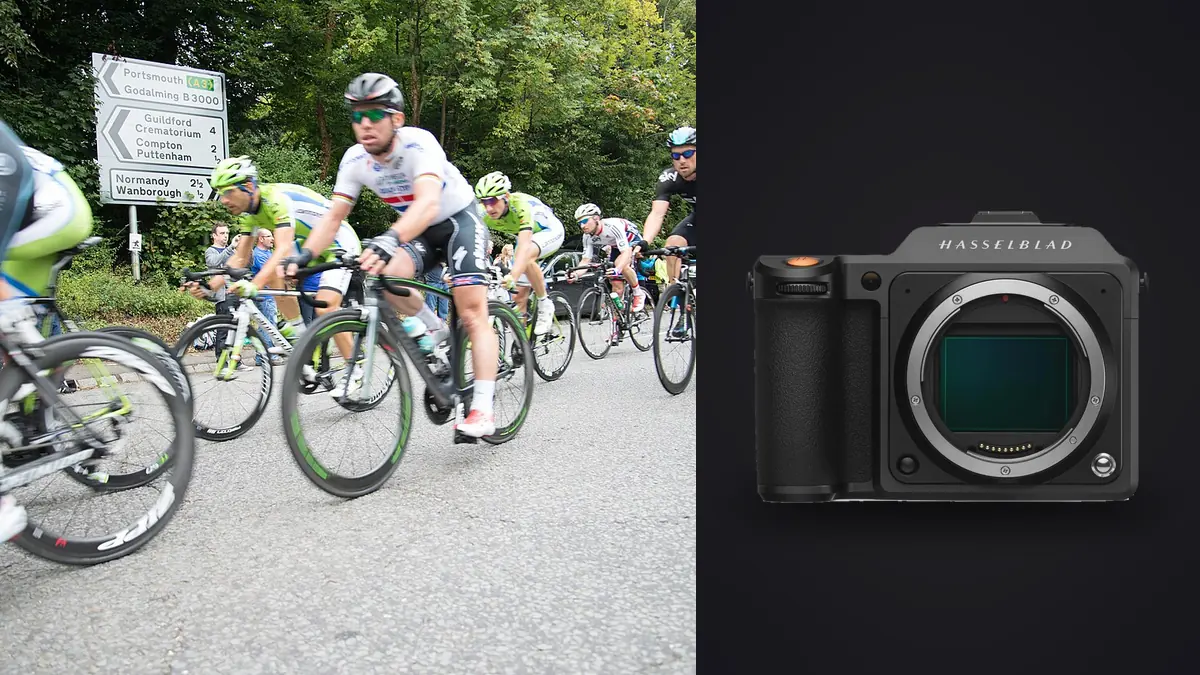
I brought a Hasselblad X2D 100C to a regional track and field championship last spring, and for the first hour I genuinely wondered if I'd made a mistake. Two hundred athletes, sixteen events running in parallel across two days, and a camera that Hasselblad itself doesn't market as a sports tool. It shipped in my bag next to a much faster mirrorless body that was doing the actual heavy lifting. The Hasselblad was there for something narrower: a handful of frames per event that needed to look like nothing else on the infield.
That distinction matters, because most gear writing about the X2D 100C treats it as a landscape and studio camera that happens to exist, and stops there. It's worth actually testing it against something that punishes slow autofocus and small buffers, because a track oval does exactly that. What follows isn't a spec sheet. It's what happened when I pointed a 100-megapixel medium format body at sprinters, pole vaulters, and a discus circle.
Why bring a medium-format body to an oval at all
The honest answer is print sales and sponsor decks. Youth and regional meets are full of parents who will buy a large canvas print of their kid clearing a bar or crossing a line, and a 100MP sensor gives you room to crop hard into a 400m field and still output something that holds up at 24x36 inches on a wall. A 24MP APS-C or full-frame crop from a monopod at the far turn starts falling apart at that size. The Hasselblad file doesn't.
There's also a color argument that's easy to dismiss until you've seen it side by side. Hasselblad's color science renders skin tones and grass under stadium floodlights in a way that needs almost no correction. Track surfaces (that saturated red or blue polyurethane) can wreck a camera's white balance and push faces toward orange or magenta under mixed sodium-vapor and LED lighting. The X2D 100C handled that mixed lighting more gracefully than either of the two mirrorless bodies I also had on hand that weekend, straight out of the raw file.
None of that matters if the camera can't hit focus on a moving human. So the real question is whether the tradeoffs are survivable.
What the sensor buys you when it's not chasing motion
The moments where the X2D 100C actually shines on a track are the moments with a predictable apex: the top of a pole vault arc, the instant before a discus release, the exact frame a runner's back foot leaves the blocks, the handoff zone in a relay where two athletes are briefly locked into the same six feet of lane. These are moments you can anticipate and pre-focus for, not moments you have to track through a burst. I shot most of these with an XCD 90V (roughly a 71mm full-frame equivalent) stopped to f/4 or f/5, prefocused on a spot on the track using a piece of chalk as a reference, and waited. Shutter speeds sat around 1/2000s to freeze limbs without freezing the motion blur in a discus spin that actually sells the shot. At that shutter speed medium format's leaf-shutter lenses aren't a limitation, since I wasn't syncing flash outdoors at noon anyway.
The dynamic range paid off more than I expected. A midday meet under open sky gives you blown-out lane markings next to deep shadow under the stadium roof overhang, and the X2D 100C's files let me pull back highlight detail in a runner's white jersey that would have clipped hard on a smaller sensor at the same exposure. That's the kind of thing that only shows up when you're grading the images later, not something you notice through the viewfinder in the moment.
Where it runs out of road mid-race
Hasselblad rates the X2D 100C's continuous shooting at a little over three frames per second, and that roughly matched what I saw in the field. For a 100m final that's over in under eleven seconds, three fps gives you maybe thirty frames across the whole race, and most of them will show a runner mid-stride in a position that reads as awkward rather than dynamic. You genuinely cannot burst-shoot your way to the peak-action frame the way you can with a 20 or 30fps sports body. You have to already know where the peak action frame is going to happen. Autofocus tracking is the other honest limitation. The X2D 100C added on-sensor phase-detection autofocus, which is a real improvement over the contrast-only system in earlier X System bodies, but it's tuned for deliberate, composed work, not for holding lock on a sprinter accelerating directly at the lens. On the 200m curve, where runners move laterally relative to the camera, I lost focus lock more than once trying to track through a stride cycle. I stopped trying and went back to prefocusing on a mark, which is a workflow more at home in 1990s film sports photography than in 2026. Buffer depth compounds this. A 100MP raw file from this sensor lands around 100 to 200MB depending on scene complexity, and the internal 1TB SSD fills up faster than you'd think across a two-day meet with sixteen events. I ended each day offloading and reviewing rather than shooting through, which isn't how you want to operate when the next heat starts in four minutes.
X2D 100C next to a body built for this
To make the tradeoff concrete, here's how the X2D 100C stacks up against a stacked-sensor sports mirrorless body (roughly a9 III class) on the specific things that matter trackside. These are rounded figures from my own use, not lab numbers.
| Factor | Hasselblad X2D 100C | Stacked-sensor sports mirrorless |
|---|---|---|
| Sensor | 100MP medium format CMOS | ~24MP full-frame stacked CMOS |
| Continuous burst | ~3.3 fps | 20 to 120 fps depending on model |
| AF tracking on lateral motion | Adequate for slow, predictable subjects | Built for exactly this |
| Raw file size | 100 to 200MB per frame | 25 to 60MB per frame |
| Realistic keeper rate on a 100m final | 1 to 3 usable frames if pre-timed well | 15 to 40 usable frames from a single burst |
| Body weight | ~895g | ~600 to 700g |
| Body-only price (approx.) | $8,200 | $3,500 to $6,500 |
| Where it wins | Hero prints, sponsor imagery, static peak moments | Full sequence coverage, guaranteed sharp action |
How the two-camera system actually played out
The mirrorless body did every dynamic sequence: the full 100m field out of the blocks, the entire long jump run-up and landing, every baton exchange in the relays. That's the coverage a meet actually needs for results and recaps. The Hasselblad came out for maybe six to ten setups a day, each one planned in advance: a vault approach shot from low and wide, a discus release from behind the cage netting, a finish-line frame from a fixed position where I knew exactly which lane the leader would occupy. The lens reach was its own constraint. XCD glass tops out well short of what a 400mm or 600mm super-telephoto gives you on a mirrorless sports rig, so I couldn't shoot tight from the stands the way I would with a dedicated long lens. I ended up planted trackside with event officials' permission, which isn't always possible depending on how a given meet manages photographer access. That's worth checking before you plan a similar setup, because not every venue lets you get close enough for a medium-format lens to be useful.
Sorting a mixed take when you get home
The real headache with a two-camera system isn't the shooting, it's the culling afterward. I came home with close to 4,000 frames from the mirrorless body's bursts and around 300 from the Hasselblad, and those two sets need completely different triage. The mirrorless takes are full of ten and fifteen-frame sequences where only one or two are actually sharp on the eyes and hands, and going through that manually at 1am after a two-day meet is how you miss the good ones. I ran that whole batch through imagic's local sharpness scoring, which flags the genuinely in-focus frames within each burst rather than making me eyeball a contact sheet of near-identical sprint frames. It cut a four-hour sort down to about forty minutes. The Hasselblad frames needed something different. Because I couldn't fully trust autofocus tracking, I'd often fire two or three frames of the same setup with slightly different focus points as insurance, and those near-duplicate sequences needed grouping rather than sharpness ranking, since more than one might be technically sharp but only one has the right expression or hand position. imagic's duplicate and burst clustering handled that grouping automatically instead of me scrolling back and forth comparing thumbnails. Since everything ran locally on my laptop with no upload step, I could do this sort in the team hospitality room between events with no wifi at all, which mattered more than I expected at a venue where the guest network kept dropping.
Matching color between two very different sensors
Cutting the frames down is only half the job. Once you're picking a final gallery, a client or a sponsor scrolling through a mixed set of Hasselblad and mirrorless files will notice if the color doesn't match, even if they can't say why. Hasselblad's Natural Colour Solution renders differently from Sony or Canon's color science by design, and pushing both toward a single unified look by hand, frame by frame, eats an evening you don't have during meet season. I'd already trained an imagic apply_my_style preset on a batch of my own previously graded track images, and running both camera's files through it got them close enough that nobody scrolling the gallery clocked a difference between the two systems. It's not magic color matching, it still needed spot corrections on a handful of frames shot in the shade of the stadium roof, but it closed most of the gap in one pass instead of one frame at a time. If you're building out a full grading process for a mixed take like this, it's worth reading through a full breakdown of color grading workflow before you commit to a specific look for a whole season of meets.
Is it actually worth doing
For a single meet, probably not, unless you already own the camera for other work. The cost of entry is steep, the learning curve on prefocusing for peak action is real, and you will miss shots a faster camera would have caught without thinking. Where it earns its keep is at meets you shoot repeatedly across a season, where you've learned the venue's sightlines well enough to know exactly where the vault apex or the finish line will land in frame, and where the client wants large prints or sponsor-grade hero images rather than just a results gallery. If you're building a repeatable process for events like this rather than a one-off, it's worth reading up on how automated culling actually evaluates a burst before you decide how much of the sort you want to hand off versus do by eye. Knowing what the tool is actually scoring changes how you shoot, not just how you edit afterward.
Frequently Asked Questions
Can the X2D 100C actually track a sprinter out of the blocks?
It can acquire focus on a runner, but its phase-detection system isn't built for sustained tracking through a full stride cycle the way a stacked-sensor sports body is. In practice I got more reliable results prefocusing on a fixed point on the track and waiting for the runner to reach it than trying to track continuously through the race.
What lens length do you actually need to shoot track from the stands?
Longer than what Hasselblad's XCD lineup currently offers. Without trackside access, a 90mm or 135mm XCD lens leaves you cropping hard on anything beyond the near straight. If you can't get field access, a dedicated telephoto system on a separate body is the more realistic option for distant events like the far turn or field events on the infield.
Is a 100-megapixel file overkill for a track meet gallery?
For a standard online results gallery, yes, it's more resolution than most viewers will ever notice. It stops being overkill the moment someone wants a large print, a magazine spread, or a sponsor banner cropped from a wide shot, which is a common ask after a meet with strong performances.
How do you handle color when shooting two different camera systems at once?
Expect a visible difference straight out of camera and plan to correct for it rather than hope it won't matter. Building a single grading pass, whether manual or preset-based, that you apply across both sets before final selects is the difference between a gallery that reads as one shoot and one that reads as two cameras stitched together.