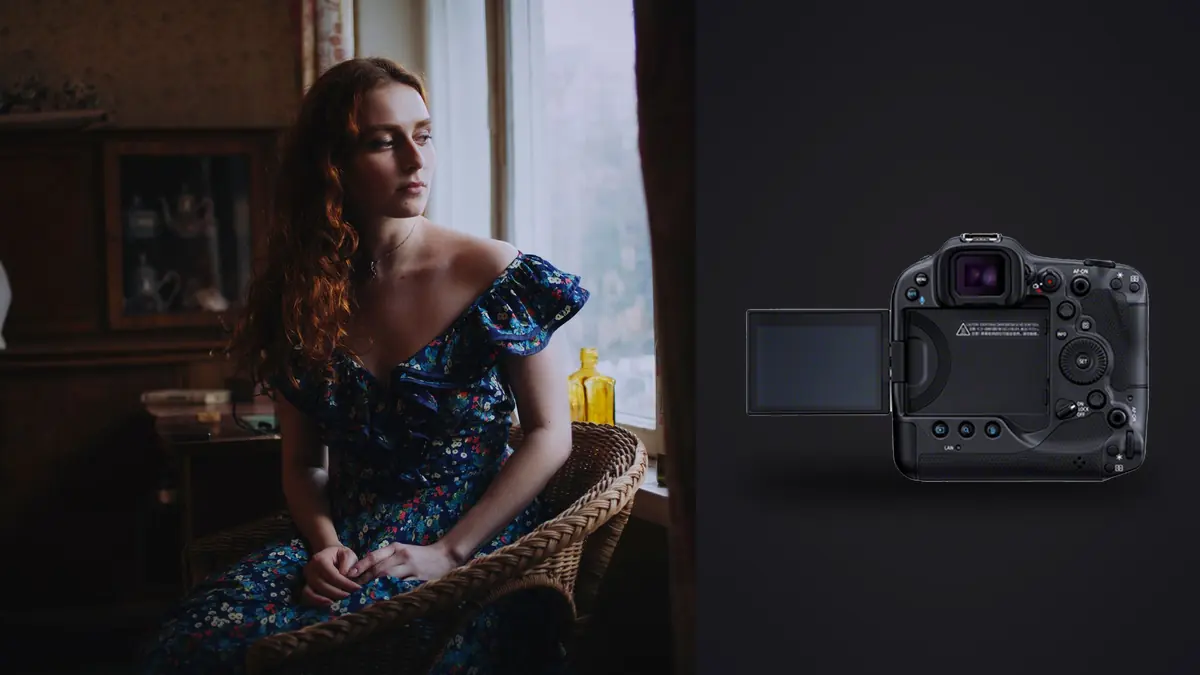
A camera built for sideline sports ends up in the boudoir bag
Canon announced the EOS R3 as its answer to action and photojournalism work: 30fps electronic shutter, eye control autofocus tuned to lock onto a moving athlete, in-body stabilization rated for handheld telephoto shooting. None of that reads like a spec sheet for a bedroom or a hotel suite. And yet a handful of boudoir and intimate portrait photographers I know picked one up anyway, myself included, and the reasons have almost nothing to do with speed. They come down to three things: how the camera behaves in low light, how quiet it is, and how forgiving the autofocus is at f1.2 where the margin for error is a few millimeters.
This isn't a camera I'd tell someone to buy specifically for boudoir work. But if you already own one, or you're deciding between it and something smaller, here's what actually changes in this genre versus general portraiture.
Where the R3 earns its keep: light you can't add
Boudoir sessions happen in spaces you don't control. A client's own bedroom, a rented apartment booked for the afternoon, a hotel suite with one lamp and a window. Adding flash changes the mood instantly, and the entire appeal of most boudoir work is low, warm, uneven light that reads as private rather than lit. The R3's sensor holds usable detail up to roughly ISO 6400 without skin tones turning muddy or blotchy, and I've pushed it to 12800 for underexposed window-light frames that needed a stop of recovery afterward. That's a practical working range, not the marketing figure some spec sheets print for the extended ceiling, which nobody should actually be shooting at if the image needs to hold up on a screen larger than a phone.
What matters more than the raw ISO number is how the noise looks under warm tungsten and lamp light specifically. Chroma noise tends to show up first in shadow areas of skin, and that's where the R3 stays cleaner longer than most bodies I've used at the same ISO. It buys you the ability to keep a lamp at its actual dim setting instead of turning it up for the camera, which matters when the whole point is candlelight-adjacent mood rather than studio-bright.
Silent shooting matters more here than in almost any other genre
The electronic shutter on the R3, run in fully silent mode, makes no sound at all. No mirror slap, no shutter clack, nothing. In most photography that's a nice-to-have. In boudoir work it changes the session. The sound of a shutter is a repeated reminder to the client that they're being photographed, and for someone who's already nervous about being in front of a camera, a mechanical clunk every two or three seconds keeps pulling them back into self-consciousness right when you need them relaxed. Anyone used to a DSLR tends to find it much easier to stop noticing the camera when it's silent.
The tradeoff is rolling shutter risk with fast motion. Flowing hair, a piece of fabric dropping, a quick shift of the shoulders can produce visible skew or banding in silent mode because the sensor reads line by line rather than all at once. In practice this shows up maybe one frame in fifty for a typical boudoir session, since most of the movement is slow and deliberate rather than athletic. I keep an eye on the rear screen for it and will switch to the mechanical shutter for anything genuinely fast, like fabric being pulled away quickly, but silent mode handles the large majority of what actually happens in a session like this.
Eye control autofocus and wide-aperture focus discipline
Shooting at f1.2 with the RF 50mm F1.2L or RF 85mm F1.2L, the plane of focus is razor thin, sometimes under an inch at close range. That's exactly where the R3's headline autofocus feature, Eye Control AF, should theoretically help by letting you look at the eye you want in focus. In practice, I've found it needs recalibrating almost every session, and it struggles specifically in the dim, warm light that defines most boudoir setups. It was built and tuned for daylight sports work, and low, uneven room light isn't its strong suit.
What actually works reliably is standard Dual Pixel CMOS AF II with face and eye detection, paired with back button focus so I control exactly when it re-acquires. It holds lock on an eye at f1.2 even in dim window light better than Eye Control does in the same conditions. I leave Eye Control off for boudoir work entirely now and treat it as a feature for a different genre.
Lens pairings that make sense in a small room, not a studio
Bedrooms and hotel rooms rarely give you the working distance a studio does. The 85mm f1.2 produces the compressed, editorial look a lot of boudoir photographers want, but it needs eight to ten feet of clearance to frame a full body, and plenty of rooms don't have that without backing into a hallway or a closet door.
| Lens | Working distance in a typical 12x12 room | Best for | Tradeoff |
|---|---|---|---|
| RF 85mm F1.2L USM | Tight, sometimes shooting from the doorway | Compressed, close three-quarter portraits | Can't fit full-length poses without backing out of the room |
| RF 50mm F1.2L USM | Comfortable at 6-8 feet | Most full-body and three-quarter poses | More background visible at f1.2 than the 85mm gives you |
| RF 35mm F1.8 Macro IS STM | Works from 3 feet | Detail shots, jewelry, hands, tight rooms | Less subject separation, needs care near frame edges for distortion |
| RF 24-70mm F2.8L IS USM | Flexible across the room | Scouting a new location quickly, safety coverage | Loses the f1.2 rendering; most usable frames from it land at f2.8 |
The weight nobody puts on the spec sheet
The R3 body alone is around 1015 grams. Add an 85mm f1.2, which is close to 1.2kg on its own, and you're holding nearly 2.2kg one-handed while crouched at odd angles for two hours or more. For sideline sports work that's irrelevant because the camera usually sits on a monopod. For boudoir, sessions are almost entirely handheld, and wrist and shoulder fatigue late in a session shows up as soft frames on your last setups, not because the subject moved but because your hands started shaking. I've started bringing a monopod purely for support during longer sessions, or swapping to a lighter body for the second half of a shoot when the R3's weight stops being worth what it's giving me.
How it stacks up against the bodies most boudoir photographers actually reach for
I get asked fairly often whether the R3 is worth it over an R6 Mark II or an R5 for this specific genre. Here's the honest comparison based on what actually changes a boudoir session, not the full spec sheet.
| Criteria | EOS R3 | EOS R6 Mark II | EOS R5 |
|---|---|---|---|
| Usable high ISO (practical ceiling, not the marketing number) | ~12800 | ~8000 | ~6400 |
| Silent electronic shutter, no viewfinder blackout | Yes | Yes | Partial blackout at higher frame rates |
| Face/eye AF reliability in dim lamp or window light at f1.2 | Excellent | Very good | Very good |
| Buffer depth shooting full-res raw bursts | 1000+ frames on CFexpress | ~140 frames | ~180 frames |
| Body weight | 1015g | 670g | 738g |
| Approximate street price, body only | Roughly $5,500-6,000 | Roughly $2,300-2,500 | Roughly $3,000-3,400 |
If boudoir is the only genre you shoot, the R6 Mark II gets you most of the low-light and autofocus benefit at less than half the weight and less than half the price. The R3 makes more sense if you're also shooting sports, weddings with fast-moving receptions, or events where the buffer depth and tracking actually get used. I kept mine because it does double duty; I wouldn't necessarily recommend buying one for boudoir work alone.
The volume problem, and the part of this nobody talks about
Run at 20 or 30fps for even short bursts during a 90-minute session and you can easily walk away with 3,000 to 5,000 raw frames, most of them nearly identical variations of the same pose while you're chasing a genuine expression. Culling that by hand is the actual bottleneck in a boudoir workflow, not the shooting itself. I run everything through imagic afterward specifically because its burst and duplicate clustering groups those near-identical frames automatically and surfaces the two or three sharpest with the best expression, instead of me scrolling through forty frames of a hand moving through hair one at a time.
There's a privacy angle here too that's specific to this genre. Boudoir and intimate images are about as sensitive as photographic content gets, and plenty of photographers are understandably uneasy running client sessions through a cloud-based culling or editing tool that uploads full-resolution intimate photos to a third-party server just to sort them. imagic processes everything locally on the machine, so nothing leaves the laptop during culling or editing, which matters both for client trust and for whatever your model release actually says about where images can travel.
Once you've settled on the tone you edit boudoir work in, warm and slightly desaturated or whatever your particular look is, imagic's apply_my_style feature trains on your own past edits and applies that look to a fresh batch of keepers without you rebuilding it slider by slider every shoot, and again without any of it touching the cloud.
A starting point for three lighting situations I run into constantly
These are the settings I actually start from before adjusting on the fly. They're specific to the R3's noise behavior; a different body might need different numbers to land in the same place visually.
| Scenario | Aperture | Shutter | ISO | Note |
|---|---|---|---|---|
| Morning window light through a sheer curtain | f1.8-f2.2 | 1/200 | 400-800 | Keep shutter above 1/160 even with 8-stop stabilization; subject motion, not camera shake, is the limiting factor |
| Late afternoon, single warm lamp as key light | f1.4-f1.8 | 1/125 | 3200-6400 | Watch for AF hesitating on skin under warm tungsten; a small clip-on eye light helps the autofocus more than the exposure |
| Evening, candles or string lights only | f1.2 | 1/100 | 6400-12800 | This is where the R3's ISO ceiling actually earns its price tag; plan on a noise reduction pass during editing |
Frequently Asked Questions
Is the Canon EOS R3 overkill for boudoir work compared to a cheaper body?
For pure image quality at reasonable ISO, yes, mostly. The R6 Mark II gets you close to the same low-light result for under half the price and well under half the weight. The R3 earns its cost if you also shoot sports, weddings, or events where the buffer and tracking speed get real use. If boudoir is the only thing you photograph, I'd point most people toward the R6 Mark II or R5 before the R3.
Do I need to turn off Eye Control autofocus for close, wide-aperture work?
You don't have to disable it, but don't expect it to be reliable in dim, warm-lit rooms without recalibrating it session to session. I leave it off for boudoir work and rely on standard face and eye detection with back button focus instead, which has held lock more consistently at f1.2 in the low light this genre lives in.
Will the silent electronic shutter cause banding under lamp or string light?
It can, depending on the light source. Warm incandescent or halogen lamps rarely cause a problem. LED string lights on a dimmer are the ones to watch, since some flicker at a frequency that produces visible banding in silent mode. Fire off a short test burst before the session starts and switch to the mechanical shutter if you see banding in the frames.
How many usable images should I expect from a typical intimate portrait session?
From 3,000 to 5,000 raw frames shot across a session, a typical delivered set runs 40 to 80 final images, so the keeper rate is somewhere around 1 to 2 percent. That ratio is exactly why manual culling stops being sustainable once you're shooting these sessions regularly, and it's the main reason I lean on a faster culling workflow rather than reviewing every frame by hand.