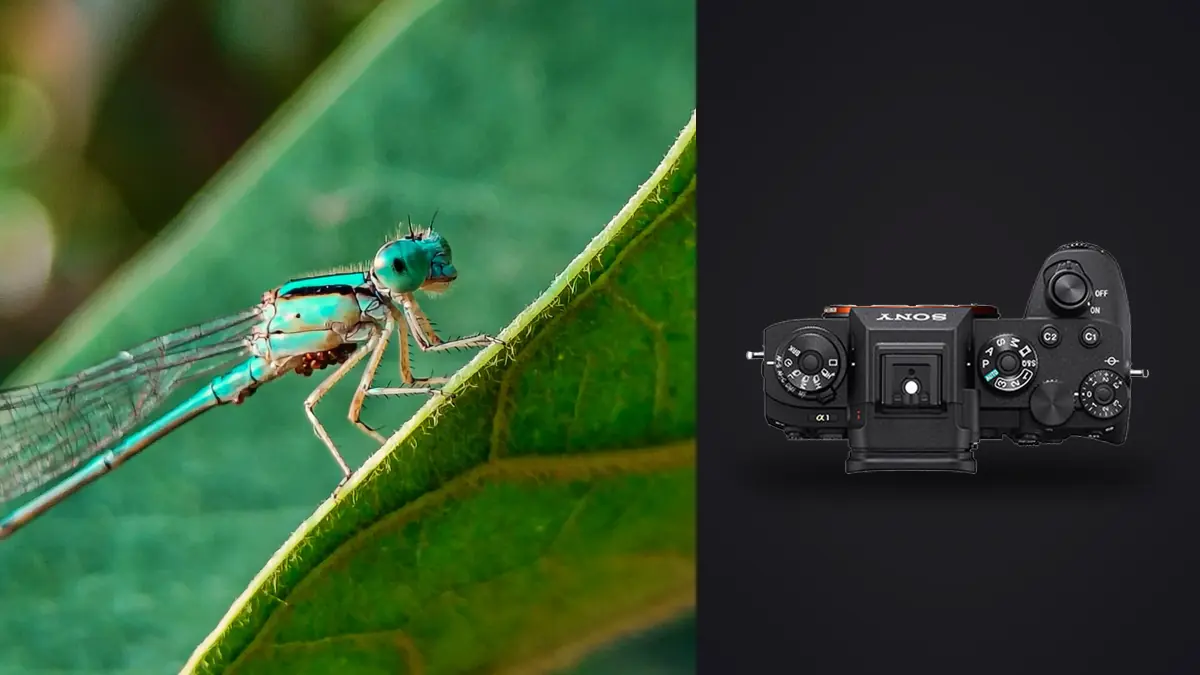
Somewhere around my third summer of chasing damselflies along a slow stretch of river, I stopped thinking of the Sony A1 as an all-purpose flagship and started treating it as two different cameras depending on what was bolted to the front. Paired with a long telephoto it's still the bird-and-action body everyone talks about. Paired with the FE 90mm F2.8 Macro G OSS at 1:1, it becomes something stranger: a 50-megapixel sensor pointed at a subject smaller than a fingernail, with a shutter that can outrun a dragonfly's wingbeat and an autofocus system that, frankly, does not know what to do with a compound eye half the time. This is what two full insect seasons with that combination have taught me, the parts that work well and the parts I've had to work around.
What the sensor actually buys you at 1:1
The A1's 50.1-megapixel stacked BSI sensor sounds like overkill for something the size of a grain of rice, and in a narrow sense it is, but the extra resolution earns its keep in a specific way: it gives you room to crop after the fact when your working distance was dictated by the insect rather than by your ideal framing. A horsefly's compound eye can occupy a quarter of the frame after a crop and still hold enough detail to print at a reasonable size. That matters because macro shooting rarely lets you frame exactly how you want on the first try, not when the subject decides how close it's willing to let you get.
The tradeoff nobody mentions on the spec sheet is diffraction. Macro apertures narrow enough to get useful depth of field, typically f/11 and smaller, start softening a 50-megapixel file well before you'd notice the same effect on a 24 or 33-megapixel body. In practice the resolution buys cropping flexibility more than it buys additional sharpness at the apertures you'll actually be shooting most insects at. It's a real advantage, just not the one people assume.
Where the stacked sensor design earns its keep unambiguously is rolling shutter. The scan rate is fast enough that a dragonfly's wings, beating well past 20 times a second, don't smear or skew the way they would on a sensor with a slower readout. Panning with an insect in flight and firing a burst produces frames where the wings look like wings instead of a rubbery blur across the frame.
Autofocus: where Eye AF helps and where it just gives up
759 phase-detection points covering 92 percent of the frame sounds impressive until the subject is eight millimeters long. Real-time Eye AF was trained on human, animal, and bird eyes, not insects, so any success on a bug is really a byproduct of pattern matching rather than a dedicated mode. On a mantis, a large dragonfly, or a robber fly with a body over roughly two centimeters, the compound eye is often defined enough in frame that Animal Eye AF locks on and tracks it convincingly. On anything smaller, jumping spiders, aphids, most beetles, it usually can't find an eye at all and just hunts back and forth.
The workaround I use almost every session: turn Eye AF off for small subjects, drop the AF area down to Flexible Spot S or smaller, and place that single point manually on the leading facet of the eye or the base of the near antenna. For anything under about a centimeter I skip autofocus entirely and switch to manual focus with peaking set to a saturated color that stands out against green foliage (red works better than the default yellow in most of my shooting), then rock gently forward and back at the working distance rather than turning the focus ring. At true 1:1 the depth of field is thin enough that body movement is a faster, more precise way to find focus than the ring is.
Working distance matters more than frame rate
None of the autofocus performance matters if the insect has already left before you frame the shot. The 90mm macro's closest focus puts the front element roughly 9 to 13 centimeters from the subject, which is uncomfortably close for anything with decent eyesight and a reason to flee. Sun angle, approach speed, and not casting a shadow across the perch matter more than any camera setting. I approach from a slight angle so my shadow falls beside the subject rather than over it, and I move in short pauses rather than one continuous creep. It sounds basic, but it accounts for more missed shots in my own take-home folders than autofocus ever has.
Burst shooting and why 30fps is a mixed blessing for bugs
The A1's blackout-free 30fps electronic shutter is genuinely useful for insects in flight, catching a hoverfly at the exact moment its wings are positioned cleanly rather than as a double-exposed blur. But running 30fps on a subject that's simply sitting still, which is most of a macro session, floods a card with near-identical frames for no benefit. I keep the camera in single-shot or a slow continuous mode for anything perched and only switch up to Hi+ when the subject is actively moving: a bee working a lavender spike, a hoverfly hovering and darting between blooms.
Silent electronic shutter matters more than the frame rate number for one specific subject: jumping spiders. They're curious enough to approach a lens on their own, but the mechanical shutter's clack is enough to send one into a defensive rear-up posture that ends the encounter. Switching to fully silent shooting is the difference between a full sequence and a single wasted frame with these subjects.
Settings I actually use, by subject
This isn't a generic exposure chart. It's what's actually written on a sticky note in my camera bag, adjusted over two seasons of getting it wrong first.
| Subject | Typical behavior | Shutter speed | Aperture | AF mode | Field note |
|---|---|---|---|---|---|
| Damselflies & perched dragonflies, early morning | Basking, sluggish before the sun warms them | 1/640s | f/8 | AF-S, small Flexible Spot on the near eye | Approach from behind the perch, keep your shadow off it |
| Bees & hoverflies on flowers | Constant micro-movement, brief pauses between blooms | 1/2500s | f/11 | AF-C, Hi+ burst (20-30fps) | Fire short bursts timed to the pause, not the approach |
| Jumping spiders | Curious, will approach the lens on its own | 1/320s, flash-lit | f/16 | Manual focus, peaking, silent shutter only | Any mechanical clack ends the session |
| Butterflies feeding | Still for several seconds once proboscis is down | 1/1000s | f/9 | AF-C with Eye AF (works above ~5cm wingspan) | Circle in slowly, don't shadow the flower |
| Ants & ground beetles | Constant fast walking at ground level | 1/500s + fill flash | f/18 | Manual focus + rail, pre-focus and wait | Flash freezes the motion; ambient alone can't at f/18 |
| Robber flies in flight | Fast, erratic, brief hovers over a favorite perch | 1/3200s | f/9 | AF-C, Eye AF reliable above ~20mm body length | Pre-frame the airspace over a perch it keeps returning to |
Lens pairings that make sense on this body
The FE 90mm F2.8 Macro G OSS is still my default. It's internally focusing, so nothing extends toward the subject as focus shifts, which matters more than it sounds like it should: a barrel creeping forward is exactly the kind of movement that spooks a resting fly. Native 1:1 magnification covers almost everything I photograph without extra hardware.
For anything that won't tolerate a nine-centimeter approach, I clip a Raynox DCR-250 onto the front of the FE 200-600mm G at the long end. That combination lets me photograph dragonflies and butterflies from a meter or two away instead of centimeters, which is the difference between getting the shot and watching the subject fly off. The optical quality softens toward the frame edges compared to the dedicated macro lens, and you're handholding well over two kilograms for close work, so the in-body stabilization is doing real work here, not just smoothing out minor shake.
Extension tubes (Sony doesn't make its own; I use a Kenko AF set) push the 90mm past native 1:1 for genuinely tiny subjects like aphids or springtails, at the cost of losing roughly a stop of light and shrinking the working distance even further.
The Super 35 APS-C crop mode is an underused compromise. It gives roughly 1.5x reach at 21 megapixels, effectively turning the 90mm into something closer to a 135mm field of view. On skittish subjects like fritillaries, where the full-frame 90mm forces me inside their flight-flush distance, cropping in-camera keeps more working distance while still filling the frame, at the cost of a third of the resolution. I don't reach for Sony's teleconverters on the macro lens at all; they're built for the GM telephotos, and mounting one on the 90mm just slows autofocus further at apertures that are already narrow.
Focus bracketing in the field versus stacking at the desk
The A1 has in-camera Focus Bracketing, up to 299 shots with an adjustable step width, but it doesn't stack them for you. That still has to happen afterward in Photoshop, Helicon Focus, or Zerene Stacker. In the field this only really works on subjects that aren't moving: a damselfly still cold and motionless at dawn, a bee gripping a stem overnight, or specimens that have already died. For anything alive and active, a single antenna twitch between frames is enough to ruin alignment across a stack, so realistically only a fraction of what I photograph in a season is a candidate for bracketing at all.
When it does apply, my settings are a step width around 3 to 5 and somewhere between 10 and 15 frames at roughly 1:2 magnification, more as I get closer to 1:1. Handheld bracketing works more often than it should thanks to the stabilization holding framing steady between shots in the burst, though I still carry a small geared rail for anything shot above 1:1, since drift that IBIS can't fully cancel becomes visible to stacking software at that magnification.
Handling the flood of frames afterward
A single morning on hoverflies at 20-30fps, plus a handful of focus-bracket stacks, easily produces several thousand raw files, most of them near-duplicates of each other. This is where the workflow actually breaks down if there's no plan for it. Scrolling through three thousand files by eye looking for the one frame where the wings landed in a clean position and the eye is critically sharp is a multi-hour task, and it's not one I'm doing on a laptop at a campsite.
I run everything through imagic before it reaches Lightroom. It scores local sharpness on the actual subject rather than the frame as a whole, so a burst where only four of forty frames landed critical focus on the eye gets sorted to the top instead of me guessing from thumbnails, and it clusters the near-duplicate burst frames and bracket sequences together so I'm reviewing groups rather than scrolling image by image. Because it processes everything on the machine rather than uploading to a server first, none of an unpublished trip's raw files leave my drive before I've decided what's worth keeping. Once I've built up a season's worth of edits with a consistent look for this kind of subject (slightly cooler shadows, clarity held back around the eye facets so it doesn't look crunchy), the apply_my_style feature picks that pattern up from edits I've already made and applies it to new keepers automatically, instead of me rebuilding the same curve by hand on every new insect. If frame volume like this is the actual bottleneck in your own workflow rather than the shooting itself, it's worth reading through how AI photo culling works before picking a tool, since the value is almost entirely in how well something scores focus on the subject rather than the frame average.
Battery, heat, and cards for a full morning outdoors
Heavy EVF use for manual-focus macro work drains the NP-FZ100 faster than typical shooting, so I carry two or three spares for anything longer than a couple of hours. Buffer depth at 30fps with compressed raw runs somewhere in the 150-240 frame range before the camera slows down to clear it, and a CFexpress Type A card clears noticeably faster than UHS-II SD when you're leaning on burst mode; for single-shot or bracket-only sessions the SD card is fine and cheaper. Heat warnings are mostly a video concern on this body rather than a stills one, but leaving the camera in direct sun between subjects, which happens constantly when you're kneeling in an open meadow, still warms the body enough that I keep it shaded inside the pack whenever I'm not actively shooting.
Frequently Asked Questions
Does the A1's Eye AF actually recognize insect eyes?
Sometimes, on the larger ones. It wasn't trained on insect eyes specifically, so any success is really a byproduct of general pattern matching. On a mantis, dragonfly, or robber fly with a body over roughly two centimeters, the compound eye is often large and defined enough in frame for Animal Eye AF to grab it and track it. On anything smaller, jumping spiders, gnats, most beetles, it typically won't find an eye at all, and you're better off switching it off and placing a Flexible Spot manually.
Is 50 megapixels overkill for something the size of a grain of rice?
Not overkill, but not free either. The extra resolution gives real cropping headroom when your working distance is dictated by the insect's flight-flush threshold rather than your ideal framing. The catch is that macro apertures narrow enough for usable depth of field, typically f/11 and smaller, start softening the file through diffraction earlier than they would on a lower-resolution sensor. In practice the resolution buys cropping flexibility more than it buys extra sharpness at the apertures you'll actually use.
Do I still need a tripod and focus rail with a body this well stabilized?
For anything moving, no. The in-body stabilization, rated to 5.5 stops, is what makes handheld 1:1 work practical at all, since a macro rig locked to a tripod usually can't react fast enough to a hoverfly relocating every couple of seconds. For genuinely stationary subjects where you're running a focus bracket at high magnification, a small geared rail still earns its place; even with strong stabilization, a bracket sequence shot handheld above 1:1 has enough frame-to-frame drift that stacking software struggles more than it needs to.
Will the shutter noise or flash scare insects off before I get the shot?
Less than you'd expect for most subjects, but jumping spiders and a few fly species are the exception. Switching to the fully silent electronic shutter removes the mechanical clack that would otherwise send a curious jumping spider into a defensive posture, and it's the difference between one usable frame and a complete sequence with subjects like that. Flash is a separate concern: a single low-power burst rarely spooks anything, but a full-power blast at close range on ants or beetles will often make them freeze or bolt for a few seconds, so I keep flash compensation down around -1.7 to -2 stops and let the aperture carry more of the exposure.
None of this makes the A1 the obvious choice for macro on paper. It's heavier than most people want to carry through a wet meadow at dawn, and a chunk of its headline autofocus features are built around eyes far bigger than the ones I'm usually pointing it at. What it does give me is a shutter and buffer that can keep up with subjects that move in fractions of a second, and enough resolution that an imperfect approach still leaves a usable frame after a crop. That's the trade I've made peace with, one insect season at a time.