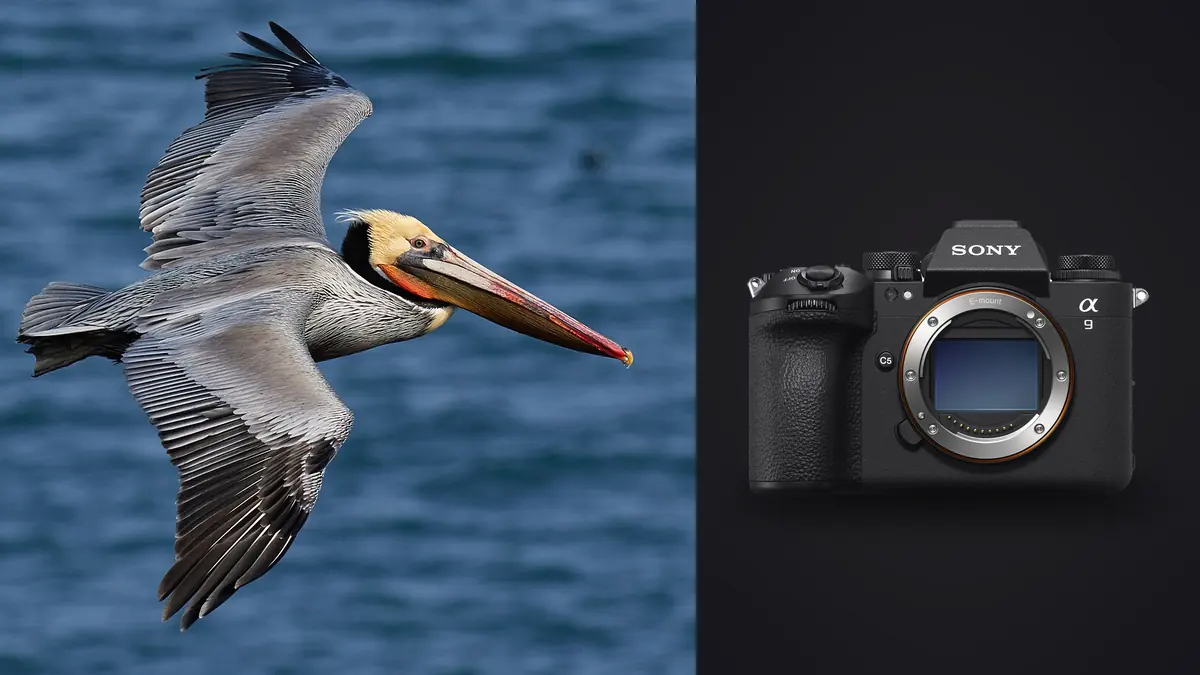
The first time I ran an osprey dive through the Sony A9 III at full tilt, I didn't hear the shutter. That's the part nobody tells you until you're standing in a marsh at 6am with the camera to your eye: at 120 frames per second with a global shutter sensor, there's no clatter, no viewfinder blackout, nothing to tell your brain the camera is even working except the frame counter climbing in the corner of the EVF. It's disorienting the first few times. Then it becomes the reason you stop shooting anything else for birds in flight.
The Global Shutter Is the Whole Story, Not a Footnote
Most camera reviews mention the A9 III's global shutter as one bullet point among many. For birding in flight it's the entire reason to care about this body. A conventional stacked sensor reads the frame line by line, fast, but not instant, which is why panning shots of a peregrine's wingtip against a bright sky can show that faint skew or "jello" warp on a rolling shutter camera at high subject speed. The A9 III reads every pixel at the same instant. Wingtips stay straight. Rapid wingbeats on something like a teal or a woodcock, which can hit 8 to 10 beats per second, don't smear or tear even shooting wide open at high shutter speeds.
The second consequence matters more day to day: flash sync at any shutter speed, up to 1/80,000 second if you want it, with zero banding. I don't shoot much flash on flighted birds, but for hummingbirds at a feeder or nocturnal owl work with a remote strobe, this removes a limitation that's shaped bird photography setups for two decades. No more high-speed sync tax on flash power.
What the Autofocus Actually Does With a Small, Fast, Erratic Subject
Sony's AI-based subject recognition has a dedicated bird detection mode that looks for the eye first, then the whole body if the eye isn't resolvable. On a red-tailed hawk gliding a thermal at 40 meters, it locks the eye and holds it through banking turns without hunting. That part is genuinely excellent and better than the A9 II or even the A1 in my hands.
Where it gets more honest: on something like a barn swallow working a pond at close range, changing direction three times a second, the system is fast enough to reacquire but not psychic. You'll still get runs of frames where focus lags a half-beat behind an erratic dip, especially if the bird crosses in front of reeds or a dock piling. The camera doesn't fix bad tracking discipline on your end, it just fails less often than older bodies did in the same situation. I still lose a higher percentage of frames to focus miss on small erratic passerines than I do on raptors and waterfowl, and no firmware update is going to change that, because the limiting factor is angular velocity relative to focal length, not processing power.
One practical note on subject recognition and clutter: if a bird is more than about 60% occluded by a branch or reed, the system tends to give up on the eye and either grabs the nearest contrasty edge or drops to a wider area. Manually narrowing to a smaller focus area (Flexible Spot M rather than Wide) recovers a lot of keepers in that specific situation.
Settings by Flight Scenario
This is the cheat sheet I actually keep taped inside my camera bag lid, built from a season of trial and error rather than a spec sheet:
| Flight Scenario | Shutter Speed | Drive Mode | AF Area | Field Note |
|---|---|---|---|---|
| Perched bird about to launch | 1/2000s | Hi+ 120fps with pre-capture | Tracking: Expand Flexible Spot | The wing-drop before liftoff is the frame most people miss entirely |
| Soaring raptor, open sky | 1/1600s | 30fps | Wide, Bird/Animal recognition | Full 120fps is wasted here; save buffer and card space |
| Small erratic passerine (swallow, warbler) | 1/3200s | 120fps | Tracking: Spot S | Miss rate stays high regardless of settings; volume is the compensation |
| Stooping falcon or diving osprey | 1/4000s or faster | 60-120fps | Wide, Bird priority on | Pre-focus manually near the expected strike point; AF alone often trails a stoop |
| Backlit bird against bright sky | 1/2000s | 20fps | Flexible Spot M | Subject recognition falters on silhouettes; manual area helps more than AI here |
Lens Pairings That Make Sense for This Body
The A9 III's 24.6-megapixel sensor is a deliberate trade against resolution for readout speed, so cropping in post matters more here than it did on a 50-megapixel A7R body. I've found the 200-600mm f/5.6-6.3 G to be the honest workhorse for this camera on a budget, light enough for handheld flight tracking over a full morning and sharp enough wide open that you're not fighting the lens as well as the subject. Add the 1.4x teleconverter and autofocus still holds up fine on the A9 III's phase-detect coverage, though you lose about a stop and it shows on overcast days.
For serious raptor and eagle work where subjects are often smaller in frame at range, the 400mm f/2.8 GM plus 1.4x or 2x teleconverter is where this camera earns its price tag. The faster aperture keeps shutter speeds up in low light without pushing ISO into the range where the global shutter sensor's narrower dynamic range starts to show grain in shadow recovery, something worth knowing since the A9 III trades a bit of low-ISO dynamic range for its read-speed advantage. I'd rather have the speed for flight work than the extra stop of shadow detail I'd use maybe one shoot in twenty.
APS-C crop mode is genuinely usable on this body if you need the extra reach, since even cropped you're still working with roughly 10 megapixels, plenty for web use and reasonable prints, and the crop doesn't slow the frame rate.
The Card and Storage Math Nobody Puts in the Marketing
Shoot a two-second burst at 120fps and you've made 240 frames. Do that eight or ten times across a morning chasing terns diving for bait fish and you're sitting on 2,000+ compressed RAW files before lunch, most of them from three or four seconds of actual bird behavior. A CFexpress Type A card is close to mandatory if you want to shoot at the top drive speeds for more than a couple of seconds at a stretch; SD UHS-II in the second slot chokes the buffer noticeably faster and I've watched it stall mid-burst on a fast pass.
The real cost isn't the card, it's what happens after. A single good flight sequence pass can leave you with 300 nearly identical frames of a heron banking to land, and across a season that becomes tens of thousands of RAW files that all look the same at a glance. This is where the shooting experience and the editing experience stop being separate problems. I moved to imagic specifically because it clusters burst sequences and near-duplicate frames together instead of making me scroll through 300 versions of the same wingbeat one at a time, and because it runs entirely on my machine rather than uploading a season of 24-megapixel RAWs somewhere. With card-fill rates like this camera produces, offline processing isn't a privacy preference, it's a bandwidth necessity.
Pre-Capture Changed How I Approach the Whole Session
Half-press the shutter (or hold AF-On, depending on your setup) and the A9 III is already buffering up to a full second of frames before you commit to a full press. That means the frame of a kingfisher's actual departure from a perch, the one that happens faster than human reaction time can trigger a shutter, is retrievable after the fact rather than lost. I underestimated how much this would change my approach until a bald eagle launched off a snag with no warning and I still had the takeoff sequence because my finger was already resting on the half-press.
The tradeoff is that pre-capture at full 120fps burns through buffer and card space fast if you leave it engaged constantly, so I only arm it when a bird looks genuinely close to launching, reading body language (a raptor's mantle drop, a duck's head-bob before takeoff) rather than running it as a default setting all day.
Where the Dynamic Range Trade Actually Shows Up
The global shutter sensor's ISO floor sits at 250 native, not 100, and dynamic range at base ISO trails a conventional stacked sensor like the one in the A1 by a noticeable margin in shadow recovery. For birding, this mostly matters in two situations: dark-plumaged birds like cormorants or ravens against bright sky, where shadow detail on the underside of the bird gets thin if you expose for the highlights, and low-light dawn or dusk flight shots where you're pushing past ISO 12800. Above roughly ISO 6400 I start seeing chroma noise creep into feather detail that I wouldn't expect from a modern stacked sensor at that ISO. It's a real limitation, not a rumor, and worth knowing before you buy this body expecting A1-level low-light latitude.
Sorting a Season's Worth of Bursts
Nobody warns you about this part when they're excited about frame rates. A camera this fast turns a single good encounter into a cataloging job. My workflow now runs the raw dump through local sharpness scoring first (imagic's version checks actual focus plane on the eye rather than just overall frame contrast, which matters a lot when half your "sharp-looking" frames have tack focus on a wingtip instead of the eye), then lets burst clustering group the 200-frame sequences down to representative picks before I ever touch a slider. That single step probably saves me two or three hours per outing compared to scrubbing through a memory card frame by frame in a traditional browser. If you're new to how automated culling tools actually make these calls rather than trusting them blindly, it's worth reading how AI photo culling works before you build a workflow around one.
Once I've got a stack of real keepers, I lean on a custom preset trained on my own past edits (imagic's apply_my_style feature) to get a consistent first pass across a hundred flight shots at once, rather than re-inventing white balance and contrast choices frame by frame for birds shot across changing light through a morning. It's not a substitute for individual attention on the ten or fifteen frames that are actually going somewhere, but it kills the tedious 80% fast.
Frequently Asked Questions
Is 120fps actually necessary for birds in flight, or is it marketing?
For predictable flight, gliding raptors, herons in steady wingbeats, 20 to 30fps captures the useful wing positions just fine and saves you an enormous editing burden. Where 120fps earns its keep is unpredictable, fast behavior: takeoffs, strikes, aerial disputes between birds, anything happening faster than you can time a shutter press by eye. I use the top speed maybe 15% of the time I'm actually shooting, but that 15% accounts for most of my favorite images from the camera.
Does the A9 III's lower resolution hurt for distant, small-in-frame birds?
Compared to a 50+ megapixel body, yes, you have less room to crop after the fact. In practice I compensate with longer glass and teleconverters rather than relying on crop-in-post, and I've found 24.6 megapixels still holds up for reasonably tight prints as long as focus is genuinely on the eye. If your style leans heavily on cropping small distant subjects after the fact, a high-resolution body will serve that specific habit better.
How does the A9 III compare to the A1 II specifically for flight photography?
The A1 II holds the resolution and dynamic range advantage and matches close in autofocus sophistication, but tops out around 30fps mechanically limited by its rolling shutter sensor read speed for full-quality bursts. The A9 III trades that resolution and a bit of dynamic range for genuinely blackout-free 120fps with zero rolling shutter artifacts. If your subjects are mostly slow and stately, egrets, herons, larger raptors, the A1 II's image quality edge is worth more than the A9 III's speed. For fast, erratic, close-range flight work, I'd take the A9 III every time.
What's a realistic battery life expectation shooting flight bursts all day?
Sony rates the A9 III around 520-530 shots per charge using the viewfinder under CIPA standard testing, but that number means very little once you're firing 120fps bursts regularly, since a single two-second burst can eat 240 of those "shots" in one press. On an active shorebird migration morning with a lot of burst shooting, I typically drain one battery in under two hours and carry three as a baseline. Cold mornings make that worse. Budget more spares than you think you'll need.
Is this camera worth it if I mostly do perched bird portraits, not flight?
Honestly, no. The global shutter and 120fps buy you almost nothing for static or slow-moving perched subjects, and you'd be paying a premium for speed you're not using while giving up the dynamic range and resolution a stacked-sensor body like the A1 II or even a well-specced A7R would give you for portrait-style bird work. This is a specialist's tool built around one problem: unpredictable, fast subject movement. Buy it for that reason specifically, not as a general wildlife body.