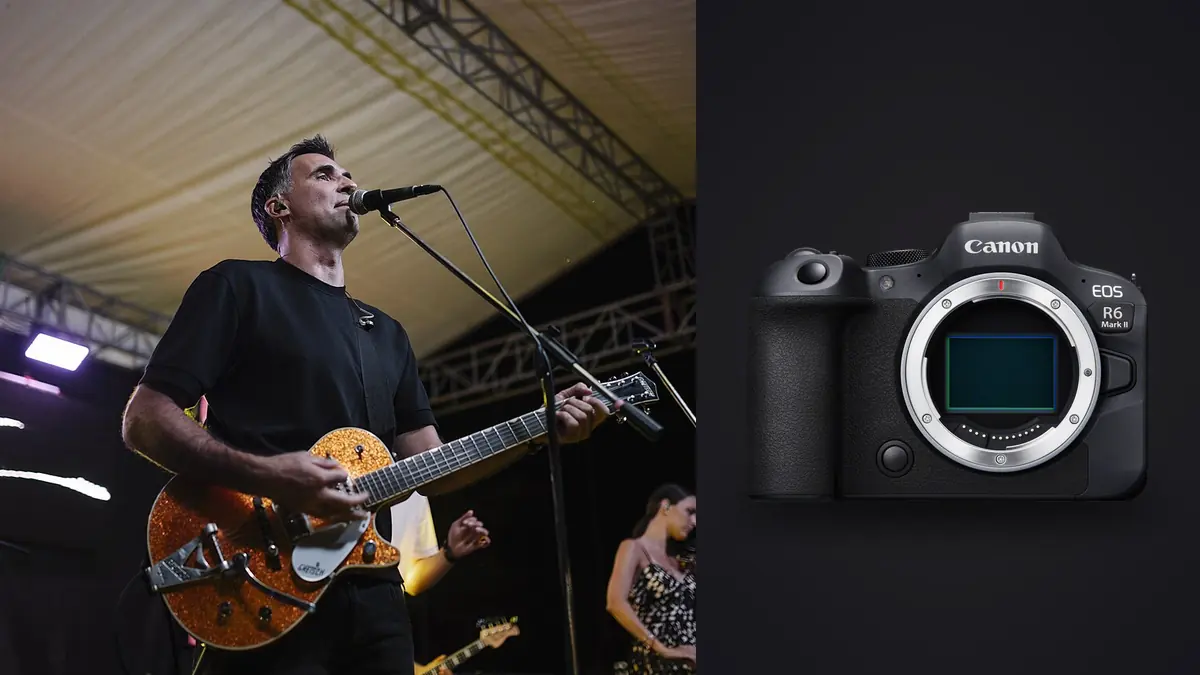
I picked up the R6 Mark II after three years of shooting local shows on an older body that fought me every time the lighting operator got creative. Two songs into my first show with it, a spotlight swept across the singer's face, the AF didn't hunt, and I stopped thinking about the camera for the rest of the set. That's really the whole review. But since a full night in a 300-capacity room or a festival side stage exposes every strength and weakness a camera has, here's what I've actually learned running this body through dozens of shows over the past year and a half.
The sensor and the autofocus matter more than the megapixel count
24.2 megapixels sounds modest next to bodies pushing 33 or 45. For concert work I've stopped caring. Most live photos get published at web resolution or printed as a tour poster crop at most, and the smaller file size means faster buffer clearing and less time waiting between bursts when a guitarist finally does something interesting. What actually matters in a dark room is how the sensor handles ISO 6400 and up, and how the autofocus behaves when the only light source is a single moving spotlight.
Canon rates the AF sensitivity down to -6.5 EV with an f/1.2 lens attached, and in practice that held up in rooms where I genuinely couldn't read a menu on my phone without the screen brightness cranked up. The eye-detect tracking is the bigger deal though. It follows a singer's face through a mic stand, through hair whipping across the frame, through a hand gesture blocking half the face for a second, and picks the eye back up without me touching a button. On drummers, where the useful "eye" is really just staying locked onto a moving head behind cymbals, it's less magic but still better than manual single-point tracking ever was for me.
High ISO is where the real limitation shows up. I'm comfortable pushing to ISO 6400 without much hesitation, and I'll go to 12800 when a shot is worth some visible grain, especially converted to black and white where noise reads as texture rather than a flaw. Past 12800 the files get soft enough that I only reach for it when the alternative is missing the shot entirely.
Pick your shutter mode before the lighting op picks it for you
This is the part nobody warns you about coming from studio or event work. Modern stage lighting, LED par cans, moving heads, and especially the LED video walls that have become standard behind bands even at small venues, all run on some form of pulse-width modulation. Your eye doesn't see it. Your electronic shutter absolutely does, in the form of banding across the frame or, worse, a video wall that reads as a mess of horizontal stripes instead of the animated visual it's actually showing.
The R6 Mark II's 40fps electronic mode is genuinely useful for catching a drumstick mid-strike or a jump at the exact peak, but I only trust it in rooms without LED walls and without fast-moving spotlights sweeping the frame. Here's roughly how I split it across a set:
| Shutter mode | Max frame rate | Risk under LED walls / moving heads | Sound in a quiet room | Typical RAW buffer before it stalls |
|---|---|---|---|---|
| Mechanical | 12 fps | Low, my default anywhere near a video wall or strobing rig | Audible clack, fine over a loud mix, obvious during an unplugged song | Around 140 frames RAW, close to unlimited in CRAW |
| Electronic first curtain | 12 fps | Low to moderate | Quiet with a faint mechanical tail | Around 140 frames RAW |
| Fully electronic (silent) | Up to 40 fps | High, banding and skewed diagonals show up fast under LED screens or a fast-panning spotlight | Completely silent | Around 75 frames RAW before it slows to a crawl |
I set up C1 as full electronic for wide, evenly-lit stages and festival sets where I'm chasing peak action, and C2 as mechanical for anything with a video wall or a headliner who loves rapid strobes. Switching between them is a dial turn, not a menu dive, which matters when you've got maybe four songs of photo pit access before security waves you out.
What actually lives in my bag for a gig
Lens choice depends entirely on where I'm standing, and where I'm standing depends on the venue's rules, not my preference.
| Where you're actually standing | Lens I reach for | Typical aperture | Why |
|---|---|---|---|
| Photo pit, right at the barrier | RF 24-70mm f/2.8 | f/2.8 to f/4 | Wide enough to catch the whole stage, long enough for a tight vocal shot without backing into the barrier rail |
| No pit, shooting from inside the crowd | RF 50mm f/1.2 or RF 35mm f/1.4 | f/1.2 to f/2 | Small enough to work through a packed room, and the extra stop matters when the stage is lit by one par can and a haze machine |
| Theater or arena, seated far back | RF 70-200mm f/2.8 | f/2.8 to f/4 | Reaches face level from twenty rows back, and the in-body stabilization keeps it steady handheld through a whole set |
If I had to keep one lens for the smaller club circuit specifically, it would be the 50mm f/1.2. It's heavier than it looks and the AF hunts a touch more in near-total darkness than the zoom does, but nothing else in the RF lineup pulls in that much light while staying small enough to swing around in a crowd of two hundred people without knocking someone's drink over.
Settings I actually dial in, not the ones in the manual
I shoot manual exposure with auto ISO, minimum shutter speed locked wherever the song tempo demands. For most rock and pop sets that's 1/320s, enough to freeze a drummer's stick without turning every frame slightly soft. For a slower ballad or an acoustic segment I'll drop to 1/125s and accept a touch of motion blur on hand gestures, since it reads as intentional rather than like a missed shot. Aperture stays wide open almost the entire night, f/1.8 to f/2.8 depending on the lens, because stage lighting rarely gives you the luxury of stopping down.
Back-button focus is non-negotiable for me here. Concert lighting changes constantly, and I want the shutter button doing nothing but firing frames while a separate button drives the AF-On tracking. Combined with the joystick to reposition the AF point fast when a second musician steps into frame, it's the one control layout change that made the biggest difference in my keeper rate, more than any camera upgrade did.
Flicker detection I leave on for venues I don't know, off for rooms I've shot before and already know run steady LED rigs. It occasionally adds a few milliseconds of shutter lag hunting for the flicker frequency, which is not something you want mid-crescendo when the singer finally hits the high note you've been waiting an hour to catch.
White balance I set manually and adjust by eye through the EVF rather than trusting auto, since stage lighting swings from cool blue washes to saturated red in the space of one chorus, and auto white balance will chase every change instead of holding a consistent look across a sequence of frames I want to sit next to each other later.
Cards, batteries, and the buffer wall
Both SD slots run UHS-II, and I keep the second card set to backup rather than overflow for anything I can't reshoot, which is every gig by definition. A festival set or a full headline show with two support acts easily produces four to six thousand frames once you're bursting through guitar solos and crowd shots between songs. That's not a criticism of the camera, it's just what 12fps and 40fps modes do to a card over three hours.
Battery life is the other quiet cost of eye-tracking AF running continuously through long bursts. CIPA numbers look generous on paper, but a real night with three acts and continuous AF tracking has drained a single LP-E6NH by the encore more than once. I carry three now and haven't regretted the extra weight.
The part that happens after you leave the venue
Nobody talks about this enough, but the shoot isn't the hard part anymore. Six thousand frames from a three-band bill, most of them burst sequences of the same guitar riff or the same jump, is genuinely more work to sort than it was to capture. I moved my post-show routine to an AI-assisted culling pass a while back specifically because scrubbing through hundreds of near-identical frames by eye at 1am after a gig was killing my turnaround time.
This is where imagic earns its place in my workflow. It clusters those 40fps bursts and flags the sharpest frame in each sequence based on actual local sharpness scoring, not just a guess from a thumbnail, which matters a lot when half the frames in a burst have the singer's eyes closed mid-scream and only one is usable. Because it runs entirely offline, there's no upload step either, which matters more than you might expect at something like an unreleased-album listening session, where a venue's contract might explicitly ban cloud services touching the footage before the label clears it.
The other piece I lean on is apply_my_style, which learns the grade I already apply by hand to my keepers, moody shadows, warm skin tones against cool stage light, and carries that look across a whole night's edit instead of me manually matching color between a red-lit chorus and a blue-lit verse for the hundredth time. It's not doing the creative work for me, it's just keeping a full gig's worth of edits from drifting in tone from song to song. If you're comparing tools for this stage of the workflow, it's worth reading through a proper culling software comparison before committing, since what works for a wedding shooter's file volume isn't always the same as what a three-band bill at 40fps demands.
Frequently Asked Questions
Is 24.2 megapixels enough to sell concert photos to bands and local press?
For web use, social promotion, and most print requests up to a tour poster crop, yes. I've supplied files at this resolution to a regional festival's press kit and a band's album promo without a single complaint about detail. Where it would fall short is a full-bleed billboard print, which almost never comes up in local and mid-size venue work.
Should I shoot mechanical or electronic shutter for stage lighting?
Default to mechanical or electronic first curtain unless you've confirmed the venue's rig won't cause banding. LED video walls behind the band are the biggest risk factor for full electronic shutter, followed by fast-moving spotlights during a chorus. Test a few frames early in the set before committing to 40fps for the whole show.
What ISO can the R6 Mark II handle before noise ruins a shot?
I treat 6400 as the comfortable ceiling and 12800 as the "worth it if the shot demands it" range, especially for black and white conversions where grain reads as style rather than a flaw. Past that, detail softens enough that I only push it when the alternative is missing the frame entirely.
Do I need the RF 70-200mm f/2.8 or can I get by with the f/4 version for gigs?
For photo pit and small club work, the extra stop on the f/2.8 genuinely matters, since you're rarely more than a few meters from the stage and want the shallower depth of field to separate a musician from a busy backline. The f/4 version is lighter and fine for daylight festival sets or seated theater work from a distance, but I wouldn't want it as my only long lens for dark club shows.