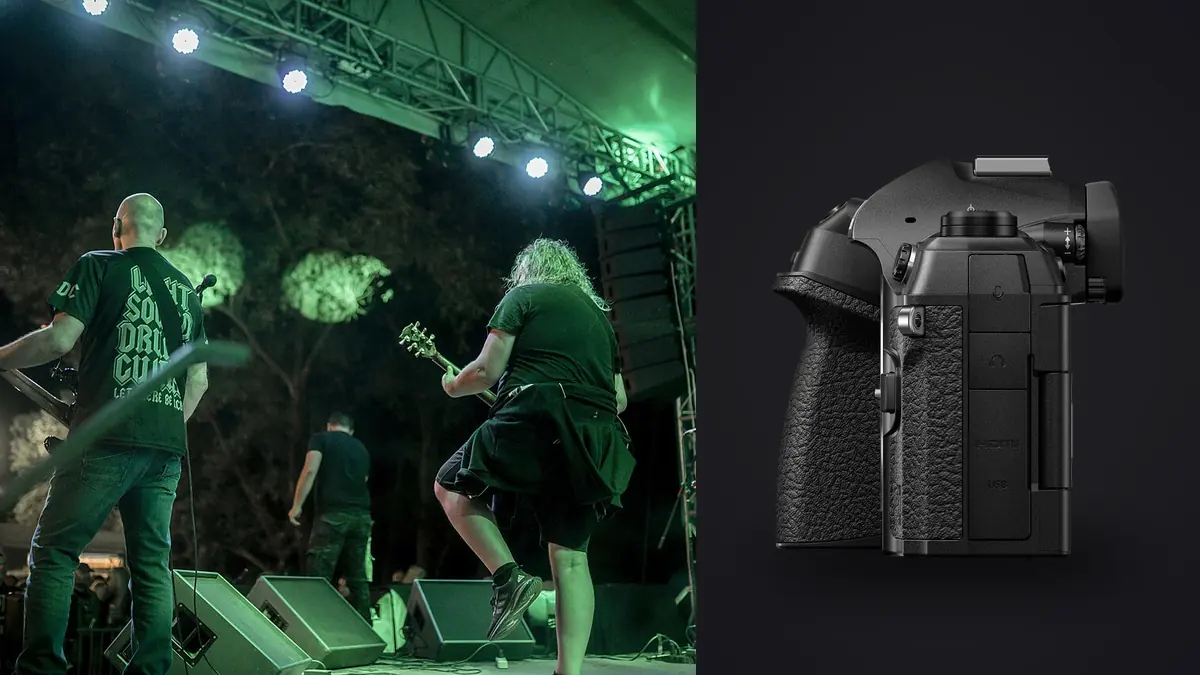
I've handed my three-song pass to a security guard at enough small venues to know that gear choice for concert work is really a series of compromises made in advance, in a well-lit room, long before the first chord hits. The OM System OM-1 Mark II gets pitched mostly as a birding and wildlife body, and on spec sheets alone that's a fair read. But a surprising number of working live music photographers have quietly adopted it for pit work, and after a year of dragging one through clubs, basements, and two outdoor festivals, I understand why. It is not a full-frame killer in low light, and I won't pretend otherwise. It is, however, a genuinely smart tool for a specific kind of concert shooter: the one who works alone, carries their own bags, and needs the camera to keep up with chaos rather than flatter a portrait.
The weight argument nobody explains properly
Most gear write-ups mention the OM-1 Mark II's size as a footnote. For anyone shooting four bands back to back with two bodies and three lenses on a shoulder rig, it's the headline. The body weighs in under 600 grams, and paired with the 12-40mm f/2.8 PRO II you're carrying a genuinely compact rig compared to a full-frame body with an f/2.8 zoom of equivalent reach. Over a ten-hour festival day, that difference stops being trivia and starts being the reason your neck doesn't hate you by the encore.
There's a secondary benefit that doesn't show up in any spec sheet: it's less intimidating. Front-row fans and smaller-venue bookers occasionally get twitchy around a camera that looks like a small cannon. A photographer with an OM-1 Mark II and a compact zoom reads as less of a production, which has, more than once, gotten me an extra song or two of access when a bigger rig would have drawn a polite tap on the shoulder.
Autofocus in light that was never designed for cameras
Concert lighting exists to serve the mood of the song, not the autofocus system pointed at the stage, and that's the real test of any camera in this genre. The OM-1 Mark II's Quad Pixel AF with subject detection handles human and eye tracking reasonably well through gobo sweeps and hard backlight, though I'll say plainly that it is not infallible the moment a strobe wall fires directly into the lens. In steady colored wash, even heavily saturated reds and blues that trip up older contrast-detect systems, it locks fast and holds through headbanging, jumping, and the general chaos of a front person working the barrier.
Where it struggles is the same place every camera struggles: total blackout into sudden spotlight, or a singer silhouetted against a blinding LED wall with no separation from the background. In those moments I switch from full-frame subject tracking to a smaller single-point zone, because letting the camera guess across the whole frame in high-contrast backlight just means more missed shots. That's a workflow choice, not a camera flaw, but it's worth knowing before your first assignment rather than discovering it mid-set.
The honest high-ISO ceiling
This is the part where I have to be straight with anyone comparing this to a full-frame body. The Micro Four Thirds sensor is smaller, and in a genuinely dark room, that shows up as noise earlier than it would on a larger sensor at the same settings. Base native ISO runs 200 to 25600, extendable further, but "extendable" and "usable for a paying client" are different claims. Below is roughly how I set exposure by venue, based on a season of shooting rather than a lab chart.
| Venue type | Light situation | ISO range I actually use | Shutter floor | AF setting |
|---|---|---|---|---|
| Small acoustic room | Even stage wash, minimal movement | 800-3200 | 1/250s | Face/eye priority, single point |
| Standard rock club pit | Moving colored gels, mid-song strobes | 3200-6400 | 1/320-1/500s | C-AF, human detection, wide zone |
| Basement/DIY show | Minimal fixed lighting, low ceiling | 6400-10000 | 1/500-1/640s | C-AF, small zone, manual exposure |
| Festival main stage, night | LED wall plus moving heads | 1600-5000 | 1/250-1/400s | C-AF tracking, watch for wall banding |
| Festival, daylight set | Full sun or open shade | 200-800 | 1/1000s+ | C-AF continuous, wide tracking |
Past ISO 6400 the files get grain that noise reduction can smooth for web delivery but that starts to fight you on anything printed large. I've delivered plenty of usable ISO 8000-10000 club shots because the alternative was no shot at all, but I'm not going to claim they hold up next to a full-frame body's file at the same setting. If your calendar is mostly basement and DIY shows in near-total darkness, that's a real factor to weigh against the weight and speed advantages before you buy in.
Burst rate and the buffer that actually matters
Where the sensor size stops being a disadvantage and starts being an asset is speed. The stacked sensor supports very high frame rates in electronic shutter, and even at more conservative continuous autofocus settings you get enough frames per second to catch a drummer's stick at the exact top of the swing or a guitarist mid-leap without guessing at timing. The two things I actually watch for are rolling shutter distortion on fast-moving LED walls behind the band (which can show as visible banding or skew at the highest frame rates under certain refresh rates) and buffer clearing time when you're firing long bursts through an entire chorus.
With dual UHS-II card slots and fast cards, buffer recovery between bursts is quick enough that I don't feel like I'm waiting on the camera during a three-song set, which is the only window most pit photographers get. The mechanical shutter is still my fallback whenever a venue's LED wall or house lighting rig produces visible flicker banding in electronic shutter mode, since it isn't affected by the same rolling readout issue.
The pre-capture buffer mode is the one feature on this body I didn't expect to lean on and now genuinely miss when I'm shooting anything else. Half-press the shutter and the camera is already holding a rolling buffer of frames from before you fully commit, so a drummer's stick hitting the crash cymbal or a singer's mic-drop moment doesn't depend on your own reaction time beating the sound. I used to accept that I'd miss the exact peak of a jump maybe one time in three. With pre-capture engaged for the more physical bands on a bill, that ratio has flipped in my favor, and it's changed how confidently I shoot anything unpredictable near the barrier.
Battery life across a long bill
A four-band local bill or a full festival day is a different endurance test than a single headline set, and this is a spot where the smaller body shows its trade-offs both ways. Battery life on a single charge is solid for a mirrorless body in this class, but continuous high-speed burst shooting through several sets in a row will pull it down faster than the rated figure suggests, especially with the rear screen active for chimping between songs. I carry two spares in a jacket pocket for anything longer than a three-band bill, and I've learned to swap proactively during a changeover rather than waiting for a low-battery warning mid-song. It's a minor logistics point, but running out of charge two songs into a headliner's set because you were reviewing frames too aggressively during the openers is an entirely avoidable mistake.
Weather sealing you'll actually use
Club photographers can mostly ignore weather sealing. Festival photographers cannot. Between spilled drinks in the pit, sweat off your own hands after an hour of shooting, and the genuine chance of rain at an outdoor stage, the OM-1 Mark II's sealing has saved a body of mine at least twice that I can point to directly. It's rated for dust and splash resistance, and paired with the PRO series lenses (which carry matching sealing), I've shot through a light festival downpour without pausing to towel the camera down between songs. That's not a feature I'd pay extra for on a studio body. For pit and festival work it's close to essential.
Lens choices that actually make sense for this genre
I run a fairly narrow kit for shows, and I'd steer most photographers toward something similar rather than a bag full of options you won't reach for mid-set:
- 12-40mm f/2.8 PRO II as the main workhorse for pit shots at close range, covering wide crowd context through mid-range portraits of the frontperson.
- 40-150mm f/2.8 PRO for bigger rooms or when you're shooting from further back than the barrier, giving genuine reach without the size of a comparable full-frame telephoto.
- 25mm f/1.2 PRO for acoustic sets and smaller rooms where a fast prime buys you a real advantage in dim, still-lit conditions.
One honest caveat on the fast primes: the depth-of-field character at f/1.2 on this sensor size looks closer to an f/2.4 full-frame lens in terms of background separation, even though the actual light-gathering at f/1.2 is real and does help your shutter speed. If you're chasing creamy, full-frame-style bokeh behind a singer, temper your expectations. If you're chasing usable shutter speed in a dark room, the fast glass still earns its keep.
What happens after the last song
Nobody talks enough about the two hours after a four-band bill, staring at nine hundred frames on a laptop in a green room or a car, trying to find the twenty that are actually sharp and actually usable before a 6am editorial deadline. This is where I've leaned on imagic for the culling side of the workflow. It runs entirely on the laptop, no upload, no waiting on a hotel wifi connection that a venue's basement never has anyway, and it scores sharpness and focus locally across a night's worth of burst sequences so I'm not squinting at thumbnails at 2am trying to tell a genuinely sharp frame from one that only looks sharp at small size.
The burst and duplicate clustering matters more here than almost any other genre I shoot, because a high frame rate through a two-second guitar solo produces a stack of nearly identical frames that all need to collapse down to the one or two worth keeping. Once the picks are made, I run imagic's apply_my_style preset, trained on my own past edits rather than a generic filter pack, so a folder mixing three different venues' lighting still comes out with a consistent look before I hand files to a publication or the band. If you're new to building that kind of culling routine at all, this workflow piece covers the basics well, and this explainer goes into more depth on how automated sharpness scoring actually works under the hood.
Frequently Asked Questions
Is the OM-1 Mark II a serious option for professional concert photography submissions?
Yes, with the caveat that publications rarely reject files based on camera brand alone. What they reject is soft or noisy frames. Kept under roughly ISO 6400 and shot with the PRO lenses, files from this body have gone through editorial review without any pushback from photo editors I've worked with. The bigger consideration is your own comfort with the noise ceiling in the darkest venues on your calendar.
How much does the smaller sensor actually hurt in a dark club compared to full frame?
It's real but manageable. You'll typically run one to one and a half stops higher ISO than a full-frame shooter next to you would need for the same shutter speed, and the resulting grain shows up sooner in shadows when you push exposure in post. For web delivery and most print sizes used in music press, it's rarely a dealbreaker. For large-format prints from the darkest shows, it's worth knowing about going in.
What's the realistic ISO ceiling for usable concert shots with this camera?
I treat ISO 6400 as the comfortable working ceiling for anything that needs to look clean, and I'll push to 8000-10000 when the alternative is no shot at all, accepting the extra noise reduction work that follows. Past that range, files get usable for social posts but start to struggle for anything printed larger than a standard editorial spread.
Do I need the full PRO lens lineup, or can budget Micro Four Thirds glass work for shows?
Budget MFT primes can work for smaller, better-lit rooms, but most non-PRO zooms top out around f/4, which costs you a full stop or more exactly where you can least afford to lose it. If you're only shooting occasional daylight festival sets, cheaper glass is a reasonable way to start. For regular club and basement work, the f/2.8 PRO zooms or fast PRO primes earn their price difference in usable shutter speed alone.