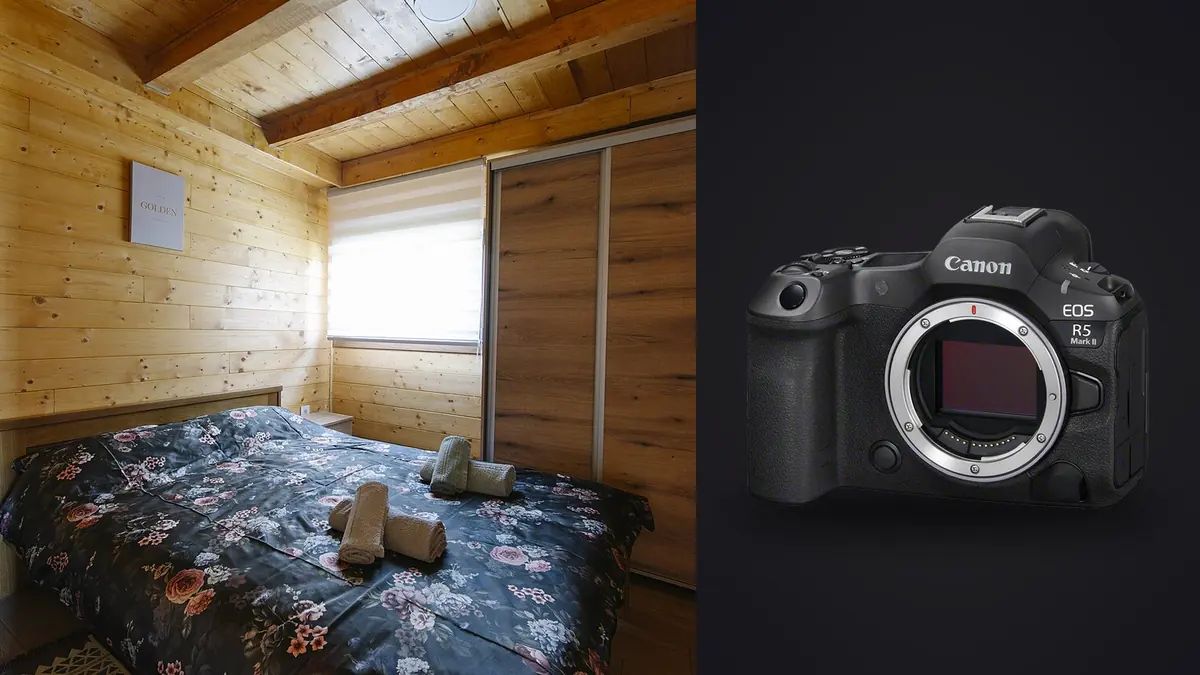
Boudoir is a strange genre to shoot technically. The finished images look soft and effortless, but getting there usually means working in a bedroom-sized space with mixed light, a client who has probably never been photographed like this before, and maybe forty minutes before the mood you built starts to slip. I moved my boudoir kit over to the Canon EOS R5 Mark II a few months back, mostly for the sensor and the shutter behavior, and it changed a handful of habits I'd carried over from years of shooting this genre on older bodies. This isn't a spec sheet rewritten with adjectives. It's what actually mattered once I was in a hotel suite with sheer curtains and a single lamp, trying not to make anyone feel like they were being photographed by a machine.
The shutter noise nobody warns you about
Nobody tells you how much the sound of your shutter matters until you're three feet from someone who's already nervous about being undressed in front of a camera. A loud mechanical clack every frame reads as clinical, almost surveillance-like, and it breaks the quiet you've spent twenty minutes building. The R5 Mark II's electronic shutter is genuinely close to silent, and I use it for probably 90 percent of a boudoir session now. The only sound left is the faint whir of lens IS and whatever room tone is already there, a fan, traffic outside, a playlist.
The catch is that electronic shutter still means a rolling readout, just a much faster one than the original R5. In practice I haven't seen the jello-effect distortion you get on slower stacked sensors when a subject turns her head quickly or fabric moves across frame, the readout is fast enough that it holds up under normal movement. Where I do switch back to mechanical is flash sync above roughly 1/200s, since electronic shutter still caps you at your camera's native sync speed unless you're running HSS, and for any shot where I want the absolute cleanest edges on fast hair or fabric movement under strobe.
Small rooms, low light, and keeping ISO honest
Most boudoir happens in spaces you didn't design: a spare bedroom, a rented Airbnb, a hotel suite with one usable window. I lean on continuous light more than strobe for boudoir specifically, because the subject can see exactly how she looks before the shutter fires, which does more for confidence than any amount of coaching. The tradeoff is less total light in the room, so the in-body stabilization on the R5 Mark II earns its keep. Canon rates it up to 8.5 stops with certain RF lenses, and while I don't trust that number at face value, I can reliably hand-hold a 50mm at 1/30s and get a sharp frame more often than not, which lets me keep ISO around 800 to 1600 instead of pushing past 3200 just to freeze a static pose.
Noise performance on this sensor is clean enough that I don't think twice about 6400 for a moodier, low-key setup lit mostly by a single softbox or window light at dusk. Where I do pay attention is highlight roll-off on skin under harder window light, since the dynamic range is very good but not infinite, and boudoir skin tones fall apart fast if you clip a highlight on a shoulder or collarbone.
| Lighting scenario | ISO | Shutter | Aperture | Shutter mode |
|---|---|---|---|---|
| Morning window light, sheer curtain diffusion | 200-400 | 1/160-1/250 | f/2.0-f/2.8 | Electronic |
| Single continuous LED softbox, evening | 800-1600 | 1/60-1/125 | f/1.8-f/2.2 | Electronic |
| Off-camera flash, bounced ceiling | 100-200 | 1/160-1/200 | f/2.8-f/4 | Mechanical (sync) |
| Candlelight or single practical lamp, low-key | 3200-6400 | 1/60-1/100 | f/1.2-f/1.4 | Electronic |
Autofocus when your subject isn't holding still
Boudoir poses drift constantly, chin turns, shoulders roll, eyes drop and lift again, and a lot of it happens between the moments you'd normally call a "shot." Eye detection on the R5 Mark II holds onto a face reliably even at f/1.2, including through hair falling across the eye or a hand partly covering the jaw, which used to be a real weak point on earlier Canon bodies I shot with. It also does a noticeably better job than its predecessor at re-acquiring an eye after a subject looks away and back, which happens constantly in this genre since a lot of boudoir posing is built around looking away from camera, not into it.
I'll give an honest take on Eye Control AF, since Canon markets it hard: it works well when I'm stationary and the calibration is fresh, but boudoir shooting has me crouching, stepping around the subject, and changing shooting height every few frames, and the tracking gets noticeably less reliable when my own eye position relative to the viewfinder shifts that much. I ended up going back to standard back-button focus with eye tracking active for most sessions and only using Eye Control for static, seated poses where I'm not moving much. Your mileage will depend on how still your own shooting style is, and boudoir tends not to reward standing still.
Lenses in a room you can't back up in
The RF 85mm f/1.2L is the lens everyone recommends for portraiture, and the bokeh is genuinely beautiful, but it needs roughly two meters of working distance to focus comfortably, and most bedrooms and hotel rooms don't give you that once you're framing anything other than a tight headshot. My actual working kit for boudoir is the RF 50mm f/1.2L for closer, more intimate framing where I can still get subject separation, and the RF 35mm f/1.8 Macro IS STM for wider environmental shots in spaces where I'm backed into a corner with nowhere left to go. The 35mm's close focusing distance also earns its keep for detail shots, hands, jewelry, fabric texture, without needing to swap lenses mid-session and lose the flow you've built.
If I only had one lens for a first boudoir shoot on this body, it would be the 50mm f/1.2. It's versatile enough to cover full-length poses in a mid-size room and tight enough to still separate the subject from a cluttered background at f/1.4 to f/1.8.
45 megapixels and what that actually buys you
The resolution matters less for detail than for flexibility after the fact. Boudoir clients frequently want large box prints or an album, not just a web gallery, and having 45 megapixels means I can crop into a composition I like without worrying about print quality falling apart at 16x20. The downside is volume. A two-hour session with continuous shooting for subtle movement, hair settling, a laugh, a breath, easily produces 1,500 to 2,000 RAW frames, most of them near-duplicates of the same three-second moment.
This is where I actually rely on imagic to get through a session in a reasonable amount of time. It clusters those burst sequences and near-duplicates together instead of making me scroll through them one at a time, and its sharpness scoring flags which frame in a cluster actually has the crisp eye focus versus the one that just looks fine on a laptop thumbnail. On a boudoir shoot that distinction matters more than usual, since a soft-focus eye at f/1.2 is a lot less forgiving than it would be at f/5.6.
Where the files actually go after the shoot
Boudoir is one of the few genres where the sensitivity of the files themselves is part of the job. Clients ask, reasonably, where their images live and who can see them before they're delivered. I stopped using culling tools that route images through a cloud service years ago, partly for speed and partly because it would be awkward to explain to a subject that her images had briefly passed through someone else's server to get sorted. imagic runs entirely on the machine, nothing gets uploaded to cull or score a set, which is a genuinely useful thing to be able to tell a nervous client honestly rather than as a sales line. If you want the mechanics of how that local scoring actually works, this breakdown of how AI photo culling works covers it in more depth than I will here.
Matching skin tones across a session
Canon's color science has always handled skin well straight out of camera, warm without tipping orange, but a boudoir session under mixed light (a warm practical lamp, cool window spill, maybe a gelled accent light) will still drift in white balance from setup to setup within the same shoot. Rather than hand-correcting every frame, I run a trained apply_my_style preset built from my own previously edited boudoir work through imagic first, which gets skin tone and contrast into a consistent starting point across the whole set before I go in and hand-finish the dozen or so images that will actually be shown full-size. It's not a replacement for actually knowing how to grade skin, more a way of not repeating the same twelve adjustments four hundred times. For the grading side specifically, this guide to color grading is worth a read if you're building your own preset from scratch.
Frequently Asked Questions
Is the electronic shutter on the R5 Mark II actually silent?
Close, but not absolute. There's no mechanical clack, which is the sound that matters most in an intimate setting, but you'll still hear lens IS motors and whatever ambient sound is already in the room. Clients notice the absence of the click far more than they notice anything that's left.
Do I really need 45 megapixels for boudoir work?
If you're only delivering web galleries, no, it's more file than you need and it slows your culling and export times for no visible benefit. If you sell large prints, canvases, or box sets, the extra resolution gives you real cropping room without a client ever knowing you reframed the shot after the fact.
Can I rely on Eye Control AF for a whole boudoir session?
I wouldn't build a whole session around it. It performs well for static, seated poses where you're not changing shooting height or angle much, but boudoir involves a lot of crouching and repositioning, and I found the tracking degraded when my own eye position relative to the viewfinder shifted that often. Standard eye-tracking AF with back-button focus was more consistent for me across a full shoot.
What's a reasonable starter lens for boudoir on this body?
The RF 50mm f/1.2L is the most versatile single choice. It handles full-length poses in an average bedroom or hotel room and still gives you strong subject separation for closer framing, without the working-distance problem you run into with an 85mm in a tight space.