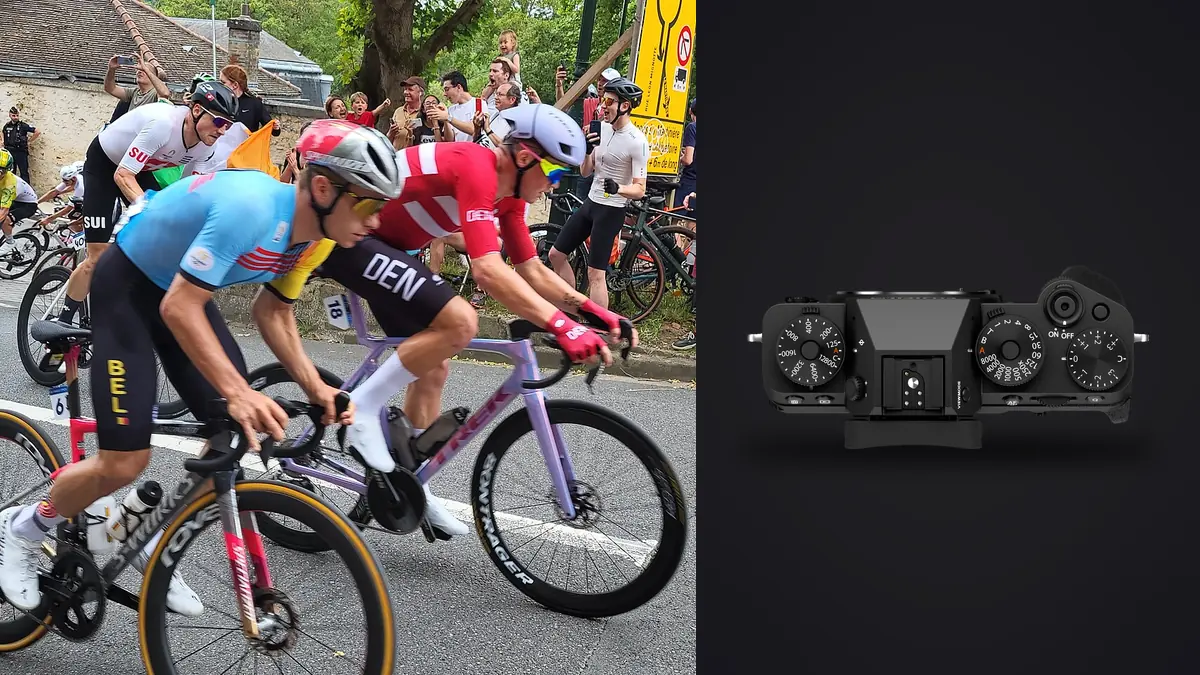
I shot my first indoor track meet with the X-T5 about three weeks after picking it up, mostly out of curiosity rather than confidence. I'd been carrying an X-T4 for two seasons of high school and club meets and figured the jump to 40 megapixels would either be a genuine upgrade or a headache I'd regret by the third heat. It turned out to be both, depending on which part of a track meet you're covering, and that split personality is really the whole story of using this camera for sport.
Why the Sensor Resolution Cuts Both Ways
The X-T5 uses Fujifilm's 40.2-megapixel X-Trans CMOS 5 HR sensor, the same generation found in the X-H2 but without the stacked readout architecture of the X-H2S. That distinction matters more for track and field than for almost any other genre I shoot, because it determines how the sensor reads out data when you switch to the electronic shutter. A stacked sensor reads the whole frame nearly instantaneously. A conventional back-illuminated sensor like the one in the X-T5 reads line by line, top to bottom, and at 40 megapixels that readout takes noticeably longer than it does on a lower-resolution chip.
In practice this shows up as rolling shutter skew. Point the X-T5 at a sprinter coming through the final fifty meters with the electronic shutter engaged and a fast pan, and you can get subtle diagonal distortion in the legs and torso, worse the closer the subject is and the faster the pan speed. It's not always visible at web resolution, but crop into a 40-megapixel file for a print order and it shows. The mechanical shutter doesn't have this problem, which is why I keep the X-T5 on mechanical for anything involving a hard lateral pan, sprints, hurdles, relay legs, even though that caps me at a lower burst rate than the electronic option offers.
On the flip side, that resolution is genuinely useful for field events. Long jump, triple jump, pole vault, discus, anything where the athlete is farther from the fence than a sprinter on the near straightaway. A 40-megapixel file gives you room to crop in post without the image falling apart, which matters a lot when your longest lens tops out around 400mm and the pit is sixty feet away.
Autofocus: Straight Lines Are Easy, Curves and Handoffs Are Not
Fujifilm's subject detection AF, added to the X-T5 through firmware after launch, handles humans reasonably well in a straight line. A 100-meter dash down a lane toward the camera is close to the easiest tracking scenario you'll find in this sport: predictable trajectory, consistent distance change, no lateral drift to speak of. The X-T5 locks onto that and mostly stays locked, assuming you've picked a sensible AF-C custom setting (I run something close to Set 4, tracking sensitivity high, speed tracking sensitivity toward the faster end, because meets rarely give you a subject that decelerates smoothly).
Where it gets harder is the curve on a 200m or 400m, where the runner's angle relative to the camera changes continuously, and relay exchanges, where two athletes overlap in the frame for a fraction of a second and the AF system has to decide who to hold onto. I've had the X-T5 jump from the outgoing runner to the incoming runner mid-exchange more times than I'd like, usually because the incoming athlete is larger in frame at the moment of the handoff and the algorithm reads that as the more prominent subject. Shrinking the AF zone down from wide/tracking to a single tighter zone around the baton exchange point helps, but it means giving up some of the automatic subject-finding that makes wide-tracking convenient elsewhere.
Hurdles sit in between. The vertical clearance moment is predictable enough that pre-focusing on a hurdle and timing the shutter manually still beats relying purely on continuous AF for me, a habit I never quite gave up from shooting DSLRs years ago.
Burst Speed and the Card Bottleneck That Actually Bites
The X-T5 shoots 15 fps with the mechanical shutter and up to 20 fps with the electronic shutter, though the electronic mode applies a 1.29x crop. On paper that sounds competitive with cameras built specifically for sport. In practice, the limiting factor for me has never been the shutter, it's the card slot. The X-T5 takes UHS-II SD cards only, no CFexpress option, and at 40 megapixels uncompressed or even compressed raw, that write speed becomes the real ceiling on how long a burst you can sustain before the buffer fills and the frame rate collapses.
Shooting a 200m final at 15 fps mechanical, I get a genuinely usable buffer for maybe two to three seconds of continuous raw capture before things slow down, which is enough for one clean stretch of the race but not enough to hold the shutter down from gun to tape. I've adapted by shooting shorter, more deliberate bursts timed to specific phases (the start, the curve, the drive to the line) rather than trying to record the whole race as one long sequence the way I might with a body that has a deeper buffer and faster card interface. It's a workflow adjustment more than a dealbreaker, but it's worth knowing before a meet, not during one.
One consequence of shooting in short deliberate bursts at 40 megapixels is that you end up with a lot of near-duplicate frames from every phase you did capture, which is exactly the kind of pile I don't want to sort through by eye at midnight. I run everything through imagic afterward specifically because its burst clustering groups those sequences automatically and its local sharpness scoring flags which frame in each cluster actually has the sharpest eyes and cleanest foot strike, without me squinting at 40-megapixel previews on a laptop screen at a hotel desk. That basic mechanism, grouping bursts and ranking sharpness before a human has to look at anything, is the same one I walked through in more detail in how AI photo culling actually works.
How the X-T5 Stacks Up Against Fuji's Other Sport-Leaning Bodies
| Spec relevant to track shooting | Fujifilm X-T5 | Fujifilm X-H2S | Fujifilm X-T4 |
|---|---|---|---|
| Sensor | 40.2MP X-Trans 5 HR (non-stacked) | 26.1MP X-Trans 5 HS (stacked) | 26.1MP X-Trans 4 (non-stacked) |
| Max mechanical burst | 15 fps | 15 fps | 15 fps |
| Max electronic burst | 20 fps (1.29x crop) | 40 fps (1.29x crop) / 20 fps full width | 20 fps (1.25x crop) |
| Rolling shutter risk on fast pans | Noticeable | Minimal (stacked readout) | Noticeable |
| Card slots | UHS-II SD x2 | CFexpress Type B + UHS-II SD | UHS-II SD x2 |
| Vertical grip available | No | Yes (VG-XH) | Yes (VG-XT4) |
| Body weight (with battery) | 557g | 660g | 607g |
| Resolution advantage for cropping field events | High | Moderate | Moderate |
If a meet is genuinely the priority (a state championship, a paid assignment where you need eight seasons' worth of relay exchanges without buffer clearing), the X-H2S is the better tool and it is worth renting one for exactly those days. But for a photographer who's covering track as one part of a broader portfolio and doesn't want to own two bodies, the X-T5 does the job at a lower price and a lighter carry, with the specific caveats above.
Glass That Actually Makes Sense at a Track
The APS-C crop factor works in your favor here in a way it doesn't for wildlife shooters chasing reach on a budget, because a 1.5x crop on a mid-length telephoto gets you close to a full-frame equivalent without the weight or cost of exotic glass. My most-used combination is the XF 70-300mm f/4-5.6, which gives roughly 105-450mm equivalent and is light enough to hand-hold for a full meet without a monopod. For infield work, discus and shot put especially, I've had good results with the XF 100-400mm, though it's noticeably heavier and I only bring it out for meets where I know I'll be stationed close to a throwing sector for a while.
For anyone shooting a 400m oval from one fixed position at the finish line, the reach math changes fast. A 150-600mm on an adapter gets you tight shots of the backstretch that a 70-300mm simply can't deliver, but autofocus performance with third-party adapted glass on Fuji bodies has always lagged the native lens lineup, and I've had noticeably more missed frames with an adapted 150-600mm than with native XF glass on fast-moving subjects.
Settings I Actually Run Trackside
Shutter priority isn't something I use much elsewhere, but for track it's close to essential because light changes constantly between indoor gym lighting, overcast outdoor meets, and the occasional bright afternoon session, and I don't want to be riding ISO manually between events. I set a minimum of 1/2000s for sprints and hurdles, and I'll drop to 1/1000s for field events where the subject moves more slowly through the frame. Auto ISO with a ceiling around 6400 keeps files clean enough that the X-T5's already-demanding 40-megapixel raws don't get noisy on top of being large.
For AF, I keep three custom banks: one wide-tracking preset for sprints where the athlete comes straight at me, one small-zone preset for relay exchanges and hurdles where I want to control exactly what the camera locks onto, and one single-point preset for field events where the subject holds still for a beat before the throw or jump. Switching between them with the front command dial takes under a second once it's muscle memory, and it's saved more frames than any single body setting I've found.
Getting Through the Files After the Meet
A full day at a multi-event meet with the X-T5 easily produces four to six thousand frames once you add up every heat, final, and field attempt, and at 40 megapixels that's a genuinely heavy folder to open in a normal browser or DAM tool. This is the part of the workflow that changed the most for me after I switched to imagic. It processes everything locally on the laptop I bring to meets, which matters because gym and stadium wifi is unreliable enough that I don't want a workflow depending on cloud upload before I can even start culling. The duplicate and burst clustering groups each short burst I described earlier into a single stack instead of six thousand individual thumbnails, and from there the focus scoring does the first pass of picking the sharpest frame per stack before I ever touch the keyboard.
The other piece that's saved real time is the apply_my_style feature, which trains a preset off my own past edits rather than a generic look someone else built. Track photos tend to need a fairly consistent treatment, contrast, a slight cool cast for indoor gym lighting, warmth pulled back on outdoor afternoon sessions, and having that applied automatically to a first pass across a few thousand images means I'm adjusting outliers rather than starting from zero on every single frame. If you're trying to get faster at moving from card to delivered gallery generally, the culling stage is usually where the time actually goes, more than editing itself, a point covered in more depth in tips for a faster photo workflow.
None of this fixes the rolling shutter or buffer limitations discussed above. Software can't undo skew that's baked into the raw file or make an SD card write faster than its interface allows. What it does is make the volume of a big meet manageable enough that the camera's real limitations are the only ones you're still fighting by the end of the day.
Frequently Asked Questions
Is the X-T5's rolling shutter bad enough to avoid electronic shutter entirely at track meets?
Not entirely, but I'd avoid it for anything with a fast horizontal pan close to the camera, meaning sprints and the home straight generally. For field events where the subject is farther away and moving less laterally, discus spins aside, electronic shutter at 20 fps is usable and the crop isn't a major loss given the reach you already have from APS-C glass.
Should I buy the X-T5 specifically for sports, or look at the X-H2S instead?
If sport is genuinely your primary subject and you're shooting paid assignments where missed frames cost you, the X-H2S's stacked sensor and CFexpress buffer depth are worth the extra weight and cost. If track is one part of a broader shooting practice that includes portraits, landscapes, or events where the X-T5's resolution and smaller body are assets rather than liabilities, the X-T5 is the more sensible single-body choice.
What card should I use to minimize buffer clearing during bursts?
A fast UHS-II card rated for sustained write speeds above 250MB/s is the realistic minimum given the file sizes involved, and even then you're working within the ceiling of the SD interface itself rather than a CFexpress bus. Two cards of that spec in the dual slots, set to overflow rather than backup, gives you the most usable capacity per outing.
Does the 40-megapixel file size actually help for track photos, or is it just extra storage to manage?
It helps specifically for field events shot from a fixed, distant position, where cropping into a smaller portion of the frame still leaves a usable file. For sprints and close action where you're already framing tight with a long lens, the extra resolution mostly just means bigger files and slower culling unless you're running something that clusters and scores bursts locally before you start opening individual images.