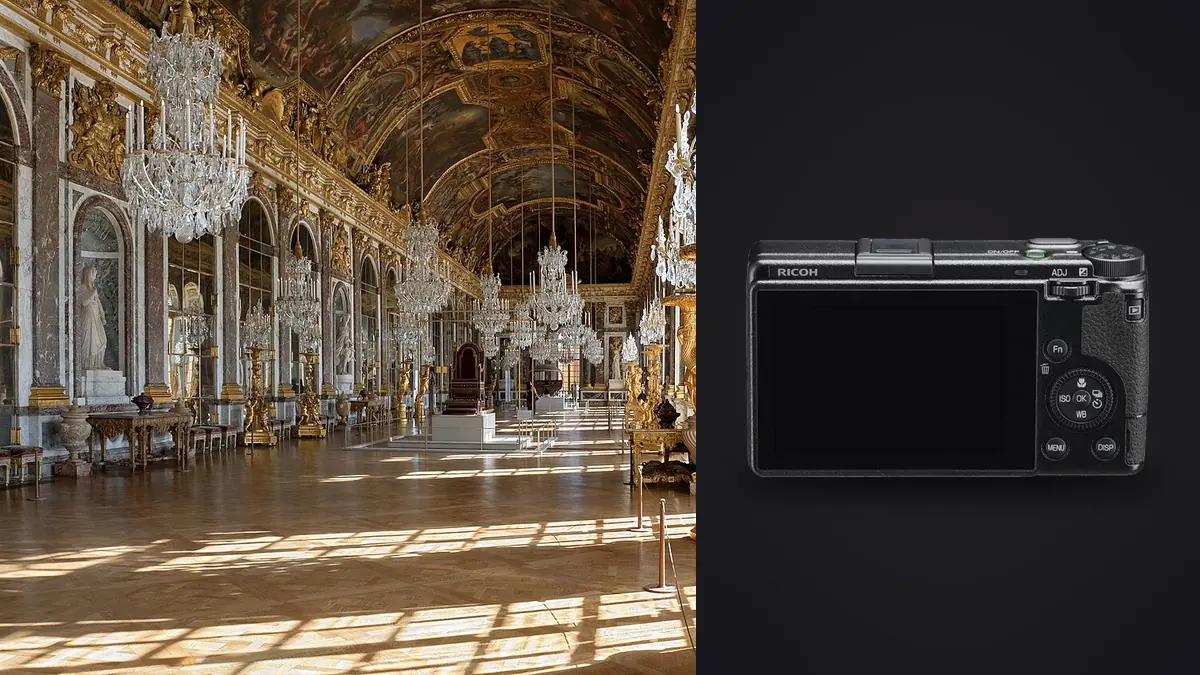
The Ricoh GR IIIx is a compact APS-C camera with a fixed 26.1mm f/2.8 lens, giving an angle of view similar to 40mm on full frame. That field is natural for details, vignettes, and layered views through a space. It is not wide enough to show many small rooms from wall to wall, and no lens change can solve that limitation.
Whether it is suitable for interiors depends on the assignment. A designer documenting materials, a traveler recording atmosphere, or a scout making visual notes may value its size and direct controls. A real-estate job requiring broad room coverage, perspective control, dual-card redundancy, and a complete professional lens range will usually need a different system.
Understand what a 40mm-equivalent view includes
A 40mm-equivalent lens sits between a traditional normal and a moderate wide view. In a medium room it can show a seating area, a kitchen work zone, or a relationship through a doorway without stretching nearby furniture. It often produces more natural proportions than an ultra-wide lens.
In a bathroom, narrow corridor, small bedroom, or room where the camera cannot step back, the lens may include only part of the space. Cropping cannot make it wider. A stitched panorama could broaden coverage in separate software, but moving objects, close furniture, and parallax make that an unreliable substitute for a wider lens, and imagic does not merge panoramas.
Use the limitation intentionally. Photograph how one material meets another, frame a chair against a window, layer two rooms, or isolate a fixture. If the brief expects every wall in one frame, the GR IIIx is the wrong primary camera.
Where compact size becomes an advantage
The small body is useful for scouting, travel, occupied properties, restaurants during setup, and editorial work where a large kit would interrupt the space. It can be placed close to a wall or into a narrow opening, and it attracts less attention in public interiors.
Compactness also makes it a useful visual notebook beside a larger architecture system. It can record alternative angles, styling details, and location references while the main camera remains locked on a tripod. Synchronize clocks if both sets will be combined.
The advantage disappears if the small body encourages careless handling. Use a wrist strap, protect the retracting lens, and keep dust away from the extension mechanism. A compact camera can still damage a finished surface if placed directly on furniture.
Resolution is useful, but framing comes first
The APS-C sensor records roughly twenty-four megapixels, enough for many editorial, web, and normal print uses. Moderate straightening and crop are practical when capture is sharp. Severe correction for a tilted camera can stretch corners and reduce the useful file quickly.
The fixed lens and sensor are well matched, but high detail still depends on focus, aperture, camera movement, and RAW processing. A small aperture increases depth but eventually softens fine texture through diffraction. Test the likely aperture at the final output size.
If the client requires large wall graphics or extensive crop variants, make a sample file in the intended room and process it through the actual delivery. Do not decide suitability from megapixels alone. Output distance and content matter.
Stabilization helps handheld details, not geometry
Sensor-shift stabilization can reduce camera shake in a dim interior, which is useful for details and informal environmental frames. It does not keep walls vertical, freeze people, or balance a bright window. Shutter speed still needs to account for moving curtains, leaves, screens, and occupants.
For a deliberate room view, use a tripod or stable support and the self-timer or remote control method supported by the camera. Confirm how stabilization should be set on that support using Ricoh guidance and a sharpness test. Keep the camera level before deciding that software will correct the frame.
The body is light, so a small tripod can carry it, but the tripod still needs stiffness. An extended center column and thin legs can move in air conditioning or when someone walks nearby. Place support where it cannot obstruct staff or damage the floor.
The fixed screen affects low and tight positions
The rear display does not articulate, which makes very low, high, or wall-adjacent viewpoints harder to compose. A phone-based remote view may help where the camera supports it, but it introduces connection and battery dependencies. Test the current app and connection before an assignment.
Without a built-in viewfinder, the rear screen is the main composing surface. Bright windows can make it hard to judge, and screen brightness can mislead exposure. Use the histogram, highlight warning, and level rather than visual brightness alone.
A low-profile right-angle solution is not built into the camera. If frequent floor-level or overhead architecture is central to the work, a body with an articulating screen may save enough time and strain to outweigh compactness.
Perspective correction has firm limits
Tilting the camera upward makes vertical lines converge. The GR IIIx cannot accept a shift lens, so the options are to keep the camera level, change height and distance, or correct the result later with a crop penalty. Leave generous space around the subject if correction is planned.
A 40mm-equivalent view reduces some of the dramatic edge stretching associated with ultra-wide lenses, but it does not make a tilted camera geometrically neutral. Use door frames and cabinetry as guides. Old buildings may not be square, so choose a coherent reference rather than forcing every line.
For commissioned architecture where vertical control and precise framing are non-negotiable, an interchangeable-lens body with a suitable wide or perspective-control lens is the better primary tool. The GR IIIx can remain the detail camera.
Single-camera and single-card risk need a plan
The GR IIIx uses one SD card slot and includes internal memory for limited use. It cannot create the same on-camera duplicate RAW arrangement as a dual-slot professional body. Use tested cards, carry spares, and copy the session promptly. Internal memory is not a replacement for a verified external backup workflow.
Battery size reflects the compact body. Carry charged spares for a full location day, keep contacts protected, and disable unnecessary wireless functions. A USB power option can help in controlled use, but a cable on a tripod creates a trip and pull risk.
For an irreplaceable commissioned interior, consider a second camera. Redundancy is not only another battery; it is a working way to finish if the fixed lens mechanism, screen, card slot, or body fails.
Color and window contrast remain full-size problems
Mixed daylight, warm lamps, LEDs, and reflected wall color can create gradients that one white-balance setting cannot solve. Photograph a neutral reference at the main subject position and decide which source should appear neutral. Switch, match, flag, or supplement lights when accurate materials matter.
Bright exterior views can exceed the desired room exposure. Choose the priority, add controlled light, wait for a better time, or capture bracketed source frames for separate HDR-capable software. The GR IIIx does not make the contrast disappear, and imagic does not merge HDR exposures.
Protect white walls and window trim with the histogram while keeping enough interior signal. A dark final mood should be created deliberately rather than through severe underexposure that later reveals noise and weak color.
Who should buy it for interior work
The GR IIIx is a strong fit for designers, editors, travelers, and photographers who want a small detail and atmosphere camera. It suits spaces where natural perspective and selective framing matter more than complete room coverage. It also works well as a scouting tool whose files are good enough to publish when the frame fits.
It is a weak fit as the only camera for real-estate listings, small-room surveys, high-end architectural commissions, or jobs requiring wide and shifted views. The fixed 40mm-equivalent lens, non-articulating screen, single card, and limited system redundancy are structural constraints rather than settings to solve.
For an honest purchase test, borrow or rent one, visit the smallest typical room, and create the complete requested shot list. Process the DNG files, correct verticals, and export at delivery size. Count missing compositions, not only successful details.
A simple suitability table
| Interior task | Fit | Reason |
|---|---|---|
| Material and fixture details | Strong | Natural perspective and compact handling |
| Editorial room vignettes | Strong | Selective framing suits the fixed lens |
| Location scouting | Strong | Small carry size and useful RAW files |
| Small-room overview | Weak | Field of view is often too narrow |
| Perspective-controlled architecture | Weak | No interchangeable or shift lens |
| High-redundancy commission | Limited | Single card slot and fixed-lens body |
Compare other bodies in the camera hardware guides and review optical choices in lenses and optics. Buy the GR IIIx because its view serves the work, not because its compactness can be stretched into every role.
Keep the accessory kit proportional to the camera
A small tripod, secure plate, spare batteries, tested SD cards, blower, cloth, neutral target, and compact polarizer cover most GR IIIx interior needs. An adapter tube may be required for certain filters or conversion accessories; use only compatible parts and confirm that they do not obstruct the retracting lens.
A circular polarizer can control glare on wood, tile, and some glass, but its effect varies with angle and may create uneven results across reflective surfaces. It also reduces light and can reveal stress patterns in glazing. Make a comparison without the filter before accepting the stronger effect.
Wide conversion accessories, if considered, change the compact premise and need optical, corner, metadata, and handling tests. They do not provide lens shift. If several attachments are required to make the camera cover a routine assignment, an interchangeable-lens system is probably the cleaner purchase.
Match the camera to a concrete location type
In a restaurant, the GR IIIx can record table arrangements, fixtures, plates, and layered views before opening, but it may not show the whole dining room. In a hotel, it can describe materials and atmosphere while struggling in the smallest bathroom. In a designer's studio, it can document objects and work areas naturally.
For a large gallery or public building, the field of view can produce restrained architectural fragments and human-scale scenes. For a property listing, missing wide room views may make the set unusable regardless of detail quality. Suitability changes with the deliverable, not with the prestige of the location.
Write the required frames for one representative site and mark which the fixed lens can make without stitching, unsafe positioning, or extreme correction. That exercise turns a vague buying preference into an operational answer.
Frequently asked questions
Is 40mm equivalent wide enough for interior photography?
It is wide enough for details, vignettes, and some medium-room views, but often too narrow for small-room overviews. Test the smallest typical space before choosing it as a primary camera.
Can the GR IIIx correct converging verticals?
Software can correct a tilted frame with crop and stretching, but the camera cannot mount a shift lens. Keeping the body level and choosing height carefully preserves more of the file.
Is the GR IIIx suitable for paid real-estate work?
It can produce useful detail frames, but its fixed field of view and single-card design make it a limited sole camera for a complete listing. A wider interchangeable system is usually more dependable.