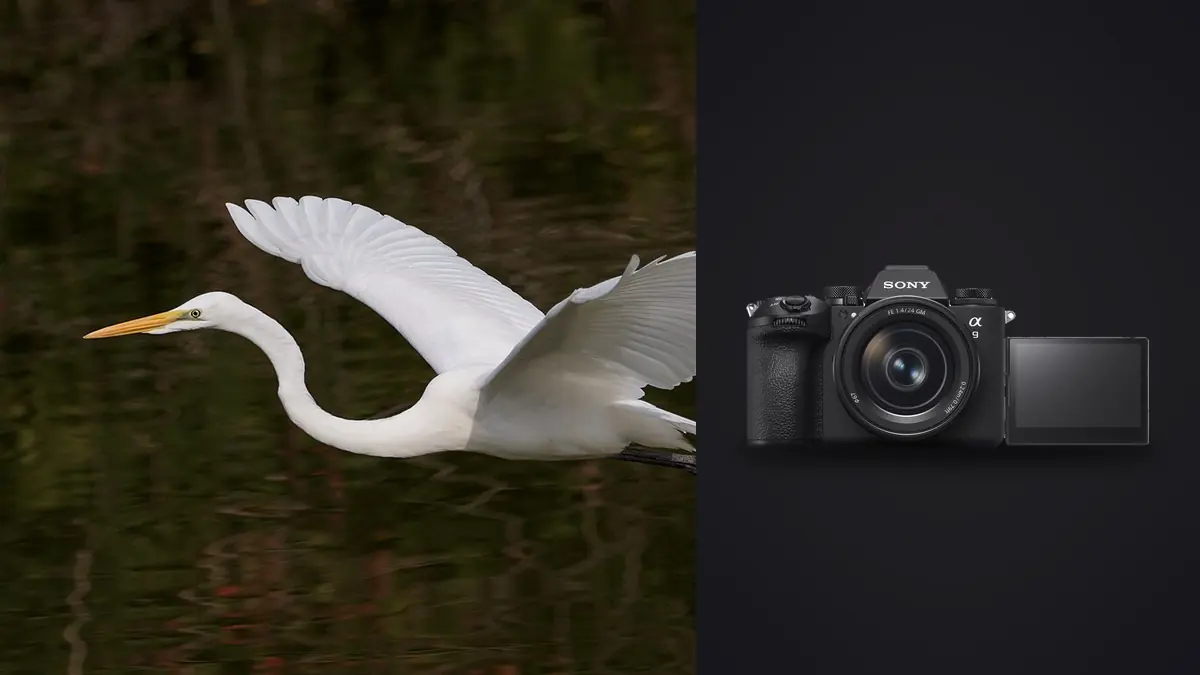
The first time I put a Sony A9 III on a monopod and pointed it at a tern colony, I wasn't testing the camera so much as testing whether a full-frame global shutter sensor could actually fix the problem that ruins more bird-in-flight frames than bad autofocus ever does: wing-tip skew from rolling shutter. Two mornings in, the answer was clear enough that I stopped carrying my old A9 II as a backup body and just left it at home.
This isn't a spec sheet rundown. Sony's marketing already covers the headline numbers well enough. What follows is what changes in practice when you take this sensor out to a wader roost at first light, how the frame rates you'll actually use differ from the ones printed on the box, and where the trade-offs that come with a global shutter show up in real files, not lab charts.
The Sensor Swap That Actually Matters
Every CMOS sensor before this one, stacked or not, reads out row by row. On a bird moving fast across the frame, that tiny delay between the top row and the bottom row bends straight lines and skews wingtips. You've probably seen it without knowing what caused it: a swift's wing looking subtly warped, a heron's primaries curved in a way they weren't in real life. It's most obvious on species with long, thin wings moving at speed, terns diving, swallows banking hard, ospreys folding up before a strike.
A global shutter exposes every pixel at the exact same instant, so that distortion simply isn't possible. There's no "less rolling shutter" to brag about here, it's not a matter of degree. I went back through a season of A9 II files afterward specifically looking for skewed wingtips on fast passerines, and once I knew what to look for, I found it in a distressing number of otherwise sharp frames I'd already kept. The A9 III doesn't produce that artifact at all, at any shutter speed, at any frame rate.
The other consequence of a global shutter gets talked about less but matters just as much for anyone photographing birds around water or in low light: flash sync at any shutter speed, up to 1/80000s. If you shoot hummingbirds with strobes, this removes the whole high-speed-sync compromise other systems force you into. You get full flash power at shutter speeds that would normally cut a rolling shutter camera down to a sliver of its sync speed.
Frame Rates You Won't Actually Use All Day
120fps is the number everyone quotes, and it's real, blackout-free through the viewfinder, full autofocus and autoexposure tracking the whole time. But I don't shoot at 120fps for most of a morning, and I'd argue you shouldn't either. At that rate a five-second burst is 600 frames, and culling 600 near-identical images of a cormorant drying its wings is not a good use of an evening. I keep the camera at 30fps for general flight tracking, which is already faster than most cameras I've owned outright, and reserve 120fps for the moments where wing position genuinely changes frame to frame at a rate you can't predict: a kingfisher's dive, a peregrine's stoop, anything under about half a second total duration.
There's also a quieter, less-hyped mode worth using around skittish species: fully silent electronic shooting with zero shutter noise and zero shutter shock, at up to 30fps, without the rolling shutter risk that made silent mode a compromise on older bodies. On a heron rookery where a mechanical shutter clack at the wrong moment flushes an entire colony, that alone changes what you can get close to.
Pre-Capture Buffering Changes How You Trigger the Shutter
The A9 III buffers frames continuously once you half-press the shutter, and you can set it to retroactively save up to a full second of frames from before you fully press the button. That sounds like a gimmick until you've tried to time a heron's takeoff by eye. Human reaction time is roughly a fifth of a second, and a bird going from standing to airborne can be well into the wingbeat you wanted by the time your finger catches up. With pre-capture set to its longest window, I've gotten clean launch sequences on birds that were already three wingbeats into flight by the time I consciously reacted.
The catch is that it changes your shooting rhythm. You have to half-press and hold earlier and longer than feels natural, which burns through buffer and battery faster than the old habit of snapping the shutter the instant something happens. I've settled on using the 0.5-second pre-capture window as a default rather than the full second, it catches the launch without me holding a half-press through every minute of dead time between actual bird activity.
Autofocus When the Bird Won't Cooperate
Sony's AI-based subject recognition can identify birds specifically, distinguishing eye, head, and body even at awkward angles, and it's genuinely better at holding onto a small bird against a busy background than the A9 II was. Where it still trips up is dense reed beds and branch clutter, the system occasionally locks onto a twig with a bird-shaped silhouette behind it rather than the bird itself, especially with subjects smaller than a duck at longer distances. I've had it happen most often photographing reed warblers and other small passerines low in vegetation, less often with anything larger flying against open sky.
My working setup is back-button focus with tracking sensitivity turned down from the default, which stops the AF from jumping to a closer branch every time a bird ducks behind one for a fraction of a second. For open-sky flight work, like gulls or raptors against a plain background, I leave tracking sensitivity higher and let the camera chase harder, because there's nothing else in frame for it to latch onto by mistake.
How the A9 III Stacks Up for Bird-in-Flight Work
Resolution, sensor readout, and how each of these bodies handles fast wingbeats matter more for this specific use case than most general camera comparisons cover. Here's how the current full-frame options actually differ once you narrow the lens to birds in flight specifically:
| Camera | Max burst (AF/AE tracking) | Sensor readout | Rolling shutter on fast wingbeats | Native ISO range | Launch price (body) |
|---|---|---|---|---|---|
| Sony A9 III | 120fps | Global shutter | None, at any speed | 250-25600 | $5,998 |
| Sony A1 II | 30fps | Stacked BSI CMOS | Minimal, occasional skew on very fast subjects | 100-32000 | $6,499 |
| Nikon Z9 | 20fps full-res raw (30fps/120fps in reduced-resolution modes) | Stacked CMOS | Minimal at full res, more noticeable in crop burst modes | 64-25600 | $5,499 |
| Canon R5 Mark II | 30fps | Stacked CMOS | Minimal, well controlled but present | 100-51200 | $4,299 |
The number that jumps out for anyone shooting fast, erratic fliers is the "none, at any speed" row. Every other camera on that list is genuinely good, and the difference in a single frame might be invisible. It shows up over a season of shooting, in the small percentage of frames per outing where a stacked sensor's residual rolling shutter quietly ruins an otherwise perfect wing position and you don't notice until you're looking closely at full resolution back at the desk.
What the Global Shutter Costs You
Nothing here comes free. The A9 III's base native ISO is 250, not the 100 you'd expect on a modern full-frame body, and independent testing has consistently put its usable dynamic range roughly a stop behind the A1's stacked BSI sensor at base ISO. For bird photography this shows up specifically in backlit scenes, a bird against a bright overcast sky where you're trying to hold detail in both dark plumage and blown-out cloud. I shoot a touch more conservatively on exposure with this body than I did on the A9 II, erring toward slight underexposure and pulling shadows back rather than risking the highlights, because there's less headroom to recover a mistake.
The other cost is more practical than optical: card throughput. Sustained 120fps bursts generate raw files fast enough that you want CFexpress Type A cards in both slots, not SD, and even fast Type A cards will eventually make you wait if you hold the trigger down through a long sequence. A single unedited morning at a tern colony, mixing 30fps tracking with a handful of 120fps bursts on actual dives, easily produces 15 to 20GB. Do that three or four mornings a week during a migration push and storage and backup time become a real line item, not an afterthought.
Glass That Actually Balances on This Body
The A9 III body itself is compact for what it does, which means it doesn't automatically balance well with the biggest super-telephotos. Paired with the 200-600mm f/5.6-6.3 G, the rig is nose-heavy but manageable handheld for a couple of hours, and it's the pairing I reach for most often simply because the zoom range covers everything from a distant osprey to a close flyby without a lens swap. With the 600mm f/4 GM the body starts to feel like an afterthought bolted onto the back of the lens, which is fine on a gimbal head but tiring handheld for anything beyond about twenty minutes.
The 400mm f/2.8 GM with the 1.4x teleconverter is the combination I'd recommend if you're buying into this system specifically for bird-in-flight work and can only own one long lens. It keeps enough working aperture for the AF system to stay confident in low dawn light, which matters more with this body's AI tracking than raw reach does, a system that's hunting for contrast in dim light won't hold onto a bird's eye no matter how good the recognition algorithm is on paper.
Getting Through the Card After a 120fps Morning
This is the part nobody mentions in the launch reviews and it's the part that actually determines whether you keep shooting at 120fps or quietly go back to 10fps out of exhaustion. A three-hour session with even moderate use of the fast burst modes can leave you with four or five thousand frames, most of them near-duplicates from the same three-second dive sequence. Scrolling through that by eye, at full resolution, checking focus on the eye of a bird the size of a thumbnail in the frame, is not a sustainable workflow.
I run everything through imagic before it ever touches Lightroom. It scores sharpness and focus locally across the raw files, which is the only way to reliably tell which frame in a 40-shot dive sequence actually nailed focus on the eye rather than the near wing, and it clusters the near-duplicate frames from each burst automatically so I'm reviewing maybe fifteen genuinely distinct moments instead of scrubbing through hundreds. It also runs an AI preset called apply_my_style that's trained on how I've edited my own bird work in the past, so a rough pass lands close to my usual color and exposure treatment before I open anything for fine adjustment. If you want the mechanics of how that kind of local scoring actually works rather than taking my word for it, this breakdown of how AI photo culling works covers it in more detail than I have room for here.
Everything runs on the machine itself, nothing uploads anywhere, which matters more than it sounds like it should when you're at a coastal reserve with no signal and a card full of files you'd rather not sit on for a week waiting to get home to a real internet connection. It's also a one-time purchase rather than another subscription stacked on top of an already expensive kit, worth a look on the pricing page if you're weighing whether a dedicated culling tool earns its place next to a five-figure camera and lens setup.
Frequently Asked Questions
Is 24.6 megapixels too low for cropping distant birds compared to higher-resolution bodies?
It's noticeably lower than the A1's 50MP or the R5 Mark II's 45MP, and if you regularly shoot small birds at real distance and crop hard, you'll feel the difference in how much you can push before pixelation shows. In practice I find the trade worth it for actual flight work, because the readout speed and buffer depth that make the global shutter possible are tied to keeping the pixel count moderate. For perched portraits where cropping room matters more than burst speed, a higher-resolution body still has the edge.
Do I need CFexpress Type A cards, or will SD cards keep up at high burst rates?
SD cards will work at lower frame rates like 10 or 15fps without much trouble, but they'll bottleneck fast at 120fps or even sustained 30fps bursts, and the buffer will fill and stall your shooting mid-sequence. If you're buying this camera specifically for fast bird-in-flight work, budget for at least one fast CFexpress Type A card in the primary slot. Running SD in both slots defeats a good part of what you're paying for.
How much does the reduced dynamic range actually show up in real bird photos, not test charts?
It shows up mainly in high-contrast, backlit situations, a dark-plumaged bird against a bright sky, or deep shadow under a mangrove canopy with bright water behind. In clean, evenly lit conditions I honestly can't tell the difference from my old A9 II files. It's a real limitation, but it's a situational one rather than something that degrades every frame.
Is the A9 III worth choosing over the A1 II if I only shoot birds and don't need video?
If wing-tip distortion and missed launches are your two biggest frustrations, yes, the global shutter and pre-capture buffer solve both problems the A1 II doesn't touch. If you split your time between birds, other genres needing higher resolution, and video work, the A1 II's extra megapixels and slightly better dynamic range are a reasonable trade for giving up 120fps and pre-capture. For a camera bought and used primarily for birds in flight, I'd pick the A9 III again without much hesitation.