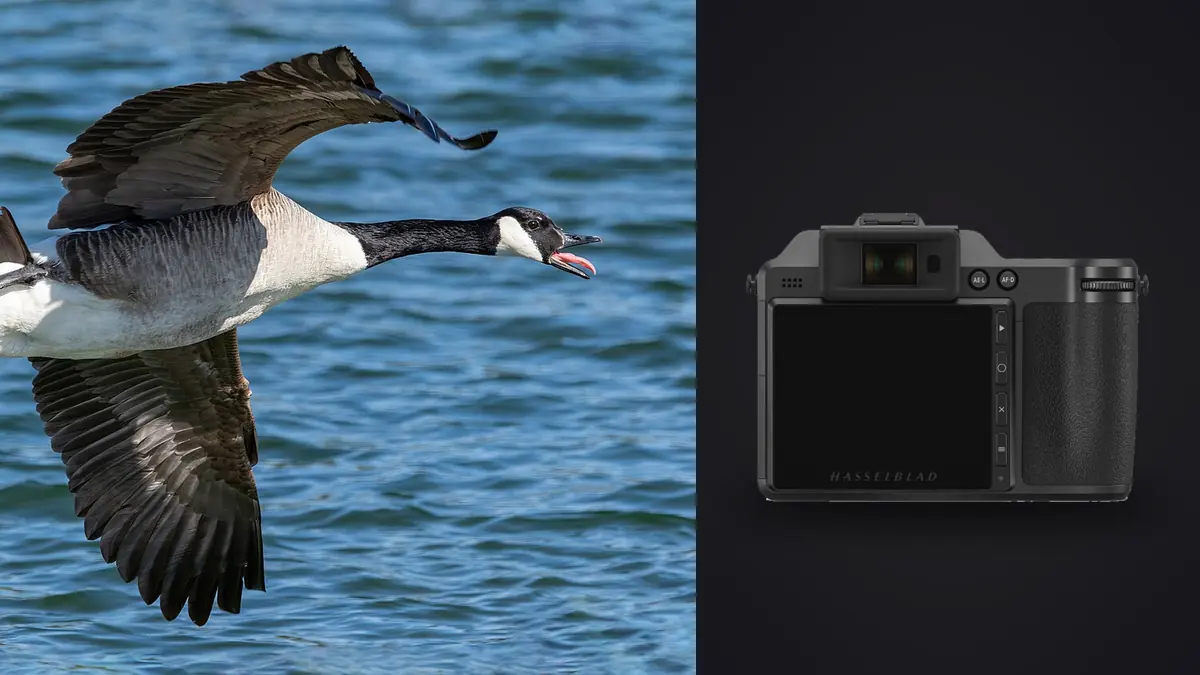
I spent four mornings on a tidal estuary in Wales this spring with a Hasselblad X2D 100C and the XCD 55-140mm, telling myself I would come home with clean flight shots of oystercatchers lifting off the mudflats. I got maybe a dozen usable frames out of roughly eight hundred exposures. That ratio is the honest starting point for anyone thinking about this camera for birding in flight: it was not designed for the job the way a modern sports mirrorless body was, and pretending otherwise just wastes a morning on the water.
None of that means the X2D 100C is useless for wildlife work. It means you have to be specific about which flight subjects it can handle, which settings actually help, and where you should just stop trying and wait for the bird to land. This is a field guide built around those boundaries, not a spec sheet reprint.
Why point a medium-format body at flying birds at all
The 44x33mm sensor is the whole argument. At 100 megapixels with 16-bit color, a frame that would be a throwaway crop on a smaller sensor still holds enough resolution to print. A heron banking against a grey sky, shot wider than you'd normally frame it because you couldn't track it tightly enough, can be cropped to 30-40% of the original frame and still hold detail in the primaries. On a 24-megapixel body that same crop turns to mush.
The dynamic range helps too. Backlit gulls over water, a kestrel hovering against a blown-out sky, an egret lifting off dark mud at low tide: these are exactly the scenarios where a sensor with 15 stops of usable range earns its keep, because you can expose for the highlights and pull the underside of the bird back out of the shadows afterward without the noise penalty a smaller sensor would pay. I routinely underexpose flight sequences by a stop and a half to buy shutter speed, then recover the shadow detail at the desk. That workflow simply does not exist on cameras with six or seven stops less headroom.
So the case for the X2D 100C in the field is never "it will out-track a Sony A1 or a Nikon Z9." It won't, not remotely. The case is that for the subset of flight photography where the bird is large, the flight path is predictable, and the light is difficult, the file quality changes what you can salvage afterward.
The parts of the spec sheet that actually decide your keeper rate
Three things matter more than anything else printed on the box: how the autofocus finds the bird, how fast the camera can fire, and what the shutter is physically doing while it fires.
The X2D 100C uses contrast-detection autofocus. There is no phase-detection layer on this sensor, and no animal-eye tracking of the kind you'd get on a current full-frame flagship. Contrast-detect AF hunts by nudging focus back and forth until contrast peaks, and against a moving subject with a shifting, low-contrast background (a bird against foliage, a bird against a rippled sea) it is noticeably slower to lock and far less willing to hold a moving subject than a phase-detect or hybrid system. In practice this means the camera is genuinely good at locking onto a bird that is perched and still, and considerably worse at re-acquiring a bird that just left the perch.
Burst speed is the second constraint. Continuous shooting sits a little over 3 frames per second, and that is with everything working in your favor. Compare that to the 15-30fps you'd get on a dedicated wildlife body and the arithmetic changes completely: where a fast mirrorless camera gives you a dense sequence to pick the one sharp wingbeat from, the X2D 100C gives you three or four widely spaced frames per second of flight, and the odds that any single one lands mid-wingbeat with the head in the right position drop hard. You are not shooting a sequence and choosing the best moment anymore. You are trying to predict the moment and hope the shutter happens to fire close to it.
The shutter itself changes how you should think about panning
The body has no focal-plane shutter. Exposure is handled either by the leaf shutter built into each XCD lens (mechanically capped around 1/2000s, though your effective sync speed depends on the lens) or by the sensor's electronic shutter, which can run up to 1/10000s. For flight work this cuts two ways. On the plus side, the leaf shutter produces almost no shutter shock, which combined with the 5-axis IBIS (rated up to roughly 7 stops) makes slower-shutter panning shots of large, slow-wingbeat birds, herons and swans in particular, more forgiving than you'd expect from a body this size. On the downside, medium-format sensors read out more slowly than smaller ones, and pushing the electronic shutter to freeze fast wingbeats can introduce visible rolling-shutter skew on anything moving quickly through the frame, a wingtip that leans or smears in a way a mechanical shutter wouldn't produce. I keep the electronic shutter for static or slow subjects and drop back to the lens leaf shutter whenever a bird is actually moving fast across the frame.
Lens reach is the limiting factor nobody mentions first
Autofocus and burst rate get the attention, but reach is what actually ends most X2D birding sessions early. The XCD lineup was built for landscape, portrait and studio work, not distance. The longest native prime for most of this camera's life has been the XCD 4/90V, and the closest thing to a birding lens is the XCD 55-140mm f/2.8-4.5 zoom. Because the medium-format sensor is physically larger than full-frame, focal lengths behave like a wide-angle relative to what a full-frame shooter is used to: that 140mm long end gives you a field of view closer to what a 110mm lens would give you on a full-frame body. A 1.7x teleconverter exists for the XCD system and stretches that reach somewhat, but you are still nowhere near the 500-800mm territory that birding bodies on smaller sensors take for granted, and you lose light and AF speed in the process.
Practically, this means you either accept that your subject fills a smaller portion of the frame than you'd like and lean on the 100-megapixel file to crop afterward, or you accept that this camera is for close, approachable, or habituated birds rather than distant raptors. Coastal seabird colonies, garden feeders, harbor gulls that have stopped caring about people, herons that will let you get within thirty meters if you're slow about it: that's the realistic working distance. Anything genuinely wild and wary at 100 meters plus is a job for a longer lens on a different system.
Matching camera settings to what's actually flying
Not every flight subject asks the same thing of this camera, and treating a soaring buzzard the same way you'd treat a swallow is where most of the wasted frames come from. Here's how I actually set up for different subjects after two seasons of testing this combination against real birds rather than a test chart.
| Subject type | Flight behavior | Shutter approach | AF / drive setup | Realistic keeper rate |
|---|---|---|---|---|
| Soaring raptor on a thermal (buzzard, red kite) | Slow, circling, altitude mostly steady | 1/1000-1/1600s, leaf shutter | Single AF lock, recompose, short bursts timed to wingbeat | Highest of any flight subject, often 1 in 15-20 frames |
| Heron or egret lifting off / gliding to land | Slow wingbeat, mostly predictable path | 1/800-1/1250s, leaf shutter | Pre-focus on the perch or landing spot, fire as it enters frame | Good, 1 in 10-15 with pre-focus |
| Gulls working a boat wake or thermal | Moderate speed, banking, somewhat repetitive | 1/1600-1/2000s, leaf shutter or electronic | Continuous low-speed burst, track by panning rather than AF | Moderate, 1 in 25-40 |
| Small fast songbirds, swifts, swallows | Erratic, fast direction changes | 1/2000s+, electronic shutter | Manual pre-focus on a fixed flight line (a gap, a nest entrance) | Low, 1 in 60-100 even with pre-focus |
| Perched bird taking off from a known branch | Brief acceleration, then straight departure | 1/1250-1/1600s, leaf shutter | Lock AF on the perch beforehand, hold, fire on the first wing drop | Best odds overall, 1 in 8-12 |
The pattern in that table is the whole strategy in one line: the X2D 100C rewards prediction over reaction. Anywhere you can pre-focus on a fixed point (a perch, a gap between reeds, a nest entrance) and wait for the bird to arrive, the contrast-detect AF's weaknesses stop mattering, because it isn't hunting a moving target, it's confirming a lock it already has.
Field techniques that close some of the gap
A few habits made a real difference to my hit rate over that estuary trip and the ones since.
Back-button focus with the AF disengaged from the shutter release is close to mandatory. You want to be able to lock focus on a perch or a likely flight line, take your thumb off the AF button, and fire the shutter repeatedly without the camera trying (and failing) to re-hunt for focus on every press. Left in single-shot AF-on-shutter mode, the camera will frequently rack focus out and back the moment a bird actually starts moving, and you lose the shot to the hunt.
Underexposing slightly and recovering in post is worth doing deliberately, not just tolerating. Pushing exposure down by a stop buys a faster shutter speed at the same ISO, and because the sensor's dynamic range is unusually deep for this level of detail, pulling that stop back in RAW processing costs you far less shadow noise than it would on most full-frame bodies. Base ISO is 64, which also means you have more headroom before you're pushed into the higher ISOs where the sensor starts to show its age.
Committing to a spot rather than chasing the bird across the sky produces more keepers than trying to track a wide arc. Pick the gap in the reeds, the stretch of open water, the space between two trees the bird has to cross, and frame for that spot rather than swinging the lens to follow the whole flight path. This plays directly to the strengths of a slower, more deliberate AF system.
After the shoot: culling a hundred-megapixel flight sequence
The other cost of this combination shows up at the computer, not in the field. A 3FR RAW file off the X2D 100C runs well over 100MB, so even a modest morning of flight attempts, a few hundred frames at low burst speed, adds up to tens of gigabytes fast, and a much higher proportion of those frames are soft or mistimed than you'd get shooting the same subject on a body built for action. Scrubbing through several hundred near-identical wing positions at full resolution on a laptop screen is slow enough that it becomes its own reason not to shoot flight sequences at all.
This is the part of the workflow where I actually lean on imagic. It runs the sharpness scoring locally on the machine rather than uploading a folder of multi-hundred-megabyte RAW files anywhere, which matters when you're dealing with file sizes this large on a boat trip's worth of laptop battery and patchy signal. It also clusters near-duplicate frames from a burst, so instead of opening all nine takeoff frames from one heron one at a time, you're looking at one cluster with the sharpest frame already flagged, and you can decide in seconds whether any of the rest are worth a second look. For the specific pattern of shooting produced by this camera, low frame count per burst but a genuinely high proportion of soft or mistimed frames, that clustering step saves more real time than it would on a camera shooting 20fps, because you're not drowning in near-identical duplicates, you're hunting for the rare frame that actually landed.
Once the keepers are picked, the apply_my_style preset (trained on edits you've already made to your own files) speeds up the second half of the job, matching the color and contrast treatment you already use for wildlife work across the new batch instead of rebuilding a look from scratch for every session. If you're new to building a culling pass into your routine at all, the general approach is covered in more depth in how AI photo culling works, and there's a broader set of habits for tightening the whole capture-to-export pipeline in 10 tips for a faster photo workflow.
Frequently Asked Questions
Is the Hasselblad X2D 100C fast enough to autofocus on a bird in flight?
It can, but not reliably against fast or erratic subjects. The contrast-detection AF locks well on stationary or slow-moving birds and holds reasonably on predictable, steady flight paths like a soaring raptor. Against a small bird making sharp direction changes, or a bird crossing a cluttered background, the system hunts noticeably and often loses the subject. Pre-focusing on a fixed point and waiting for the bird to arrive works far better than trying to track continuously.
What's the longest lens you can realistically use for birding with the X2D system?
The XCD 55-140mm f/2.8-4.5 is the closest thing to a birding zoom in the native lineup, and its field of view is roughly equivalent to a 110mm lens on full-frame because of the larger sensor. A 1.7x teleconverter stretches that further but costs light and AF speed. There is no native super-telephoto in the XCD range, so this system suits close or approachable birds far better than distant, wary ones.
Does the lack of a mechanical focal-plane shutter cause problems with fast wingbeats?
It can, depending on which shutter you use. The lens leaf shutters produce very little vibration and pair well with the in-body stabilization for slower panning shots. Pushing the sensor's electronic shutter to its fastest speeds to freeze quick wingbeats can introduce rolling-shutter skew on fast-moving wingtips, since medium-format sensors read out more slowly than smaller ones. For genuinely fast wing motion, the leaf shutter at a slightly slower speed often looks cleaner than the electronic shutter at a faster one.
Is 100 megapixels actually useful for wildlife cropping, or is it wasted on flight shots?
It's genuinely useful, and it's arguably the main reason to use this camera for wildlife at all given the AF and reach limitations. Because the native lens lineup doesn't reach as far as dedicated telephoto glass on other systems, you'll often be framing wider than you'd like and cropping in afterward. A 100-megapixel file tolerates a heavy crop, down to a third or even a quarter of the frame, and still holds enough resolution for a decent print, which is not something you can say about a wider crop from a 24 or 30-megapixel sensor.