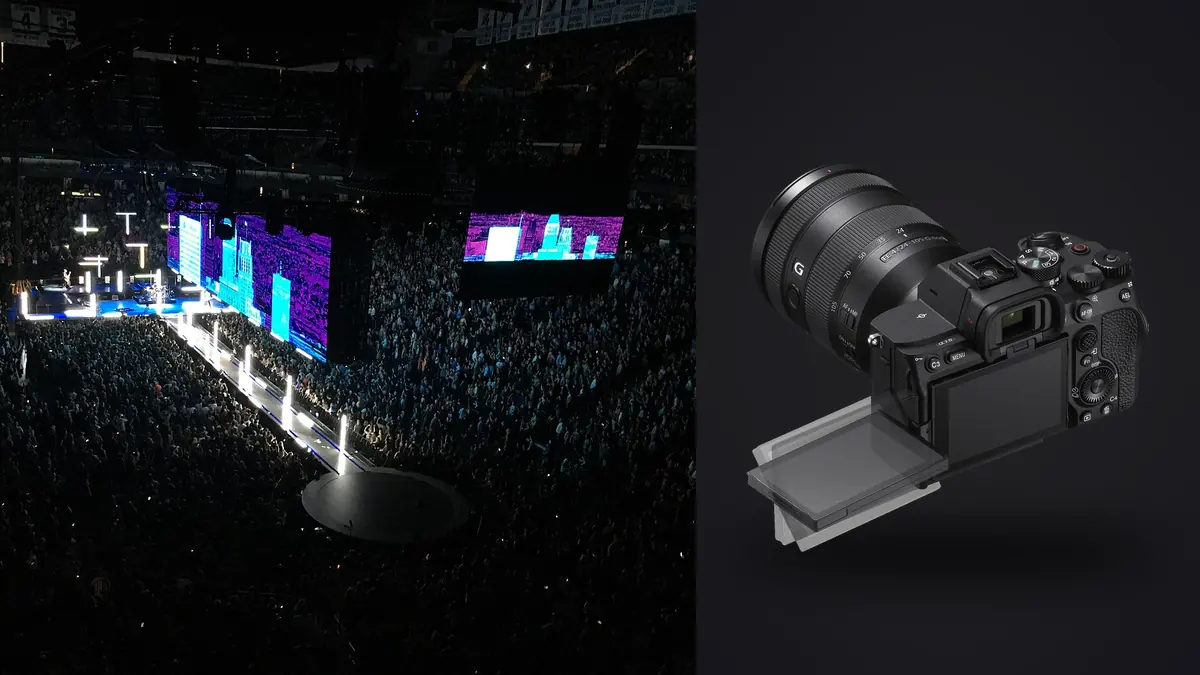
Picture a run of club tours and festival weekends shot with a Sony A7 IV, mostly from the photo pit and occasionally for the whole night including the merch table portraits after. It is not a camera built specifically for concert work the way something like the a9 III is, but it is the camera many working music photographers actually own, because it also has to shoot weddings on Saturday and product work on Monday. This is what it is actually like to point at a stage for three songs a night, not a spec sheet rewrite.
The Sensor Handles Stage Light Better Than the Reviews Suggest
The 33MP BSI sensor in the A7 IV gets criticized for being a step behind the older A7S III at high ISO, and in a lab chart that is true. On an actual stage, where you are rarely pinned above ISO 8000 unless the lighting designer is being deliberately moody, the difference barely matters. I regularly work at 6400 with a single key light on the vocalist and get files that clean up fine in post, especially once you're not viewing them at 400% on a 27 inch monitor. Where the sensor actually earns its keep is dynamic range: a spotlight blowing out against a black background is the single most common lighting scenario in a small venue, and the A7 IV's raw files let you pull back highlight detail on a blown-out face without the skin turning grey and flat the way some older sensors do.
The one place I do notice the ceiling is festival mainstage work with LED walls running behind the band. Push past ISO 12800 there and you start losing color fidelity in the reds especially, which matters a lot when half your frame is stage lighting gel. I try to stay under 10000 whenever the venue allows it and accept a slightly slower shutter instead.
Autofocus in a Moving Light Show Is the Real Test
Eye AF tracking a singer's face is not hard when they are standing still under a spotlight. It gets genuinely difficult when a strobe cuts in, the singer spins away from you, and a moving head light sweeps across the frame a half second later. The A7 IV's real-time tracking holds onto a subject through this kind of chaos noticeably better than the A7 III did, which was the camera most of us were replacing. I run Wide area with Eye AF priority for most of a set and switch to a single flexible spot only for tightly composed guitarist shots where I want a specific hand or headstock in focus rather than whatever face the algorithm decides is the subject.
Where it still trips up: drummers. A kit sits far enough back that limbs cross in front of the face constantly, and the camera occasionally locks onto a cymbal or a rack tom instead of reacquiring the face. I have started deliberately shooting drummers a stop or two down on aperture, f/4 instead of f/2.8, just to buy myself a wider plane of focus so a missed eye-lock still produces a usable frame.
Settings by Venue, Because "Concert Settings" Isn't One Thing
The advice to "shoot 1/250 at f/2.8, ISO auto" gets repeated constantly and it is only really true for one kind of room. A small basement club with a single tungsten wash behaves nothing like an arena floor lit by LED walls, and treating them the same is how you come home with a card full of either motion-smeared or unnecessarily noisy frames. Here is roughly what I actually dial in depending on where I'm standing.
| Venue type | Typical light | Shutter speed | ISO range | AF setup | Shutter mode |
|---|---|---|---|---|---|
| Small club / bar stage | Single wash, often warm tungsten or cheap LED PAR cans | 1/160 to 1/250 | 6400 to 12800 | Wide + Eye AF, AF-C | Mechanical (avoid electronic, cheap LEDs flicker badly) |
| Mid venue, moving heads | Fast color-shifting washes, occasional strobe | 1/320 to 1/500 | 3200 to 8000 | Zone or flexible spot, AF-C | Mechanical or front-curtain electronic only |
| Arena / festival mainstage | Bright, LED walls, follow spots | 1/500 to 1/800 | 800 to 3200 | Wide area tracking | Full electronic usually safe (test the LED wall first) |
| Theater / seated jazz or orchestra | House lighting, silent-shutter requirement | 1/125 to 1/200 | 1600 to 6400 | Single point, AF-S if subjects are stationary | Fully electronic (required for silence), watch for banding under old fluorescents during load-in shots |
The banding note in that last row is not a footnote, it has cost me usable frames more than once. Fully silent shutter is non-negotiable for a seated theater gig because the mechanical shutter clack carries in a quiet room, but the A7 IV's electronic shutter reads the sensor line by line, and under certain LED drivers (particularly older, cheaper fixtures in venues that haven't upgraded their house rig) that produces visible horizontal banding in the frame. Test it during soundcheck if you get access. If you don't get soundcheck access, shoot a burst of test frames the moment doors open and check them at 100% before the set starts, not after.
The Three-Song Rule Shapes Everything
Most photo pit credentials still come with the standard restriction: first three songs only, no flash, shoot from the pit or side of stage. That constraint dictates the gear choice more than any spec sheet does. You get roughly ten to twelve minutes, the lighting designer is usually still finding their rhythm for the set, and you will not get a second chance if the singer's best expression happens on song four. This is why I lean on the A7 IV's continuous shooting modes hard during those three songs rather than trying to time single shots. Hi+ gets you 10fps with full AF/AE tracking, and the buffer with a fast CFexpress Type A card holds up for a genuinely long burst before it stutters, long enough to shoot through an entire chorus without worrying about the buffer clearing mid-song.
The tradeoff is what that burst does to your card afterward. Ten minutes of continuous 10fps bursts across three songs regularly leaves me with 900 to 1,400 raw files from a single pit credential, and maybe 25 to 40 of those are actually usable, sharp, well-timed, good expression. The rest are the same beat gesture repeated across a burst, or a face mid-blink, or a limb crossing the frame at the wrong instant. That ratio is normal for concert work and it's also exactly why culling matters more here than in almost any other genre I shoot.
Lenses That Actually Get Used, Not Just Owned
Plan on carrying three lenses to a show and genuinely using two of them most nights. The 24-70mm f/2.8 GM II lives on the body for the pit, wide enough to catch the whole stage from a tight photographer scrum and long enough to isolate a singer at the mic. A 70-200mm f/2.8 comes out for side-of-stage or riser positions where I can't get close, and it earns its weight on nights when the pit is packed with eight other photographers all fighting for the same three feet of rail. The 85mm f/1.4 is for merch table portraits after the set, not for the stage itself, wide open at f/1.4 under moving stage light is a focus-hunting nightmare and not worth the frustration.
One thing I'd tell someone building a kit for this specifically: don't chase the fastest possible glass for stage work at the expense of a fast, reliable AF motor. A slightly slower f/2.8 zoom that locks focus instantly beats an f/1.4 prime that hunts for half a second when a strobe hits, because that half second is the difference between catching the peak of a jump and getting the landing instead.
What Happens to the Files After the Show
This is the part nobody puts in the camera review. You load in at 6pm, shoot doors-to-encore, and by 1am you have three to five thousand raw files across the night if you're covering support acts too, sitting on a card, with a client or an editor expecting a gallery by morning. Going through that manually, frame by frame, at 1am is how you either fall asleep at the keyboard or ship a gallery with duplicate near-identical frames you were too tired to compare properly.
I run the take through imagic before I touch anything in an editor. It scores sharpness and focus locally on the machine, so the frames where AF actually missed (that drummer-cymbal problem from earlier) get flagged before I waste time looking at them, and it clusters the burst sequences from Hi+ mode so I'm comparing five near-identical shots of the same chorus against each other instead of scrolling past all five separately. Because it runs fully offline, that also matters more than it sounds on tour: venue wifi is unreliable at best and I'm not uploading a night of an artist's unreleased stage show to anyone's cloud before I've even picked the keepers. Once I've built a short list from a few different venues on a tour, I run the apply_my_style preset trained on my own past edits across the set, which keeps the color consistent night to night even though the actual stage lighting was completely different in every room.
If you're building this part of your workflow from scratch, How AI Photo Culling Works covers the mechanics of what a sharpness pass is actually doing under the hood, and 10 Tips for a Faster Photo Workflow has more on trimming the gap between "shoot ends" and "gallery delivered," which on a tour is the thing that actually determines how much sleep you get.
Where the A7 IV Falls Short
I don't want this to read as a pure endorsement. Rolling shutter is a real limitation in electronic shutter mode, fast horizontal camera pans during a wide shot can skew straight lines like mic stands into a slight lean, and it's worse than a stacked-sensor camera would produce. Battery life across a long multi-band night is fine but not generous, I carry three batteries for anything past a four-hour bill. And the body's single UHS-II SD slot alongside the CFexpress Type A slot means if you want a true in-camera backup during the pit set, your second card is capped at SD speeds, which occasionally becomes the actual bottleneck on your buffer clearing during a long burst, not the CFexpress card. None of these are dealbreakers for the money, but they're the things that actually show up on a real night rather than in a spec comparison.
Frequently Asked Questions
Is the Sony A7 IV fast enough for concert photography without an add-on grip?
Yes for the vast majority of gigs. 10fps in Hi+ with full AF tracking covers everything short of a true action-sports pace, and most concert moments (a jump, a guitar swing, a crowd surf) resolve in well under a second, which the buffer handles fine on a fast CFexpress card.
Do I need the electronic shutter for live music, or is mechanical fine?
Mechanical is usually fine and often safer, since it avoids banding under flickering LED fixtures. Electronic (silent) shutter becomes mandatory only for venues that explicitly require silence, seated theaters, some jazz clubs, classical performances, and even then it's worth testing against that specific venue's lighting rig first.
How much noise reduction does a typical concert raw file from the A7 IV need?
At ISO 6400 to 8000, moderate luminance noise reduction with minimal color noise reduction usually keeps detail without going smeary. Above 12800 I apply more aggressively and accept some softness, since a slightly soft usable frame beats a technically sharp one nobody wants to look at because the noise is distracting.
Why do so many frames from a burst look almost identical, and how do you pick the keeper?
Continuous shooting at 10fps captures roughly one frame every tenth of a second, so a two-second burst produces around twenty frames of essentially the same gesture. The differences that matter are usually tiny: eyes open versus mid-blink, hand fully extended versus half-raised. Grouping the burst and comparing frames side by side, rather than scrolling through them in isolation, is the only reliable way to catch which one actually has the sharpest focus and best expression.