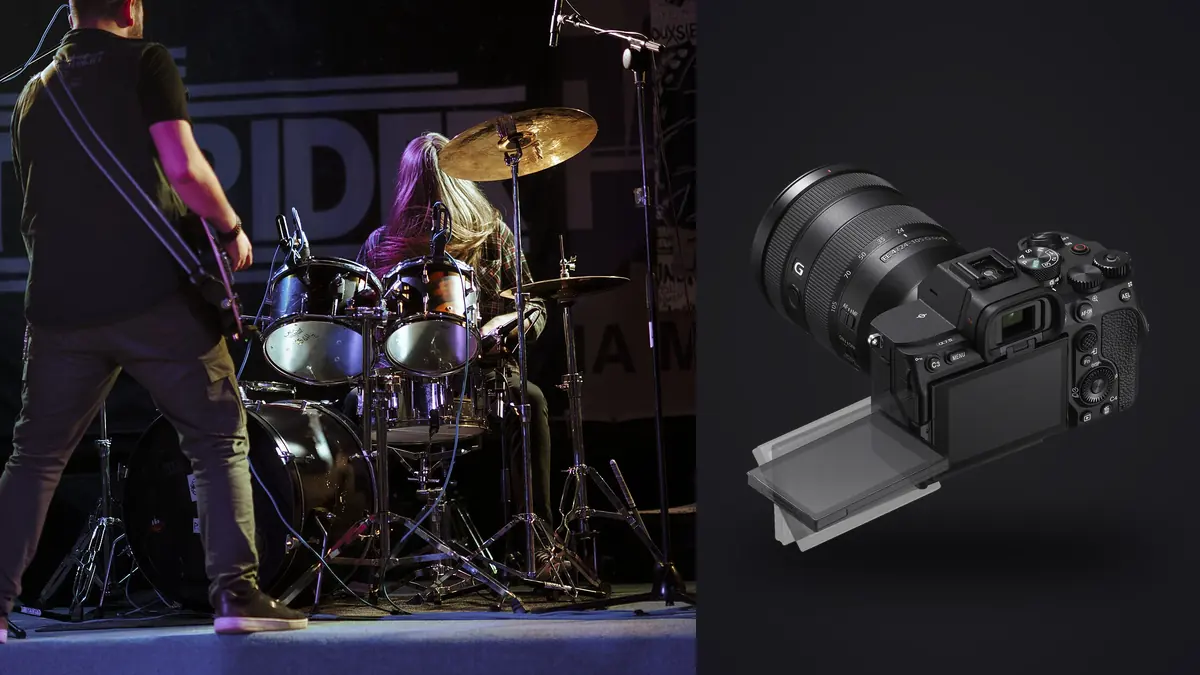
Three songs, no flash, and a barrier full of elbows. That is the deal at most venues, and it is the environment the Sony A7 IV either handles or does not. I have shot with this body in rooms as small as 150-cap basements and as large as amphitheater mainstages, and the honest verdict is that it is a very good concert camera with two or three habits you need to know about before you trust it under real stage lighting. This is not a spec sheet rehash. It is what actually changes in your settings menu between a sweaty club show and a festival headliner slot.
Why the sensor and the autofocus hold up under moving light
The 33-megapixel BSI sensor in the A7 IV gives you room to crop when you are stuck at the barrier and the singer walks to the far side of the stage. That extra resolution matters more at concerts than it does at, say, a portrait session, because pit photographers rarely get to choose their distance or angle. You shoot what the rope allows and crop later.
The autofocus is the bigger win. Real-time Eye AF keeps tracking a singer's face even when a moving spotlight sweeps across them and drops the exposure by two stops mid-note. Sony rates the AF sensitivity down to -4 EV, and in practice that means the camera keeps a lock in the dim gaps between light cues, the moments right before a chorus hits and the rig goes full brightness. Older bodies I have used would hunt in that gap. The A7 IV mostly does not.
Where it still struggles is with hard backlight from a follow spot pointed straight at the lens, or a strobe-heavy segment where the sensor genuinely cannot tell if a face is there for three frames in a row. That is not unique to Sony. Every mirrorless camera loses the plot when a 1200-watt spot hits the front element directly.
Shutter mode: mechanical, electronic, or the silent middle ground
This is where a lot of buyers get surprised. The A7 IV's 10fps ceiling is real, but it only holds with compressed RAW or JPEG. Switch to lossless compressed or uncompressed RAW and the burst rate drops to roughly 6fps. For a three-song pit set where you are firing in short bursts to catch a jump or a guitar swing, that difference decides whether you get the peak frame or the one just after it. I shoot compressed RAW for anything with fast movement and only switch to lossless for slower, seated performances where speed does not matter as much.
When silent shooting actually earns its keep
The fully electronic, silent shutter mode is not a gimmick for concerts. Acoustic sets, spoken interludes between songs, comedy acts opening for a band, any moment where the venue is quiet enough that a mechanical shutter clack turns heads two rows back. I flip to silent mode for those stretches and back to mechanical once the set gets loud again. The tradeoff is rolling shutter: a drummer's stick or a headstock whipping through frame fast enough can skew and bend under electronic shutter in a way that looks wrong even to someone who has never heard the term. Mechanical shutter avoids that entirely, so it stays my default whenever the room noise allows it.
Stage lighting is the real opponent, not the camera body
Most of what goes wrong in concert photos has nothing to do with the camera and everything to do with LED lighting rigs that pulse faster than your eye can see. Cheaper LED wash and wall panels run on pulse-width modulation, and at certain shutter speeds that shows up as a dark band rolling through the frame or a flat, dead exposure on a light that looked bright to the naked eye. The A7 IV has a variable shutter / anti-flicker option in the menu that scans the light's frequency and nudges your shutter speed to sync with it. It works, but it only scans when you half-press the shutter with the feature enabled, so it is easy to forget mid-set and end up with a run of banded frames you cannot fix later.
Fighting the color, not chasing it
Deep magenta and cyan stage gels wreck auto white balance. The camera tries to correct toward neutral and ends up killing the mood the lighting designer built. I set a fixed white balance (usually somewhere around 4500-5000K as a starting point, adjusted by venue) rather than letting the camera guess song to song. Shooting RAW is non-negotiable here regardless of what mode you're in, because the amount of WB and highlight recovery a single-color stage wash needs is more than an in-camera JPEG profile can give you.
| Venue type | ISO range I actually use | Shutter floor | Shutter mode | What bites you |
|---|---|---|---|---|
| Small club (100-300 cap) | 3200-12800 | 1/250, 1/320 for drummers | Mechanical | Single hot spot blows out faces, everything else goes black |
| Theater / seated venue | 1600-6400 | 1/200 | Silent electronic | Ushers enforce silence; watch for rolling shutter on pans |
| Arena | 800-4000 | 1/320-1/500 | Mechanical | LED video walls behind the band can band under electronic shutter |
| Outdoor festival, after dark | 1600-6400 | 1/500+ | Mechanical | Battery drain from heat, dust on the sensor between sets |
None of these are formulas you set once and forget. They are starting points I dial in before doors open, then adjust once I see the first cue of the actual show, because tour lighting varies more than venue type does.
Lenses that earn their keep in the pit
The 24-70mm f/2.8 GM II is the lens I have on the body for probably 70 percent of a set, because pit shooting means you cannot always move your feet and the zoom range covers a wide stage shot and a tight face in the same song. For arenas and anything where the barrier is far from the stage, the 70-200mm f/2.8 GM OSS II earns its weight, and it has genuinely improved autofocus tracking over the original version, which matters when a guitarist is thirty feet away and moving.
The 85mm f/1.4 GM is my choice for smaller rooms where I can get close: shallow depth of field separates a singer from a busy background of amp stacks and other musicians in a way a zoom at f/2.8 cannot quite match. A 35mm f/1.4 or similar wide prime is worth carrying for crowd-and-stage context shots, the wide frame that shows the room, not just the performer. None of this is exotic. It is the same lens logic that applied to the A7 III, just with faster, more confident autofocus behind it now.
From the last chord to a same-night inbox
Here is the part nobody puts in a camera review: a three-song set shot at 10fps in bursts produces somewhere between 400 and 900 frames once you add up every attempt at the drop, the jump, the guitar solo. Most of those are near-duplicates of each other, three or four frames apart, where only one has the eyes open and the focus locked exactly where you wanted it. Sorting that by hand at 1am after a show is the actual bottleneck in this job, not the shooting.
This is the part of my workflow I moved to imagic. It runs entirely on the laptop, no upload required, which matters a lot at venues where the wifi is either nonexistent or locked behind a guest network nobody bothers to share with photographers. It groups burst sequences from a single moment (the jump, the solo, the crowd surf) and ranks them by actual sharpness rather than just showing me thumbnails, so I am not squinting at a laptop screen backstage trying to tell which of six nearly identical frames is the one in focus. For more on handling that kind of volume, this guide to managing burst photography is worth reading.
The other piece I lean on is the apply_my_style preset. I trained mine on a batch of my own past concert edits, the moody, slightly desaturated look I use for club shows versus the punchier grade I run for outdoor festival sets in daylight. Once the culling pass is done, that preset gets me most of the way to a finished edit before I open anything else, which is the difference between sharing a same-night gallery and one that goes out two days late. The general idea behind training a style on your own past edits rather than a generic preset is covered in more depth in this walkthrough of matching your own editing style.
Settings I actually dial in before doors open
- Continuous AF with Eye AF (human) locked to the subject, not face-only, because a singer turning to the drummer mid-song still needs tracking.
- Zone or Wide AF area for wide shots of the full band, spot or expand-flexible for tight singles.
- Auto ISO with a minimum shutter speed I set manually, never left on the camera's default guess, because the default tends to undershoot for anything with real stage movement.
- Highlight-weighted metering when a single hard spotlight dominates the frame, center-weighted for evenly lit stages.
- Anti-flicker scanning turned on and re-checked after any lighting cue change, since a new scene on the rig can shift the PWM frequency.
None of these are set-and-forget. The whole point of shooting a live set on this body is that the light changes every thirty seconds and the camera needs a photographer actively adjusting, not a preset baked in before the first song.
Frequently Asked Questions
Is 10fps fast enough for a three-song photo pit set on the A7 IV?
Yes for most club and theater work, where you are catching discrete moments rather than a continuous sprint. Where it gets tight is a high-energy set with constant jumping and crowd interaction, where 10fps in short bursts (using compressed RAW, not lossless) gives you the coverage you need. Drop to lossless compressed and the rate falls to around 6fps, which is noticeably slower for catching a mid-air moment.
Should I shoot compressed RAW or JPEG for same-night concert delivery?
Compressed RAW gives you the highlight and white balance recovery a mixed-lighting stage demands, while still keeping file sizes and buffer depth manageable enough for full-speed bursts. Fine JPEG only makes sense if you are handing files straight to a publication with an immovable deadline and no time to edit at all, which is rare outside breaking-news coverage.
Does the A7 IV struggle to autofocus under moving spotlights?
It handles gradual light changes and spot sweeps well thanks to its low-light AF sensitivity, but a hard backlight source pointed straight into the lens, or a rapid strobe segment, will cause it to hunt or lose lock briefly like any mirrorless camera in that situation. It recovers quickly once the light passes.
What ISO ceiling actually looks usable for small club shows?
I treat ISO 6400 as comfortable and ISO 12800 as usable with some noise reduction in post, particularly on shadow areas away from the main light source. Past that the color noise in deep reds and blues from stage gels gets harder to clean up without flattening the image, so I would rather underexpose slightly at a lower ISO and recover in RAW than push past 12800 as a habit.