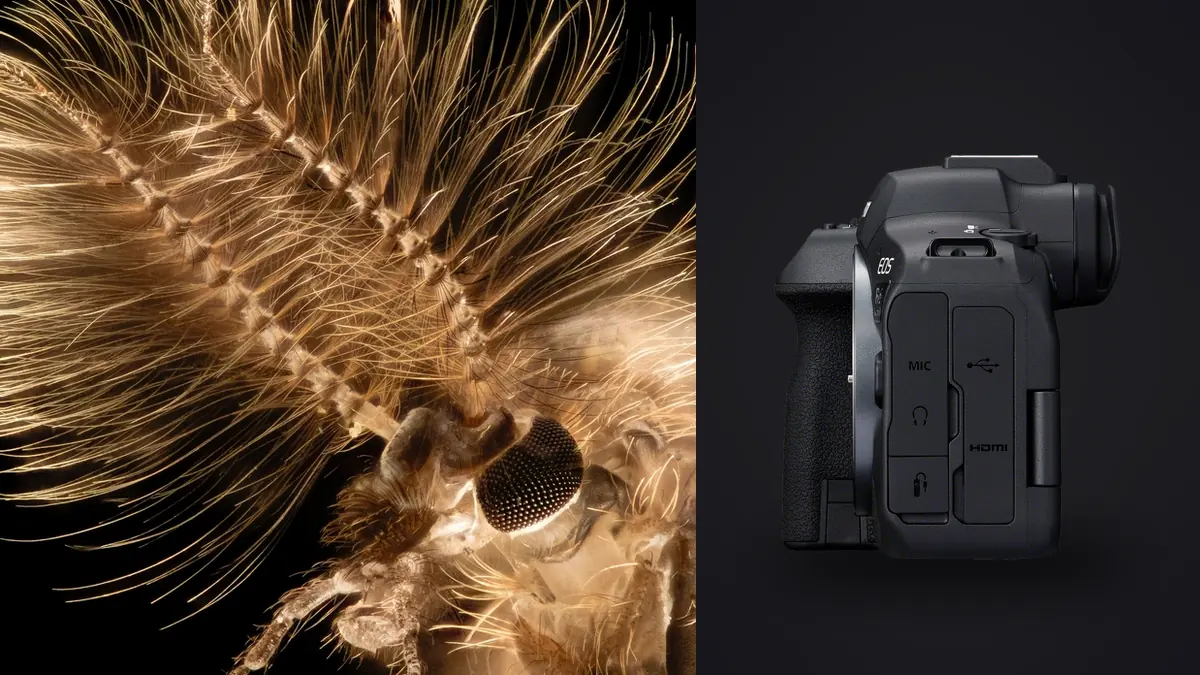
I picked up the R6 Mark II expecting it to be a slightly better version of the original R6 for everyday shooting, and it is that. What I did not expect was how much of a difference the sensor readout speed and the focus bracketing menu would make once I started pointing it at damselflies and jumping spiders instead of people. Macro insect photography punishes a camera in ways portrait or landscape work never does. Depth of field collapses to fractions of a millimeter, the subject is alive and unpredictable, and you are usually crouched in wet grass at 6am trying not to breathe on anything. This is what actually happens when you take the R6 II into that world, not the spec sheet version.
What changes when the subject is 8mm long
General wildlife autofocus assumes a subject with a recognizable shape and a bit of distance to work with. A dragonfly perched on a reed at 1:1 magnification gives the camera almost nothing to grab onto: a sliver of compound eye, some translucent wing, a background that is often just as textured as the insect itself. At true macro distances the working distance between the front of the lens and the bug can be as little as 12-15cm, which means your own shadow, your breathing, and the vibration of pressing the shutter all become variables you didn't have to think about with a 400mm lens on a bird thirty meters away.
The R6 Mark II's 24.2MP full-frame sensor is not the highest resolution option Canon sells, and for macro work that is mostly fine. You are not usually cropping hard the way a birder does, because you're already filling the frame at high magnification. What matters more is how the camera behaves in the half-second between spotting a robber fly and it lifting off, and that is where the R6 II's faster processor over the original R6 actually earns its keep.
Autofocus that mostly works, until it doesn't
Canon's Dual Pixel CMOS AF II on this body is genuinely good at animals, people, and vehicles. It is not tuned for insects specifically. There is no bug detection category the way there is for dogs, cats, and birds, so at close focusing distances the camera's subject-detection AI will sometimes lock onto a leaf edge or a highlight on the exoskeleton instead of the eye, especially with something as reflective as a beetle. I've had it happily track a moth's wing pattern while completely ignoring the moth's head six millimeters away.
What works consistently is switching out of full subject tracking and using a single small AF point, placed manually, combined with back-button focus. For a stationary insect like a resting butterfly or a spider sitting in its web, One-Shot AF with a small point on the nearest eye gets you there reliably. For something moving erratically, a jumping spider hopping between leaves or a fly grooming itself, I've had better luck switching to manual focus and doing the focusing by rocking my body forward and back rather than turning the focus ring, which is the old-school macro technique and still the most reliable one at magnifications above about 0.7x. Autofocus at 1:1 and beyond tends to hunt because the depth of field is thinner than the AF system's confirmation tolerance.
In-body stabilization helps more than I expected for handheld work, but it stabilizes the sensor, not the insect, and it does nothing about focus breathing from your own sway at high magnification. Treat IBIS as something that reduces the number of blurry frames, not something that lets you abandon good handholding technique.
Lens choices and how they actually behave on this body
There isn't one correct macro lens for the R6 II, and the right choice depends heavily on what insects you're chasing. Skittish subjects like dragonflies reward more working distance. Deliberately slow subjects like caterpillars or resting moths let you get away with a shorter, cheaper setup.
| Lens / setup | Max magnification | Working distance at max mag | AF on R6 II | Best for |
|---|---|---|---|---|
| RF 100mm f/2.8L Macro IS USM | 1.4x | ~13cm | Fast, usable AF even close-in, thanks to the L-series motor | General insect work, the lens I reach for most |
| MP-E 65mm f/2.8 1-5x Macro | 5x (manual only) | 4-6cm at 5x | None, fully manual focus, no distance scale | Extreme detail on small, still subjects like ants or fly eyes |
| RF 24-105mm f/4L + 25mm extension tube | ~0.5x | ~18cm | AF works but slows noticeably, hunts in low light | Budget entry into macro without buying a dedicated lens |
| EF 100mm f/2.8L IS Macro (via RF adapter) | 1x | ~15cm | Slightly slower AF than native RF version, still usable | Anyone upgrading from an EF-mount R-series body who already owns this lens |
The RF 100mm L is the one I'd tell most people to buy first. It autofocuses well enough to use in servo mode on cooperative subjects, has enough working distance that you don't spook every insect you approach, and the built-in image stabilization genuinely reduces shake at handheld macro distances. The MP-E 65mm is a specialist tool. It has no autofocus at all and no distance markings, and using it well requires a focusing rail or a lot of practice rocking on your knees. I only bring it out for subjects I know will hold still, dew-covered spiders early in the morning, resting mayflies, that kind of thing.
Getting enough light without cooking the bug or blowing the highlights
Stopping down for depth of field at macro distances kills your light fast. At f/11 or f/16, even in good midday sun, you're often into shutter speeds too slow to freely handhold or freeze insect movement. Flash solves this, but a flash mounted straight on the hot shoe of the R6 II blasts a subject three inches away with harsh, flat light and throws a hard shadow directly behind it.
My actual rig for most insect sessions is a single off-camera speedlite on a small bracket, angled from about 45 degrees above and diffused through a piece of white foam translucent enough to soften without eating too many stops. A dedicated macro twin-lite mounted around the lens barrel gives more even, shadowless light and is worth the money if you're shooting macro often, but it's a real cost add-on and not something I'd buy before the lens itself.
Natural light still has its place, particularly early morning when insects are cold and sluggish and the light itself is soft and low-angled. The R6 II's high ISO performance is good enough that ISO 3200 to 6400 available-light shots are usable, especially once you know the noise reduction and sharpening will be handled in post rather than baked into a JPEG straight out of camera. I lean on available light for slow subjects and flash for anything likely to bolt the second I get close.
Depth of field math you can't avoid at high magnification
At life-size (1x) magnification with an aperture of f/11, total depth of field is roughly half a millimeter. That's not a typo. It means at 1x, an insect's near eye can be tack sharp while its antennae, a centimeter further from the lens, are visibly soft. This is true regardless of how good your lens or sensor is; it's a function of magnification and aperture, not gear quality. Stopping down to f/16 or f/22 buys you a little more depth but introduces diffraction softness that becomes visible when you view images at 100%, and macro viewers almost always zoom in.
The practical answer most working macro shooters land on is a compromise around f/11-f/13 for single frames, and focus stacking (multiple frames at different focus points, merged afterward) for anything where you want the whole insect sharp front to back. The R6 II has an in-camera focus bracketing mode that will fire off a sequence at incrementally shifted focus points automatically, which is genuinely useful in the field, though you'll still need Helicon Focus, Zerene Stacker, or a stacking routine in Photoshop to merge the results afterward. The camera doesn't do the merge for you.
Bursts, stacking, and what to do with 400 nearly identical frames
A single focus-bracketed sequence at, say, 40 frames, combined with a few insurance bursts because the insect twitched mid-sequence, adds up fast. A morning session chasing dragonflies at a pond can leave you with 800-1,000 raw files, most of which are duplicates of each other with only microscopic focus shifts, plus a chunk that are simply out of focus because the subject moved between frames.
This is the part of macro work nobody warns you about before you get into it: the shooting is the fun part, and then you're staring at a folder that would take an evening to sort by eye. I've been running these sessions through imagic, which does its sharpness and focus scoring locally on the machine rather than uploading anything anywhere, so a folder of insect macro shots stays private and gets scored while I'm still packing up gear. Its burst and duplicate clustering groups the focus-bracketed sequences together automatically, which matters a lot here because a normal duplicate detector built for portrait bursts tends to treat every frame in a five-position focus stack as "different enough" to keep, when really you just want the two or three sharpest to hand off to a stacking tool. If you're regularly generating this kind of high-volume, near-identical macro output, our breakdown of how AI photo culling actually works covers the sharpness-scoring approach in more depth.
Once the keepers are picked, I use imagic's apply_my_style preset feature, trained on my own past macro edits, to get a consistent starting point across a session, since insect macro shots swing wildly in color temperature between flash-lit and available-light frames and a consistent base saves a lot of manual white balance correction later. The rest of that turnaround is mostly general workflow habits rather than anything macro-specific, and 10 tips for a faster photo workflow covers several that pair well with a culling and preset routine like this one.
Field habits that matter more than gear
Cold mornings are underrated. Insects are ectothermic, so on a cool morning before the sun has warmed the air, dragonflies, bees, and spiders move slowly or not at all, which turns a nearly impossible handheld autofocus chase into a calm, tripod-friendly session. I try to be out by first light specifically because of this, not for the quality of the light itself.
Approach angle matters more than most people expect. Coming at an insect from directly above casts your shadow across it before you're anywhere near working distance, and most insects react to a shadow crossing them faster than to your actual movement. Approaching from the side, low, and slow, gets you far closer before anything reacts.
Background matters as much as the subject at macro distances because at f/2.8 to f/5.6 anything more than a few centimeters behind the insect turns into a soft color wash. I actively look for insects with clean backgrounds behind them (grass, sky, water) rather than trying to fix a busy background afterward, because there's only so much a wide aperture can do when the clutter is only slightly further away than the subject itself.
On multi-day trips to sites without reliable signal, the fact that imagic does its scoring and culling entirely offline has mattered in practice, not just as a feature on a list. Reviewing a day's shoot on a laptop at a campsite with no connection and still getting sharpness rankings back in minutes changes how much you shoot the next morning, because you're not carrying three days of unsorted backlog into a fourth day of shooting.
Frequently Asked Questions
Does the R6 Mark II's in-body stabilization actually help handheld insect macro?
It helps, but it's not a substitute for a tripod or a focusing rail when you need critical sharpness across a stack. IBIS reduces the camera shake component of blur, which cuts down on wasted frames when you're handholding at 1:1, but it cannot compensate for your own body sway toward and away from the subject, which is what actually shifts focus at high magnification. Think of it as raising your keeper rate, not eliminating the need for good technique.
Is a full-frame body like the R6 II better than a crop-sensor camera for insects?
Not automatically. A crop-sensor body like the R7 gives you extra effective reach from the same lens, which is genuinely useful for skittish insects where more working distance matters. The R6 II's advantage is in low light and dynamic range, useful for early morning or shaded-canopy shooting, and in overall image quality at the ISOs macro work often demands once you're stopped down for depth of field. Neither is a wrong choice; it depends on whether working distance or low-light performance is your bigger limiting factor.
What aperture should I use to get an insect's whole face in focus?
For a single frame at close to 1x magnification, f/11 to f/13 is a reasonable starting point that balances depth of field against diffraction softness. If you need the entire insect sharp from the front of the head to the tip of the abdomen, a single frame at any aperture usually can't do it at high magnification, and focus stacking (multiple frames, merged) is the more reliable route.
Do I need the MP-E 65mm, or is the RF 100mm macro enough for insect photography?
For the vast majority of insect subjects, the RF 100mm f/2.8L is enough, and its autofocus and working distance make it far more practical day to day. The MP-E 65mm is worth adding only once you're specifically chasing extreme close-ups, individual compound eye facets, tiny ant species, that kind of subject, and only once you're comfortable focusing manually without any autofocus assistance at all.