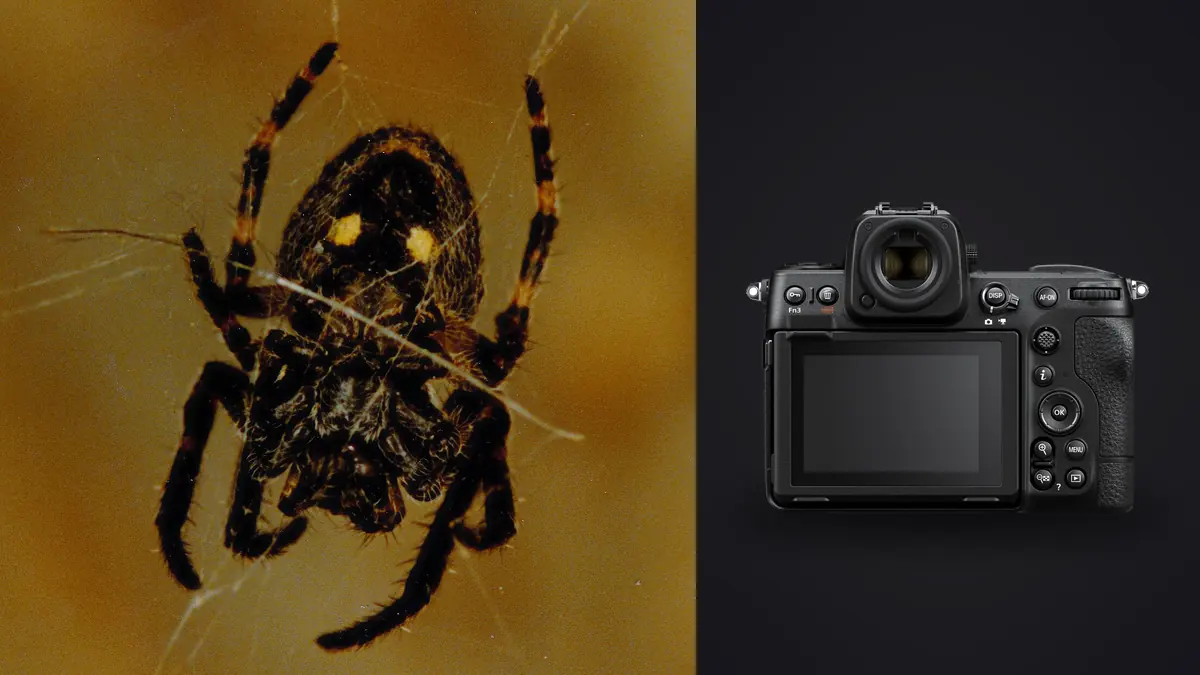
The first time I took a Nikon Z8 out to photograph dragonflies at a reed-choked pond near sunrise, I expected the autofocus system to just handle it. It didn't, not entirely, and that gap between what the marketing promises and what actually happens when a robber fly is six centimeters from your front element is the whole subject of this piece. The Z8 is a genuinely capable body for macro insect work, but it gets there through a combination of things that work brilliantly (the sensor, the buffer, the blackout-free viewfinder) and a couple of things you have to work around (subject detection that was built for eyes and faces, not compound eyes and antennae).
What the sensor and buffer actually buy you in the field
Macro insect photography is a game of failed frames. You get one animal, one moment of stillness, and you burn through a dozen shots hoping two or three land with the eyes sharp. The Z8's 45.7MP stacked sensor and its buffer depth matter here more than most spec sheets let on. Shooting 14-bit lossless compressed RAW to a fast CFexpress card, I've pushed well past 100 consecutive frames at the camera's high-speed burst setting without the buffer choking, which for a bee working a lavender spike means I can hold the shutter through the whole approach-and-retreat cycle instead of guessing when to fire.
The blackout-free electronic viewfinder is the underrated part of this. With a mirror-based body, every frame you fire is a flicker of black in your eye at exactly the moment a jumping spider decides to reposition. The Z8's stacked readout keeps the finder live through the burst, so you can actually track a moving subject through a sequence instead of losing it between frames. It sounds like a small thing until you've missed a mantis strike because the viewfinder blinked at the wrong instant.
Silent electronic shutter is the other quiet win. Grasshoppers and dragonflies react to mechanical shutter clatter more than people expect, especially within the twenty to thirty centimeter working range a lot of macro lenses demand. Switching to full silent mode on the Z8 doesn't eliminate spookiness (they still notice the lens looming), but it removes one variable, and on a still morning next to water it makes a real difference in how many attempts you get before a subject bails.
Lens and magnification: what actually gets you 1:1 and closer
Nikon's own Z MC 105mm f/2.8 VR S is the obvious pairing and it's a genuinely good lens: true 1:1 magnification, internal focusing so the working distance doesn't collapse as you focus closer, and the VR is surprisingly useful for handheld macro even though most serious insect work ends up stopped down enough that shutter speed does the stabilizing anyway. But it's not the only option, and depending on how skittish your subjects are, it might not be the right one.
Working distance is the variable that actually decides whether you get the shot. A damselfly will tolerate a lens tip twelve centimeters away far more readily than four. That's why longer macro lenses, or shorter ones stacked with extension tubes to boost magnification without changing focal length, change your hit rate more than any camera setting does.
| Setup | Max Magnification | Working Distance at 1:1 | Best For |
|---|---|---|---|
| Nikon Z MC 105mm f/2.8 VR S | 1:1 | ~14 cm | Bees, butterflies, general insect work |
| Nikon Z MC 50mm f/2.8 | 1:1 | ~4.5 cm | Static subjects only (leaf-litter insects, mounted specimens) |
| 105mm + 20mm extension tube | ~1.3:1 | ~11 cm | Slightly reluctant subjects needing extra magnification |
| Laowa 100mm f/2.8 2X Ultra Macro (manual, FTZ adapted) | 2:1 | ~15 cm | Small stationary subjects (mites, small flies, eyes/wing detail) |
| 105mm handheld focus-bracketed sequence | 1:1 (composited to appear higher) | ~14 cm | Cooperative subjects at rest, dew-covered mornings |
Something worth flagging honestly: the 50mm macro is a trap for insect work specifically because of that 4.5cm working distance at full magnification. It's a fantastic lens for product shots and flat, static subjects, but at true 1:1 you're closer to the animal than most insects will accept, and you end up backing off to a lower magnification anyway, which defeats the point of buying a macro lens in the first place. I keep it in the bag for flowers and dew, not insects.
Autofocus: where 3D-tracking helps, and where you're better off in manual
Nikon's subject detection on the Z8 is trained primarily around animal eyes, and for larger insects like dragonflies, mantises, and big beetles with clearly defined compound eyes, it locks on more often than not, particularly in good light with some contrast between the eye and the surrounding cuticle. For small, fast, low-contrast subjects, though (aphids, small flies, anything under about a centimeter), it frequently hunts or grabs the nearest high-contrast edge instead, which at macro distances is a razor-thin plane and rarely the one you want.
My working rule after a couple of seasons: for insects actively moving (foraging bees, hunting mantises, anything mid-behavior), I use AF-C with 3D-tracking and let the camera try, because a moving subject makes manual focus nearly impossible to keep up with regardless of skill. For anything reasonably still, dew-slowed damselflies at dawn, resting butterflies, spiders in a web, I switch to manual focus and use the focus peaking overlay combined with the rear-command-dial fine focus adjustment. It's slower per shot but the hit rate on genuinely sharp eyes goes up substantially, and at f/5.6 or wider the depth of field at these magnifications is measured in millimeters, so precision beats speed. For a comparison point on how a different stacked-sensor body handles the same focus, motion, and exposure tradeoffs, see our Sony A1 macro troubleshooting guide.
One setting change that helped more than I expected: dropping AF-C priority from release to a slight focus bias in the custom menu. The Z8 defaults toward keeping the frame rate moving, which is right for birds in flight but wrong for insects, where a soft frame is a wasted frame regardless of how many you shot per second.
Focus stacking, in the field and not just on a rig
The Z8's in-camera focus shift shooting is genuinely useful for insect work, not just flower macro, provided the subject cooperates. I typically set it for 40 to 80 shots at a step width of 3 to 5 depending on aperture and magnification, then let the camera rack through automatically. It only works for subjects that hold still for the two to four seconds the sequence takes, so it's mostly a technique for cold mornings when insects are torpid, or for specimens you've photographed after a brief chill in a cooler (a common, if slightly unglamorous, macro photographer's trick for calming a subject just enough to get a stack without harming it).
For live, unpredictable subjects, I don't bother stacking at all in the field. I stop down to f/9 or f/11 to buy a bit more depth of field on a single frame, accept that the background will render less smoothly than a wider aperture would give, and rely on getting the eye tack sharp in one shot rather than risking a stack where the animal moves mid-sequence and half the frames are useless. Diffraction starts softening detail noticeably past about f/13 on this sensor, so I rarely push further than f/11 even when I want more depth.
Light: diffusion matters more than raw output
A twin macro flash bracket mounted around the 105mm's filter thread is what I reach for most days, but the actual quality difference comes from diffusion, not flash power. Bare macro flash heads produce a small, harsh catchlight and flat, slightly clinical lighting on cuticle and wing membrane. A simple diffuser made from a section of white plastic bottle, or a purpose-built diffuser dome, softens that considerably and lets texture in compound eyes and wing veins actually read instead of blowing out.
On overcast mornings I skip flash entirely and just use available light with a wide aperture, since the Z8's low-light autofocus performance holds up well enough at these distances that I'm not fighting the camera on top of fighting the wind. High-speed sync at 1/8000 comes in handy on breezy days when I want flash to freeze a swaying stem but also need a shutter speed fast enough to freeze the ambient background motion; without it you get ghosting where the flash-frozen insect sits on a blurred stem.
What happens after the shoot
A morning of insect macro produces a genuinely absurd number of frames relative to how many keepers come out the other end. Between AF-C bursts on moving subjects, manual focus brackets, and the occasional in-camera stack sequence, I'll come home with anywhere from six hundred to over a thousand RAW files from two or three hours of shooting, and maybe fifteen or twenty of those are actually worth editing.
This is where I stopped doing the culling manually. I run the card through imagic before I open anything in an editor, since the local sharpness scoring catches the specific problem macro work creates: dozens of near-identical frames where the difference between a keeper and a reject is whether the eye facets are in focus, not whether the frame is blurry in any obvious sense. It also clusters the focus-stack sequences and the burst runs together automatically, so instead of scrolling through eighty visually similar frames of one dragonfly I'm looking at grouped bursts with the sharpest candidate flagged first. Because it processes everything locally rather than uploading a card full of RAWs somewhere, I'm not waiting on a connection at a campsite with no signal, which matters more than you'd think when you're shooting somewhere genuinely remote.
Once the culling pass is done, I lean on the apply_my_style preset for the first editing pass on the survivors. I trained it on a batch of my own past macro edits (fairly desaturated greens, warmer highlights on cuticle, a specific contrast curve I use on wing membrane), and it gets close enough on a new insect set that I'm usually just fine-tuning individual frames rather than rebuilding the look from scratch each time. If you shoot a lot of one subject type over a season, that consistency pass alone saves real time, and it's a big part of why the whole workflow feels less like a chore than the manual triage-and-edit routine I used before.
Frequently Asked Questions
Does the Nikon Z8's animal-eye AF actually work on insects?
Sometimes, and it's genuinely subject-dependent. On dragonflies, large beetles, and mantises, it locks reliably often enough to be useful, especially in decent light with contrast around the eye. On small, low-contrast insects like aphids or tiny flies it struggles and tends to grab the wrong plane, so manual focus with peaking is the more reliable fallback for anything under roughly a centimeter.
What aperture should I use for insect macro on the Z8?
f/8 to f/11 is the range I use for most live subjects, balancing depth of field against diffraction softening, which becomes noticeable past about f/13 on this sensor. For in-camera focus stacks on still subjects I'll shoot wider, often f/5.6, and let the stack build depth instead of the aperture.
Is in-camera focus shift shooting practical for photographing live insects?
Only for subjects that hold still for a few seconds, which in practice means cold mornings, torpid insects, or specimens briefly chilled to slow them down. For anything actively moving, a single well-focused frame stopped down to f/9 or f/11 is more reliable than attempting a stack that a moving subject will break halfway through.
How do I stop insects from flying off before I can get close with a macro lens?
Working distance matters more than any camera setting. A 105mm macro lens gives roughly 14cm of working distance at 1:1, which many insects tolerate better than the 4 to 5cm distance a 50mm macro lens demands at the same magnification. Silent electronic shutter and slow, low approach angles also reduce how often a subject bolts before you fire.
How many keeper shots should I expect from a macro insect shooting session?
In my experience, roughly two to four percent of frames end up as genuine keepers from a session heavy on AF-C bursts and manual focus brackets. That ratio is exactly why running a culling pass before editing matters. Sorting six hundred near-identical frames by eye is where most of a macro shooting day gets lost if you're doing it manually.