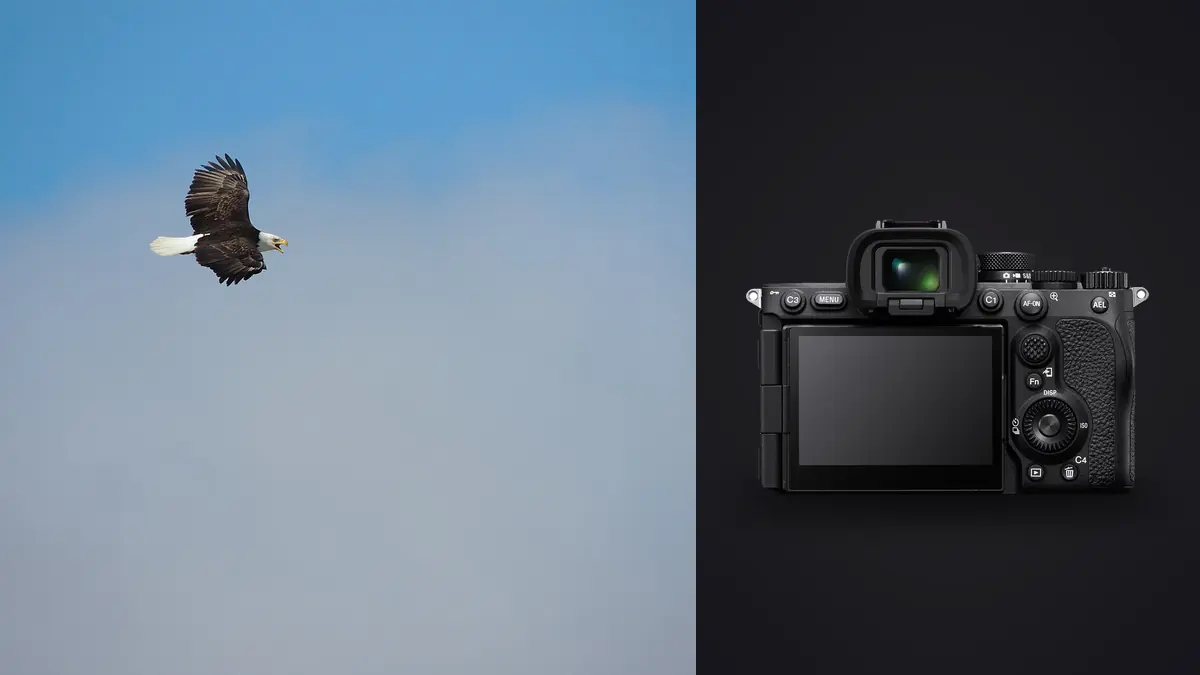
I picked up the A7R V mostly for landscape and product work, then took it to a heron rookery on a whim in April with a borrowed 200-600mm. I expected to hate it for birds in flight. A 61-megapixel sensor sounds like exactly the wrong tool for a genre that's already brutal on buffer depth and card write speed. Four months and a few thousand frames later, my opinion has landed somewhere more useful than either "amazing" or "wrong camera for the job." It's neither. It's a resolution monster that needs you to change how you shoot and how you cull, and if you don't adjust both, you'll end up disappointed for reasons that have nothing to do with the sensor (imagic's Sony A7R V page covers the spec side in full).
The 61-Megapixel Question Nobody Answers Honestly
Every review of this camera for wildlife gets to the same sentence eventually: "the resolution gives you room to crop." True, but it undersells the actual tradeoff. At 61MP, a bird that fills a quarter of the frame still resolves down to roughly 15 usable megapixels after you crop it to a reasonable composition. That's plenty for web, plenty for a 16x20 print, marginal for a gallery-wall piece. What the extra resolution actually buys you in flight photography is forgiveness for a slightly loose composition when you're panning on an unpredictable subject, not a free 800mm lens.
The tradeoff is buffer and card throughput. Shooting 14-bit lossless compressed raw at 61MP, I get roughly 45-50 frames before the buffer chokes on a UHS-II V90 card, fewer if I'm also running electronic front-curtain shutter at 30fps in the APS-C crop mode. Switch to compressed raw and you buy back maybe 15 more frames but you're throwing away some of the highlight recovery that makes backlit wingspans usable later. I settled on compressed raw for BIF sessions specifically, uncompressed only for perched portraits where I have time.
APS-C Crop Mode Is the Real Story
The A7R V's Super 35 crop mode drops you to about 26 megapixels but gives you a 1.5x reach multiplier and, more importantly, a noticeably deeper buffer because the sensor is reading less data per frame. For a 600mm lens that becomes an effective 900mm. For anything smaller than an eagle or a heron, that crop mode is where I shoot 80% of my flight sequences now. Full-frame 61MP mode is for when a subject is already close and I want the option to crop creatively afterward, not for chasing distant specks across open sky.
Autofocus Settings That Actually Held Up
The bird-eye AI autofocus gets marketed hard, and it does work, but it works best under conditions the marketing doesn't dwell on: clean sky backgrounds, decent contrast between subject and surroundings, and a bird that isn't smaller than about 5% of the frame. Put a tern against a cluttered reed bed and the eye-detect box starts hunting between the bird and the vegetation texture behind it. Here's what actually got me a workable hit rate over a season of gull, heron, and osprey sessions:
- AF-C with Tracking: Expand Spot, not Wide. Wide area tracking on a busy background locks onto whatever has the most contrast, which is rarely the bird.
- Subject recognition set to Bird specifically, not Animal/Bird combined. The dedicated bird mode weights the eye and beak detection differently and it shows in edge cases like a bird banking hard against the sun.
- AF Tracking Sensitivity at 4 or 5 (out of 5) for erratic fliers like terns and swallows, dropped to 2 for steady soarers like ospreys and herons where you don't want the camera jumping to a passing gull in the background.
- Pre-AF turned on, burned through battery faster than I'd like but worth it for launch sequences off a perch.
None of this is exotic, but the default out-of-box settings (Wide tracking, Animal/Bird combined, sensitivity at 3) are tuned for general use, not for a heron launching off a snag with a cluttered treeline behind it. Spend twenty minutes in the menus before your first real session, it's worth more than any lens upgrade.
Lens Pairings That Made Sense for Me
I've run this body with three long lenses over the season and the results varied more than I expected given they're all reputable glass.
| Lens | Effective reach (APS-C crop) | Buffer clears (compressed raw) | Where it earned its keep |
|---|---|---|---|
| Sony 200-600mm G | 300-900mm | ~1.6s per burst pause | General BIF, best AF motor pairing with this body |
| Sony 600mm f/4 GM | 900mm | ~1.9s per burst pause | Distant raptors, low light over water at dawn |
| Tamron 150-500mm | 225-750mm | ~2.4s per burst pause | Travel days, hand-holdable for hours, AF noticeably less confident in flight |
The 200-600mm is the one I'd tell most people to start with. It's slower to lock onto erratic small birds than the 600mm f/4, but the weight difference means I actually kept shooting into hour three of a shoot instead of quietly wishing for a monopod. The Tamron is a fine lens for perched birds and slower subjects but I noticed a real drop in first-frame accuracy on fast passes, probably a combination of the slower aperture and a less aggressive AF motor tune rather than anything wrong with Sony's algorithm.
What Happens After the Shoot
This is the part nobody warns you about clearly enough. A three-hour morning at a rookery with this camera in APS-C burst mode routinely leaves me with 2,500 to 4,000 frames. At full-frame 61MP resolution those files run 90-120MB each in compressed raw, so a single session can be pushing 300+ GB before you've even opened a laptop. Scrolling through that in a standard raw browser to find the handful of frames where the wingtip is sharp and the eye caught light is not a workflow, it's an evening lost.
I run these sessions through imagic now before touching Lightroom. It processes entirely on my own machine, nothing gets uploaded anywhere, which matters to me both for speed with files this large and because I don't love the idea of shipping gigabytes of raw files to a cloud service every time I go shooting. The sharpness scoring is the piece that actually saves time on a BIF take: it reads local focus data per-frame, so out of a 40-frame burst of a tern diving, it'll flag the three or four where the eye is genuinely in focus rather than just technically inside the depth of field. On a 61MP file that distinction matters more than it would on a 24MP body, because a soft-eye frame at this resolution still looks "fine" at thumbnail size and only reveals itself as unusable once you're zoomed to 100%, which is exactly the mistake I used to make manually.
It also clusters the near-duplicate bursts, which with this camera's frame rate is most of what you shoot. A single wing-flap cycle at 30fps can produce eight or nine frames that look nearly identical in a grid view. Having those grouped automatically instead of scrolled past one at a time is the difference between a culling session taking forty minutes and taking three hours. I've also trained the apply_my_style preset on a batch of my own graded heron and osprey shots, mostly to get consistent tone on backlit water and grey plumage without redoing white balance decisions frame by frame, and it holds up reasonably well across a session as long as the light doesn't shift dramatically between morning and midday.
Where I'd Push Back on the Hype
I don't think this is "the best wildlife camera Sony makes" the way some coverage frames it. The A9 III, if you can afford it and don't mind lower resolution, will out-track this body on genuinely erratic small birds in low light, the global shutter and the AF system tuned specifically for speed over resolution show up in exactly the situations where the A7R V starts to hunt. What the A7R V gives you instead is the option to shoot a heron in flight and a landscape of the same wetland at sunset with the same body and get files that hold up for large prints on both. For someone who doesn't want to carry two systems, that's a real advantage, just not the one the spec sheet leads with.
A Few Field Notes Worth Passing On
Battery life drops noticeably with Pre-AF and continuous eye-AF both active, I carry three batteries for a full morning session where I used to carry two with older bodies. The five-axis stabilization is genuinely good for handheld shooting with the 200-600mm at the long end, but it does nothing for subject motion blur on a fast wingbeat, that's still down to shutter speed (I don't go below 1/2000 for small fast fliers, 1/1600 is workable for herons and larger raptors with slower wingbeats). And the card slots matter more than I expected: running a CFexpress Type A in slot one and offloading raw there while JPEG previews go to the SD card in slot two kept my workflow moving in the field without the buffer choking as often. If wildlife is your main genre rather than a side trip, imagic's wildlife photography workflow page has more on culling this kind of high-volume take.
Frequently Asked Questions
Is 61 megapixels overkill for birds in flight, or does it actually help?
It helps specifically with distant or partially-obscured subjects where you need to crop hard after the fact, and it helps with print quality on the frames that do land well. It does not substitute for reach, and it does cost you buffer depth and storage, so it's a genuine tradeoff rather than a pure upgrade over a lower-resolution sensor.
Should I shoot full-frame or APS-C crop mode for flight sequences?
For anything smaller than a large raptor at moderate distance, APS-C crop mode is worth the resolution loss for the extra reach and deeper buffer. Reserve full-frame mode for close subjects or when you want maximum flexibility to crop the composition after the fact.
What's a realistic keeper rate from a BIF session with this camera?
Across a full season I'd put my true keeper rate (sharp eye, clean wing position, usable background) at somewhere between 2 and 5 percent of total frames shot, which is fairly typical for the genre regardless of camera. The resolution doesn't change that ratio, it just changes how punishing it is to miss on focus.
Do I need a faster card than what Sony recommends for this body?
For sustained bursts at the top APS-C frame rate, yes, I'd treat the minimum spec as a floor rather than a target. A CFexpress Type A card noticeably outperforms even fast UHS-II SD cards for buffer recovery time, and that recovery time is what determines whether you're ready for the next launch or landing sequence.