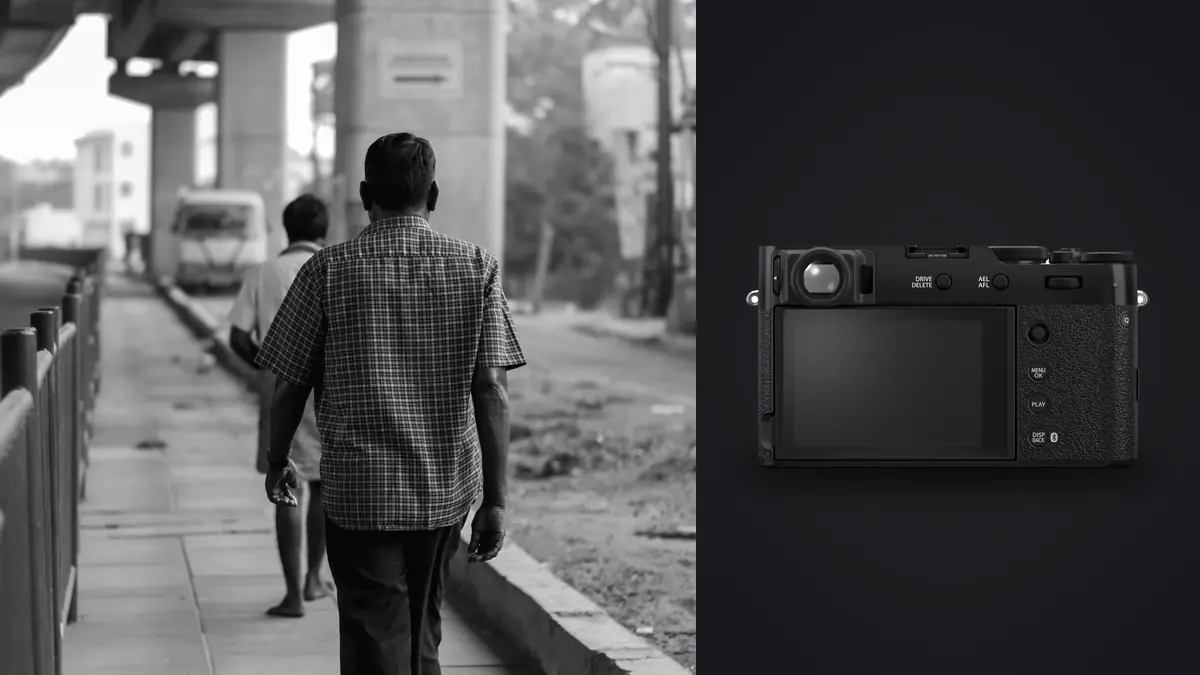
I spent three weeks last spring shooting a documentary project in a port town where nobody wanted a big camera pointed at them. The X100VI went with me because it had to, not because I was chasing a trend. What I came back with changed how I think about the camera, in both directions. It is genuinely good at the thing it is built for, and it has a handful of quirks that will annoy you if nobody tells you about them first.
A 35mm-equivalent frame is a discipline, not a limitation
The X100VI has a fixed 23mm f/2 lens, which works out to roughly 35mm in full-frame terms. People coming from zoom lenses treat this as a restriction, and for the first week it felt that way to me too. I kept wanting to step back for a wider shot or creep in for a tighter one. By week two, something shifted. Not having a zoom ring meant I stopped thinking about focal length and started thinking about distance, which is a more useful instinct for documentary work anyway. You move your feet, you get closer to the scene, and the 35mm frame forces you to include context rather than isolate a subject.
That focal length also reads as unthreatening. A 35mm lens on a small body doesn't look like surveillance equipment the way a 70-200mm on a full-frame body does. People notice you less, and when they do notice, they read the camera as casual rather than professional. For documentary work where trust matters more than reach, that matters more than most spec sheets admit.
The digital teleconverter modes (crops that simulate 50mm and 70mm equivalents) are worth knowing about but not worth relying on. They're fine for a quick reframe when you can't move, but you're cropping into the sensor and the files show it under real scrutiny. I used the 50mm crop maybe a dozen times in three weeks and always felt slightly like I was cheating.
The hybrid viewfinder changes how subjects react to you
This is the feature that gets buried under sensor talk, and it shouldn't be. The X100VI's viewfinder switches between an optical window with projected frame lines and a full electronic display, using a small lever on the front of the body. In practice I used the optical mode for maybe 80 percent of the trip. You can see outside the frame lines, which means you catch the person walking into your shot two seconds before they arrive, and you can time the shutter instead of chasing it. The electronic view earns its keep in two situations: dim interiors where you need to confirm exposure before firing, and fast unpredictable action where you want to see exactly what the sensor sees, distortion and all. Fujifilm added a small electronic window in the corner of the optical view for focus confirmation, which sounds gimmicky until you're shooting wide open at f/2 in a doorway and need to know if the eye is actually sharp before you fire.
What surprised me is how much less conspicuous the optical viewfinder makes you feel compared to holding a camera at arm's length staring at a rear screen. You look like someone glancing through a rangefinder, not someone filming. That's a small psychological thing, but on a documentary shoot it adds up over hundreds of frames.
Shutter sound, the built-in ND, and staying invisible
The leaf shutter is close to silent even in its mechanical mode, and the fully electronic shutter setting is completely silent, which matters more for documentary work than almost any other spec on this camera. I shot an entire funeral procession sequence without a single head turning toward me, something I would not attempt with a DSLR's mirror slap. The built-in 4-stop neutral density filter is the sleeper feature nobody talks about. It lets you shoot wide open at f/2 in bright daylight without blowing out highlights, which means you can keep that shallow depth of field look on a sunlit street instead of stopping down to f/8 and losing the separation. No screw-on filter to fumble with, no vignetting from a stacked filter, just a switch in the menu.
The tradeoff with the fully electronic shutter is rolling shutter distortion on fast-moving subjects. I caught a cyclist mid-frame with a visibly skewed wheel because the sensor readout couldn't keep up with the motion. If you're shooting anything with real speed (bikes, cars, a kid on a skateboard), stick to the mechanical leaf shutter even though it's marginally louder. Nobody in the frame heard the difference anyway.
How it stacks up against the other cameras documentary shooters actually debate
Everyone doing street or documentary work eventually cross-shops the same short list. Here's how the X100VI compares against the cameras I get asked about most, based on specs and my own time with each body.
| Camera | Effective focal length | Viewfinder | Quietest shutter mode | Built-in ND | Approx. weight (body) |
|---|---|---|---|---|---|
| Fujifilm X100VI | 35mm (fixed) | Hybrid optical/electronic | Fully silent electronic | Yes, 4-stop | 521g |
| Ricoh GR IIIx | 40mm (fixed) | None built in (add-on optical finder sold separately) | Near-silent electronic | No | 262g |
| Fujifilm X-Pro3 + 23mm f/2 | 35mm (interchangeable) | Hybrid optical/electronic | Silent electronic | No | 497g body, ~677g with lens |
| Leica Q3 | 28mm (fixed) | Electronic only | Silent electronic | No | 743g |
The GR IIIx wins on pure pocketability and is the camera I'd grab for a single-day walk where I want to disappear entirely, but the lack of any real viewfinder makes composing in bright sun or fast-moving scenes harder than it should be. The X-Pro3 gets you the same hybrid viewfinder concept in an interchangeable-lens body, but you're carrying two things instead of one and you lose the ND filter and stabilization. The Q3 is a genuinely excellent documentary tool if budget isn't a factor, but at nearly four times the price and with a wider 28mm default, it's solving a slightly different problem than the X100VI.
Where it actually struggles for documentary work
I don't think a gear writeup is honest if it skips the friction points, so here's what annoyed me over three weeks of daily use.
Autofocus in low interior light hunts more than I'd like. It's not bad, and it's dramatically better than the X100V it replaced, but in a dim bar or a low-lit workshop it will occasionally rack back and forth before locking. I learned to preemptively switch to single-point AF with a smaller box in those conditions rather than trust the wide-area tracking.
The buffer fills faster than the spec sheet implies once you're shooting RAW at 40 megapixels. A burst of unpredictable street action (someone crossing frame, a dog running, a door opening) can fill the buffer in under two seconds if you're not disciplined about when you press the shutter. I started shooting shorter, more deliberate bursts instead of holding the trigger down, which is arguably better practice anyway.
Weather sealing is conditional, not standard. The body and lens are only weather resistant once you've added the AR-X100 adapter ring and a protective filter, which is an extra purchase most first-time buyers don't know about until they're caught in the rain. I got soaked through a drizzle on day four before I'd bothered to fit mine.
Battery life is honest but not generous. CIPA rates it around 450 shots, and in mixed use with a lot of chimping through the EVF and reviewing frames, I was closer to 350 on a demanding day. I carried two spares and used both more than once.
Film simulations as part of the documentary process, not just a look
Fujifilm's film simulations get treated as a gimmick by people who haven't shot documentary work with deadlines. Shooting Classic Chrome or the newer Reala Ace as your baseline JPEG means you're seeing something close to your final tone in the viewfinder and on playback, which speeds up decision-making in the field. I stopped second-guessing exposure and color as much because what I saw on the rear screen was close to what I'd deliver.
I still shoot RAW alongside the JPEG for anything going into a final edit, because RAW files give far more latitude than an in-camera JPEG gives you. Once I settled on an edit style across a batch of favorites from the first week (a slightly desaturated, warm-shadow look built off Classic Chrome), I used imagic's apply_my_style feature to train a preset on those specific edits and apply it consistently across the following two weeks of RAW files. That saved a genuine amount of time compared to manually matching tone across a few thousand frames, and it kept the look consistent without me having to remember exact slider values from three weeks earlier.
What actually happens after the card comes out of the camera
A 40-megapixel sensor sounds great until you're staring at a card with 4,000 frames from three weeks of continuous shooting. Street and documentary work generates a lot of near-duplicates almost by definition, you fire two or three frames of the same moment because you're not sure which one nailed the expression or the gesture, and sorting that by eye at the end of a long shoot day is exhausting. I ran each day's card through imagic before doing anything else. It's local-first, so there's no upload step and no waiting on a server, which mattered given some of the subjects in this project were people who hadn't consented to their images going anywhere near a cloud service. The duplicate and burst clustering grouped near-identical frames together automatically, and the sharpness scoring flagged which frame in each cluster was actually in focus, since eye-level street shooting at f/2 has a thin margin for error and it's easy to keep the wrong frame from a three-shot burst. If you haven't looked at how AI photo culling actually works under the hood, it's worth understanding before you trust it with a shoot this size.
What used to take me two to three hours of manual culling per shoot day came down to about 40 minutes of quick review and confirmation. For anyone building out a faster end-to-end process, the broader habits in this workflow piece pair well with a camera like the X100VI that's going to generate volume fast.
A practical starting point if you're picking one up for this kind of work
Aperture priority with auto ISO capped around 6400, minimum shutter speed set to 1/125 for walking-pace subjects and bumped to 1/250 if you're covering anything with movement. Back-button focus so you can recompose without the camera hunting for a new subject mid-frame. Single point AF with a small box for anything indoors or low-light, wide-tracking only outdoors in good light. I leave the optical viewfinder as default and flip to electronic only when I need exposure confirmation or I'm shooting something moving fast enough that rolling shutter is a real risk.
Frequently Asked Questions
Is the X100VI quiet enough for candid shots without triggering the fully electronic shutter?
Yes, for most situations. The mechanical leaf shutter is already quiet enough that people a few feet away rarely notice it in ambient street noise. Save the fully electronic silent mode for genuinely sensitive settings like ceremonies or interiors, and be aware of the rolling shutter tradeoff on fast subjects.
Does the fixed 35mm-equivalent lens ever actually limit documentary coverage?
It limits certain shots, tight portraits and distant compressed scenes mainly, but it rarely limits the story. Most documentary sequences are built from wide establishing frames and medium human-scale shots, both of which sit comfortably in 35mm's range. If you regularly need a genuine telephoto reach, this isn't your only camera anyway.
How much does the missing weather sealing actually matter day to day?
It matters more than the spec sheet suggests, because sealing only kicks in once you've bought and fitted the adapter ring and filter separately. Budget for that add-on before your first rainy assignment rather than after.
Is the 40-megapixel file size a real problem for a high-volume documentary shoot?
It's a real consideration for storage and culling time, less so for shooting itself. Buffer depth is the more immediate issue in the field. Afterward, tools built for fast local culling and sharpness scoring make the file size a non-issue rather than a bottleneck, since you're not manually opening every frame at full resolution to judge focus.