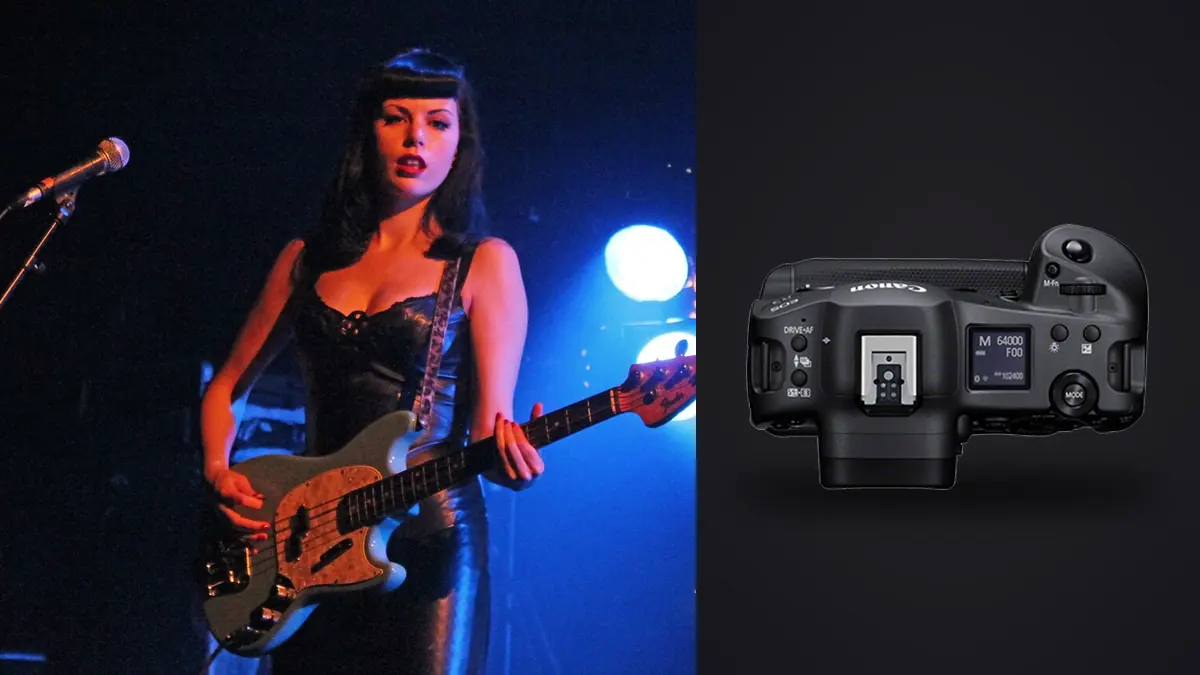
Picture the first full arena tour date shot with the R3, and the drive home convinced the gig had been blown. Not because the camera failed, but because it allowed so much shooting that there were over 4,200 frames from a 45-minute set and no idea how to get through them before the label's 6am deadline. That's the real story with this camera in a photo pit: it solves the problem you used to worry about (missing the shot) and hands you a new one (finding it again).
Why photo pit shooters gravitate toward this body
Three songs, no flash, house lighting that swings from near-darkness to a wall of white strobes in the space of a chorus. That's the environment the R3 was clearly built to survive. The stacked, back-illuminated sensor reads out fast enough that rolling shutter distortion on a swinging guitar neck or a drummer's stick blur is rarely an issue even in full electronic shutter mode, which is not something I could say about older stacked sensors I've used. And because the shutter is silent at up to 30fps, you can sit three rows back from an acoustic encore and not be the reason a fan complains to venue security.
The blackout-free viewfinder matters more than it sounds like it should. In a pit, you're often tracking a singer moving unpredictably toward the barricade while a spotlight operator loses interest in following them. Every camera I used before this one gave me a flicker or a half-second blank in the finder during bursts, and that's exactly when a hand comes up or a jump happens. With the R3 the finder stays live through the whole burst, so you keep visual contact with the subject instead of guessing where they went.
Where it actually changed how I shoot
I used to ride the shutter in short bursts of four or five frames to avoid filling the buffer on marginal moments, saving the long bursts for choruses and jumps. With this body I stopped doing that math mid-show. The buffer holds up well into triple digits of raw frames before it needs to catch its breath, long enough that I can hold the button through an entire chorus without watching the counter. That changes your shooting rhythm: you commit to the moment instead of pre-editing it in your head.
Eye Control AF: useful, but calibrate it properly or skip it
This is the one feature every R3 review mentions and almost nobody explains well. Eye Control AF tracks where your pupil is looking inside the viewfinder and moves the AF point there. In theory, you look at the bassist's face when he steps forward and the camera follows your gaze instead of you nudging a joystick. In practice, it works brilliantly for some people and is nearly unusable for others, and the difference usually comes down to two things: how carefully you ran the calibration routine, and whether you're shooting with glasses on.
My own calibration took three attempts before it stuck reliably, and I had to redo it after a few months when it started drifting to the upper-left of frame. Shooting with prescription glasses under stage lighting (versus the dim, evenly-lit room where I calibrated) introduces enough glare that the system sometimes loses my eye entirely mid-song. Contact lens shooters I know swear by it and use it for every gig. My advice: calibrate in conditions close to what you'll actually shoot in, not in your living room, and don't assume the feature is broken if the first attempt disappoints you. It's also worth having Face Detection + Tracking as a fallback you can switch to with one button press when the eye tracking gets confused.
ISO, stage lighting, and where the sensor actually holds up
Concert lighting design has gotten more aggressive over the last few years, more moving heads, more strobes, more single-color washes that leave almost nothing for autofocus contrast to grab onto. The R3's low-light AF sensitivity (down to roughly -7.5 EV with a fast lens) means it will still lock focus in situations where I've watched other bodies hunt visibly. High-ISO noise is well controlled up through the low five-digit range for club and small-theater work, and still printable at magazine sizes into the 12,800 to 25,600 range if you're not planning to crop hard.
Here's roughly how to set up depending on the room, rather than from a spec sheet:
| Venue type | Typical light level | My starting settings | R3-specific note |
|---|---|---|---|
| Small club, single wash | Very low, often under 50 lux | f/1.8-f/2.8, 1/250s, Auto ISO capped at 12800 | Eye Control AF struggles here; I switch to Face Detect + joystick backup |
| Mid-size theater, moving heads | Moderate, swings hard between songs | f/2.8-f/4, 1/500s, Auto ISO capped at 8000 | Anti-flicker mode earns its keep against LED PAR cans |
| Arena, full production | Bright but erratic, strobes and blackouts | f/3.2-f/5.6, 1/800s, Auto ISO capped at 6400 | Buffer depth matters most here; strobe hits eat frames fast |
| Outdoor festival, daylight set | High and even | f/4-f/5.6, 1/1000s, Auto ISO capped at 800 | Mechanical shutter fine here; save the electronic mode for after dark |
The anti-flicker setting deserves a specific callout. A lot of touring LED fixtures pulse at frequencies that create visible banding in electronic-shutter bursts, especially at 30fps. Turning on anti-flicker detection doesn't eliminate every case, but it catches the common ones, and I'd rather lose a fraction of a stop of shooting speed to it than come home with a card full of banded frames from a headliner set I can't reshoot.
Mechanical versus electronic shutter, picked by song
| Shutter mode | Max burst | Sound | Best use in a pit |
|---|---|---|---|
| Mechanical | 12fps | Audible click | Loud rock/metal sets where a click is inaudible anyway, or any shoot where a promoter specifically wants mechanical for flash sync |
| Electronic (silent) | Up to 30fps | None | Acoustic sets, quiet intros, seated venues, any moment where the crowd noise drops and a shutter clack would carry |
The part nobody warns you about: what 30fps does to your evening
Shooting silent electronic bursts at up to 30fps for three songs across four acts on a multi-band bill produces an amount of raw material that a normal culling workflow just isn't built for. I stopped trying to eyeball every frame in Bridge or Lightroom's grid view years ago, it doesn't scale past a couple hundred images before your judgment gets sloppy from fatigue. This is where I actually rely on imagic now: it runs local sharpness and focus scoring across the whole take and clusters near-duplicate burst frames together, so instead of scrolling through 40 nearly identical frames of a singer's jump, I'm looking at the two or three that are actually sharpest and best-timed. Because it processes everything on the laptop rather than uploading a night's shoot to somebody's cloud, it also fits the reality of pit work, you're frequently under an NDA from the artist's management about where images can go before they're cleared, and a tool that never leaves your machine sidesteps that problem entirely.
If you shoot enough gigs to build a consistent look (the same slight warmth in skin tones under blue stage wash, the same contrast curve you always reach for on arena shots), imagic's apply_my_style feature is worth setting up once. You feed it a batch of your own previously-edited concert photos and it learns your adjustments well enough to apply a first pass automatically on the next show, which turns editing from "redo everything from scratch at 2am" into "review and tweak fifteen photos" before the site update goes live. For a rundown on how that kind of local scoring actually works under the hood, I wrote more detail in how AI photo culling works, and if buffer-clearing and file-transfer speed are your bigger bottleneck on show nights, the workflow tips in 10 tips for a faster photo workflow cover more of that ground than I have room for here.
Glass I'd actually bring into a pit with this body
The RF 70-200mm f/2.8 is the lens that lives on this camera for me during full-set coverage, close enough on a small stage, long enough for an arena's front-of-house barricade position. For the wider look, and for shooting up at a singer leaning over the crowd, the RF 28-70mm f/2 is heavier than it has any right to be but earns its keep in a dark club where an extra stop matters more than your shoulder does. If you're doing three-song access only and need to cover a whole stage width from a fixed spot, the RF 24-70mm f/2.8 is the more sensible carry, lighter, and the loss of that extra stop compared to the f/2 rarely bites in venues with any kind of production lighting.
One practical note: the body alone is already a two-camera-bag kind of heavy once you add a battery grip's worth of body plus a 70-200mm, and after three or four shows in a row on a tour credential, that weight adds up in a way spec sheets don't communicate. A proper harness, not just a neck strap, stopped being optional for me after the second week of a run.
Where it comes up short for this specific job
None of this is a knock against the camera generally, but for concert and live music work specifically there are real tradeoffs. The price puts it well above what a lot of working gig photographers, especially those shooting local venues rather than touring press credentials, can justify against the day rate they're actually earning. Eye Control AF's inconsistency means you can't fully trust it as your only focus method on a night that matters, you need a backup habit built in. And while the buffer is deep, it isn't infinite: hammer 30fps through an entire five-minute song and you will eventually feel the write speed catch up with you, particularly if you're shooting full raw rather than C-RAW. I shoot C-RAW almost exclusively for pit work now for exactly this reason, the quality difference has never once mattered for a live music edit, and the buffer headroom does.
Frequently Asked Questions
Is the R3 overkill for a small club shoot with basic lighting?
For a single-wash club gig, most of what makes the R3 special (30fps silent bursts, eye control tracking a wandering spotlight) goes unused. A camera with strong high-ISO performance and reliable single-shot AF handles that room just as well. The R3 earns its price tag in venues with erratic lighting and fast, unpredictable stage movement, arenas, festivals, theaters with a real lighting rig, not a four-piece playing a 150-capacity room under two par cans.
Does Eye Control AF work if I wear glasses?
It can, but expect more inconsistency than contact lens or non-glasses shooters report. Glare and lens curvature both interfere with the infrared tracking the camera uses to find your pupil. Recalibrate in the actual lighting conditions you'll shoot in rather than a bright, even room, and keep a fast manual fallback (I use back-button AF with the joystick) ready for nights it drifts.
How do I stop 30fps bursts from destroying my editing time?
Don't try to review every frame manually, it doesn't scale and your judgment degrades with fatigue faster than you'd think. Run the take through a local culling pass first (imagic's sharpness scoring and burst clustering is what I use) to cut a 4,000-frame night down to the genuinely distinct, sharpest options before you open Lightroom at all. That single step has saved me more post-show hours than any lens or setting change.
Mechanical or electronic shutter for a photo pit, which should I default to?
Electronic for anything with unpredictable crowd noise or quiet passages, since a mechanical click during a hushed acoustic moment is exactly the kind of thing that gets a photographer's credential pulled. Mechanical still has a place for very loud sets where flash sync or rolling-shutter-sensitive fast pans (certain strobe-heavy productions) make it the safer technical choice. When in doubt in a loud room, electronic at 20fps rather than the full 30fps gives you a comfortable buffer margin without giving up the silence.