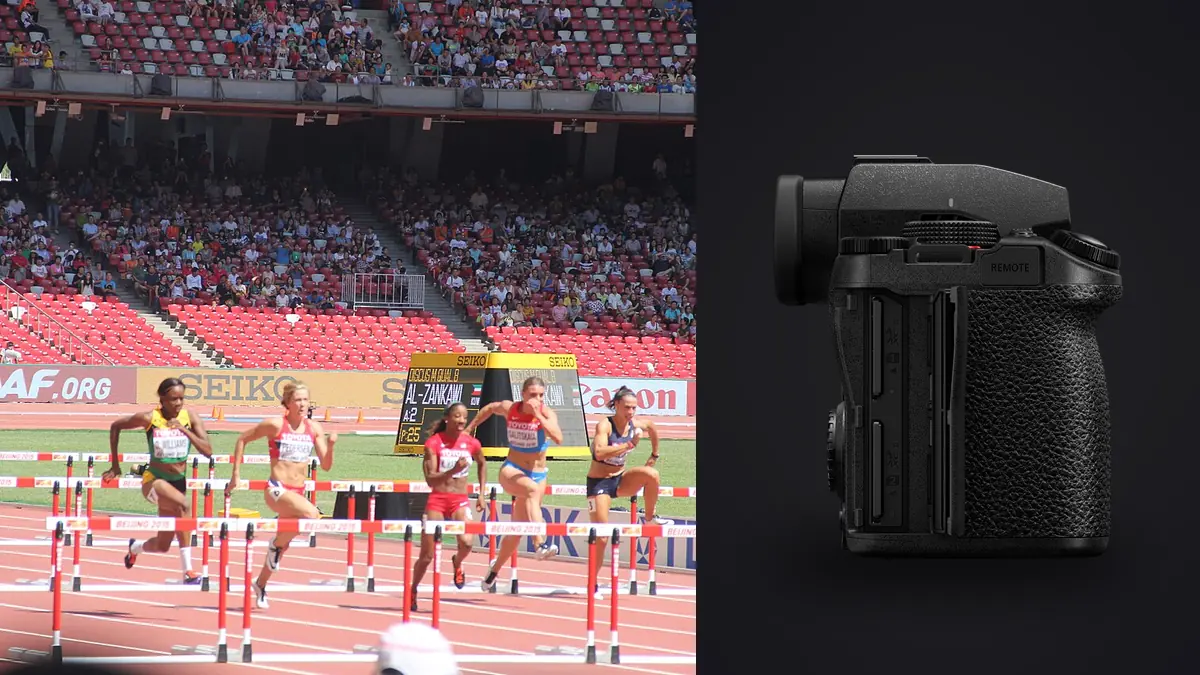
Why the S5IIX Ended Up in My Track Bag
I picked up the Panasonic Lumix S5IIX about eight months ago mostly for club-level video work, then found myself dragging it to a regional track and field meet when my usual sports body was in for a sensor clean. I went in expecting to babysit the autofocus through every 100m heat. I didn't have to, and that surprised me enough that the S5IIX has stayed in the bag for every meet since, alongside a longer telephoto that actually earns its keep on a track.
Track and field is an unforgiving test for a camera. You've got sprinters covering the frame in under a second, javelin and discus throwers rotating through a compact space where timing matters more than tracking, and distance runners who look almost static until you check your shutter speed and realize you've been under-exposing motion blur into every frame. The S5IIX isn't marketed as a sports camera first. Panasonic built it as the video-forward sibling to the standard S5II, with internal ProRes recording to an external SSD and a cooling fan for unlimited record times. But the phase-hybrid autofocus system it shares with the S5II turns out to be genuinely competitive for stills work at a track meet, and that's the part nobody talks about when they're comparing it to the G9II or the Sony bodies most meet photographers already own.
Autofocus When the Gun Goes Off
The S5IIX uses Panasonic's phase-hybrid AF system, the same 779-point layout introduced on the S5II, which replaced the old Depth From Defocus contrast system that gave the original S5 such a rough time with anything moving toward the camera. That switch matters more at a track than almost anywhere else you'll shoot. Sprinters coming out of the blocks are moving nearly straight at you if you're shooting from the infield near the finish line, and contrast-only AF systems tend to hunt exactly when you need them not to.
In practice, human body detection locks onto a runner well before their face is resolvable, which is most of a 100m or 200m race from your position. I leave it on Human detection rather than switching to Animal or the general subject-tracking mode, since a full field of runners in matching kit gives the eye-detection algorithm too many similar targets to choose between. Once a runner separates from the pack, especially in the back straight of a 400m, eye detection takes back over and tracks through to the line cleanly.
Where I still see hesitation is with field events shot from an angle where the athlete's body is partially turned away, javelin release and long jump takeoff being the two worst offenders. The AF will occasionally jump to background athletes warming up rather than staying locked on the thrower mid-motion. I've started pre-focusing manually on the runway or throwing circle and switching to a single focus zone for those events rather than relying on subject detection, which solves it but means you're back to old-fashioned technique for maybe 20 percent of your shooting.
Burst Speed, Shutter Choice, and the Rolling Shutter Question
This is where shooting choices actually matter more than the spec sheet suggests. The S5IIX gives you several practical options for a track meet, and each one trades something away.
| Shutter mode | Approx. burst rate | AF behavior | Rolling shutter risk | Best use at a meet |
|---|---|---|---|---|
| Mechanical shutter | ~7 fps | Full AF-C tracking | None | Sprints, relays, any panning shot with a moving background |
| Electronic shutter (AFS priority) | Up to 30 fps | Focus locks on first frame | Noticeable skew on fast lateral motion | Field events with a fixed focus plane (shot put circle, long jump board) |
| Electronic shutter (AFC) | ~10 fps | Continuous tracking, reduced rate | Moderate, worse on hard pans | Distance events, mid-race moments where subjects move slower across frame |
| SH pre-burst mode | ~30 fps, buffers before shutter press | Locked at half-press | Same as electronic AFS | Starting gun reactions, pole vault release, catching the exact instant of a baton pass |
The pre-burst mode is the one I'd tell any track shooter to learn first, because it solves the specific problem of human reaction time versus a starter's pistol. It buffers roughly a second and a half of frames before you fully press the shutter, so half-pressing as the runners set means you actually capture the gun smoke and the first stride out of the blocks instead of the frame after it. I missed more start-line shots in my first two meets with this camera than I want to admit, purely because I was still shooting like I had a mechanical-only body that needed the press to happen before the moment.
The tradeoff most people don't mention until they've panned a 400m runner through the electronic shutter at 30fps: the S5IIX's sensor readout is quick for a full-frame body, but it's not a stacked sensor, and a hard horizontal pan on a runner at speed will show a slight lean or skew on verticals in the frame, lane lines especially. It's subtle at 200-400mm and mostly invisible if you're shooting a runner coming toward you rather than crossing the frame, but it shows up if you crop tight on a side-on 100m shot. Mechanical shutter at 7fps has been my default for anything with lateral motion, saving electronic mode for moments where the subject is essentially stationary relative to the frame, like a shot putter mid-spin.
Buffer Depth and Card Choice
Shooting compressed RAW at 30fps electronic, I get through my dual UHS-II V90 cards' buffer in a little under 4 seconds before the frame rate drops noticeably, somewhere around 110 to 120 frames in practice rather than the paper buffer numbers Panasonic quotes for JPEG. That's plenty for a 100m final but tight if you're trying to hold a burst through an entire long jump approach and landing. I've settled into short, deliberate bursts (a second or two around the moment I actually want) rather than holding the shutter down for the whole event, partly to protect the buffer and partly because a full memory card of near-duplicate frames from a single jump is exactly the kind of thing that makes culling take three times as long back at the laptop.
Dual card slots let me mirror RAW across both cards for anything I can't reshoot, which for a school or club meet is most of them since parents are often the ones hoping for the photos. For casual weekend meets I'll split RAW to one card and a JPEG backup to the second, mostly to save card-swap time mid-event.
Lens Pairings by Event Type
The S5IIX is L-mount, which means you're not locked into Panasonic's own catalog. For track work specifically, reach matters more than aperture speed in most cases, since meets are usually run in daylight or under reasonably bright stadium lighting.
| Event type | Shooting position | Lens I'd bring | Why |
|---|---|---|---|
| Sprints (100m/200m) | Infield, level with finish line | Lumix S 70-200mm F2.8 OIS | Fast aperture holds up under stadium shade, close enough range that 400mm+ overshoots the frame |
| 400m/800m | Infield, mid-turn | Lumix S 100-400mm F4.5-6.3 | Runners cover more track distance from your position, extra reach keeps them frame-filling through the bend |
| Distance/relays | Elevated stand or infield | Sigma 100-400mm DG DN | Budget-friendlier L-mount option, more than sharp enough at meet viewing distances, lighter for a multi-hour shoot |
| Field events (throws) | Behind safety line | Lumix S 70-200mm F2.8 OIS | Throwers are close enough that a shorter zoom covers the whole circle-to-landing arc without a lens swap |
| Field events (jumps) | Runway side, close range | Standard 24-105mm zoom | Approach run needs wide framing before tightening on takeoff, one lens covers both without a swap mid-jump |
If I could only bring one lens to a meet, it's the 100-400mm without much debate. It's not the fastest glass and you'll be shooting it wide open more than you'd like once the sun drops behind the stand, but the reach covers everything from a distant 800m pack to a reasonably close long jump pit, and the S5IIX's in-body stabilization (rated around 6.5 stops with compatible lenses) does real work keeping handheld shots usable at the slower shutter speeds you end up at in overcast conditions.
Getting Through the RAW Pile After the Meet
A full day at a track meet with this camera routinely leaves me with 3,000 to 5,000 RAW files, and that's shooting in short bursts rather than holding the shutter down. Most of those frames are near-duplicates from the same 30fps sequence, three or four usable moments buried in a run of near-identical shots where the only difference is which stride the runner's foot is in.
This is where I stopped trying to cull by eye in Lightroom and started running everything through imagic first. It does its sharpness and focus scoring locally on the machine, no upload step, which matters at a track meet because I'm usually culling on a laptop at the venue or in a car in the parking lot with no reliable connection. It groups the burst sequences automatically too, so instead of scrubbing through 90 nearly identical frames from one 400m turn, I'm looking at one cluster with the sharpest frame already flagged. For a meet with five or six events shot back to back, that's the difference between a two-hour cull and a twenty-minute one, and it's the part of this camera's output that actually determines whether I deliver photos to parents the same night or three days later.
The other habit that's changed my workflow: I built an apply_my_style preset in imagic from a batch of meets I'd already color-graded by hand, matching the slightly cool, high-contrast look I use for outdoor daylight sports (the same kind of consistent, repeatable grading covered in more general terms in this color grading guide). New RAW files from the S5IIX get that same look applied automatically on import now, which is a bigger deal than it sounds when you're trying to keep a consistent look across a season of meets shot in wildly different light, some under stadium floodlights, some in flat midday sun.
Battery, Weather Sealing, and the Practical Stuff
Meets run long. A full day of qualifying heats through to finals can be six or seven hours on your feet, and I've gone through a battery and a half using the S5IIX with the EVF active most of the time and pre-burst mode drawing more continuously than a standard shutter press. Two spare BLK22 batteries in a jacket pocket is the realistic minimum if you're not near a charging point between sessions.
The body itself has held up fine through a rained-out relay final and a genuinely dusty long jump pit, magnesium alloy build with weather sealing that Panasonic rates for light rain and dust, not submersion. I wouldn't shoot it through a downpour without a rain cover, but a passing shower hasn't caused any issues so far. The one thing I've learned to watch is the SSD connection for anyone also recording video off the back of a track session for a highlight reel: the USB-C port and the cable strain from being jostled in a bag are more fragile than the body itself.
None of this makes the S5IIX the obvious first choice for a photographer who shoots nothing but track meets. If that's your entire job, a body built around a stacked sensor and a deeper native buffer will still out-shoot it on paper. What the S5IIX gets right is being good enough at the parts that matter (start-line reaction, mid-race tracking, field-event timing) while doing video and stills equally well, which is the more common situation for anyone shooting a season of school meets on a single camera body and a modest lens budget.
Frequently Asked Questions
Is the Panasonic Lumix S5IIX fast enough for sprint finishes and finish-line photos?
Yes, for the vast majority of finish-line work. Mechanical shutter at roughly 7fps with continuous AF tracking handles a sprint finish reliably, and pre-burst mode is genuinely useful for reaction-dependent moments like the start. Where it falls short of a dedicated flagship sports body is sustained high-speed AFC bursts: the frame rate drops once you push past mechanical shutter speeds with tracking active, so it rewards short, well-timed bursts over holding the shutter down for the whole race.
Does the electronic shutter's rolling shutter actually matter for track photography?
It matters more than most reviews suggest if you shoot side-on pans of runners at speed, where lane lines and verticals in the frame can show a visible skew. It's largely a non-issue for events where the subject is coming toward you or relatively stationary within the frame, like a shot put throw or a runner approaching the finish head-on. Mechanical shutter avoids the problem entirely at the cost of a lower top frame rate.
What's the single best lens to bring to a track meet with this camera?
A 100-400mm zoom covers the widest range of situations, from distance races on the far side of the track to close-range field events, and it's light enough to hand-hold through a multi-hour meet. A 70-200mm f/2.8 is the better choice if you know you'll be shooting mostly close-range sprints and throws from an infield position, but it runs out of reach for anything on the far turn.
How much does the S5IIX improve on the original S5 for this kind of shooting?
Substantially, mainly because of the autofocus system. The original S5 used a contrast-based Depth From Defocus system that hunted noticeably on subjects moving directly toward the camera, which describes most sprint and relay photography. The S5IIX's phase-hybrid AF locks and tracks far more confidently in exactly that scenario, and the added pre-burst shooting mode is a genuine workflow advantage the original S5 never had.