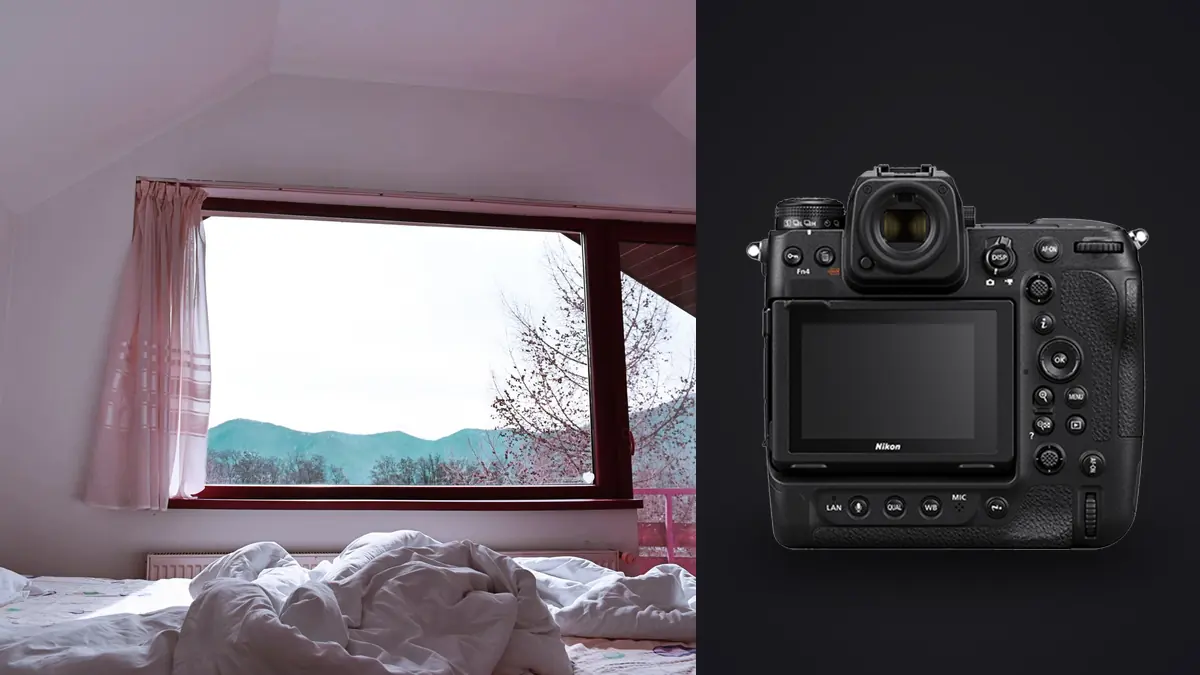
Plenty of people buy the Z9 for weddings and elopements, then find out by accident that it's one of the better bodies for boudoir. Not because Nikon designed it with that genre in mind (it clearly didn't, the marketing is all birds-in-flight and Olympic sidelines), but because the specific things that make a boudoir session go well are things this camera happens to do without trying: it doesn't clack, it doesn't need you to chimp constantly, and it doesn't lose the eye when a client shifts her weight mid-pose. None of that shows up on a spec sheet as "boudoir mode." It just quietly removes friction from a kind of shoot that runs entirely on trust and pacing.
This isn't a full review. It's what changed for me in practice after about a year and a half of shooting boudoir, budoir-adjacent branding, and intimate couples work with a Z9 as the primary body, plus what I'd tell someone who's on a D850 or an older mirrorless body and wondering if the upgrade is worth it for this specific genre.
Silence changes the room, not just the file
The Z9 has no mechanical shutter at all. That's not marketing language, it's a hardware decision Nikon made, and for most other genres it's a nice-to-have. For boudoir it's closer to essential. A DSLR-style clack, even a soft one, is a reminder every single frame that a machine is documenting the room. Clients who are already nervous (and most are, even the ones who booked the shoot themselves and seem confident in the consult call) tense up on the sound. You see it in the shoulders before you see it in the face.
With the shutter fully silent, I can fire off six or eight frames while someone settles into a pose, without them flinching at the noise or asking "did you get it?" every time. That changes the rhythm of direction. I talk through movement, "chin down, now roll your shoulder toward me, hold," and I'm shooting the whole transition instead of one static frame at the end of it. The best expression in a boudoir set is almost never the one where the subject knows the shutter fired. It's the one two frames before or after, when they're mid-breath.
The catch: fully electronic shutter means you're vulnerable to banding under certain artificial light sources, and boudoir sessions happen in hotel rooms, rented Airbnbs, and home bedrooms with whatever lamps are already there far more often than in a studio with controlled lighting. I've been burned twice by cheap LED bedside lamps causing faint horizontal banding at faster shutter speeds. Run a quick flicker check on location before the client even changes, and drop to a slower shutter speed or swap the lamp for a different one if you see it. It's a five-minute problem to solve if you catch it early, and an infuriating one to discover in post.
Autofocus behavior that actually matters for this genre
Eye-detection AF gets talked about mostly in terms of wildlife and sports, locking onto a moving subject at distance. For boudoir the challenge is different: close working distances, wide apertures, and subjects who are often partially turned away, half-lit, or wrapped in fabric that confuses contrast detection. The Z9's subject tracking is genuinely good at holding an eye through a slow turn of the head, but it's not infallible, and I've learned its specific failure modes.
Sheer fabric and lace draped near the face will occasionally pull focus away from the eye and onto the texture, especially in lower light where contrast is already thin. Backlit hair against a bright window does the same thing sometimes, hunting between strands and the eye. My workaround is unglamorous: I switch out of full auto-area tracking and into a smaller AF area with the eye-AF overlay on, then use the joystick to nudge the focus point onto the eye myself before the subject moves into position, and let tracking take over from there rather than asking it to find the subject from scratch in a cluttered frame. It costs half a second per setup. Worth it.
The no-blackout viewfinder is the other autofocus-adjacent feature that matters more here than people expect. In a genre where you're reading emotional state as much as focus confirmation, being able to watch continuously through the finder while firing bursts, instead of the image cutting out with every frame, means you actually see the moment happen rather than reconstructing it later from the memory card. I catch real laughs and real held breaths that I would have missed with a blackout finder, because I was watching the actual person instead of a strobing viewfinder.
Lens choices for small rooms
Boudoir is usually shot in bedrooms, not studios, and bedrooms are small. This matters more for lens choice than any amount of bokeh chatter online accounts for. Here's how the lenses I actually rotate through behave in real rooms, not on a lens chart.
| Lens | Working distance in a small room | Character | Where it earns its spot |
|---|---|---|---|
| Nikkor Z 85mm f/1.2 S | Often too tight. In a 10x12 room you're backed against the far wall for anything beyond a tight close-up | Creamy, almost liquid falloff, gorgeous skin rendering wide open | Detail shots, close portraits, or any room bigger than a standard hotel bedroom |
| Nikkor Z 50mm f/1.2 S | Comfortable in most bedrooms without backing into furniture | Sharper edge-to-edge than the 85 at matching apertures, still very soft transition to blur | My default for full-length and three-quarter poses on a bed or chaise |
| Nikkor Z 35mm f/1.4 | Very forgiving, works even in cramped ensuite bathrooms and closets | More environmental, brings in window frames, headboards, texture of the room itself | Storytelling frames, wide shots that establish the setting before the tighter set |
| Nikkor Z 24-70mm f/2.8 S | Flexible by definition, the reason to bring it at all | Clinically sharp but the f/2.8 background separation reads flatter than the primes | Scouting a new location fast, or client work where reshoots aren't an option and you need coverage over character |
If I could only bring one lens into an unfamiliar room, it's the 50mm f/1.2. It's heavy (over a kilogram with the hood on, which becomes noticeable after ninety minutes of handheld shooting at low angles), but the working distance is right for most bedrooms and the falloff still looks intentional rather than clinical.
The stacked sensor solves a problem you don't notice until it's gone
Boudoir involves a lot of small, quick movement that older sensors render badly: a hair flip, a sheet pulled back, fabric settling after a pose shift. Rolling shutter on a slower sensor readout smears that motion into a slight skew, most visible at the edges of fast-moving fabric or hair. The Z9's stacked sensor reads out fast enough that I genuinely stopped thinking about this as a variable. I used to avoid shooting mid-movement on older bodies specifically because of the skew risk. Now some of my favorite frames from a session are the ones caught in the middle of exactly that kind of motion, because the sensor doesn't punish me for shooting it.
Dynamic range at base ISO is also doing real work in window-lit boudoir, which is most of it. A single north-facing window as the key light means you're routinely three or four stops down between the highlight side of a face and the shadow side of the room. I shoot to protect the highlights on skin and pull shadow detail back in post, and the Z9's files give me enough room to do that without shadows turning noisy or blocked. Above ISO 6400 that headroom shrinks fast, and I try to stay under that even in dim rooms by opening up the aperture or adding a single small continuous light rather than pushing ISO further.
What happens to 900 frames afterward
A ninety-minute boudoir session with a body that shoots 20fps electronic produces a genuinely absurd number of frames if you're not disciplined about burst length. I've walked away from sessions with over a thousand images, most of them three or four near-identical variations of the same pose a fraction of a second apart. That's manageable in the moment, since the silent shutter and no-blackout finder let me shoot loosely and sort later. But "later" used to mean hours at a lightbox in Lightroom clicking through duplicates one at a time, which for this kind of content I never wanted sitting in a browser tab connected to a cloud sync service in the first place.
This is the part of the workflow where I actually changed tools. I run the take through imagic before it ever touches an editing app, entirely on my own machine, nothing uploaded anywhere. Its burst and duplicate clustering groups those four-frames-apart variations together so I'm choosing between five options instead of scrolling past all nine hundred, and the sharpness scoring flags which frame in each cluster actually has the crisp eye, which matters more in this genre than usual since a soft eye at f/1.2 is unforgiving and easy to miss at a glance on a laptop screen. For a genre where the whole point is that the files are sensitive and the client is trusting you with them, doing that first pass fully offline isn't a nice-to-have, it's the reason I trust the tool at all.
Once I've got a culled set, I lean on the apply_my_style preset, trained on my own past edits rather than someone else's LUT pack, to get a consistent first pass across the set before I go in and hand-finish the handful of hero images. Skin tone consistency across a set shot over ninety minutes of shifting window light is genuinely hard to nail manually image by image, and having a starting point that already reflects how I personally grade skin saves real hours. If you're building color consistency into your own process, it's worth reading up on color grading fundamentals before you lean on any automated preset, since the automation is only as good as the judgment it's mimicking.
A few things I'd tell someone considering the switch
The Z9 is not a subtle camera. It's large, the grip is deep, and in a small bedroom with a nervous first-time client, pulling out something that looks like a professional sports camera can work against the intimate, low-key mood you're trying to build. Try leaving it on a strap slung low and out of sight during the initial consultation and client walkthrough, only bringing it up once you're actually shooting, because the visual weight of the body itself changes the room's energy before a single frame is taken.
Battery life is a non-issue for this genre specifically. A boudoir session rarely runs past two hours and the Z9 will get through several sessions on one charge, so I don't carry spares anymore, which is one less thing in the bag for an already gear-heavy day. Dual card slots matter more here than in most genres, since a corrupted card on a boudoir session isn't just a lost shoot, it's a broken promise to a client who trusted you with something personal. I run CFexpress as primary and SD as an instant backup, and I've never regretted the redundancy.
If you're weighing the Z9 against a smaller body for this specific kind of work, my honest advice is that the autofocus tenacity and shutter silence outweigh the size and weight downsides, but only if you actively manage the intimidation factor of the body itself around clients who are already stepping outside their comfort zone. It's a tool that gets out of the way once the session is moving. Getting to that point takes a little more deliberate handling than it does on other genres.
Frequently Asked Questions
Does the Z9's 45.7-megapixel sensor create problems for boudoir retouching?
Not in terms of quality, but it does inflate file size and storage fast when a session produces close to a thousand frames. I shoot RAW at full resolution and don't regret the detail, especially for close crops, but it does mean culling aggressively before you start editing rather than dragging the whole take into your editor is worth the extra step. A quick automated sharpness and duplicate pass before you open anything saves real disk space and real time.
Is the mechanical shutter sound really gone, or just quieter?
Gone. The Z9 has no mechanical shutter mechanism at all, only electronic. There's a synthesized shutter sound you can enable for feedback, but I turn mine off entirely for boudoir work. Some photographers keep a faint sound on so clients have an audible cue that a frame was captured; many clients relax faster without any sound cue at all.
Should I shoot boudoir in the Z9's high-speed 20fps mode?
Rarely, and only for genuine movement, like a hair flip or fabric falling. For static or slowly transitioning poses I stay around 5-8fps. Full 20fps bursts on posed, mostly-still subjects just multiplies your culling workload for almost no gain in usable variety between frames.
How do you handle client privacy with such large native RAW files?
Everything stays on a local drive from capture through the first culling pass, nothing gets synced to a cloud service until a final, client-approved gallery is ready to deliver, and even then it goes through a private delivery link rather than a general photo host. If you're evaluating tools for the culling stage of a similar workflow, it's worth reading up on how AI photo culling actually works so you know what's happening to sensitive files at each step, and whether processing happens on your machine or someone else's server.