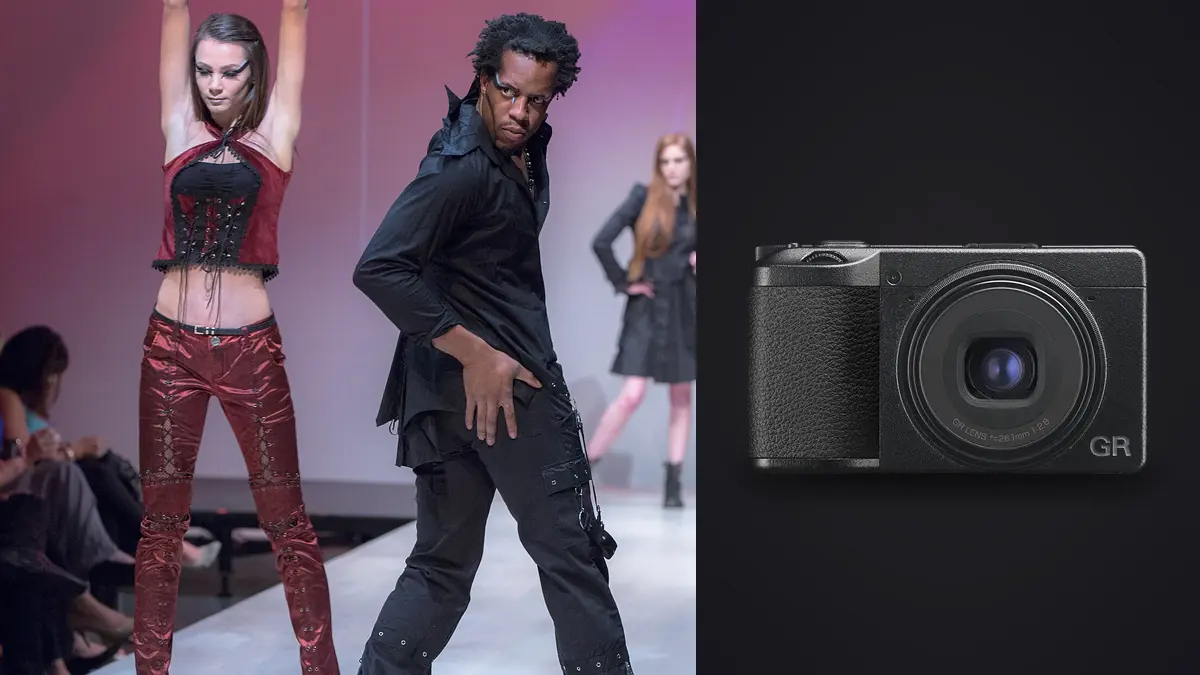
Picture being handed the Ricoh GR IIIx for a lookbook job almost by accident. The brand's usual second shooter cancels two days out, you own a GR IIIx for personal street work, and the art director shrugs and says "bring whatever gets you images fast." What you expect to be a backup camera for behind-the-scenes texture ends up shooting close to a third of the final selects. That would be surprising enough that it's worth writing down what can actually happen, not the marketing version of what a fixed-lens compact "can" do.
A 40mm Equivalent Lens Is an Odd Choice Until You're Moving Fast
The GR IIIx carries a fixed 26.1mm f/2.8 lens on an APS-C sensor, which works out to roughly a 40mm field of view in full-frame terms. That's a strange spec on paper for fashion work, where 50mm, 85mm and the occasional 35mm dominate most kits. But 40mm sits in a genuinely useful gap: wide enough to hold a full-length pose with a bit of environment around the model without stepping back into traffic, and tight enough that you're not fighting the barrel distortion and stretched-limb problem you get from the standard GR III's 28mm lens when you close the distance for a three-quarter shot.
On a lookbook day, distance control matters more than people expect. You're often shooting on a sidewalk, in a stairwell, or in a cramped studio corner with a client and a stylist standing behind you. A 28mm lens forces you either back into the wall or into distortion territory the moment you frame tighter than full length. The IIIx's narrower angle of view gives maybe a stop more breathing room before proportions start looking off, which matters more than any spec sheet number when shooting six looks in ninety minutes with a stylist re-pinning garments between every third frame.
Three Focal Lengths From One Lens: What the Crop Modes Actually Get You
The feature that made the GR IIIx more than a novelty on this shoot was its in-camera crop modes. The camera can simulate 50mm and 71mm equivalent framing by cropping into the center of the sensor and showing you the new frame lines live, before you shoot. It's not optical zoom, it's a digital crop recorded straight into the file, but it changes how you compose without switching gear. For a lookbook where you need a wide establishing shot of the outfit, a three-quarter shot, and a tighter detail crop of the shoes or the collar, that's effectively three "lenses" out of one small body.
The catch, and it's one I didn't fully register until reviewing files that evening, is that cropping doesn't change depth of field. The lens is still physically an f/2.8 26.1mm optic doing the work; the 71mm crop just uses fewer of the sensor's pixels. So a "tight" crop shot still has the depth of field of a wide lens at f/2.8, not the compressed, softer-background look you'd get from an actual 71mm prime. If you're expecting portrait-style subject separation out of the crop modes, you won't get it. What you do get is a real resolution tradeoff worth planning around before the shoot, not after.
| Mode | Equivalent focal length | Approx. resolution | Best use in a lookbook set |
|---|---|---|---|
| Native (no crop) | 40mm | Full sensor, ~24MP | Full-length looks, environmental context, walking shots |
| Crop 1 | 50mm | ~15MP | Three-quarter shots, pose details, texture on garments |
| Crop 2 | 71mm | ~7MP | Accessory close-ups, footwear, small social-crop inserts |
Those crop resolution figures are close approximations, not numbers I'd bank a print run on, but they're close enough to plan a shoot list. The 71mm crop is genuinely too soft for a large print or a billboard, but it's more than enough for e-commerce thumbnails, Instagram carousel inserts, or the small "detail" frames that pad out a digital lookbook PDF. Keep the 71mm crop away from anything the client might blow up and use it strictly for supporting shots.
RAW Files, DNG, and Keeping One Look Across a Whole Set
The GR IIIx shoots DNG, not a proprietary raw format, which sounds like a footnote until you're on a tight same-day turnaround. Every raw processor I own opened the files immediately, no waiting on a camera profile update, no converting through Adobe's DNG converter first because it already is one. For a commercial job where the client wants three finished lookbook images emailed before you've even wrapped the shoot, not having to fight software compatibility on day one is a real, if unglamorous, advantage.
The harder problem was consistency. A lookbook lives or dies on every image reading like it belongs to the same set, and that's difficult to maintain when you're switching between the GR IIIx and a main mirrorless body with a completely different color science. What works is building a grade on the first ten or so GR IIIx frames you like, in the muted, slightly warm tone a brand might want, and then running the rest of the day's DNGs through imagic's apply_my_style feature, which trains a preset from those edited files and applies the same look automatically to the rest of the take. It's not a substitute for finishing each hero image by hand, but it means the two hundred-plus supporting frames don't need individual grading before a client sees a coherent set the next morning.
Ricoh's own in-camera color profiles are worth mentioning too. The Positive Film and Negative Film simulations gave me a rougher, more editorial starting point straight out of camera than I expected from a compact, and on a couple of candid walking shots I used the JPEG output almost as-is for a same-day social teaser while the RAW files were still being culled.
Snap Focus, the Built-In ND, and Other Handling Details That Actually Mattered
Autofocus hunting kills spontaneous fashion shots, especially the ones where a model turns mid-stride or a coat flares out on a gust of wind. The GR IIIx's snap focus mode, which locks focus to a preset distance (I ran it at 2.5 meters for most of the walking shots) the instant you fully press the shutter, let me shoot those moments without waiting on the AF system to confirm. It's a zone-focusing trick as old as photography itself, but having it built into a menu toggle instead of manually guessing distance on a focus ring saved real time between poses.
The built-in 2-stop ND filter turned out to be more useful than I expected too. Shooting f/2.8 in open shade at midday to keep some background separation on the wider crop meant I was regularly bumping into the camera's max shutter speed; toggling the ND on kept the aperture open without blowing highlights. And the macro mode, focusing down close enough to fill the frame with a shoe buckle or a fabric weave, covered the small product-style detail shots a lookbook usually needs without borrowing a second lens from anyone.
Battery Life and Buffer: The Unglamorous Limit of a Full Shoot Day
None of this matters if the camera is dead by lunch. The DB-110 battery is rated for roughly 200 shots per charge under CIPA testing, and a lookbook day with bursts for movement (hair flips, coat swings, walking sequences) chews through that faster than a still-life street session ever would. Expect to go through four batteries across a six-hour shoot day. USB-C charging means you can top one up from a power bank between looks, but I'd still tell anyone borrowing a GR IIIx for a paid job to buy at least two spares before the batteries become the reason a shot list doesn't get finished.
The single UHS-I SD slot and modest buffer showed up the same way. A burst of eight or ten frames on a walking shot would occasionally stall the camera for a second or two while it cleared to the card, right when the model hit the pose I actually wanted. It's not a dealbreaker, but it's worth knowing before you plan to lean on continuous shooting the way you might with a dedicated sports or event body.
Culling a Full Day's Worth of Near-Identical Frames
Here's the part that surprised me most: leaning on snap focus and short bursts to catch movement produced a lot of frames that looked nearly identical at a glance but weren't, a half-step of stride, a slightly different fabric flare, one frame a fraction sharper on the face than the one next to it. Sorting that by eye at the end of a shoot day is exactly the kind of work that eats an evening. I ran the full card through imagic afterward, which does its sharpness and focus scoring locally on the machine rather than uploading anything, and its duplicate and burst clustering grouped those near-identical walking sequences together so I was comparing four or five frames at a time instead of scrolling through two hundred loose thumbnails looking for the one where the coat hit the right angle.
That matters more on a shoot like this than it usually does with a single primary camera, because you end up culling two cameras' worth of files against each other on the same evening with a client expecting a first pass by morning. If your workflow already leans on culling software for a single-camera shoot, the value only goes up once you add a compact second body shooting bursts alongside your main kit. For anyone building out a faster review process generally, it's worth reading through how AI photo culling actually works before assuming every tool handles bursts the same way, because clustering near-duplicates well is a different problem than just scoring sharpness.
Where the GR IIIx Isn't the Right Tool
I don't want to oversell a fixed-lens compact for commercial work, because it has real limits on a fashion set. There's no hot shoe, so if the brief calls for off-camera flash or a beauty dish for a studio-style shot, this camera sits that portion of the day out entirely. There's no tethering workflow worth relying on; Ricoh's Wi-Fi image transfer is slow and mostly JPEG-oriented, so an art director who wants to see full-resolution frames pop up on a laptop as you shoot is going to be disappointed. And the fixed f/2.8 aperture, combined with the fact that the crop modes don't change actual depth of field, means you simply can't get the creamy, isolated background a client sometimes wants from a beauty close-up. For that, you're reaching for a longer prime on a mirrorless body regardless of how good the GR IIIx's files look.
It also isn't weather sealed in any meaningful sense, so a lookbook shoot with light rain or a beach location with blowing sand is not where I'd want to risk it as a primary camera. I treat it as what it is: an extremely fast, extremely pocketable second angle, not a replacement for a full kit.
Building a Lookbook Day Around a Small Fixed-Lens Camera
The workflow that ended up working was simple. Main mirrorless body handled the hero shots the client had actually storyboarded, on a tripod or with a assistant holding a reflector. The GR IIIx stayed on a wrist strap the entire day, used the second the model relaxed between formal poses, walked to the next location, or laughed at something off-camera. Those informal frames ended up being roughly a third of what made the final lookbook, because they read as more natural than the posed shots around them, exactly the kind of candid, slightly-off-guard energy a lot of current lookbook briefs are asking for.
Budget is worth mentioning too, since this is often shot by a freelancer or a small brand rather than a studio with a full equipment budget. A GR IIIx is a fraction of the cost of a second full-frame body and a fast prime, and tools like imagic being a one-time purchase rather than a subscription matters in the same way when you're pricing out software for a small operation; you can check current tiers on the pricing page if you're weighing a culling tool against the cost of paying an assistant to sort files by hand. If you're still refining the rest of your shoot-day process, a few workflow habits that speed up any shoot apply just as well whether you're running one camera or two.
Frequently Asked Questions
Is the Ricoh GR IIIx sharp enough for large lookbook prints or billboard use?
At native resolution, yes, the roughly 24-megapixel APS-C files hold up fine for large prints and even outdoor advertising if the frame is well exposed and in focus. The crop modes are a different story. The 71mm equivalent crop drops down to somewhere around 7 effective megapixels, which is fine for web and social use but not something I'd send to a print house for anything larger than a small insert.
Can the GR IIIx replace a full mirrorless kit for a commercial fashion shoot?
Not on its own. It has no hot shoe for flash, no reliable tethering, and a fixed f/2.8 aperture that can't produce the shallow depth of field some beauty and product shots call for. Where it earns its place is as a fast, pocketable second camera for candid and behind-the-scenes coverage running alongside a primary body with interchangeable lenses.
How does the GR IIIx's 40mm equivalent lens compare to the standard GR III's 28mm for fashion work?
The 28mm on the standard GR III is wider and better suited to environmental street shots, but it distorts proportions noticeably once you close the distance for a three-quarter or half-body fashion frame. The IIIx's 40mm equivalent gives you more working distance before that distortion shows up, which is why it fits fashion and lookbook use better despite being the less popular of the two models for street photography generally.
What's the fastest way to sort a full day of RAW files from a lookbook shoot?
Separate the culling from the editing. Run the full card through a local sharpness and duplicate-clustering pass first to group near-identical burst frames and surface the sharpest one in each group, then build your color grade on a handful of hero images and apply it to the rest of the selects rather than editing every frame individually. Doing both at once on two hundred-plus files is where most shoot days lose their evening.