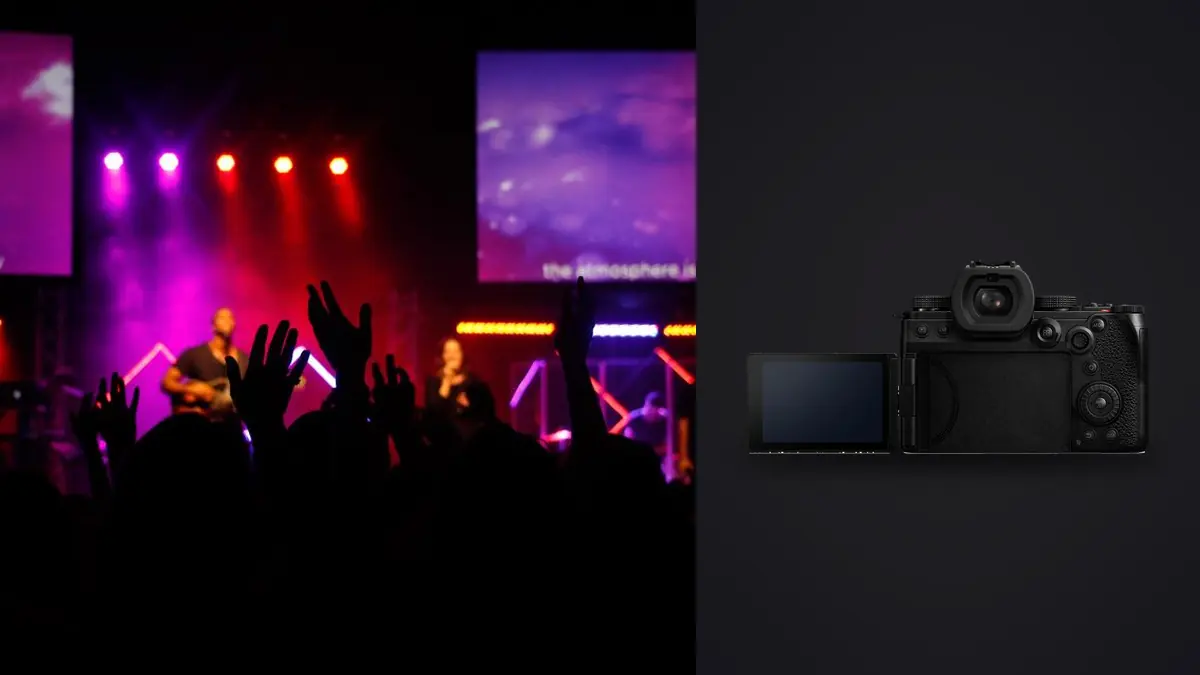
I picked up the Lumix S5IIX for club shows mostly because I was tired of carrying two bodies. One camera that could shoot a three-song pit set in near-darkness and then, later that night, sit on a tripod for a fixed wide angle covering the whole stage during the encore, without me swapping gear between sets. A year and a few hundred shows later, that's roughly what it's turned into, with a few caveats worth knowing before you bring it into a venue with a strict photo policy and terrible lighting.
What the S5IIX Actually Brings to a Photo Pit
The S5IIX and its sibling the S5II share the same 24.2MP full-frame sensor and the same phase-detection autofocus system, Panasonic's first since it dropped contrast-detect-only AF. That single change is the reason I'll recommend this body for live music over the original S5, which hunted visibly under moving stage lights and occasionally locked onto a guitar headstock instead of a singer's face. The phase-detect system tracks through strobes and colour washes far more reliably, though it's still not as sticky as Sony's or Canon's flagship tracking when a drummer's arm crosses the frame at the wrong moment.
High ISO, Realistically
Native ISO tops out at 51200, with an extended range up to 204800 that I've never used for anything I'd want to share. In practice I shoot most small-venue sets between ISO 3200 and ISO 12800 depending on how aggressive the lighting operator is that night. Files at 6400 clean up fine in post with modest luminance noise reduction; by 12800 you're managing visible grain in the shadows, which for black and white conversions of a sweaty basement show is often exactly the look you want anyway. Past 25600 I only shoot if the alternative is missing the shot entirely, and even then I know I'm trading detail for a usable exposure.
The Electronic Shutter Trade-off
Most pits have a "no flash, first three songs" rule, and increasingly venues are asking for silent shooting during quiet acoustic sections too. The S5IIX's electronic shutter is dead silent, which solves the noise problem, but the sensor isn't stacked, so rolling shutter is real. Pan quickly across a strobing light, or catch a singer mid-jump under fast-moving beams, and you can get a visible skew or banding, especially under LED stage lighting running at odd refresh rates. Panasonic's variable shutter speed setting for flicker reduction helps with the banding specifically, but it doesn't fix skew on fast lateral motion. My workaround is mechanical shutter whenever the room allows any shutter noise at all, and electronic only when I genuinely need silence.
Setting Up AF Before Doors Open
I don't touch the default AF Custom setting for live shows. Panasonic gives you six AF Custom slots, and I've got one saved specifically for stage work with tracking sensitivity turned down a step from default so the camera doesn't snap off the singer's face every time a hype man walks through the background, and switching sensitivity turned up so it commits to a new subject quickly when the frontperson actually does move to a different mic. Human eye/face/body detection stays on throughout, but I keep it on face-priority rather than full-body, because full-body detection in a crowd shot at a festival will happily lock onto a fan's face in the front row instead of the guitarist you're actually trying to shoot. Back-button focus is non-negotiable for me here; half-press-to-focus means every accidental shutter bump during a rushed reload refocuses on whatever's closest, usually a monitor wedge.
Body Details That Change How You Work a Set
A few things about the physical camera matter more at a gig than they do on paper. The S5IIX dropped the red recording tally lamp that's on the S5II, which sounds trivial until you're three feet from the stage in a dark room and don't want a glowing red dot broadcasting exactly where you're pointed. Dual card slots pair CFexpress Type B with SD UHS-II, which is a genuine upgrade over the S5II's dual-SD setup if you're shooting RAW bursts of a band that won't stop moving; the CFexpress slot clears the buffer fast enough that I rarely see the camera choke mid-song. IBIS rated to 8 stops with a compatible Dual I.S. 2 lens lets me hand-hold down to around 1/15s for wide shots when I want motion blur on a moving crowd, though for anything with a performer's face in frame I still keep shutter speed at 1/250s or faster regardless of stabilization, because IBIS does nothing about subject motion.
Weather sealing matters more for outdoor festivals than club gigs, but I've had it rained on at two summer shows now and the body has taken it without complaint. At around 740g body-only it's noticeably lighter than a comparable DSLR-era body, which matters when you're holding a 70-200mm up over your head for three hours at a festival barricade.
Lens Choices That Actually Work in a Pit
L-mount gives you Panasonic, Leica, and Sigma glass, and for concert work I've settled on a two-lens rotation rather than trying to cover everything with one zoom. A Sigma 24-70mm f/2.8 DG DN Art handles most of the pit work, wide enough for full-stage shots from the barrier and long enough for a reasonable head-and-shoulders crop without cropping in post. For anything shot from further back, whether that's a photo pass restricted to the back of the venue or a festival stage with a deep barricade, the Lumix S PRO 70-200mm f/2.8 earns its weight, particularly for isolating a single performer against a busy backline.
Primes come out for specific looks rather than general coverage. A 50mm f/1.8 stays in the bag for tight, low venues where a zoom is overkill and I want the extra stop of light. Sigma's 35mm f/1.4 DG DN Art is my pick when I want environmental context, drummer and half the stage in frame, without losing too much light. None of these are cheap, but on this system they're noticeably lighter than their Sony or Canon RF equivalents, which after a four-hour festival day is not a small thing.
Battery life is the one area I plan around rather than trust. A single charge gets me through a full night of three-band bills if I'm disciplined about chimping less and reviewing bursts on the laptop between sets instead of on the rear screen, but I still carry two spares in a jacket pocket because a dead battery mid-headliner is not a mistake you get to make twice with the same booker. The USB-C port charges in-camera off a power bank between sets if it comes to that, which has saved me exactly once so far.
How the S5IIX Compares for This Specific Job
Every full-frame body released in the last few years can technically shoot a concert. What actually separates them for this job is buffer depth, rolling shutter behaviour, and how much you're carrying by the end of the night. Here's how the S5IIX stacks up against two bodies I get asked about most often by other shooters at the same shows.
| Spec (concert-relevant) | Panasonic Lumix S5IIX | Sony a7 IV | Nikon Z6III |
|---|---|---|---|
| Resolution | 24.2MP | 33MP | 24.5MP (partially stacked) |
| Native ISO ceiling | 51200 | 51200 | 64000 |
| Mechanical burst rate | 9fps | 10fps | 14fps |
| Rolling shutter risk (e-shutter) | Moderate to high, not stacked | Moderate, not stacked | Low, partially stacked sensor |
| AF-assist tally light | None (S5IIX-specific) | None | None |
| Card slots | CFexpress B + SD UHS-II | CFexpress A + SD UHS-II | CFexpress B + SD UHS-II |
| Body weight | ~740g | ~658g | ~760g |
| Approx. street price (body only) | ~$1,800 | ~$2,000 | ~$2,300 |
The Z6III's partially stacked sensor is the meaningful edge if you shoot electronic shutter constantly and hate rolling shutter artifacts, and its faster burst rate matters for mosh-pit chaos or a guitarist windmilling through a solo. The a7 IV gives you more resolution to crop into after the fact, useful if you're shooting from a restricted position and cropping tight later. The S5IIX's case is really about the whole kit: lighter lenses, a lower price for the body, and a discreet, unlit shell that a lot of photo pit veterans quietly prefer.
RAW Settings That Save Time Later
I shoot RAW only, standard colour profile rather than V-Log, because I'm not grading footage and a flat profile just adds a step to every single frame during culling. 24.2MP RAW files run around 30-40MB each depending on scene complexity, which for a three-song pit set at 9fps adds up fast, easily 800-1,200 frames if I'm shooting continuous bursts through the loud choruses. That volume is the actual bottleneck in a concert workflow, not the shooting itself. Nobody wants to sit at 1am scrubbing through twelve hundred nearly-identical burst frames looking for the three where the singer's eyes are actually open and the focus landed on the right eye instead of the mic.
This is where I stopped doing that manually and started running the take through imagic before touching Lightroom. It runs entirely on the laptop, no upload, which matters at a venue with dead wifi or when you're not willing to put unreleased tour photos anywhere near a cloud service. It scores focus locally across the burst and groups near-duplicate frames from the same phrase or jump, so instead of eyeballing forty frames of a guitarist mid-strum I'm looking at the two or three the software flagged as sharpest. Between sets, that's realistically fifteen minutes of culling instead of an hour, which on a three-band bill is the difference between reviewing files at the bar and reviewing them at 3am. If you haven't compared culling tools directly, our breakdown of how AI photo culling actually works covers the mechanics in more detail than I can here.
For the edit itself, I trained imagic's apply_my_style preset on a batch of my own graded concert work from last tour, high contrast, cooler shadows, warm highlights pulled off the stage lighting, and now a fresh set of culled S5IIX RAWs gets a first-pass grade that's already close to my usual look before I open a single file for spot corrections. It's not a replacement for actually editing, but it cuts the flat starting point out of the process entirely.
None of this requires a subscription or an internet connection at the venue, which matters more than it sounds like it should when you're editing in a van between cities on tour wifi that can't be trusted to upload a single JPEG, let alone a folder of RAW files. It's a one-time purchase rather than a monthly fee, which for a working photographer doing forty shows a year adds up to a real difference over renewing a subscription every single month. If your current culling routine is still built around scrolling through a Lightroom filmstrip one frame at a time, our notes on speeding up a photo workflow cover a few habits worth changing before you even open new software.
Frequently Asked Questions
Is the S5IIX fast enough for mosh pits and high-energy shows?
9fps mechanical is enough for most club and festival sets, but if you regularly shoot hardcore or punk shows with constant crowd surfing and stage diving, a body with a faster burst and a stacked sensor, like the Nikon Z6III, will land more peak-action frames per attempt. I still get usable sequences with the S5IIX, I just shoot in slightly shorter, more deliberate bursts timed to the movement rather than holding the shutter down continuously.
Do I need V-Log if I'm only shooting stills?
No. V-Log is a flat picture profile built for video colour grading, and applying it to stills just adds a low-contrast, desaturated starting point you have to correct in every RAW conversion. For photography I shoot the standard photo style and let the RAW file carry the full dynamic range; there's no stills-specific reason to flatten the image before you've even opened it in an editor.
How many shots does a typical three-song pit set produce on this camera?
For me, somewhere between 700 and 1,300 frames, depending on how many burst sequences I fire during high-energy moments versus how much I shoot single-frame during calmer parts of the set. That range is why culling software has become a non-negotiable part of the workflow rather than a nice-to-have; reviewing that volume by hand between three back-to-back band sets simply doesn't fit the time you actually have.
Is the lack of a stacked sensor a dealbreaker for concert work?
Not for most club and mid-size venue shooting, where you're rarely shooting electronic shutter continuously and rolling shutter shows up mainly during fast pans or extreme motion under harsh lighting. It becomes more of a factor at big festival stages with fast-moving lighting rigs and pyro, where I'll deliberately switch to mechanical shutter for anything with rapid lateral motion, accepting the shutter sound because nobody's going to hear it over the PA anyway.