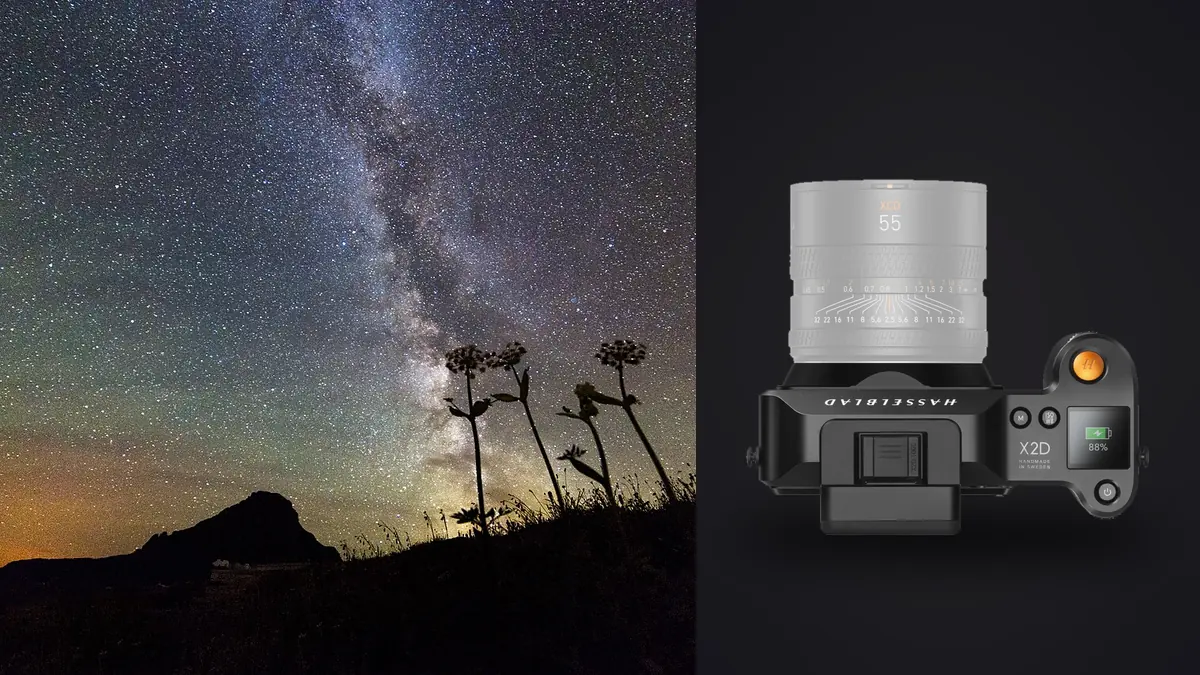
A 100-megapixel medium format body is not the camera most people reach for when the plan is three hours on a dark ridge with a tripod that keeps dewing over. The Hasselblad X2D 100C was built for studio portraiture and landscape work where you have time to think. Point it at the Milky Way instead and you inherit a strange mix of advantages and headaches that nobody selling you the camera mentions. I have spent enough clear nights with this body strapped to a ball head to have opinions about both sides of that trade, and most of them are not the ones you read in the marketing copy.
Why bother with medium format for the night sky
The honest answer: mostly you shouldn't, unless you already own the system for other work and want to see what it does after sunset. A full-frame mirrorless body with a fast 14mm or 20mm lens will out-resolve your printer at Milky Way core detail for a fraction of the cost and weight. What the X2D brings that a smaller sensor can't match is tonal depth in the gradient between the galactic core and the surrounding sky glow. Sixteen-bit raw files off that 43.8 x 32.9mm sensor hold up to aggressive curve pulls in a way that 14-bit APS-C or even full-frame files start to band under. If you have ever stretched a Milky Way frame in post and watched a smooth violet-to-black transition turn into visible steps, that's the difference showing up.
The other reason people try it: dynamic range. Hasselblad rates the X2D sensor at roughly 15 stops, and while that number gets inflated by every manufacturer's marketing team, the practical gain is real when you're trying to hold detail in a bright foreground (a lit cabin, a headlamp-lit ridge, a rising moon) against a genuinely dark sky in the same frame without blending two exposures.
What actually gets in the way
Three things bit me the first few times out. First, cold weather battery life is worse than the spec sheet implies. Hasselblad quotes something in the neighborhood of 420 shots per charge under CIPA testing, but that number assumes room temperature and normal shutter cadence. At 0°C with the screen active between subs to check focus, I've watched a full battery drop to a blinking warning inside ninety minutes. Carry three batteries minimum and keep the spares inside your jacket, not in a bag on the ground.
Second, there is no built-in intervalometer worth trusting for a long stacking sequence out of the box the way there is on something like a Nikon Z8. You'll want the Hasselblad app tethered, or an external intervalometer through the camera's remote port, because manually triggering forty consecutive 10-second exposures by hand is how you introduce vibration into half your subs.
Third, and this surprised me: the in-body 5-axis stabilization, rated up to seven stops, does nothing for you once the shutter is open long enough that Earth's rotation is the thing blurring your stars, which is any exposure past a few seconds at a wide focal length. IBIS is genuinely useful for handheld blue-hour foreground shots before the sky goes fully dark, and that's about where its usefulness for this genre ends.
Picking a lens and knowing your exposure ceiling
Because the X2D's sensor is larger than full frame, its focal-length-to-field-of-view math changes, and so does the shutter speed at which stars start to trail. The rough crop factor from medium format to 35mm-equivalent is about 0.79, meaning a 30mm XCD lens behaves like a 24mm on a full-frame body in terms of framing. Where it gets less forgiving is star trailing tolerance: at 100 megapixels with a pixel pitch around 3.76 microns, trailing shows up sooner than the old "500 rule" assumes, because that rule was built around cameras with much coarser pixels. I use a tighter version, roughly 300 divided by the full-frame-equivalent focal length, and even that gets nitpicky if you're planning to crop in during editing.
| XCD lens | Full-frame equivalent | Max single exposure before visible trailing |
|---|---|---|
| XCD 21mm f/4 | ~16.6mm | ~18 sec |
| XCD 30mm f/3.5 | ~23.7mm | ~13 sec |
| XCD 38mm f/2.4 | ~30mm | ~10 sec |
| XCD 55mm f/2.5 V | ~43.5mm | ~7 sec |
| XCD 65mm f/2.9 | ~51mm | ~6 sec |
| XCD 90mm f/2.5 V | ~71mm | ~4 sec |
The 21mm and 30mm are the only two lenses in the current XCD lineup I'd actually recommend for wide nightscape work. Past 40mm equivalent you're fighting exposure time so hard that you either need a star tracker or you accept a lot more subs at higher ISO to build up signal, which brings its own problems.
ISO, dual gain, and where the sweet spot actually sits
The X2D's sensor has a dual conversion gain switch, and for astro work you want to be shooting at or above the point where the sensor flips into its high-gain state, because read noise drops noticeably there. In practice that lands somewhere around ISO 400 to 800 for this body, not the ISO 3200+ you might default to out of habit from smaller-sensor cameras. Push past ISO 1600 and you start trading away the dynamic range advantage that was the whole reason to bring this camera out in the first place. My typical starting point for a Milky Way core shot at 21mm, f/4, 18 seconds is ISO 800, then I check the histogram and nudge down if the foreground has any ambient light at all.
Shoot in the camera's electronic shutter mode if your composition allows it. The mechanical shutter on the X2D is quiet but not silent, and on a long unsupported tripod leg or in any wind, that vibration shows up as a faint softness in the stars that you won't catch on the rear screen and will absolutely catch once you're stacking at 100%.
Tracked versus untracked: two different projects
Untracked, you're stacking static, wide subs to reduce noise while keeping the foreground sharp, which is the classic "nightscape" approach and the one most people mean when they say star stacking for landscape astro. Tracked, you mount the body on something like a Star Adventurer or an iOptron unit, let it follow the sky's rotation, and shoot much longer subs (60 to 180 seconds) to pull in genuinely deep detail in nebulosity, at the cost of a blurred foreground that you shoot separately and blend in afterward.
The X2D's weight (about 895g body-only, more like 1.3kg with a lens attached) matters more here than people expect. A lot of consumer star trackers are rated for payloads around 3kg to 5kg including the tripod head, and once you add a medium format body and a lens, you're eating into that margin fast. If you're going the tracked route, budget for a sturdier mount than you'd need for a mirrorless full-frame kit, or expect periodic error to show up as slight star elongation in your longer subs.
The stacking workflow, and where the files fight you
This is the part nobody warns you about before you buy in: most star stacking software doesn't open Hasselblad's 3FR raw files natively. DeepSkyStacker and Sequator, the two most common free tools for this kind of work, both choke on 3FR. You need to run your subs through Phocus first and export as 16-bit TIFF, or convert through Adobe's DNG Converter, before any stacking software will touch them. On a 100-megapixel sensor, a batch of forty 16-bit TIFFs is not a small export. Budget real time and real drive space, I've had single-night sessions produce more than 60GB of intermediate files before a single stacked output existed.
Starry Landscape Stacker (Mac only) handles the untracked nightscape case well once you're working from TIFFs, aligning on the stars while masking the foreground so it doesn't get smeared across frames. PixInsight is the deeper option if you're doing tracked deep-sky work and want proper calibration with dark and flat frames, but it has a real learning curve and honestly feels like overkill unless you're chasing nebulosity specifically rather than a wide Milky Way arch.
The math behind why you stack at all is worth keeping in mind when you're deciding how many subs to shoot. Signal-to-noise ratio improves with the square root of the number of stacked frames, so the gains are front-loaded: your first ten subs buy you a lot more than your next ten.
| Subs stacked | Theoretical SNR improvement | Practical read |
|---|---|---|
| 4 | 2x (~1 stop) | Noticeable but still grainy in shadows |
| 16 | 4x (~2 stops) | Where most nightscape stacks start looking clean |
| 36 | 6x (~2.6 stops) | Diminishing returns begin, long capture time for the gain |
| 64 | 8x (~3 stops) | Rarely worth the battery and card space for landscape astro |
In practice I land on 16 to 24 subs for most wide Milky Way sequences. Past that, the extra noise reduction is small and you're more likely to run into a satellite trail, plane light, or a gust of wind ruining one of the frames anyway.
Culling before you stack, not after
Here's where a lot of the frustration in this workflow actually comes from, and it isn't the camera. It's that out of 20 or 30 subs, a handful will have a focus drift you can't see on a 3-inch rear screen at night, a satellite streak through the frame, or a slight vibration from wind that softens the stars just enough to blur the final stack instead of sharpening it. Feeding all of those into your stacking software without checking first means the bad frames drag the average down, and you end up with a stack that's softer than your best five individual subs.
I run the batch through imagic before I open anything else. Its local sharpness and focus scoring flags the subs where focus crept during the session, which happens more than you'd think with the X2D's manual-focus-by-wire XCD lenses in the cold, since the focus ring can drift slightly if you bump the barrel while changing a battery. It also clusters the near-duplicate frames from a sequence, which matters when you've bracketed exposure or shot a few test frames at the start of a session and don't want to manually sort which ones are keepers. Because everything runs locally with no upload step, you're not waiting on a connection you probably don't have on a dark ridge anyway, and you're not sending 100-megapixel raw files anywhere before you've decided which ones are worth the bandwidth. That matters more with this camera's file sizes than it does with a 24-megapixel body.
Once you've picked the sequence you actually want to stack, applying a consistent color treatment across all the frames matters too, since inconsistent white balance between subs (easy to happen if auto white balance shifted between frames) will show up as color fringing in the stack. I lean on imagic's apply_my_style preset, trained on my own past edits, to push the same tonal curve across the whole batch before stacking rather than after, which keeps the final blend from needing a second pass to fix color drift between frames. If you'd rather see how that culling step compares to sorting a folder by hand, the breakdown in how AI photo culling works covers the mechanics in more depth than I have room for here.
Field mistakes worth avoiding
Dew is the most common thing that kills an otherwise good session with this camera, because the front element on the wider XCD lenses sits close to the barrel edge and fogs faster than you'd expect. A basic dew heater strap around the lens barrel, the kind sold for telescope eyepieces, solves this for about $20 and I don't go out without one anymore.
Focus is the second recurring problem. Autofocus on stars is unreliable at best with this system in the dark, so you're focusing manually using live view zoomed into a bright star, and it's worth locking the focus ring with a strip of gaffer tape once you've nailed it, because the fly-by-wire focus ring on XCD lenses has no hard mechanical stop and can drift if the lens gets bumped while you're swapping cards or batteries between subs.
Last one: shoot a set of dark frames (same settings, lens cap on) at the end of every session while your camera is still at ambient temperature. Skipping this because you're cold and ready to pack up is the single most common reason people end up with hot pixels scattered across an otherwise clean stack.
Frequently Asked Questions
Is the Hasselblad X2D 100C actually good for astrophotography, or just usable?
It's genuinely good for wide Milky Way and nightscape work where the tonal depth of a 16-bit medium format file pays off in the sky gradient, and it's mediocre for anything requiring fast, long tracked exposures where a dedicated astro-modified full-frame body would out-resolve it for the same setup time. Treat it as a specialist tool you already own rather than a camera worth buying new just for this.
Do I need a star tracker to get good results from this camera at night?
No, not for wide nightscape shots with foreground included. Untracked stacking of 15 to 20 short subs at a wide focal length (21mm or 30mm XCD) produces clean results without one. A tracker becomes worth the extra weight and setup time only if you're after deep-sky detail in nebulosity rather than a wide Milky Way arch with landscape.
Why won't my stacking software open the raw files straight from the camera?
Hasselblad's 3FR format isn't natively supported by DeepSkyStacker, Sequator, or most free stacking tools. Export to 16-bit TIFF through Phocus first, or run the files through a DNG converter, before bringing them into your stacking software of choice.
How many subs should I actually shoot in one session?
Sixteen to twenty-four is the practical range for most wide nightscape stacks. The noise reduction from stacking follows a square root curve, so you get most of the benefit in the first fifteen or so frames, and shooting far more than that mostly just increases the odds one of your subs gets ruined by a plane, satellite, or gust of wind.