Boudoir work asks a camera to do a few things at once that most gear reviews never test for: stay quiet, stay steady at shutter speeds you'd never use for anything else, read skin tone correctly under lamp and window light without help, and keep going for an hour and a half without becoming a third presence in a room that's already tense enough. Picture a year of these sessions on a Sony A7 IV, mostly in bedrooms, a couple of rented apartments with good natural light, and one small studio with blackout curtains and a single tungsten practical. None of it needs a flagship body, and that matters less than you might expect.
This isn't a spec dump. It's what actually changes about the way you shoot when the A7 IV, specifically, is the body in your hands for this genre, where the compromises show up, and where they don't.
An All-Rounder Body Ends Up Being the Right Tool Here
The A7 IV isn't Sony's fastest camera and it was never marketed as a specialist tool for anything. 33 megapixels, 10 fps at best with the mechanical shutter and a compressed buffer, autofocus borrowed down from the A1 rather than matching it exactly. On paper that reads like a camera built for generalists. In a bedroom or a small rented apartment, that generalist spec sheet is closer to ideal than a sports body would be, because almost nothing in a boudoir session actually needs 20 or 30 frames per second.
What you need instead is steady low-shutter-speed handheld work, because you're rarely bringing in enough continuous light to shoot at 1/500 and f/4, and you're not always working with a tripod when you're following a pose around a bed or a chaise. The A7 IV's in-body stabilization is rated around 5.5 stops depending on the lens, and in practice that lets me hand-hold at 1/30 or even 1/15 with a 50mm on a static pose and come away with a sharp frame more often than not. That's the spec that actually earns its keep in this genre, more than burst speed ever does.
The Rolling Shutter Trade-off Worth Knowing Before You Shoot
Here's the part that doesn't show up in the marketing copy and that I'll say plainly: the A7 IV does not have a stacked sensor. Its electronic shutter reads the sensor line by line, slower than a stacked-sensor body like an A1 or A9 series camera, which means fast movement captured in silent shutter mode can skew. A robe pulled off in one quick motion, hair whipped mid-turn, fabric dropping fast under its own weight, all of these can show a slight lean or wobble if you're shooting electronic-only at a fast enough action speed.
In practice this matters less than it sounds like it should, because a lot of boudoir posing is deliberately slow and held, not fast and dynamic. But on the handful of shots per session that do involve real movement (a hair flip, a fabric drop, a quick weight shift into a new pose), I switch back to the mechanical shutter. It's audible, which costs you a little of the silent-shutter advantage for those specific frames, but a sharp frame with a shutter click beats a skewed one shot silently. I treat the electronic shutter as the default for held poses and quiet direction, and the mechanical shutter as the tool I reach for anytime something in the frame is actually moving fast.
Building a Lens Kit for a Bedroom, Not a Studio Cyc Wall
Most client bedrooms give you six to ten feet of usable working distance before you're backed into a closet door or a wall. That constraint decides the lens kit more than any preference for character or bokeh shape does. Here's what actually earns a spot in the bag, with the numbers that matter for a small room:
| Lens | Max Aperture | Closest Focus | Weight | Where It Actually Gets Used |
|---|---|---|---|---|
| Sony FE 35mm f/1.4 GM | f/1.4 | 0.27m (0.9 ft) | 524g | Full-room environmental shots, tight quarters, showing the space and the light source together |
| Sony FE 50mm f/1.2 GM | f/1.2 | 0.40m (1.3 ft) | 778g | The default lens for most of a session; three-quarter and half-body posing at typical bedroom distances |
| Sony FE 85mm f/1.4 GM II | f/1.4 | 0.80m (2.6 ft) | 642g | Larger rooms or hallways with more depth; tighter face and shoulder framing with real compression |
| Sony FE 90mm f/2.8 Macro G OSS | f/2.8 | 0.28m (0.9 ft) | 602g | Detail work: lace, jewelry, hands against skin, texture shots that fill out a gallery |
The 50mm f/1.2 GM is the one I'd keep if I had to cut the kit down to a single lens. It's heavy for a prime, and it's not cheap, but at typical bedroom distances it gives you both the separation you want from a busy headboard or a window with a view of the neighbor's fence, and enough working room that you're not backed against a wall trying to fit a full-length shot. The 85mm only comes out when the room genuinely has the depth for it, which in my experience is maybe a third of the locations I actually shoot in.
Why the Fully Articulating Screen Changes How You Direct
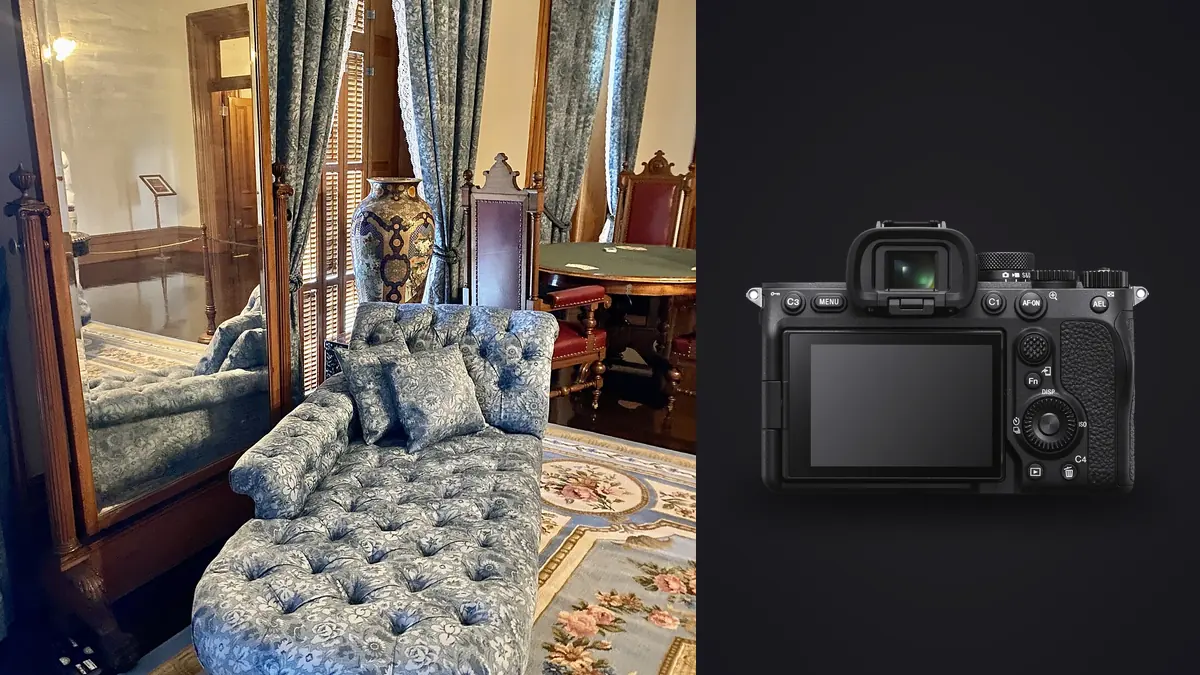
This is a small feature that ends up mattering more than it should on paper. The A7 IV's rear screen flips out and rotates on a hinge rather than just tilting up and down, and that changes two things about how a session actually runs. First, low-angle floor shots (shooting up along a bed, or from ground level toward a window) stop requiring you to lie on the floor yourself to check framing. You flip the screen out, hold the camera low, and you can still see exactly what you're composing without contorting to get your eye behind the viewfinder.
Second, and this matters more for client comfort than for the images themselves, a fully articulating screen lets you angle it away from the client entirely when you want her focused on the direction you're giving rather than watching herself on a screen mid-pose, and just as easily flip it toward her between setups so she can see a frame you're happy with. Being able to control which of those is happening, on demand, without switching gear or awkwardly covering the screen with a hand, is a small thing that changes the rhythm of a session more than the spec sheet suggests it would.
Skin Tone Straight Off the Sensor
Sony's Creative Look profiles and the S-Cinetone color response (borrowed down from the cinema line) both render skin with less of the slightly cool, slightly clinical cast that older Sony bodies were criticized for. I shoot most boudoir work with the FL profile, which is close to S-Cinetone in how it rolls off highlights on skin, and I dial saturation down a notch and contrast down two notches from the default. That gives me more room to push warmth back in during editing without highlights on skin clipping first.
None of this replaces a proper color grading pass, but starting from a profile that isn't fighting you on skin tone from frame one saves real time across a gallery of two or three hundred selects. If you haven't built out a consistent approach to this part of the workflow yet, the breakdown at the complete guide to photo color grading covers the grading side in more depth than I'll go into here. Once I have a look I'm happy with on a handful of hero frames from a session, I carry it across the rest of the gallery with imagic's apply_my_style feature, which applies a preset trained on my own past edits rather than a generic filter, so the warmth and contrast choices I made on the first ten frames show up consistently on frame two hundred without me manually matching each one.
Card Slots and Why Redundancy Matters More in This Genre
The A7 IV has two card slots, both accepting either CFexpress Type A or SD UHS-II, and running them in simultaneous backup mode for every boudoir session without exception is the sensible default. That's not a habit worth the bother for every kind of shoot, but for this genre specifically, a corrupted card or a dropped card on the walk back to the car isn't just a lost afternoon, it's a client's most private images gone with no way to reshoot the moment. Simultaneous recording to both slots costs you nothing in the field beyond a second set of cards to buy, and it's the cheapest insurance in the whole kit.
The same logic extends past the card slots and into how the files get handled once they're off the camera. Clients in this genre ask, more often than in any other kind of portrait work, what happens to their images between the shoot and the final gallery. "They go into a cloud service for processing" is not an answer that reassures anyone when the images are of their own body. Culling in imagic helps here because everything runs locally on the machine, nothing gets uploaded anywhere to get sorted or scored, and a photographer can say that plainly to a nervous client instead of hedging around what a third-party service actually does with the files.
Cutting a Two-Hour Session Down to a Gallery
A typical hour-and-a-half session on the A7 IV, mixing held poses on the mechanical shutter with a handful of movement sequences on electronic burst, lands somewhere around 700 to 1,100 RAW frames once you count the near-duplicates from each held pose (I rarely take just one frame of a pose; I take four or five in case an exhale or a blink ruins the best-composed one). That's a manageable number compared to what a faster body produces, but it's still hours of scrolling if you're doing it by eye in a folder.
I run the take through imagic before I sit down to actually edit anything. It scores sharpness and focus accuracy locally, which matters with an f/1.2 lens where the plane of focus is thin enough that four frames of the same held pose can have one that's genuinely sharp on the near eye and three that are softer than they look at thumbnail size. It also groups the burst and near-duplicate frames from each pose into clusters, so instead of clicking through every one of those four or five frames per setup, I'm looking at the one or two the software actually flagged as sharp and worth a second look. There's more on how that scoring and clustering approach works at how AI photo culling works if the mechanics of it are useful to you.
Handling the Body Itself Through a Long Session
At around 659 grams for the body alone, the A7 IV is noticeably lighter than the Sony pro bodies and considerably lighter than most of its Nikon and Canon flagship equivalents. Paired with the 50mm f/1.2 GM it's still a substantial combination at close to 1.4 kilograms, but held for an hour and a half with breaks between setups, the difference from a heavier body shows up in your wrists and shoulders by the end of the day, especially if you're crouching for low-angle work or holding a position for a long exposure sequence.
There's a less technical reason the lighter body matters too. A smaller, less visually imposing camera reads as less intimidating in a small, personal space with a client who's often nervous about the session before it even starts. The A7 IV's compact-for-its-class body is probably not the reason clients relax during a shoot, that's mostly about pacing, communication, and giving clear direction, but a camera that doesn't look like industrial equipment doesn't work against you either.
Frequently Asked Questions
Is the A7 IV fast enough for boudoir work, or should I be looking at a faster body?
For this genre specifically, yes. Most boudoir posing is held rather than continuously dynamic, and 10 fps on the mechanical shutter is more than enough to catch a natural transition into or out of a pose. A faster body mostly buys you more near-duplicate frames to sort through afterward without adding much usable variety, since you're rarely photographing genuine fast action in a bedroom.
Should I shoot boudoir on the electronic shutter for silence, or does it cause problems?
Silent electronic shutter is worth using for held poses and quiet direction, where the client benefits from not hearing a shutter click that signals "photo taken." For anything with real motion (a hair flip, fabric dropping, a fast weight shift), switch to the mechanical shutter, since the A7 IV's non-stacked sensor can show rolling shutter skew on fast movement in electronic mode.
What's a realistic lens kit if you can only carry two lenses into a client's home?
The 50mm f/1.2 GM and the 90mm f/2.8 Macro cover the widest range of what a typical bedroom-sized session needs: the 50mm for the bulk of your posed shots at normal working distances, and the macro for detail work on lace, jewelry, and hands that fills out the back half of a gallery without requiring a lens change mid-pose.
How do you keep client trust intact when you're handling this many private images?
Simultaneous dual-card recording in the field so there's no single point of failure on the day, and a culling and editing workflow that keeps the files off the cloud entirely, running the initial sort locally on the machine instead. Being able to tell a client honestly that her images aren't leaving the laptop to get processed somewhere else is, for this genre, often as important to the booking as the final photos themselves.