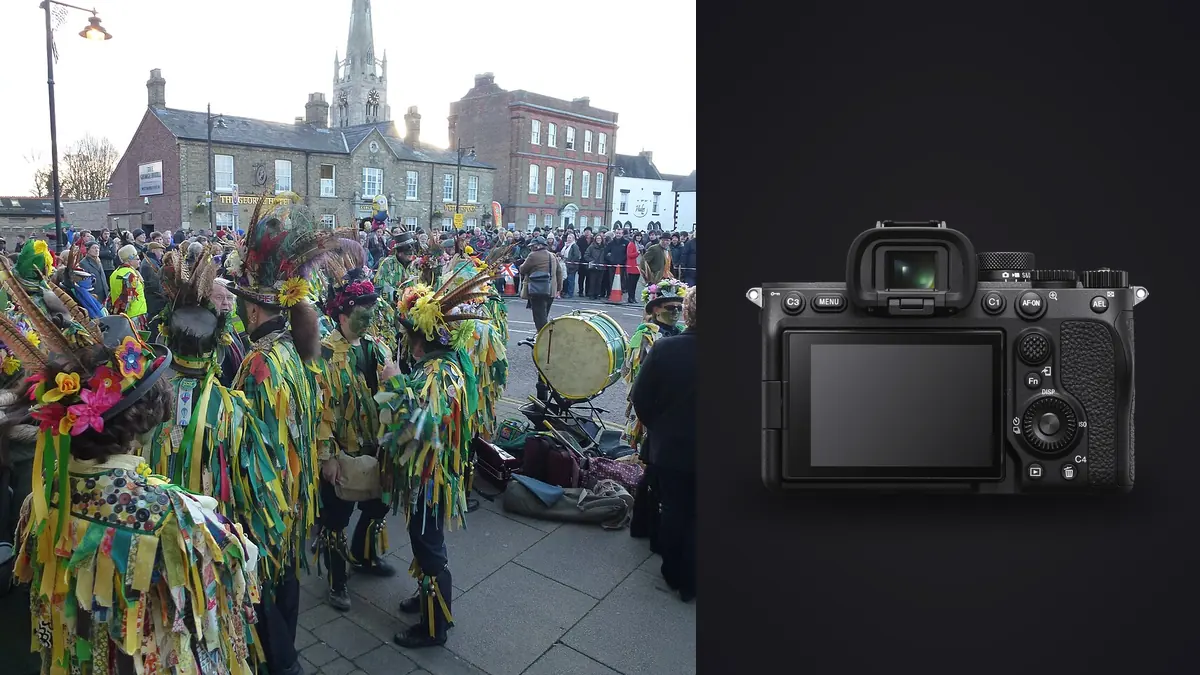
I've put a Sony A7 IV through three overseas documentary trips and more weekend street sessions than I can count, and the honest summary is this: it's not a camera built specifically for this genre, but almost nothing built specifically for this genre exists anymore. What the A7 IV gives you instead is a 33-megapixel body that tracks people reliably, handles a full day of walking without becoming a burden, and produces files that hold up when you need to crop a frame you didn't have time to compose properly. That's most of what street and documentary work actually asks of a camera.
This isn't a spec-sheet rundown. It's what changes about how you shoot and how you process files when this particular body is the one in your hands.
Why This Body Suits Unscripted Work
Street and documentary photography punishes cameras that hesitate. You don't get a second take when someone crosses a shaft of light on a market street, and you don't get to ask a subject to hold their expression while the camera hunts for focus. The A7 IV's 759-point phase-detection array covers almost the entire frame, which matters more on the street than in a studio because your subject is rarely centered. Someone walking into frame from the left edge, a hand gesture caught mid-motion at the bottom corner, a face turned three-quarters away near the edge of a doorway: the AF system finds and holds these without you recomposing first.
The 33MP sensor sits in a useful middle ground. It's not the 61MP of Sony's resolution-focused bodies, which would give you more cropping room but also punishing file sizes when you're shooting 2,000 frames a day. It's also not the 24MP of the older A7 III, which starts to feel thin when you need to crop a candid frame down to the actual moment inside it. For documentary work where you're often shooting a bit wide to stay unobtrusive and cropping in later, 33MP gives you real room to reframe without turning every file into a storage problem.
Body weight is close to its predecessor, around 658 grams for the body alone, and after a few days it disappears into the rhythm of the work the way any camera does once your hand learns it. What actually changes day to day is the menu system and the touch-driven controls, which are faster to operate one-handed than earlier Sony bodies, useful when your other hand is holding a bag, a coffee, or someone's door open.
Handling on the Street
The vari-angle screen gets more use in documentary work than most photographers expect going in. Shooting from hip height or low angles without lifting the camera to your eye keeps you visually unremarkable in a crowd, and being able to tilt the screen to check framing without raising the whole camera makes that approach usable rather than a guess. I use this constantly in markets and transit stations where a raised camera changes how people behave around you.
The shutter itself has three real states worth knowing. Mechanical shutter has an audible clack that's not loud but is noticeable in a quiet room. Electronic front-curtain splits the difference. Fully electronic (silent) shutter drops the sound to nothing, which matters in libraries, religious spaces, courtrooms, or any interior where a shutter click reads as an interruption. The tradeoff is rolling shutter distortion under fast motion and banding under certain artificial lighting, flickering fluorescent tubes and some LED fixtures in particular, so I switch back to mechanical for anything with fast panning motion or dodgy lighting and reserve silent mode for static or slow-moving scenes.
Back-button focus paired with a custom function button set to Eye AF toggling has become my standard setup. It lets me pull focus off the eye deliberately when I want to recompose around a static element (a doorway, a sign, negative space) without the camera re-hunting for a face that's about to leave the frame anyway.
Autofocus in Crowds and Fast Scenes
Real-time Eye AF is the single feature that changed how I shoot people in public. It locks onto the near eye of a human subject and keeps tracking through partial obstruction, a hand passing in front of a face, someone briefly stepping between you and your subject, a passing car. It doesn't track through a full multi-second occlusion, but a half-second gap doesn't lose the subject the way it would on older bodies, which used to mean re-acquiring focus and missing the moment entirely.
Animal Eye AF is a genuine bonus for street work, not a gimmick. Dogs show up constantly in documentary and street frames, and having the camera reliably find an animal's eye instead of hunting on fur texture saves shots you'd otherwise lose.
One caveat worth being direct about: AF speed depends heavily on the lens. Native FE glass, the 35mm f/1.8 and 24-70mm f/2.8 GM II in particular, focuses fast enough to keep pace with someone walking briskly toward you. Older adapted glass or third-party lenses on the LA-EA adapters lag noticeably, and I've missed frames because I forgot which lens I had mounted. If you're building a kit specifically for this genre, native autofocus glass is worth prioritizing over legacy lenses you already own.
RAW Formats and What They Cost You
The A7 IV gives you three RAW compression options, and the choice actually matters for documentary shooters in a way it doesn't for someone doing planned studio work. Here's how they compare in practice, based on a 33MP sensor and the two card slot types the camera supports.
| RAW Format | Approx. File Size | Buffer Depth (CFexpress Type A) | Buffer Depth (SD UHS-II) | Best Use in This Genre |
|---|---|---|---|---|
| Compressed RAW | ~40-45 MB | 1,000+ frames, effectively unlimited for bursts | ~220-240 frames | Default for street and documentary; keeps up with continuous bursts on either card type |
| Lossless Compressed RAW | ~50-60 MB | ~550-600 frames | ~120-140 frames | Planned portraits within a documentary sequence, environmental shots you'll grade harder |
| Uncompressed RAW | ~65-70 MB | ~350-400 frames | ~85-95 frames | Static, high-value frames where every bit of tonal data matters and burst speed is irrelevant |
These figures are approximate and vary with card speed class, but the pattern holds: on Compressed RAW, buffer depth basically stops being a concern for street work, even shooting long bursts at 10fps as a subject crosses a frame. Step up to Lossless Compressed or Uncompressed, and you'll notice the buffer fill during a long sequence, especially if you're on the SD UHS-II slot rather than CFexpress Type A.
That leads to the slot question. The A7 IV's dual slots are both SD UHS-II compatible, but only Slot 1 also accepts CFexpress Type A cards. Type A cards are Sony's own format, not the more common Type B used by other brands, so they're pricier and less interchangeable with other gear you might own. My working setup is Compressed RAW to a fast SD card in both slots with backup recording enabled, which covers a full shooting day without buffer anxiety and without the added cost of CFexpress media. I only bother switching to CFexpress and a higher-quality RAW setting for planned portrait sessions embedded within a longer documentary project, where I have time to wait for the buffer and want maximum tonal latitude for grading.
Low Light: Markets, Interiors, Night Streets
Documentary work rarely happens in good light. Market stalls under mixed fluorescent and daylight, dim cafe interiors, streets after dark lit by shopfronts and headlights: the A7 IV's native ISO range up to 51200 (expandable further) holds detail reasonably well through ISO 6400, with noise becoming more of a creative choice than a technical failure past that point. Paired with 5-axis in-body stabilization rated around 5.5 stops, I can hand-hold static subjects at 1/15s or slower indoors without a tripod, which matters when setting one up would kill the candid feel of a scene entirely.
Where this genuinely helps documentary work specifically is interiors you can only shoot once: a service, a ceremony, a workshop floor. You don't get to relight or reshoot, so having enough usable ISO range that you're not choosing between blur and grain gives you more real options in the moment.
Lens Choices That Actually Get Used
Three lenses cover almost everything I shoot in this genre. The 35mm f/1.8 is the one that lives on the body most days: light, fast enough for interiors, close enough to the classic documentary field of view that framing becomes automatic after a while. The 40mm f/2.5 G is smaller still and forces a slightly tighter, more deliberate compositional habit, useful when you want to slow down and be more selective. For portrait-adjacent frames within a broader documentary sequence, an 85mm or the older 55mm f/1.8 gives separation from a background without needing to get physically close enough to change a subject's behavior.
Worth knowing: the A7 IV's APS-C crop mode gives you an effective reach boost (roughly 1.5x) at a reduced 14MP resolution, useful in a pinch when you need distance from a scene, a protest, a public event, without a longer lens. I use it rarely, but it's saved a shoot when the only lens on hand was too wide.
From Card to Finished Edit
The part that changes most with this camera isn't the shooting, it's what happens after. A single day of street or documentary shooting with the A7 IV's AF tracking and 10fps burst regularly produces 1,500 to 3,000 frames, and a meaningful chunk of those are near-identical bursts: five or six frames of the same person mid-stride, three versions of the same gesture a half-second apart. Reviewing that volume frame by frame at 100% zoom is how a shoot day turns into a three-hour editing slog. This is where I actually rely on imagic rather than working through Lightroom's grid view manually. It runs its sharpness and focus scoring locally on the RAW files as they come off the card, so within a burst of six near-identical street frames I can see which one actually nailed focus on the eye without opening each file individually. It also clusters bursts and near-duplicates automatically, so a review pass becomes "pick the best of this group" six or seven times instead of scrolling past thirty similar frames one at a time. If you want the mechanics behind that kind of local scoring, how AI photo culling works covers it in more detail.
The offline part matters more in documentary work than it might elsewhere. A lot of this shooting happens in places with unreliable wifi, or involves identifiable people whose images I'd rather not route through a cloud service before I've even looked at them myself. Since imagic processes everything locally with no upload step, culling can happen on a laptop in a hotel room the same night, card in, review done, without waiting on a connection or thinking about where the files are actually going.
Once a project's visual tone is set, usually after the first day or two of a shoot, I've started using imagic's apply_my_style feature to carry that grading across the rest of the take. It's trained on my own previously edited work rather than a generic preset, so a multi-day documentary project ends up looking consistent without me manually re-applying the same curve and color adjustments to every folder. Between that and the culling pass, the actual editing time on a shoot has dropped enough that I finish projects while the details are still fresh rather than three weeks later. For more on tightening that end of the process, 10 tips for a faster photo workflow is worth a read alongside this.
Frequently Asked Questions
Is the Sony A7 IV too heavy for all-day street shooting?
At around 658 grams body-only, it's heavier than a rangefinder or a mirrorless APS-C body, but lighter than most full-frame DSLRs it replaces. Paired with a 35mm or 40mm prime, the combination sits comfortably on a wrist strap for a full day. Where you'll feel the weight is if you pair it with the 24-70mm f/2.8 GM II for a whole shoot; that combination is closer to two kilograms and worth switching out for a lighter prime on long walking days.
Does the shutter sound draw attention in quiet documentary settings?
Mechanical shutter has a soft but audible click that's fine outdoors or in ambient noise but noticeable in a silent room. Switching to fully electronic (silent) shutter removes the sound entirely, which is what I use for services, courtrooms, or any interior where the shutter itself would be an interruption. The tradeoff is a higher chance of rolling shutter artifacts on fast motion and banding under some artificial lighting, so it's a scene-by-scene choice rather than a permanent setting.
Which RAW setting should I actually shoot for this kind of work?
Compressed RAW covers nearly all street and documentary shooting well: file sizes stay manageable, buffer depth is effectively unlimited even at 10fps on either card slot, and the quality loss versus lossless formats is difficult to see outside of aggressive shadow recovery. Reserve Lossless Compressed or Uncompressed RAW for planned, lower-volume shots, portraits, static environmental frames, where you have time for the larger files and want maximum data for grading.
Can the autofocus keep up with a moving crowd scene?
Within the limits of the lens attached, yes. Real-time tracking combined with Eye AF holds a chosen subject through brief obstructions, someone crossing in front of them, a passing vehicle, reasonably well. It's not infallible in dense, fast crowds where multiple subjects overlap constantly, and native FE lenses focus noticeably faster than adapted or older glass, so lens choice affects this as much as the camera body does.