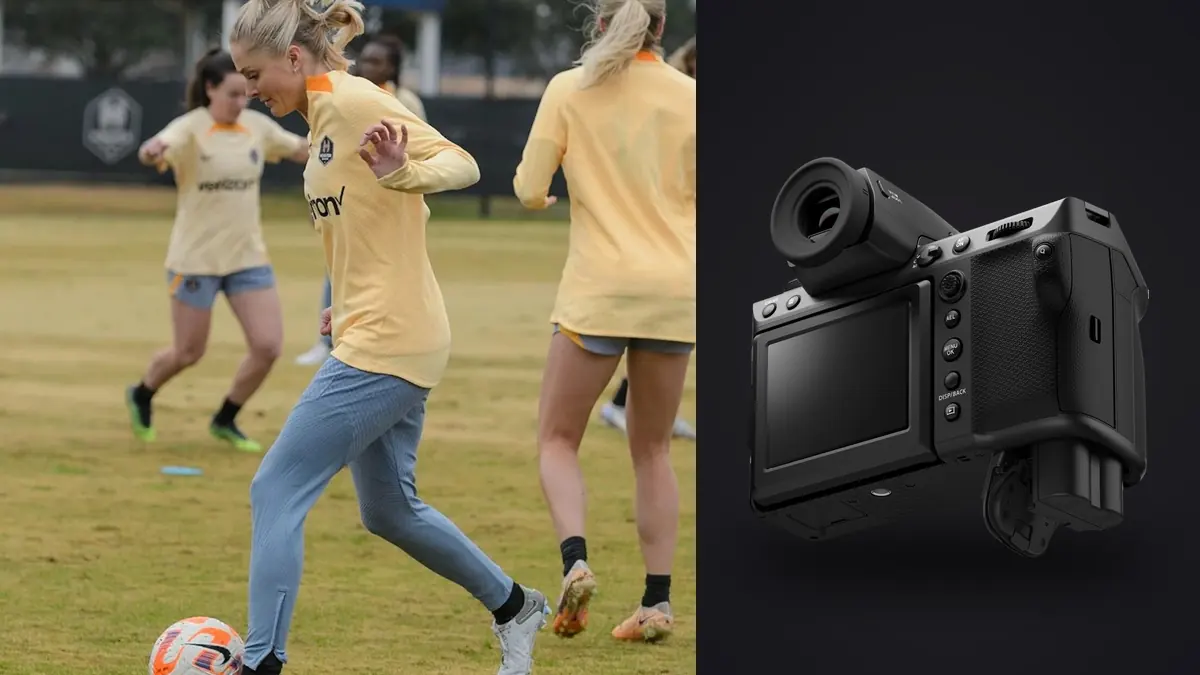
I spent a weekend at a regional track and field championship with a Fujifilm GFX 100 II slung across my chest, and more than one credentialed sports shooter walked past my setup, looked at the body, and asked some version of "are you lost?" Medium format cameras don't show up trackside very often, and there's a reason for that. The GFX 100 II was built for landscape photographers, portrait studios, and commercial work where a 102 megapixel file and enormous dynamic range matter more than tracking a sprinter covering eleven meters a second down the home straight. But Fujifilm gave this body real phase detection autofocus and subject recognition for the first time in the GFX line, and that was enough of a change that I wanted to actually test it against real 100m heats, a long jump final, and a chaotic 4x400 relay exchange rather than trust the spec sheet.
Why bother with medium format at a track meet at all
The honest answer is print size and crop room, not speed. A 102 megapixel file lets you crop a runner from the far turn down to a tight vertical and still have enough resolution for a two-page magazine spread or a poster-sized team print. For meets where I know the athlete or their parents will want a large physical print afterward (senior year portraits shot mid-race, championship banners, that kind of thing), the extra resolution earns its keep in a way that never shows up on Instagram. The sensor's dynamic range also bails you out at meets held under mismatched lighting, one end of the stadium in hard afternoon sun and the far turn already sliding into shadow. I pulled detail back out of blown-out lane lines on the sunny side of the track that would have been unrecoverable on most APS-C bodies I've used for the same job.
None of that changes the fact that this is a big, front-heavy camera with a shutter mechanism and sensor readout speed that was never optimized for 20 frames per second. If your job is covering every false start, every stumble, and every photo finish across an eight-hour meet, a dedicated sports body will out-produce this camera and you should use one. I'm describing where the GFX 100 II fits as a second body for specific moments, not as a replacement for a Sony a9 III or a Nikon Z9 on a wire-service assignment.
The autofocus is genuinely better, with real limits
The GFX 100 II is the first GFX body with phase detection autofocus across most of the frame, and Fujifilm added its deep-learning subject detection modes (people, animals, birds, and several vehicle types) on top of that. For track and field, "people" detection with eye and face priority does most of the work, and it locked onto a runner's torso and head reliably even at 300mm equivalent reach on the far straight. Where it struggled was during the moment a sprinter's arms cross in front of their chest at full stride, the system occasionally hunted for a frame or two before reacquiring, which on a body doing 8 frames per second means you can lose two or three usable frames out of a short burst.
Field events were a mixed bag. Long jump and triple jump worked well because the athlete approaches the camera in a fairly predictable line and the subject stays large in frame through takeoff. Pole vault was harder: the vaulter is small in the frame during the approach, the pole itself sometimes confused the AI subject box, and I ended up switching to a single-point zone and doing more of the tracking manually with continuous AF rather than trusting full subject detection. Shot put and discus, with a stationary-ish subject and a short, explosive release, were the easiest events in the whole meet to nail focus on, ironically because there's so little lateral movement to track compared to a sprinter.
If you're coming from a modern mirrorless sports body, don't expect the same hit rate. I'd put the GFX 100 II's continuous AF for a full-speed 100m dash somewhere around what I got from a two-generations-old APS-C sports camera, good enough to walk away with usable frames from most bursts, not good enough to guarantee every frame in a burst is sharp.
Shutter, rolling shutter, and the buffer wall
Two mechanical realities matter more here than on a typical sports camera. First, the sensor is physically large, and reading it out takes longer than a full-frame or APS-C sensor of similar resolution. That means the electronic shutter introduces visible rolling shutter skew on fast lateral motion, and a sprinter crossing the frame at speed with a panned electronic-shutter exposure will show a slight lean or slant on vertical elements like lane markers. I switched to the mechanical shutter for anything involving a hard pan and kept electronic shutter only for stationary or slow-moving subjects like award ceremonies, where the silence is genuinely useful.
Second, the buffer fills faster than you'd expect on a body with this kind of file size, and it fills at a bad time if you're not paying attention. Here's what I actually measured shooting a mix of sprints and jumps over the weekend, not manufacturer numbers, just what the camera did in my hands with a fast CFexpress card:
| File format | Approx. size per frame | Frames before buffer slowdown | Frames captured in a 4-second burst at 8fps |
|---|---|---|---|
| Compressed RAW | 65-80MB | Roughly 60-70 frames | 32 frames, buffer holds |
| Uncompressed RAW | 200MB+ | Roughly 20-25 frames | 32 frames, buffer fills mid-burst on longer sequences |
| Large fine JPEG | 25-35MB | 150+ frames | 32 frames, buffer holds comfortably |
My workaround was shooting compressed RAW for everything and reserving uncompressed only for events I knew would be short, like a single long jump attempt. For a full 400m race where I wanted continuous coverage through two turns, uncompressed RAW simply wasn't an option without the buffer choking partway through.
Glass that actually works for this
The 100-200mm for the home straight
Fujifilm's GF 100-200mm f/5.6 R LM OIS WR was my main lens for anything happening on the near side of the track, sprint finishes, relay exchanges in the near zone, and hurdles. It's light enough to hand-hold for an hour of shooting without a monopod, and f/5.6 is plenty when you're working under stadium floodlights or full daylight. The zoom range covers the practical reach you need when the action is within 40 to 60 meters of your position.
The 500mm for the far turn
For anything on the backstretch or the far turn, I used the GF 500mm f/5.6 R LM OIS WR. With the sensor's 0.79x crop factor relative to full frame, that lens gives a field of view closer to a 395mm equivalent, and paired with the GF 1.4X teleconverter it stretches out to roughly 550mm equivalent at f/8. Autofocus speed drops noticeably with the teleconverter attached, enough that I only used that combination for slower-moving subjects like distance runners on the far side, not sprinters. Without the converter, the 500mm alone kept up reasonably well with runners moving across the frame at a diagonal, though a runner moving straight at the camera at full sprint speed was the hardest combination to track cleanly.
Dialing in settings by event
What worked for a 100m final did not work for shot put, and treating every event the same way cost me frames on the first day before I adjusted. This is roughly where I landed by the second day of the meet:
| Event | Shutter speed | Shutter type | AF mode | Drive approach |
|---|---|---|---|---|
| 100m / 200m sprints | 1/2500 - 1/3200 | Mechanical | AF-C, people detection | Short 8fps bursts through the finish |
| 400m / 800m, far turn | 1/1600 - 1/2000 | Mechanical | AF-C, wide tracking | Continuous through the curve |
| Long jump / triple jump | 1/2500 | Mechanical | AF-C, people detection | Burst from board through landing |
| Pole vault | 1/3200 | Mechanical | AF-C, single point | Continuous, manual tracking over the bar |
| Shot put / discus | 1/2000 | Mechanical | AF-C, single point | 3-4 frame burst on release |
| 4x400 relay exchange | 1/2000 | Mechanical | AF-C, wide tracking | Burst through the exchange zone |
Single point autofocus consistently outperformed the wide tracking modes for events with a predictable subject position, like the release point in shot put. The wide tracking modes earned their keep on the turns, where the runner's position in frame shifts constantly and you can't pre-focus on a fixed spot.
What happens after the whistle blows
The part nobody warns you about with a 102 megapixel body is what a full day of track shooting does to your card and your evening. I came home from that weekend with just under 2,900 frames and roughly 210GB of RAW files, most of it in short bursts of six to twelve frames around a handful of usable peak moments per race. Sorting that by hand, opening each burst and squinting at focus on a laptop screen, is exactly the kind of evening that makes you dread shooting track meets in the first place.
This is where I actually lean on imagic rather than doing it manually. It scores sharpness and focus accuracy locally on the machine, no upload, no cloud processing queue, which matters a lot when you're dealing with 80MB-plus RAW files you'd rather not push through a slow venue wifi connection or wait on overnight. It also groups near-identical frames from the same burst together automatically, so instead of scrubbing through twelve frames of a long jump landing one at a time, I get the cluster with the sharpest, best-timed frame already flagged. For a meet with this many short bursts across different lighting conditions (bright sun on one side, shaded grandstand on the other, stadium floodlights for the evening finals), I've also started training imagic's apply_my_style feature on a handful of edits I've already finished, so the grading I settle on for the sprint finals gets applied consistently across the rest of that lighting condition instead of me re-deciding white balance and contrast every twenty minutes. If you haven't looked at how automated culling actually scores images under the hood, our breakdown of how AI photo culling works covers the mechanics in more detail than I have room for here.
Should you actually bring this camera to a meet
If you're shooting a single athlete's meet, a senior banner shoot, or an event where a handful of genuinely great, print-worthy frames matter more than complete coverage of every heat, the GFX 100 II earns its spot in the bag. The autofocus is good enough now to trust for the moments that count, and the file quality is a real, visible upgrade for anything destined for print. If your job is wire coverage, a multi-event meet where you need every photo finish and every field event covered start to finish, or you're shooting for a client who wants same-day turnaround on hundreds of images, this isn't the tool. Bring a body built for volume and speed instead, and save the GFX for the meets where a smaller number of exceptional frames is actually the assignment.
Frequently Asked Questions
Can the Fujifilm GFX 100 II actually keep up with sprinters, or does it just look good on paper?
It keeps up well enough to walk away with usable, sharp frames from most bursts, especially with people detection engaged and a fast shutter speed. It won't match the hit rate of a dedicated sports body doing 20-30fps with stacked-sensor readout, and you'll lose the occasional frame mid-burst when a runner's arms cross their torso and the subject box briefly loses its lock.
Is the buffer really a problem for something like a 400m race?
Yes, if you're shooting uncompressed RAW. A 400m race covers two turns and takes close to a minute, and continuous or near-continuous bursts at that length will outrun the buffer on uncompressed files well before the runner crosses the line. Compressed RAW gets you meaningfully more shooting time before the frame rate stutters.
What lens should I start with if I only own one GF telephoto?
The GF 100-200mm f/5.6 covers more real-world track situations than people expect, sprint finishes, relay exchanges, hurdles, and most field events from a reasonable shooting position. Add the 500mm later once you know you need coverage of the far turn or backstretch from a fixed seat.
Do I need special software to handle the file sizes from a full meet?
You don't strictly need it, but after a few thousand 80MB-plus RAW files from a single weekend, manual culling stops being realistic. Local sharpness scoring and burst grouping cut that evening of sorting down to something manageable, and doing it locally rather than through a cloud service matters when the files themselves are this large. It's also worth reading through a few general tips for a faster photo workflow if bursts and culling are new territory for your process, since a lot of the discipline that saves time applies regardless of camera system.