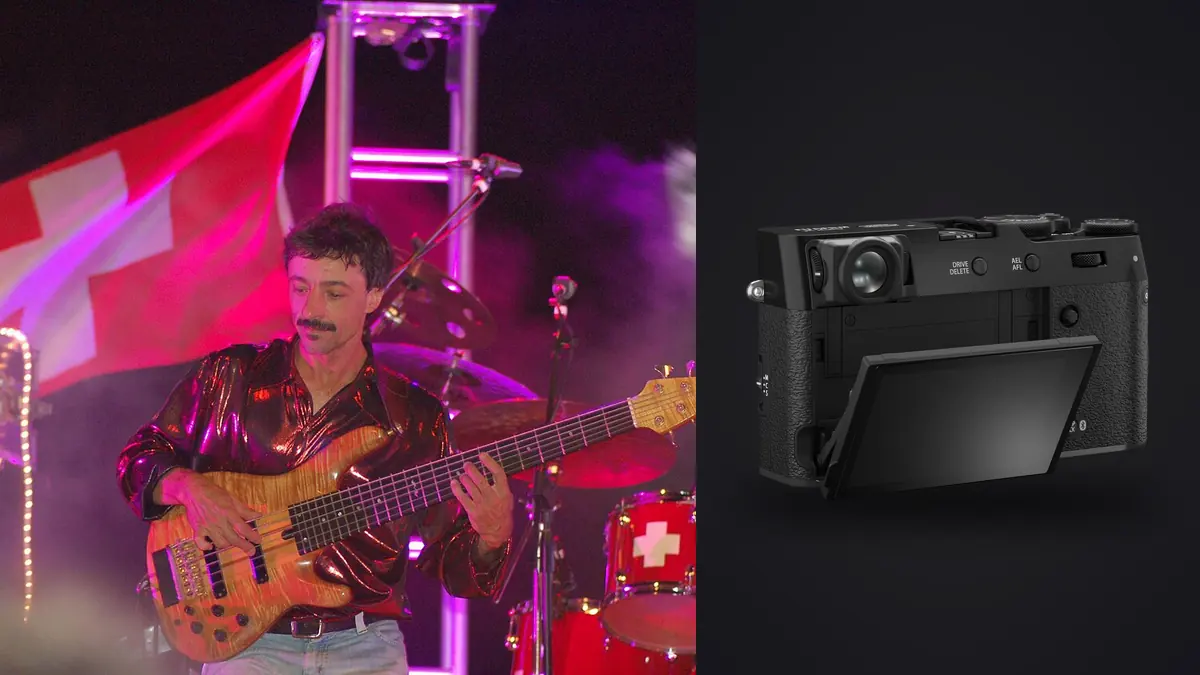
I get asked some version of the same question every few weeks by photographers thinking about taking a Fujifilm X100VI into a venue: can this thing actually keep up with a band, or is it a street camera that photographs well-lit statues and gets embarrassed the moment the house lights drop? The honest answer is that it depends entirely on what kind of show you're shooting, and most of the advice floating around treats "concert photography" as one job when it's really three or four very different ones.
The lens is the whole conversation
Everything about whether the X100VI works for you comes down to accepting, or not accepting, that you're stuck at 23mm (35mm-equivalent) for the entire set. There's no reaching for a 70-200mm when the singer walks to the back of the stage, no cropping your way to a tight face shot without eating into a 40-megapixel file you'll need for other things later. For some rooms that's not a problem at all. For others it's a genuine limitation you need to plan around before you buy a ticket, let alone a photo pass.
In a small bar or basement club where you're standing three to eight feet from the stage lip, 35mm-equivalent is close to perfect. You get the guitarist's pedal board in frame along with his face, the crowd's raised arms creep into the corners, and the whole image reads as "I was there" rather than "I photographed this from far away with a long lens." That's the X100VI's actual strength as a music camera: it makes documentary-style, environmental shots that a 70-200mm simply can't produce, because a telephoto compresses the room away and this lens keeps it in.
Where it falls apart is the credentialed photo pit at a theater or arena, the kind where you're behind a barricade fifteen to thirty feet back and the band member you want is standing at center stage, not walking toward you. At that distance 23mm gives you a wide shot of the whole stage rig with a small human somewhere in the middle of it. You can crop, and the 40.2MP X-Trans 5 sensor gives you real room to do it, but you're throwing away two-thirds of your resolution to manufacture a "tight" shot that a 56mm or 90mm lens would have given you natively. If pit work at bigger venues is your actual job, the X100VI works best as a second body next to something with reach, not as your only camera.
What the sensor can and can't do once the lights get ugly
Stage lighting rigs are not designed with photographers in mind, and colored gels murder autofocus and metering in ways that daylight simply doesn't. The X-Trans 5 sensor is genuinely good up through about ISO 6400: fine detail holds, and even with a mixed red-and-blue wash the color separation stays readable instead of collapsing into a single muddy hue. Push past 6400 and you start trading detail for grain in a way that's fine for web use but starts to hurt if a client wants a print or a tour poster crop.
I treat 12800 as the ceiling I'll use, not the ceiling I want to use. Above that the X-Trans color filter pattern shows its personality more than a Bayer sensor would, with a slightly mottled look in shadow areas under heavy red or magenta lighting specifically. If you shoot a lot of black-box theater gigs with a single hard spotlight and everything else falling to black, that mottling shows up fast once you start dodging the shadows in post. Shooting a stop or two under and recovering in editing makes it worse, not better, so I'd rather expose closer to correct at a higher ISO than underexpose at a "safer" ISO and lift it later.
In-body stabilization is rated for up to 6 stops depending on the source, and while that number sounds academic, what it actually buys you is the ability to hand-hold static or slow-panning shots at 1/15 or 1/30 without ghosting on stationary elements like a drum kit or a mic stand. It does nothing for a singer's head whipping side to side, obviously. IBIS fights camera shake, not subject motion, and conflating the two is the most common mistake I see photographers make with this body. If the performer is moving fast, you still need shutter speed, full stop.
What actually changes from room to room
Rather than give one blanket "use these settings" recommendation, here's roughly what I'm dialing in depending on where I'm standing, because the honest answer changes venue to venue more than most guides admit.
| Room type | Typical distance from stage | Light you're working with | Settings I run | What the fixed 23mm means here |
|---|---|---|---|---|
| Tiny club or bar | 3 to 8 feet | One or two wash lights, often a single hard color | f/2, 1/125 to 1/200, Auto ISO capped around 6400 | Ideal focal length, you're basically shooting from inside the band |
| Mid-size theater with a pit | 15 to 30 feet at the barricade | Proper rig, some color separation, still dim | f/2.8 to f/4, 1/250, ISO 3200 to 6400 | You're shooting the stage as a scene, not a headshot; crop later or bring a longer second body |
| Festival side stage, daylight set | 30 to 60 feet | Ambient daylight, minimal stage lighting effect | f/4 to f/5.6, 1/500, ISO 800 to 1600 | Works as a wide environmental B-camera, not for isolating a performer |
| Seated acoustic show, no barricade | 10 to 20 feet | Warm, dim, often a single tungsten spot | f/2, 1/60 to 1/100 leaning on IBIS, ISO 3200 to 12800 | Quiet shutter matters more than reach; you can walk closer between songs |
The leaf shutter is the real reason to bring this camera
People talk about the X100VI's sensor and autofocus, but for live music the leaf shutter is genuinely the standout feature, and it's the reason I still pack this camera for acoustic sets and small listening rooms where a DSLR's mirror slap would get you dirty looks from the front row. Set to the mechanical leaf shutter, it's a soft, almost inaudible click even at close range. Switch to the fully electronic shutter and it's silent, full stop, which matters a lot at venues that explicitly ban "clicking cameras" during quiet passages.
The tradeoff with the electronic shutter is rolling shutter distortion under certain LED stage lighting, which can scan in visible bands if the LED fixtures are pulsing at a frequency that clashes with your sensor readout speed. I've had it show up as faint horizontal banding on fast-flickering strobe cues specifically. My workaround is boring but reliable: mechanical leaf shutter for anything with strobes or fast lighting changes, electronic only for steady, dim, single-source lighting where discretion actually matters more than avoiding a lighting-frequency conflict.
Sorting the file count afterward is its own job
A three-band bill at even a small venue with the X100VI easily produces 1,500 to 2,500 RAW files by the time the headliner wraps, and a decent chunk of those are near-duplicate frames from bursts fired during a chorus or a jump shot. Going through that folder image by image, at full resolution, checking focus on every frame, is a genuinely miserable way to spend a Tuesday, and it's the part of this job nobody warns you about before you buy the camera.
I run those folders through imagic before they ever touch my main catalog. It clusters burst sequences from the same moment automatically, so instead of scrolling past nine nearly identical frames of a drummer mid-hit, I'm looking at one representative frame per cluster with the sharpest one already flagged. The sharpness scoring runs entirely on the local machine, which matters to me specifically with unreleased tour photography, since nothing gets uploaded anywhere before a band or label has cleared it for release. For a night of colored stage lighting where focus can drift subtly between frames, having that check done automatically instead of by eye on a laptop screen at 1am saves a real hour of work.
The other thing that's genuinely useful across a multi-night run is apply_my_style. If you're covering the same tour across three cities, you want the grading to feel consistent from Tuesday's club show to Friday's theater date even though the venues, lighting rigs, and your exposure choices differ night to night. Training that preset once on a batch of edits you're happy with and having it apply consistently afterward keeps a tour gallery looking like one coherent body of work instead of three separate photographers' takes on the same band. If your workflow is still built around editing every image from scratch, our piece on building a faster photo editing workflow is worth a read before your next multi-date run.
Worth understanding, too, is that this isn't a black box making arbitrary calls on your work. If you're curious how the underlying scoring actually decides what counts as sharp versus soft in a stack of near-identical frames, we cover the mechanics in how AI photo culling actually works.
Frequently Asked Questions
Is the fixed 23mm lens really a dealbreaker for photo pit work?
Not a dealbreaker, but a real constraint you should plan for. At barricade distance in a mid-size or large venue, 35mm-equivalent gives you a wide stage shot rather than an isolated performer shot, and you'll be cropping into a 40MP file to compensate. If pit credentials at larger rooms are your main gig, pair the X100VI with a longer second body rather than relying on it alone.
How quiet is the X100VI's shutter during a hushed acoustic set?
The leaf shutter is a soft click, quiet enough that I've used it two rows back from the stage during a completely acoustic performance without anyone turning around. The fully electronic shutter mode is silent, though it can pick up rolling shutter banding under fast-strobing LED fixtures, so I reserve it for steady, single-source lighting rather than anything with a lighting operator running quick strobe cues.
What ISO would you actually deliver from a night shoot, not just shoot at?
I'm comfortable with anything up to about 6400 without reservation. Between 6400 and 12800 it's usable if someone needs the shot and the exposure was accurate, but watch for shadow mottling under heavy red or magenta gels specifically. Past 12800 I'm only shooting to have a record of the moment, not because I expect a print-quality result.
Should I bother shooting a multi-band bill in both RAW and JPEG?
I shoot RAW only and let the film simulation guide my editing intent rather than lock it in at capture. A three-band bill with different lighting per act already generates enough files without doubling the count, and it's faster to fix a color cast in one RAW pass than to reconcile a JPEG and RAW version of the same frame later.