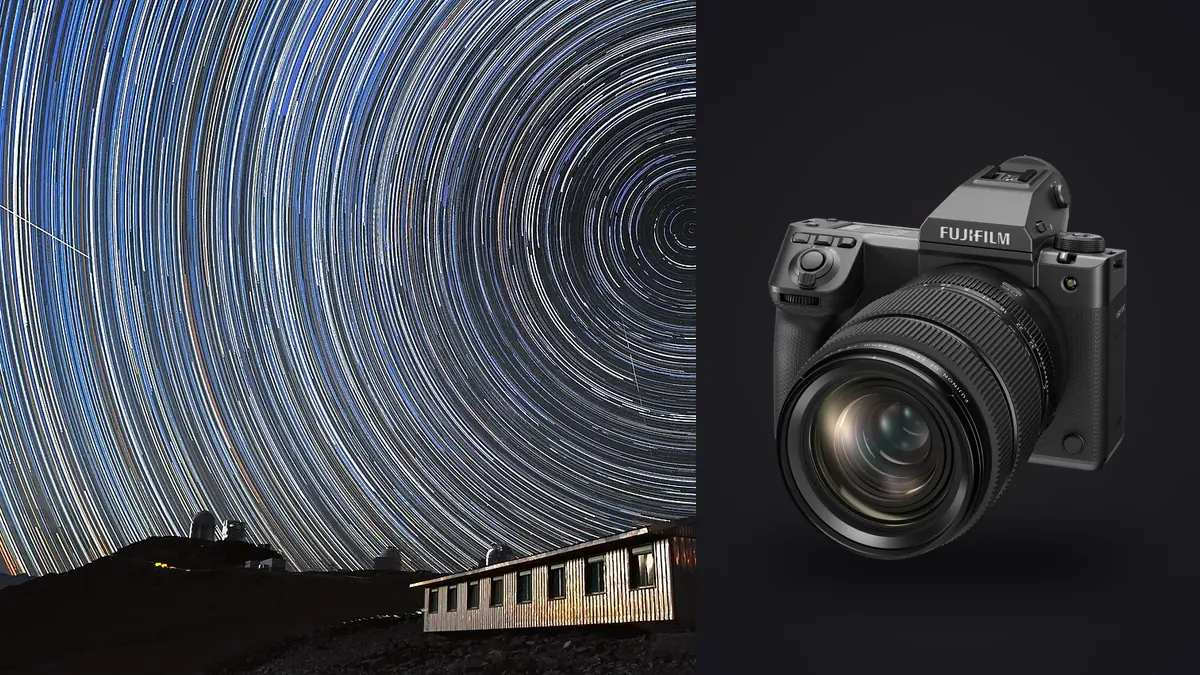
The Fujifilm GFX100 II offers a large high-resolution sensor, detailed RAW files, in-body stabilization, and access to GF lenses. Those qualities can produce demanding night photographs, but they do not make the camera the automatic choice for astrophotography. The system is larger than many full-frame alternatives, its files put more pressure on storage and processing, and a star tracker must carry the complete load accurately.
The right question is whether the camera's specific strengths serve the intended sky work. A landscape photographer seeking large detailed prints has different needs from a traveler hiking to a dark ridge or a deep-sky photographer building a dedicated tracked rig. This buying-fit guide weighs those uses without treating sensor size as a substitute for planning, darkness, optics, or technique.
Where the large sensor and resolution help
The GFX100 II records around one hundred megapixels on a sensor larger than full frame. That resolution provides fine landscape detail, substantial print latitude, and room for moderate composition refinement. For a carefully focused, stable, well-exposed night landscape, the combination can preserve subtle terrain and star-field structure.
Resolution also supports multi-image projects where the final output is large and viewing distance is close. It is less meaningful when the result will be a small web image or when focus, lens corners, tracking, or atmospheric haze limit detail first. More pixels record technique errors with the same enthusiasm as subject detail.
A large sensor does not guarantee unlimited dynamic range or clean shadows at every setting. Sky brightness, exposure length, temperature, and RAW processing still determine what can be recovered. Compare files at the final output size rather than declaring a winner from equal pixel-level crops.
GF lens choice is a central constraint
Astrophotography asks lenses to render point lights cleanly across the frame. Wide aperture is useful, but corner coma, sagittal smear, chromatic fringing, field curvature, and focus stability can matter more than the marked maximum. The GF range includes wide and normal options, yet the exact focal length and aperture combination should be tested on stars before a major trip.
A wide zoom offers composition flexibility and may suit landscapes where the camera position is fixed. A fast prime can gather more light and simplify optical design, but the available native choice may not match every preferred field of view. Adapted lenses can broaden options, though they need an image-circle, corner, flange, and focus test on the larger sensor.
Do not assume that a full-frame lens will cover the GFX sensor cleanly. Vignetting or poor corners may appear even when the center looks good. An adapter also adds another mechanical joint that can introduce tilt or allow focus movement. Test the exact sample, not only the model name.
The tracker must support more than the body
A star tracker carries the camera, lens, head, plate, cables, and sometimes a counterweight. The GFX system can make that load substantial, particularly with a fast or wide GF lens. Stay within the tracker's stated capacity, balance the axis, and judge performance at the intended focal length. A capacity figure alone does not guarantee round stars.
Polar alignment error becomes more visible as focal length, exposure time, and output resolution increase. The GFX100 II can therefore demand more precise alignment than a smaller final image from a lighter setup. Practice the complete sequence in daylight and on a local clear night before relying on it at a remote site.
A static tripod remains suitable for shorter untracked exposures, foreground frames, and images where slight star movement is accepted. It is also simpler in wind, on steep ground, and during a long hike. Buy a tracker only when the desired exposure or focal length requires it, not because the camera is expensive enough to seem incomplete without one.
In-body stabilization has a limited astro role
Stabilization is useful for handheld low-light work and for framing before the tripod is ready. It cannot compensate for Earth's rotation during a long sky exposure, and it does not replace a tracker. On a tripod or tracker, follow Fujifilm and lens guidance about stabilization settings and make a comparison test for the exact support.
The camera's high-resolution sensor can reveal small support movement from wind, a loose plate, cable pull, or an unsettled tripod foot. Use an L-bracket or secure plate, keep the center column down, and avoid touching the camera. A remote release, interval function, or self-timer removes the initial press.
If a lens has its own stabilization switch, understand how it interacts with the body. Do not rely on a remembered rule from another system. Firmware and lens design can alter behavior, and the manual for the current combination is the appropriate reference.
Focusing rewards precision and patience
Use magnified live view on a bright star and adjust until it becomes the smallest clean point. The infinity mark is not proof of infinity focus, and autofocus may settle near rather than at the optimal plane. Once confirmed, switch to manual focus and prevent accidental movement without placing adhesive where it can damage the lens.
Inspect a center star and at least one corner. Field curvature may mean the corner is not best when the center is perfect. The practical choice can be a slight focus compromise or a smaller aperture. Recheck after a strong temperature change because lens dimensions and focus can shift through a long night.
The tilting screen makes low tripod positions easier, but brightness should be reduced enough to preserve night vision. Use a short high-ISO framing exposure, then return to the planned settings. Do not wait through a full final exposure merely to discover that the horizon cuts through the wrong part of the frame.
Large files change the stacking workflow
A sequence of high-resolution RAF files requires substantial card space, verified backup capacity, memory, and processing time. Star stacking multiplies that load before a final image exists. Confirm that the chosen stacking application supports the GFX100 II RAW files directly or establish a consistent intermediate format without discarding needed data.
Calibration frames and sky exposures need clear folder separation. Record exposure, temperature context, lens, aperture, tracker use, and sequence purpose. A slate frame or written note helps identify transitions. Do not mix untracked foregrounds with tracked skies merely because their timestamps are close.
imagic can locally ingest supported RAF files, group near-duplicates, and help assess sharpness and exposure, but it does not merge star stacks, panoramas, or HDR source frames. A complete GFX astro workflow therefore needs separate software for alignment and stacking, plus enough storage for all originals and outputs.
Portability can outweigh image potential
The camera, GF lens, sturdy tripod, tracker, counterweight, dew heater, batteries, and cold-weather gear form a system. On a roadside dark site, that load may be manageable. On a long ascent, it may reduce safety, limit water or clothing, and make setup less likely. A lighter full-frame or APS-C kit that reaches the location can be more productive than a technically stronger system left behind.
Weather sealing reduces risk but does not make the equipment waterproof. Condensation, dew, dust, and cold still need management. Keep batteries protected, use a lens heater when conditions demand it, and allow equipment to warm gradually inside a closed bag to reduce condensation after returning indoors.
Consider setup complexity in darkness. Larger controls and a substantial grip can be comfortable with gloves, while the tracker balance and heavier head take more time. A buying decision should include a realistic carry and assembly test, not only an indoor handling session.
Who benefits most from the GFX100 II
The strongest fit is a photographer already using GF lenses who produces large detailed night landscapes, works from accessible locations, uses robust support, and has a computer and storage plan for high-resolution sequences. The camera can also make sense for mixed commercial landscape work where daylight detail and night capability must share one body.
It is a weaker fit for long backcountry travel, casual wide-field sky photography, or a project whose final output is modest. It may also be inefficient when the preferred astro lens does not exist natively and adaptation compromises the corners. In those cases, system weight and optical availability matter more than maximum sensor resolution.
For deep-sky work at long focal lengths, evaluate the complete telescope, adapter, tracking, guiding, and software ecosystem. The GFX sensor's dimensions can expose image-circle and field-flatness limits that a smaller sensor avoids. A dedicated astronomy camera or smaller interchangeable body may integrate more easily, depending on the rig.
Buying checklist and limitations
- Output: identify whether the final print or crop will use the available resolution.
- Lens: test star shape, corners, vignetting, and infinity-focus stability.
- Support: weigh the complete tracked load and confirm balance and alignment performance.
- Storage: calculate capacity for RAF sequences, backups, calibration files, and intermediate renders.
- Software: verify RAW decoding and separate stack-merging support before capture.
- Access: carry the complete kit to a realistic location safely.
- Weather: include dew, cold battery, and condensation procedures.
- Alternative: compare the result with a lighter system at the actual delivery size.
Use the camera hardware guides to compare wider system tradeoffs and the lens and optics section to frame the optical decision. The best choice is the smallest system that reliably produces the required file, not automatically the camera with the largest sensor.
Run a rental test before committing
Rent the body with the intended GF lens, plate, and tracker rather than testing each item separately. Carry the packed system over a realistic distance, assemble it after dark, polar-align it, focus on a star, and record a full sequence. The test should include the same gloves, cables, heater, and power arrangement planned for the field.
At home, copy and verify the files, run the chosen RAW decoder and stacking application, and export at the real print or display size. Note memory use, storage growth, corner quality, tracking loss, and focus stability. A successful single frame is less informative than a complete sequence that survives the intended workflow.
Compare the result with an existing camera from the same location and output. If differences disappear at delivery size or the heavier system prevents a useful composition, the purchase case is weak. If the file supports a required large output that the existing system cannot, the advantage is concrete.
Frequently asked questions
Is the GFX100 II too heavy for a star tracker?
Not for every tracker, but the complete body, lens, head, plate, and cables must fit the stated load and balance correctly. Test round-star performance at the intended focal length rather than relying only on capacity.
Does the GFX100 II need a tracker for Milky Way photos?
No. Wide lenses and suitably short exposures can record untracked Milky Way landscapes. A tracker is useful when longer exposure or a longer focal length is needed and a separate foreground workflow is acceptable.
Can imagic merge a GFX star stack?
No. It can help with local RAF ingest, technical review, and duplicate grouping, but alignment and stack merging require dedicated software. Preserve the source sequences in clearly labeled folders.