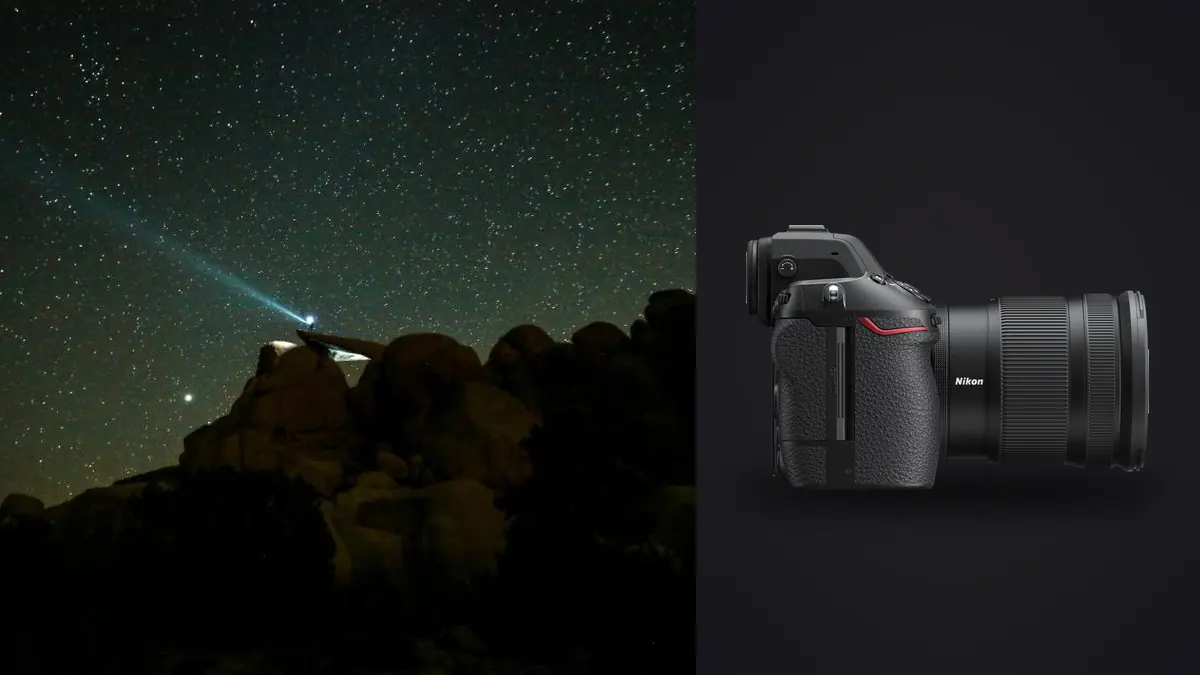
The first time I took the Z8 out for a proper dark-sky session, I underestimated one thing completely: how many frames I'd come home with. Not the exposures themselves, those are the easy part once you've got your settings dialed in, but the sheer volume of near-identical subs that pile up over a two-hour interval timer run. Star stacking is as much a data management problem as it is an exposure problem, and the Z8 happens to be an unusually good body for both halves of that equation. This is what I've learned running it under genuinely dark skies in the Atlas Mountains and on a few colder nights in the Cairngorms, not a spec sheet regurgitation.
Why the Z8 holds up well for this specific job
Star stacking, whether you're doing a static Milky Way composite or building a smooth star trail from a hundred-plus short exposures, punishes two things: sensor noise at high ISO and any inconsistency between frames. The Z8's stacked 45.7MP sensor was built for speed and readout cleanliness rather than astro work specifically, but both of those traits transfer well. Read noise at ISO 3200 to 6400 is low enough that a stack of 15 to 25 subs cleans up nicely without the smeary color noise I used to fight on older 24MP bodies. That headroom matters more than raw resolution here, because you're going to be shooting at wide apertures and moderate ISOs, not pushing the sensor to its ceiling.
The other underrated advantage is buffer depth and card write speed. A star trail session might mean firing off 200 to 400 consecutive 10-to-20 second exposures with the built-in intervalometer. On a body with a shallow buffer, you get write lag that either drops frames or introduces gaps between shots, which shows up as broken trail segments after stacking. The Z8 with a fast CFexpress card in slot 1 just doesn't choke on this. I've run three-hour interval sessions without a single dropped frame, which I couldn't say about the D780 I used before it.
Battery life is the one place I'd flag a caveat. Cold nights above 2,000 meters will chew through a battery in under two hours of continuous long-exposure shooting with the rear screen active. I now carry three EN-EL15c cells for anything longer than a single-composite session and keep the spares in an inside jacket pocket, not the camera bag, because cold cells lose voltage fast.
Lens choices that actually matter
For wide-field Milky Way work I've settled on the Nikkor Z 20mm f/1.8 S as my default. It's sharp into the corners by f/2.2, coma control is genuinely good (a lot of fast wide primes smear stars into little seagulls near the frame edges, this one mostly doesn't), and the focal length is forgiving enough that you don't need pinpoint-precise tracking to keep stars round. The 14-24mm f/2.8 S is the better choice when I want a wider field for a foreground-heavy composition, but I'm giving up roughly a stop and a bit more coma at the corners for the flexibility.
I'll admit I was skeptical the 24mm f/1.8 S was worth carrying as a third option, but for compositions where 20mm feels too wide and 14mm distorts the foreground too much, it's become the lens I reach for more than I expected. None of this is Z8-specific advice exactly, but the body's sensor resolves enough detail that lens shortcomings at the corners show up more obviously than they did on lower-resolution bodies, so lens choice matters more here than it might on a 24MP camera.
Dialing in exposure without the old rules
Forget the 500 rule. It was built for lower-resolution sensors with bigger photosites, and on a 45.7MP body it will absolutely give you visible star trailing at 100% crop. The pixel pitch on the Z8 is around 4.35 microns, small enough that star movement across a few pixels during a long exposure becomes obvious the moment you zoom in on a final composite. I use the NPF rule instead (it accounts for aperture and pixel pitch, not just focal length), and I've settled on a set of numbers through repeated field testing that I now just have memorized rather than recalculating every trip.
| Focal length | Aperture | Max shutter for pinpoint stars (Z8, field-tested) | Old "500 rule" would suggest |
|---|---|---|---|
| 14mm | f/2.8 | ~8 sec | ~35 sec |
| 20mm | f/1.8 | ~6 sec | ~25 sec |
| 24mm | f/1.8 | ~5 sec | ~20 sec |
| 35mm | f/1.8 | ~3.5 sec | ~14 sec |
| 50mm | f/1.8 | ~2.5 sec | ~10 sec |
Those shutter numbers look aggressive if you're used to the 500 rule, and they are, because that's the point. On a 45.7MP sensor the old rule was already giving you soft, slightly elongated stars, you just couldn't see it until you cropped in. I'd rather shoot more, shorter frames and stack them than accept mushy stars in a single long exposure. ISO 3200 with a 6-second exposure at f/1.8 on the 20mm gets me a well-exposed sky in most dark-sky locations, and stacking 20 to 30 of those subs brings noise down to something I'm happy printing.
Setting up the interval timer session
A few things I do every time before starting an unattended run:
- Manual focus, confirmed with live view zoomed to 100% on the brightest star in frame, then taped down so it can't drift when I bump the lens barrel packing up.
- Manual white balance around 3800-4000K rather than auto. Auto white balance drifts slightly between frames on long sessions, which shows up as color banding once you stack.
- Shoot RAW, lossless compressed 14-bit. Not because you need every bit of dynamic range for a stack, but because you want consistent color response across frames and RAW gives you that.
- Interval set with zero gap where possible, or as close to zero as the exposure length allows. Gaps between frames show up as dashed rather than continuous star trails if that's the effect you're going for, and they waste time if you're building a Milky Way stack where every additional sub reduces noise.
- Exposure delay off, electronic front-curtain shutter on. On a tripod with no mirror to slap, this mostly matters for minimizing any vibration transfer if wind is present.
I also shoot 8 to 10 dark frames at the end of the session, same ISO and shutter speed, lens cap on. Not every stacking tool needs them, Sequator largely ignores dark frames and does fine, but DeepSkyStacker and Starry Landscape Stacker both benefit from having them for hot pixel removal, and the Z8's sensor does pick up a handful of hot pixels on exposures past 15 seconds once the body has been running for an hour or two and warmed up slightly.
The part nobody warns you about: sorting the output
Here's the bit that actually eats the most time on a night like this. A three-hour trail session at a 20-second interval leaves you with 500-plus RAW files, and a decent chunk of them are unusable: a plane crossed the frame, dew fogged the front element halfway through, wind nudged the tripod, or focus drifted slightly when the lens barrel contracted in the cold. Going through those manually in Lightroom, one at a time, at 2am with cold fingers, is miserable.
This is honestly where imagic earns its keep in my workflow now. I run the whole folder through it before touching anything else. Its local sharpness scoring flags the frames where focus drifted or a gust blurred the stars, which matters a lot on a stack because even a handful of soft frames dragged into DeepSkyStacker or Sequator will slightly degrade the whole composite's sharpness. The duplicate and burst clustering is also useful here in a way I didn't expect: a long static interval run is essentially one giant burst, and being able to group visually near-identical frames and quickly compare which ones have the cleanest stars (no plane trail, no satellite streak, no dew haze creeping in) saves a genuine chunk of the post-session slog. It's all processed locally too, which matters more than it sounds like it should when you're doing this at a remote site with no signal and don't want to wait until you're back near wifi to start culling.
Once I've got a clean shortlist of subs, that's when they go into the actual stacking software, not before.
Picking a stacker
I use two different tools depending on what I'm building, and neither is universally better:
- Sequator (Windows, free) for Milky Way composites with a static foreground. It handles sky-versus-ground masking automatically most of the time, and for a quick composite it's genuinely fast. It struggles a bit if there's a lot of foreground detail near the horizon with fine branches or grass, the mask edges get a bit rough there.
- Starry Landscape Stacker (macOS, paid) when I want more manual control over the sky mask, particularly for compositions with a complicated horizon line. The masking brush is more forgiving than Sequator's automated approach.
For a genuine star trail (not a stacked pinpoint sky), I skip both of those and just use StarStaX, which is built specifically for additive trail blending and does that one job better than either of the above.
Blending in the foreground
If there's a foreground element I care about, I shoot it separately: same composition, same focal length, but a longer exposure at lower ISO to keep noise down, sometimes with a headlamp or handheld light briefly painting it if there's no ambient light source nearby. Trying to expose the foreground and sky identically almost never works well, the sky wants a short exposure to keep stars sharp and the ground usually wants either a longer exposure or supplemental light. I blend the two in Photoshop with a simple luminosity mask rather than trying to get Sequator's automatic blend to handle a foreground that's meaningfully darker than the sky.
Once the composite is built and I'm happy with the base edit, I'll run my finished frame through imagic's apply_my_style preset, since I've trained it on a batch of my previous night-sky edits and it gets me most of the way to my usual color balance (slightly cooler shadows, restrained magenta in the Milky Way core) before I do any final manual tweaking.
Frequently Asked Questions
Do I actually need a star tracker, or does stacking on the Z8 make one unnecessary?
They solve different problems. A tracker lets you use much longer individual exposures because it compensates for Earth's rotation, which is useful for deep-sky targets where you need serious cumulative exposure time. Stacking multiple short, untracked exposures gets you a similar noise reduction benefit for wide-field Milky Way shots without carrying a tracker, but you're still limited by the NPF-rule shutter speed per frame. For nightscapes with a foreground, I don't bother with a tracker. For pure deep-sky work through a telephoto lens, I would.
Why do my stars still look slightly egg-shaped even after keeping shutter speed within the NPF limit?
Usually one of three things: the lens has coma that gets worse toward the corners regardless of exposure time (test wide open versus stopped down half a stop), the tripod head wasn't fully locked and crept slightly over the session, or focus drifted as the lens cooled and contracted. I've had the third one happen more than I'd like to admit on longer sessions and now recheck focus every 30 to 40 minutes on anything past an hour.
How many subs do I actually need for a clean Milky Way stack?
On the Z8 at ISO 3200-6400, I get diminishing returns past about 25 to 30 subs. The first 15 or so make a dramatic visible difference in noise. Beyond 30, you're mostly just extending your capture time in the field for a marginal gain that's hard to see outside 100% crops. If time in the field is limited, 15 to 20 well-exposed subs beats 40 rushed ones with inconsistent focus.
Does the Z8's in-body stabilization do anything useful for this kind of shooting?
Not for tripod-mounted long exposures, no, it should be switched off entirely on a locked-down tripod since IBIS can actually introduce micro-vibration when it has no genuine camera shake to correct for. Where it does help is handheld high-ISO test shots to quickly check composition and framing before committing to a full tripod setup, which I do more often than I expected to when scouting a new location in the dark.
What I'd tell someone starting out
Don't buy a star tracker before you've shot a few stacked Milky Way sessions the simple way. Most of what people assume needs a tracker is actually solved by shooting more, shorter frames at a sensible NPF-based shutter speed and stacking them. The Z8 is well suited to that approach specifically because of its buffer depth and clean high-ISO output, not because of any dedicated astro feature. And budget real time for sorting frames afterward. If you're regularly running interval sessions, something like automated culling genuinely changes how much of the process feels like a chore versus a hobby, and it's worth building into your workflow from the start rather than bolting it on after you've got a backlog of unsorted nights sitting on a drive.