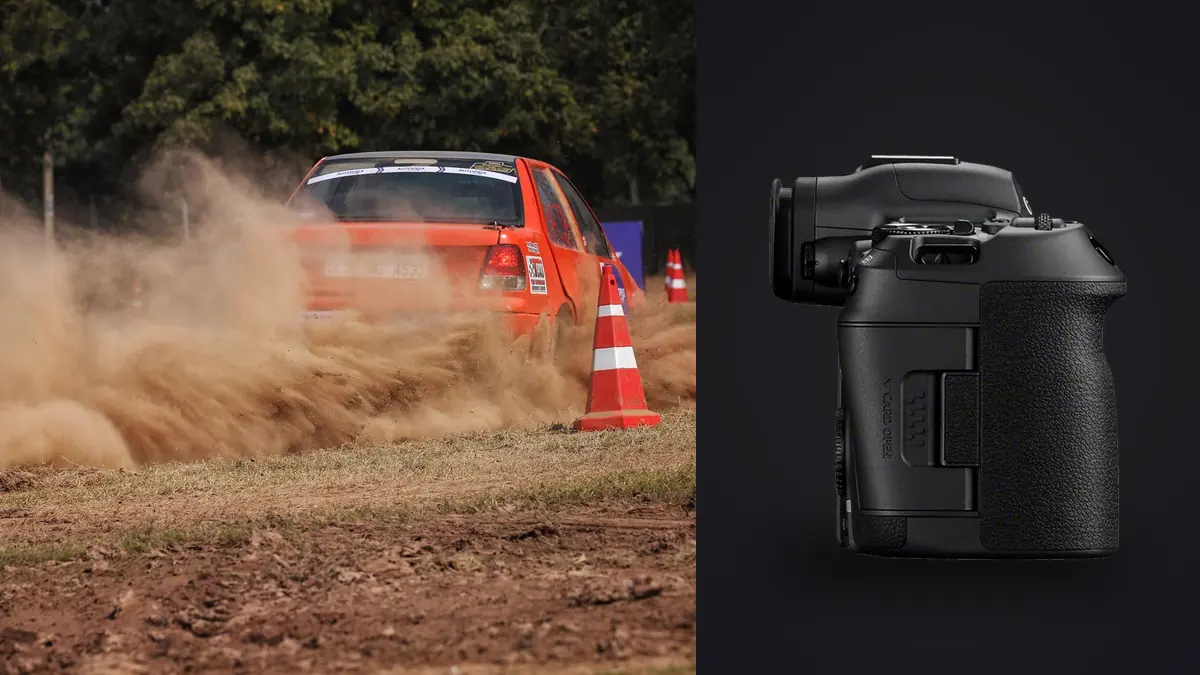
I picked up the Canon EOS R5 Mark II halfway through last outdoor season, mostly because I was tired of my old body hunting focus on the backstretch when a sprinter came out of the blocks under stadium shadow. Track and field is a strange sport to shoot. You've got athletes moving at wildly different speeds within the same 90 minutes, from a 100m final that's over in ten seconds to a pole vault approach that builds for six full strides before anything interesting happens. One camera body has to handle both. This is what I've learned putting the R5 Mark II through a full season of dual meets, one conference championship, and a very cold indoor invitational in February.
Why This Body Changed How I Shoot a Meet
The short version: the R5 Mark II is the first Canon body I've used where I stopped thinking about the camera during a race and started thinking only about the athlete. That sounds like marketing language, so let me be specific about what changed. The stacked sensor design means the rolling shutter that used to make me avoid electronic shutter entirely is now something I use for most of a meet, not just the quiet moments. The autofocus system holds a bib number in a crowded field of runners instead of drifting to the nearest high-contrast jersey. And Eye Control AF, which I was skeptical of when Canon first shipped it on the R3, actually works when I'm tracking a hurdler's face through a long lens on a curve, provided I recalibrate it every time the light changes meaningfully.
None of that means the camera does the job for you. It means the gear stops being the limiting factor, which at a track meet is a bigger deal than it sounds. You get maybe three usable frames of a discus release before the athlete's body blocks the disc from the angle you're shooting. If the camera hunts for even a quarter second on frame one, you've lost the sequence.
Autofocus and Frame Rate: What Actually Holds Up
The 45-megapixel stacked sensor gives you up to 30 fps with the electronic shutter, and Dual Pixel CMOS AF II runs subject detection across nearly the whole frame. For track and field specifically, the subject detection modes that matter are People and, less obviously, Animals (I use it for equestrian-adjacent shots when the mascot's on the infield, which is not a joke, mascots wander into frame more than you'd think). The People mode's ability to lock onto a torso when a face is turned away, which happens constantly in sprint starts, is what actually earns its keep.
Where I still see the system get confused is in relay handoffs. Two bodies converging in the exchange zone, both moving fast, both partially obscuring each other for a half second, is exactly the scenario that breaks subject tracking on every camera I've used, this one included. My workaround is dropping to a single AF point or a small zone right on the baton hand rather than trusting whole-area tracking through the exchange.
Buffer depth is the other number people ask me about, and the honest answer is that it depends entirely on your card. With a fast CFexpress Type B card I get well over 200 RAW frames before the buffer meaningfully slows me down, which in practice means I can hold the shutter through an entire 100m final without worrying about it. Switch to the UHS-II SD slot as your only card and that number drops hard, especially if you're shooting uncompressed RAW instead of the C-RAW option. For anything faster than field events, I don't shoot SD-only anymore.
Matching AF and Drive Mode to the Event
Different events call for different settings, and I've settled into a rhythm over the season. This is what I actually dial in, not a theoretical best case:
| Event | AF Area / Mode | Shutter / Drive | Notes |
|---|---|---|---|
| 100m / 200m sprints | Whole Area AF, People detection, torso priority | Electronic, 20-30 fps | Pre-focus on the blocks, let tracking take over at the gun. Eye Control AF helps if I'm panning smoothly with the field. |
| Hurdles | Zone AF (center-weighted) | Electronic, 20 fps | Full tracking tends to jump to the trail leg or an adjacent lane. A tighter zone keeps it on the lead athlete through the barrier. |
| Long / triple jump | Single-point, manually placed on the board | Mechanical, 12 fps | I pre-focus the takeoff board and let the athlete run into focus rather than tracking the approach. Electronic shutter's rolling readout warps the extended limbs at peak flight if there's any pan. |
| Pole vault | Zone AF, upper third of frame | Mechanical, 12 fps | Long approach means AF has time to settle before the clearance. I keep it mechanical here because the pole's whip motion reads badly under electronic shutter. |
| Shot put / discus | Single-point on the throwing shoulder | Electronic, 20 fps | You get one real release sequence. Pre-continuous shooting (the buffer that captures frames just before your full shutter press) has saved more than one throw for me when the release happened faster than my reaction time. |
| 4x400 relay exchange | Small zone locked to the baton hand | Electronic, 20 fps | Whole-area tracking loses the plot when two runners overlap. Narrow the zone before the exchange, not during it. |
Rolling Shutter, Panning, and When to Go Back to Mechanical
Electronic shutter on the R5 Mark II is genuinely usable in a way it wasn't on the original R5, but it isn't magic. The stacked sensor reads out fast enough that a clean pan on a sprinter rarely shows the skew you'd get on a non-stacked competitor's body, but you'll still see it if you whip-pan hard across a field event or shoot something spinning fast, like the tail end of a discus rotation. My rule of thumb: anything moving in a straight line at a speed I can pan smoothly with, electronic shutter stays on. Anything with rotational motion, a whipping pole, or a camera movement that isn't a clean pan, I flip back to mechanical at 12 fps and accept the lower frame rate for clean geometry. It costs me maybe two extra seconds fiddling with a dial mid-meet, which is annoying, but a warped javelin is worse than a missed frame.
Lens Pairing for a Full Day at the Track
I run two bodies at most meets now, which the R5 Mark II's price makes a genuinely reasonable proposition compared to pairing it with an R3. The RF 100-500mm f/4.5-7.1 lives on one body for sprints, hurdles, and anything on the far side of the track where I can't get close. It's not a constant f/2.8, and in a poorly lit indoor facility that shows up as higher ISO than I'd like, but the reach and the in-body stabilization working alongside the lens's own IS gets me sharp handheld frames at shutter speeds I wouldn't have trusted five years ago.
The second body carries the RF 70-200mm f/2.8, which does the heavy lifting for field events where I'm closer to the action: long jump, triple jump, pole vault, and the throwing circle when I've got infield access. The faster aperture matters more here than the extra reach would, especially for evening meets where the stadium lights are already fighting me.
For a 1.4x teleconverter on the 100-500mm, autofocus speed takes a noticeable hit in anything but bright daylight, enough that I only reach for it during outdoor afternoon sessions, never under lights.
The Card and Buffer Reality Nobody Puts in the Spec Sheet
Manufacturer buffer numbers assume ideal conditions and usually a specific fast card that most people don't own. In practice, at a typical two-and-a-half-hour dual meet, I come home with somewhere between 3,000 and 5,000 RAW frames once you count warm-ups, field events running in parallel with track events, and the inevitable habit of holding the shutter a beat too long on a close finish. Dual card slots mean I can write RAW to CFexpress and a JPEG backup to SD simultaneously without touching the buffer ceiling for the primary card, which is the setup I'd recommend to anyone shooting a full slate of events solo.
The real cost of that frame count doesn't show up on meet day. It shows up the next morning staring at a folder with thousands of near-identical burst frames from six different events, trying to find the two or three keepers per athlete before a coach emails asking for finals photos.
After the Gun Fires: Getting Through the RAWs
This is where I changed my workflow the most this season, and it has nothing to do with the camera body. A 100m final at 30 fps electronic shutter produces a burst of 60 or more nearly identical frames for a race that lasts ten seconds, multiplied across eight lanes if you're panning the whole field, multiplied again across every heat of every event. Scrolling through that manually, event by event, was eating three or four hours after every meet.
I moved that first pass into imagic, which runs entirely on my laptop rather than uploading anything to a cloud service, which matters when I'm culling from a hotel room with bad wifi after an away meet. It scores each frame locally for sharpness and clusters the burst sequences and near-duplicates from a race automatically, so instead of clicking through 60 sprint frames one at a time I'm looking at the handful it flagged as sharpest within each cluster and picking from those. It cut my post-meet triage time by more than half, which for a solo shooter covering six events in an afternoon is the difference between getting photos to a coach that night versus two days later.
The other habit that's stuck: I built an AI photo culling pass into every meet now, not just the big championship ones, because the volume problem doesn't scale down much even for a small dual meet. It's the same reason I stopped trying to eyeball sharpness on a laptop screen in a stadium tunnel between events. Local scoring catches soft frames from a slightly-off focus lock faster and more consistently than my eyes do after four hours on my feet.
Editing for a Consistent Look Across a Season
Track season means shooting the same handful of venues over and over under wildly different light: overcast afternoon dual meets, floodlit Friday night invitationals, a fluorescent-lit fieldhouse for the indoor season. I got tired of every meet's photos looking like they came from a different photographer, so I set up an apply_my_style preset in imagic trained on a batch of edits I was already happy with from earlier in the season. It's not a generic filter, it's built from my own adjustments, so new imports from a new venue land close to my usual look before I touch anything manually. I still hand-finish the shots that are actually going out to a team or a parent, but the baseline consistency across a whole season's worth of meets used to take real effort to maintain and now mostly takes care of itself.
If you're comparing tools for this kind of high-volume, event-based shooting rather than studio or portrait work, it's worth reading through a general culling software comparison before committing, since the right tool depends a lot on whether you're shooting 200 frames a week or 5,000.
Is It Worth It Over a Cheaper Body
I get asked this a lot by other meet photographers still shooting an R6 II or an older R5. The honest answer is that the R5 Mark II earns its price difference specifically in the situations this article has been describing: dense subject fields, mixed lighting, and events that demand both high frame rates and full resolution crops afterward, since a 45-megapixel file gives you real room to crop a distant field event tighter in post without falling apart. If you mostly shoot slower sports or wider group shots where subject tracking through a crowd isn't the daily challenge, the jump matters a lot less. For track and field specifically, where you're constantly asking the autofocus system to pick one athlete out of a moving pack, it's the single biggest upgrade I've made in years.
Frequently Asked Questions
Is the R5 Mark II fast enough for sprint finals without stepping up to a body like the R3?
For nearly all track and field work, yes. The 30 fps electronic shutter and stacked sensor readout handle sprint finals and relay exchanges well, and the buffer depth with a fast CFexpress card is deep enough to hold through an entire race. The R3's advantage shows up more in extreme low-light night meets and in a slightly more refined viewfinder blackout during bursts, which matters most to shooters chasing peak action in very dim floodlit stadiums.
Does Eye Control AF actually help when panning a long lens through a curve on the track?
It helps, but only after a proper calibration under the specific light you're shooting in, and it needs redoing if you move from bright sun to shade or into an evening session under stadium lights. When calibrated well, it lets me redirect focus to a different lane mid-pan just by looking there, which is faster than repositioning an AF point manually during a live race. Skip the calibration step and it becomes more distraction than help.
What card setup avoids buffer slow-down during a finals session?
A fast CFexpress Type B card in the primary slot is the difference maker. Shooting RAW to CFexpress with a JPEG backup to the SD slot keeps you well clear of buffer limits through a full 100m final at 30 fps. Relying on SD alone, especially for uncompressed RAW, will slow the buffer noticeably faster during long bursts.
How do you realistically get through thousands of RAW files from a single meet?
Volume is the actual challenge, not the camera. A single meet with several sprint finals and field events can easily produce 3,000 to 5,000 RAW frames once bursts are counted. Running a first local pass to score sharpness and group burst sequences before doing any manual review is what makes same-day or next-morning delivery realistic, rather than trying to scroll through every frame by hand.