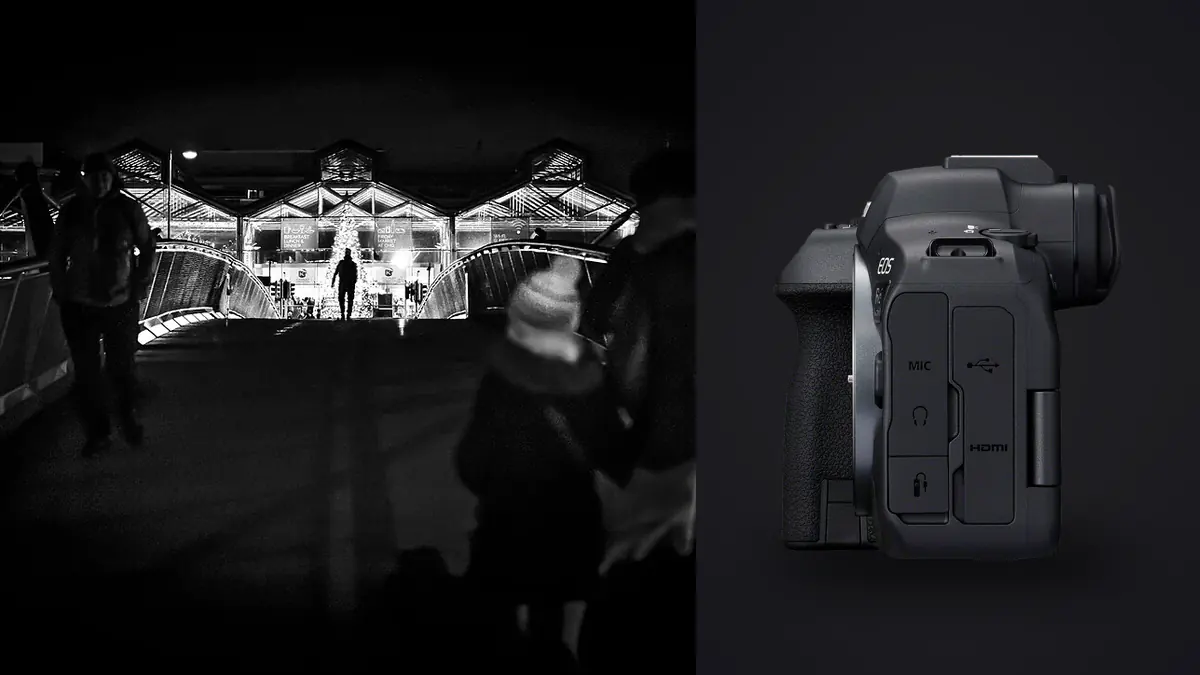
I switched to a Canon EOS R6 Mark II about eighteen months ago after four years of shooting a 5D Mark IV on the same kind of street subjects: markets, protests, migrant shelters. The DSLR never let me down mechanically, but it was loud, it hunted in doorways and under awnings, and I was tired of carrying two kilos of camera into rooms where I was trying to disappear. The R6 II was the first Canon body that actually felt built for that kind of work rather than adapted to it after the fact.
This isn't a spec sheet rundown. Canon's own page will tell you the megapixel count and the burst rate. What I want to cover is what changes when you take this specific body onto a specific kind of job: fast, unscripted, low light more often than not, and unforgiving of a camera that needs babysitting.
Size and Handling: Small Enough to Stop Mattering
At around 588 grams body-only, the R6 II sits in an odd middle zone. It's not a pocketable compact, but it's light enough that after four or five hours slung across my chest I stop noticing it, which is the actual bar for street work, not "lightweight" as a marketing word. Paired with the RF 35mm f/1.8 the whole rig comes in under a kilo, and that combination disappears into a crowd in a way my old 5D with a 35L never did.
The grip is deep enough for one-handed shooting while the other hand fends off a subway door or steadies a kid on your shoulders, which matters more than people give it credit for. I do wish the joystick sat a few millimeters further from the AF-ON button; in cold weather with gloves I've selected the wrong AF point more than once mid-shot. Small complaint, but on documentary jobs where you don't get a second take, small complaints compound.
Electronic shutter silent mode is the feature I use constantly and almost never see mentioned in reviews written by people who don't shoot events. Full silence, zero shutter sound, at up to 40fps if you want it (I rarely go past 8-10fps in practice, more on that below). Shooting inside a courtroom, a funeral, a small apartment where four generations are watching you work: the difference between an audible clack every frame and total silence is the difference between being tolerated and being invited back.
Autofocus in Rooms Full of Moving People
This is where the camera earns its price for documentary work specifically. Eye detection on the R6 II locks onto faces in a crowd, not just the nearest one, and it's genuinely good at holding a specific person's eye through partial occlusion, someone walking behind a pole, a hand passing in front of their face. I shot a protest last spring where a line of riot shields kept crossing my frame and the camera stayed locked on the same face through every gap rather than jumping to the shield.
Where it struggles: dense crowds where multiple faces overlap at similar distance and similar size. The camera sometimes can't decide, and it'll swap subjects between frames in a burst, which is annoying when you're trying to build a sequence around one person's expression. My workaround is registering the subject with a quick tap on the touchscreen before the sequence starts, which locks priority far more reliably than letting the algorithm guess.
Continuous AF with subject tracking also holds up well in genuinely bad light, courtyard interiors lit by a single window, night markets under sodium vapor lamps. It hunts occasionally below roughly EV -3 with an f/1.8 lens, but that's a scenario where most cameras give up entirely, mine included on the old body.
ISO Ceiling for Real Documentary Conditions
Canon rates native sensitivity to ISO 102400, and while that number is mostly marketing, the practical usable ceiling for editorial-quality files sits closer to ISO 6400-12800 depending on how much you're willing to fight noise in post. That's roughly a stop and a half better than what I was getting out of the 5D Mark IV in the same conditions, which sounds modest until you're the one deciding whether to push shutter speed and accept motion blur, or push ISO and accept grain.
For documentary work specifically, I'd rather have grain. A slightly noisy frame of someone's face mid-sentence reads as authentic; a motion-blurred one just reads as a missed shot. The R6 II's noise pattern at 6400 and even 12800 stays fine-grained rather than blotchy, and it responds well to modest noise reduction without turning faces waxy, which is the failure mode I hated most in older sensors.
In-body stabilization rated around 8 stops with compatible RF lenses lets me shoot static or slow-moving subjects at absurdly low shutter speeds indoors, 1/15s handheld is routine, which keeps ISO down when the subject itself isn't moving. It does nothing for a kid running across frame, obviously. Know which problem you're solving before you reach for a dial.
What This Means for Night Markets and Interiors
Two recurring documentary scenarios: night markets and dim interiors. In markets I generally shoot 1/250s minimum to freeze hands and faces, which pushes ISO up fast under string lights and stall lamps, often into the 4000-8000 range. Interiors depend entirely on the room, but I budget for ISO 3200 as a baseline and treat anything under that as a bonus. Neither scenario is comfortable, but the R6 II is the first body I've used where I stopped mentally apologizing for the files afterward.
Buffer and Burst: The Part Nobody Tells You
Mechanical shutter tops out at 12fps, electronic at 40fps, but the number that actually matters on a documentary shoot is how long the buffer lasts before the camera slows down, and how fast it clears. Shooting RAW with a fast UHS-II card, I get somewhere around 5-6 seconds of sustained 12fps mechanical shooting before the buffer starts to choke, which in practice covers almost any single gesture or exchange worth capturing in a burst. Push to 40fps electronic and that window shrinks considerably, so I only use full electronic speed for genuinely unpredictable action, someone about to fall, a scuffle breaking out, not as a default setting.
The bigger practical issue is what 40fps does to your card and your evening. A single ten-second decision to hold the shutter down can generate 400 frames of nearly identical content. Multiply that across a full day of documentary coverage and you end up with tens of thousands of frames that all need sorting before a single edit gets made. This is the actual bottleneck of modern high-speed mirrorless work, not the camera, the review process afterward. I run everything through imagic before I open a single frame in an editor; its local sharpness and focus scoring flags which frame in a 40-frame burst is actually sharp on the eyes, and its duplicate and burst clustering groups those near-identical sequences so I'm making one decision per moment instead of scrolling through four hundred thumbnails that look the same at a glance.
How the R6 II Compares for This Kind of Work
I get asked fairly often whether the extra money over the original R6, or a Sony equivalent, is worth it for street and documentary shooting specifically. Here's how I'd actually lay it out based on time spent with each, not spec sheets:
| Camera | Weight (body) | Silent shooting | Subject tracking in crowds | Realistic usable ISO ceiling | Street discretion |
|---|---|---|---|---|---|
| Canon EOS R6 Mark II | ~588g | Full electronic, no compromise | Strong, occasional overlap confusion | ~ISO 12800 | Medium (grip and lens size) |
| Canon EOS R6 (original) | ~598g | Full electronic | Good but noticeably slower to reacquire | ~ISO 12800 | Medium |
| Sony a7 IV | ~659g | Full electronic | Excellent, best-in-class eye tracking | ~ISO 12800 | Medium (menu system slower to operate one-handed) |
| Fujifilm X100VI | ~478g | Full electronic (leaf shutter) | Good, fixed 35mm equivalent limits framing | ~ISO 6400 | High (rangefinder-style body reads as non-threatening) |
The honest takeaway from that table: the R6 II doesn't win outright in any single category. What it wins is the combination, autofocus that keeps pace with the a7 IV closely enough that the gap rarely costs you a frame, ISO performance in the same tier as its direct rivals, and a body that isn't quite as pocketable as the Fuji but comes with interchangeable optics for when a job genuinely needs a 24mm one day and an 85mm the next. Documentary work in particular benefits from that flexibility more than street photography does, since assignments rarely stay within one focal length for an entire day.
Lens Pairings That Actually Get Used
I own five RF lenses. Two get used for ninety percent of documentary work. The RF 35mm f/1.8 Macro IS STM is the default, small, sharp wide open, close focusing distance that doubles as a decent detail lens for hands, texture, small objects on a table. The RF 50mm f/1.2L is the one I bring when I know I'll be working further from subjects, press conferences, formal moments within an otherwise informal shoot, but it's a heavy, obvious lens that changes how people react to the camera. I leave it home more often than I bring it.
For pure street work rather than assignment documentary, I've moved almost entirely to the RF 28mm f/2.8 STM pancake. It's not fast enough for dim interiors, but it makes the whole camera small enough that I stop reading as "a photographer" to strangers on the street, which changes the photographs you're able to get in the first ten minutes of a walk before people notice you.
Where the Workflow Actually Slows Down
None of the camera's strengths matter if the files pile up faster than you can process them, and that's the real story of shooting a body capable of 40fps for a living. A single afternoon covering a community event can produce 3,000-6,000 frames once you account for bursts, safety frames, and the inevitable reshoots. Culling that manually at even a generous three seconds per image is close to four hours of screen time before a single caption gets written.
This is the part of the R6 II ownership experience that reviews never mention, because reviewers shoot a few hundred test frames, not a full documentary assignment. I run my card straight into imagic after every shoot; it processes everything locally without uploading a single frame anywhere, which matters when photographing vulnerable subjects where confidentiality isn't optional. The sharpness scoring catches the soft frames in a burst before I waste time opening them, and once I've graded a batch of finished edits, the apply_my_style feature learns from those edits and applies a first pass to the rest of the set, so the fifty selects from a shoot start from something closer to my actual look instead of a flat RAW file. It's cut my average turnaround on a same-day documentary shoot from most of an evening to under an hour of actual sorting. The general idea of training a look on your own past edits rather than a generic preset is covered in more depth in this walkthrough of matching your own editing style.
If you're weighing whether faster culling tools are worth building into your workflow at all, it's worth reading through how AI photo culling actually works before assuming every tool in the category behaves the same way. Not all of them score sharpness the same way, and the difference shows up specifically in burst-heavy work like street and documentary shooting.
Frequently Asked Questions
Is the R6 Mark II too big to shoot street photography discreetly?
It's not a rangefinder-sized camera and it won't disappear the way a compact will, but paired with a small prime like the RF 28mm or 35mm it's manageable. Most of the discretion problem on the street comes from body language and how long you linger with the camera raised, not the camera's physical size.
Do I need the battery grip for a full day of documentary coverage?
I don't use one. A single battery gets me through 800-1,200 frames depending on how much I'm chimping and using continuous AF, which covers most single-day assignments. I carry two spares in a jacket pocket instead, lighter than a grip and just as reliable.
How bad is rolling shutter with the electronic shutter on fast street subjects?
Noticeable on genuinely fast lateral motion, a cyclist crossing close to frame, a car passing near the lens, you'll see mild skew on verticals. For walking pace subjects and most documentary scenes it's a non-issue. I switch to mechanical shutter specifically for anything moving faster than a jog.
Is the R6 Mark II worth it over the original R6 just for street and documentary work?
If your main use case is dim interiors and unpredictable crowds, yes, the improved subject detection and faster buffer clearing solve real problems the original R6 has. If you mostly shoot outdoors in decent light at a walking pace, the gap matters much less and the money is better spent on a second lens.