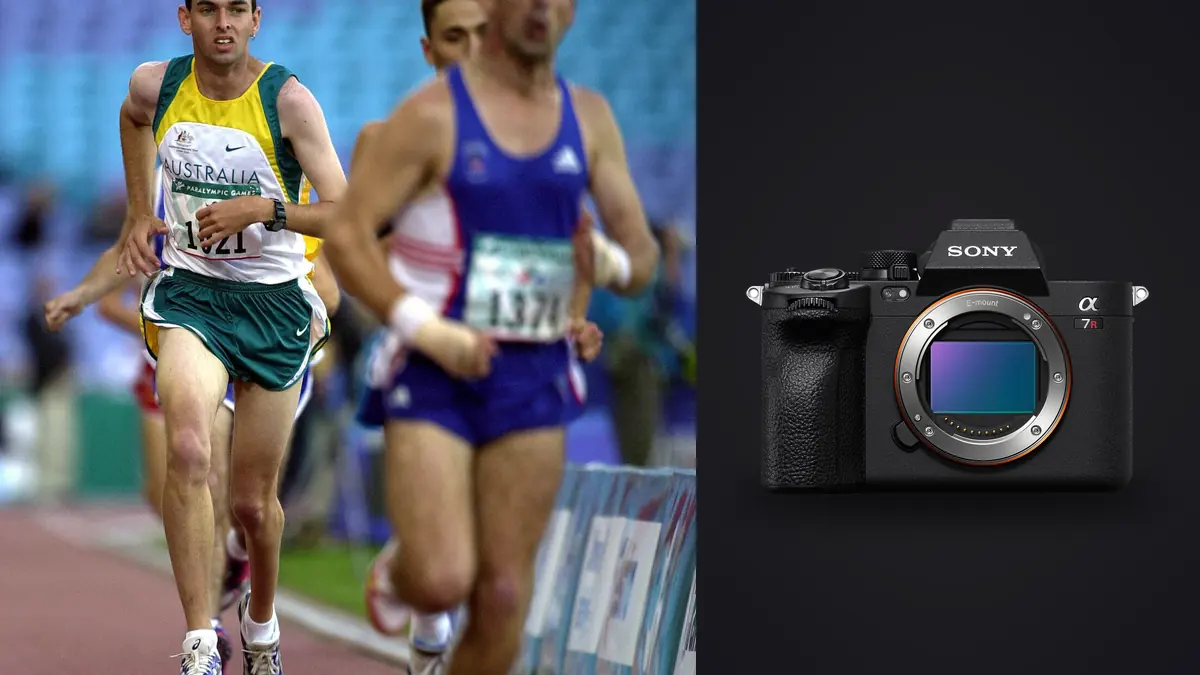
The Sony A7R V was not built for a track oval. It was built for landscape shooters, product photographers, and anyone who wants 61 megapixels to crop into for a print. That said, a lot of track and field shooters own one anyway, usually because they already had it for other work and didn't want to buy a second body just for meet season. So the real question isn't "is this a sports camera," it's "what happens when you point a resolution-first camera at a 100m final." The answer is: some of it works better than you'd expect, and some of it will genuinely frustrate you if you don't adjust your settings for what the sensor actually is.
The resolution trade-off nobody mentions until race day
A 61-megapixel sensor produces enormous files. Compressed RAW from the A7R V lands somewhere around 60 to 80MB per frame depending on scene complexity, and that's before you touch uncompressed RAW, which roughly doubles it. At a track meet you are not shooting single frames. You are holding the shutter through a 100m final for two seconds, then doing it again nine more times over the course of a session, then doing the same through hurdles, relays, and field events running in parallel. The math adds up fast: a full day of finals can leave you with 200 to 400GB of RAW files, and a meaningful chunk of it is redundant frames of the same stride captured a hundredth of a second apart.
This matters for two reasons. First, your card and buffer have to keep pace in the moment. Second, and this is the part people underestimate, you have to get through that pile of files afterward without losing your evening to it. I'll come back to the second problem later, because it's the one that actually decides whether you enjoy shooting meets or dread them.
Where the AI autofocus genuinely helps
Sony put a dedicated AI processing unit in the A7R V, separate from the main image processor, and it's the same subject-recognition system that shows up across the rest of the current lineup. For track work specifically, the human pose detection is the part that matters. It doesn't just find a face, it reads the skeleton, so it holds focus on a sprinter's torso even when their head is tucked forward and their arms are pumping across the frame. On an isolated runner in an outside lane with clean background separation, this tracks about as reliably as anything Sony makes, including bodies that cost twice as much.
Where it gets less confident is anywhere subjects overlap: relay exchanges, the start of a distance race before the pack strings out, hurdlers bunched at the first barrier. The AI system has to decide which human shape is the "subject," and if you haven't pinned a focus point on the right athlete before the scrum happens, it will sometimes hop to whoever is closest to center or has the most contrast. Zone tracking with a manually placed starting point, rather than wide tracking that lets the camera pick, solves most of this. Give it a starting point and let the AI hold onto it rather than asking it to choose cold.
The rolling shutter problem with the electronic shutter
This is the one that catches people who bought the A7R V expecting it to shoot like an A9-series body. The sensor is not stacked, so the electronic shutter reads line by line at a speed that's noticeably slower than a stacked sensor. Pan with a sprinter at full stride using silent electronic shutter and you'll get skew, verticals leaning, a slight jello wobble on fast limb movement. It's subtle enough to miss on the rear LCD and obvious enough to ruin a frame you wanted to print large.
The fix is simple but costs you the silence: use the mechanical shutter for anything with fast lateral motion, which is most of track. You give up the fully blackout-free viewfinder experience and drop to a harder cap on burst rate, but you get a clean, undistorted frame. Save electronic shutter for static or slow-moving subjects where you actually need silence, like archery-adjacent field events or shooting near an athlete who's about to attempt a personal best in the long jump runway and doesn't need a mechanical shutter clacking behind them.
Settings by event, not one setting for the whole meet
Track and field is really six or seven different sports happening on the same afternoon, and treating it as one photographic problem is how people end up with soft frames. Here's roughly how I split it up:
| Event type | Typical shooting distance | Shutter / drive | AF area | Shutter speed |
|---|---|---|---|---|
| Sprints (100m/200m) | 15-30m, lane-side | Mechanical, Hi+ | Tracking: Human, zone start point | 1/2500-1/3200 |
| Hurdles | 20-40m | Mechanical, Hi+ | Zone, manually placed on lead hurdler | 1/2000-1/2500 |
| Relay exchange zones | 10-15m | Mechanical, Hi | Wide tracking (multiple bodies expected) | 1/2000 |
| Long/triple jump | 8-20m, runway side | Mechanical, Hi+ | Zone on takeoff board | 1/2500-1/3200 |
| Throws (shot/discus/javelin) | 25-50m | Mechanical or e-shutter (static wind-up) | Zone, human tracking | 1/1600-1/2000 |
| Distance/pack running | 20-60m, variable | Mechanical, Hi | Wide zone on pack leader | 1/1000-1/1600 |
The shutter speed range for distance events is the one people get wrong most often. You don't need 1/2500 for a runner doing 5:30 mile pace, and shooting that fast just burns buffer for no visual gain. Save the high shutter speeds for the events where limbs are actually moving fast enough to blur, sprints, jumps, the release phase of a throw.
Buffer depth and cards, in practical terms
The A7R V takes one CFexpress Type A slot and one that can run either CFexpress Type A or UHS-II SD. If you put a UHS-II SD card in both slots, which a lot of people do because CFexpress Type A cards are expensive and not that common in normal camera-store stock, you will feel the buffer ceiling during a race. Shooting compressed RAW at the top burst rate on SD, you get a burst that runs out well before a 400m final does, and the camera slows to a crawl trying to write while you're still trying to shoot. Swap even one slot to a real CFexpress Type A card and the difference is immediately noticeable, longer bursts before the frame rate throttles and much faster clearing between events so you're not staring at a busy card light when the next heat lines up.
Practical recommendation: put CFexpress Type A in the primary slot for the images you actually need at full speed, and use the SD slot as a JPEG backup or for anything shot outside of bursts. Don't rely on dual SD for anything faster than field events with natural pauses between attempts.
Lenses that make sense on a 400m oval
Track stadiums have a fixed, predictable geometry, which actually makes lens choice easier than most sports. From an infield or turn position, the Sony 70-200mm f/2.8 GM II covers sprints, hurdles, and jumps without needing a teleconverter, and its autofocus keeps up with the AI tracking system well enough that it doesn't become the bottleneck. For anything on the far straight or the far side of a distance race, you need real reach, the 100-400mm GM or the 200-600mm G both work, though the 200-600 gets slow to reposition if athletes bunch up close to your position during a relay.
Teleconverters are usable but come with a real AF penalty on this body. A 1.4x on the 70-200 GM II still tracks reliably in good light; a 2x starts to hunt more than I'm comfortable with for anything moving faster than a distance runner. If you need more reach than a 1.4x gives you, switching the camera into its APS-C crop mode is a better trade than stacking a 2x teleconverter: you lose resolution, dropping from 61MP to roughly 26MP, but you keep full-speed, full-confidence autofocus, and 26MP is still plenty for web use, prints up to a reasonable size, or handing to an athlete's family.
Getting through what you shot
This is the part that actually determines whether the A7R V is a good fit for you, more than any spec on paper. A single afternoon session can leave you with several thousand frames, a meaningful share of them near-duplicates from continuous bursts through the same stride cycle, plus a chunk that are technically in focus but caught an athlete blinking, grimacing mid-exertion, or half out of frame. Going through that manually in a normal RAW browser is a multi-hour job, and it's the reason a lot of otherwise-capable meet photographers deliver galleries a week later than they'd like.
I run everything through imagic before I open a single frame in an editor. It scores sharpness locally on the machine, so the frames where a sprinter's face is genuinely soft from motion (as opposed to just being mid-blink, which is a different problem) get flagged separately from the ones with closed eyes or an awkward expression, and it groups the burst sequences so you're comparing five near-identical relay-exchange frames against each other instead of scrolling past four extra copies of the same moment one at a time. Because it runs fully offline, this works fine at a stadium with no reliable wifi, which describes most of the track venues I've shot at. If you want the mechanics of how the scoring and grouping actually work, we've written that up separately at how AI photo culling works.
The other piece that saves real time across a meet season is the apply_my_style preset feature. Track photography from a fixed position tends to have consistent light and consistent backgrounds within a single meet, so once you've graded the first solid batch from a session, applying that same edit to the rest of the day's selects gets you most of the way to a finished gallery without re-grading two hundred frames one by one. The general idea of training a style on your own past edits rather than a generic preset is covered in more depth in this walkthrough of matching your own editing style.
Is the A7R V actually the right camera for this
Honestly, it depends on what else you shoot. If track and field is genuinely most of your income and you shoot it every weekend during season, the A7R V is not the efficient choice. An A9 III or A1 will out-track it in chaotic moments, clear its buffer faster, and shoot electronic shutter without the rolling shutter concerns above. Those bodies exist specifically to solve the problems this section just described.
But if you already own an A7R V for portrait, product, or landscape work and you shoot a handful of meets a season for a school, a club, or a local paper, it's a genuinely competent tool once you shoot around its two real weaknesses (buffer depth and electronic-shutter rolling shutter) rather than ignoring them. The resolution advantage is also not nothing: a frame from the far straight that would be a tight, grainy crop on a 24MP sensor still has real detail left on a 61MP file, which matters when a family wants a print bigger than a phone screen.
Frequently Asked Questions
Can the Sony A7R V keep up with relay exchanges and crowded moments?
It can, but you need to help it. Wide subject tracking sometimes hesitates when multiple athletes overlap in the exchange zone, so manually placing your AF start point on the incoming or outgoing runner before the handoff gets more reliable results than letting the camera choose on its own.
Should I shoot compressed or uncompressed RAW at a track meet?
Compressed RAW, in almost every case. Uncompressed RAW roughly doubles file size for a difference in editing latitude you're unlikely to need from a well-exposed daylight track shot, and it will cut your usable burst length noticeably on any card slower than a top-tier CFexpress Type A.
Is the A7R V a good choice for field events like pole vault or long jump?
Yes, field events are actually where the camera's weaknesses matter least. There's a pause between attempts, subjects are usually isolated against open sky or a landing pit, and the extra resolution is genuinely useful for cropping to the moment of peak height or landing without losing print quality.
What's the single biggest adjustment coming from a dedicated sports body?
Accepting the buffer limit. A body built for sports can often shoot through an entire race without slowing down. The A7R V can't, at least not on an SD card, so you have to be more deliberate about when you hold the shutter down versus when you fire short, timed bursts around the moments you actually expect to matter.