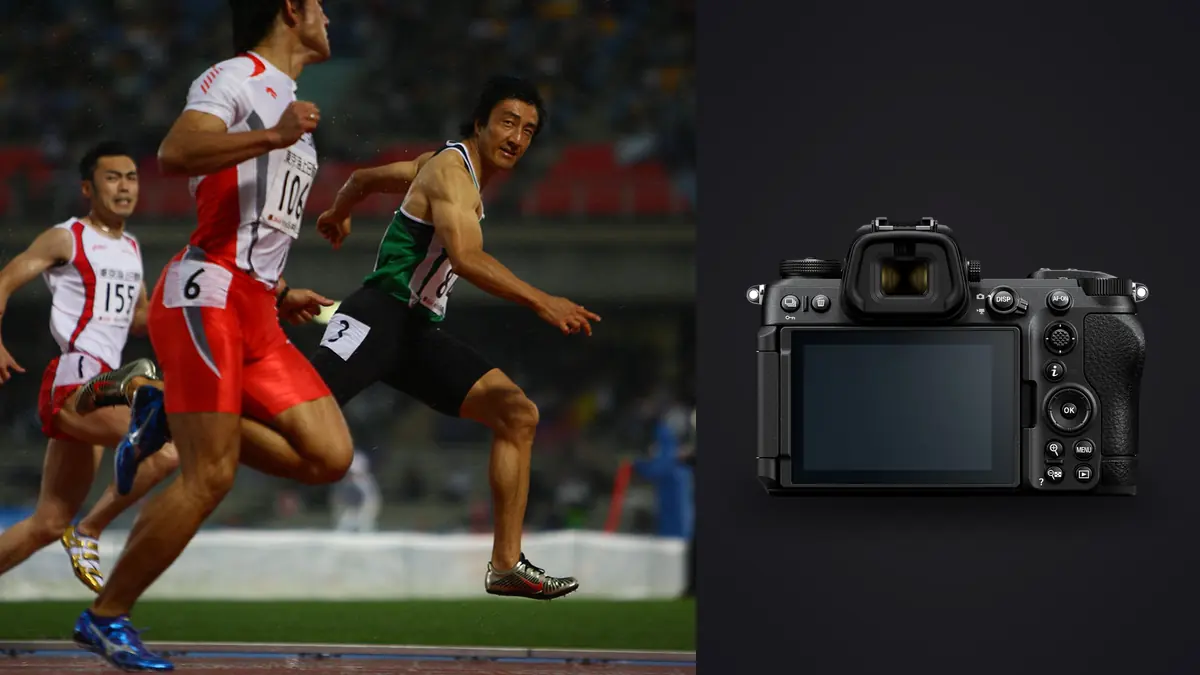
I picked up the Nikon Z6 III mainly to replace an aging D500 for weekend track meets, and it took about two meets for the swap to feel like a genuine upgrade rather than a lateral move. Track and field is a strange sport to shoot compared to something like basketball or soccer: you've got sprinters covering 100 meters in under eleven seconds on one side of the infield, throwers rotating through a shot put circle on the other, and a long jump pit that nobody bothers to light properly at evening meets. One camera body has to do all of it, often within the same twenty-minute window. Here's what actually held up, what I had to work around, and where the Z6 III genuinely earns its price over the older Z6 II.
Autofocus on runners: 3D-tracking beats subject detection more often than I expected
Nikon leans hard on subject detection in its marketing for the Z6 III, and for isolated portraits or a single athlete jogging toward you in an empty lane, it works close to how you'd hope. Point the box near a runner's torso and the camera locks onto a person and holds it through most of a sprint. But track meets rarely give you an empty lane. During a 4x100 relay, you've got eight bodies in a staggered line, and subject detection has a habit of hopping to whichever runner is closest to the center of the frame rather than the one you actually want.
What worked better for me most days was falling back to 3D-tracking with a smaller AF area, placed directly over the athlete's bib or shoulder before the gun goes off, then just following the pan. It's a more manual approach and it means paying attention rather than trusting the camera to sort a crowded scene, but the hit rate on in-focus frames went up noticeably once I stopped relying on auto-area detection during relay legs and 4x400 exchanges. For field events, where there's usually one athlete in frame at a time (a long jumper mid-flight, a pole vaulter clearing the bar), subject detection does its job without complaint.
One thing worth flagging: athletes in sunglasses, which is most sprinters on a sunny afternoon, occasionally confuse eye-detection enough that the camera parks focus on the bridge of the nose or a cap brim instead of locking properly. It's not a dealbreaker, but if you're shooting wide open at f/2.8 on a long lens, that small a miss shows up.
Frame rate and buffer: the numbers that actually matter mid-meet
The spec sheet throws a lot of frame rate options at you, and most of them are irrelevant for track work. Here's how I actually use the burst modes across a meet, and roughly what the buffer gives you before it starts to choke.
| Mode | File type | Rough buffer before slowdown | When I use it |
|---|---|---|---|
| CH+ mechanical, 14 fps | 14-bit lossless raw | Deep enough on CFexpress that I've never hit the wall mid-sprint; noticeably shallower on SD alone, maybe 150-200 frames before it stutters | Sprint finishes, relay exchanges, anything where I want full raw files to grade later |
| Electronic shutter, up to 20 fps | Full-res raw | Buffer clears faster than the mechanical shutter can physically cycle, but rolling shutter shows up as slight lean on the fastest sprinters if you pan too aggressively | Long jump take-off, pole vault bar clearance, moments where silent shooting matters |
| Pre-release capture (C30) | JPEG/HEIF only | Captures up to roughly a second before you fully press the shutter | Starting blocks reaction, discus release, anything where the exact trigger moment is impossible to time by hand |
| High-speed frame capture, 60/120 fps | JPEG, reduced resolution | Short bursts only, and the crop plus resolution drop is noticeable if you're printing large | Almost never for a paying job, occasionally for a single dramatic finish-line frame for social media |
The pre-release capture mode is the one nobody talks about enough for track. Sprint starts are a timing problem as much as a focus problem: by the time your brain registers the gun and your finger reacts, the athletes are already out of the blocks. C30 buys you back that reaction gap. The catch is it only shoots JPEG or HEIF, not raw, so I only turn it on for the start of a race and switch back to mechanical CH+ raw for the rest.
Light at evening meets is the real test
Daytime meets are easy for almost any modern camera. Where the Z6 III separates itself from the Z6 II is under stadium floodlights at a Friday night invitational, where you're shooting 1/1600 or faster to freeze a sprinter and still need something like ISO 5000-6400 to hold a workable aperture. The dual base ISO design (a second, higher native ISO point where the sensor reads more efficiently) keeps noise more controlled in that range than the older sensor did. It's not magic, and you'll still see grain if you pixel-peep at 100%, but it holds up fine printed or posted at normal sizes, which is what 95% of track photography actually needs.
Mixed-lighting meets, where part of the track is under floodlights and part is lit by ambient dusk, are the trickiest white balance situation I run into. I shoot raw specifically so I'm not fighting a baked-in white balance decision made mid-race, and I do the actual color correction afterward rather than trying to nail it in camera between events.
Lens choices that actually make sense for this sport
A 70-200mm f/2.8 covers most of what happens on the near side of the track and through the infield, throws, jumps, and the finish line if you're positioned reasonably close. But track venues are wide, and the far turn or the far straight is often 60-80 meters from any spot you're allowed to stand. For that I've been reaching for a 100-400mm more often than I expected, and on the biggest venues, a 180-600mm earns its weight, even though it's not a lens I enjoy hand-holding for a full meet.
A short zoom like a 24-70mm stays on a second body or gets swapped in during warmups and award ceremonies, where you want context and crowd rather than a tight isolated frame. If you only own one lens and shoot track occasionally, the 70-200 is the one to own; everything past that is a function of how much of the far side of the oval you're expected to cover.
Weather sealing, because outdoor meets don't wait for good weather
I've shot the Z6 III through a light drizzle and through a genuinely cold morning session with no issues, no fogging, no sticky dials. It's built to the same standard as Nikon's higher-end bodies in this respect, which matters more for track than most sports because meets rarely get rescheduled for weather short of lightning.
What a full meet does to your card, and to your evening
A single afternoon covering four or five events at 14 fps produces an absurd number of frames. I've come home from a three-hour meet with north of 4,000 images, most of them 40-60 frame bursts of the same sprint or the same jump attempt, with maybe two or three usable frames buried in each burst. Sorting that by hand after a meet, at 9pm, when you'd rather be doing anything else, is the actual bottleneck in this workflow, not the camera.
This is the part of the job where I stopped fighting it manually and started running everything through imagic before I touch Lightroom. It's a local desktop app, no cloud upload involved, which matters when you've got a card full of minors' faces from a school meet and no interest in that data leaving your machine. It scores focus and sharpness across a folder automatically, so a 45-frame sprint burst where the sharpest three frames are scattered in the middle somewhere gets flagged without me squinting at a loupe view on a laptop screen at a picnic table. It also clusters those burst sequences together instead of showing you 45 nearly identical thumbnails in a row, which on its own probably saves me half an hour a meet.
The other piece that's genuinely useful for this kind of high-volume, repetitive-scene shooting is the apply_my_style feature, which builds a preset from edits you've already made on your own photos rather than a generic canned look. Track meets have a consistent color problem (stadium lighting, green infield turf, team uniform colors that clash) and once I'd graded a couple hundred frames the way I wanted, having that same treatment apply itself across the rest of the folder cut a real chunk of time out of getting a gallery back to a coach or a parent booster club the same week instead of two weeks later.
Where the Z6 III still falls short for this specific use
It's not a perfect sports camera, and it's worth being honest about where the Z8 or Z9 would still beat it for this exact job. The buffer, while deep, isn't infinite, and if you're the type to hold down the shutter through an entire 400m rather than timing your bursts, you'll find the wall eventually, especially on SD alone. The single CFexpress slot plus SD combo is fine for most shooters, but if you're delivering same-day proofs to a school and can't afford a corrupted card, dual CFexpress slots (which the Z8 has) buy peace of mind this body doesn't. And the viewfinder, while excellent, still isn't quite the blackout-free experience Nikon's flagship bodies deliver at the very top of the frame rate range.
None of that changed my decision to keep it as my primary track body. For the price difference against a Z8, giving up a small amount of buffer depth and a second CFexpress slot is a trade I'll make every time.
Frequently Asked Questions
Is the Z6 III fast enough to reliably catch a sprint finish?
Yes, at 14 fps mechanical you're getting a frame roughly every 70 milliseconds, which is tight enough to catch a lean at the tape in most cases. For the exact trigger moment of a gun start, pre-release capture (C30) is the more reliable tool since it removes human reaction time from the equation, though it only records JPEG or HEIF rather than raw.
Do I need a CFexpress card, or will an SD UHS-II card keep up during a meet?
SD UHS-II will get you through most individual bursts without issue, but the buffer clears much slower than on CFexpress, and during a busy relay block with back-to-back races you'll notice the camera stalling more often. If you shoot meets regularly rather than occasionally, CFexpress is worth the cost for that reason alone.
Does the electronic shutter cause visible distortion on fast runners?
Some rolling shutter lean is visible on sprinters if you pan very aggressively at 20 fps electronic, though it's subtle enough that most viewers won't clock it outside of a side-by-side comparison. For anything where a perfectly straight vertical matters (a runner's torso crossing the finish line in a tight crop), I default back to the mechanical shutter.
How do you get through thousands of burst frames without spending the whole night culling?
Running the folder through imagic before opening Lightroom is what changed this for me. It groups burst sequences and duplicate-heavy frames together and ranks them by sharpness, so instead of scrolling through 45 near-identical sprint frames I'm looking at the two or three that are actually in focus, sorted out automatically and processed locally on the machine rather than uploaded anywhere. There's more on how that scoring approach works generally in imagic's culling breakdown, and a broader look at speeding up the rest of the post-meet routine in the workflow tips piece.