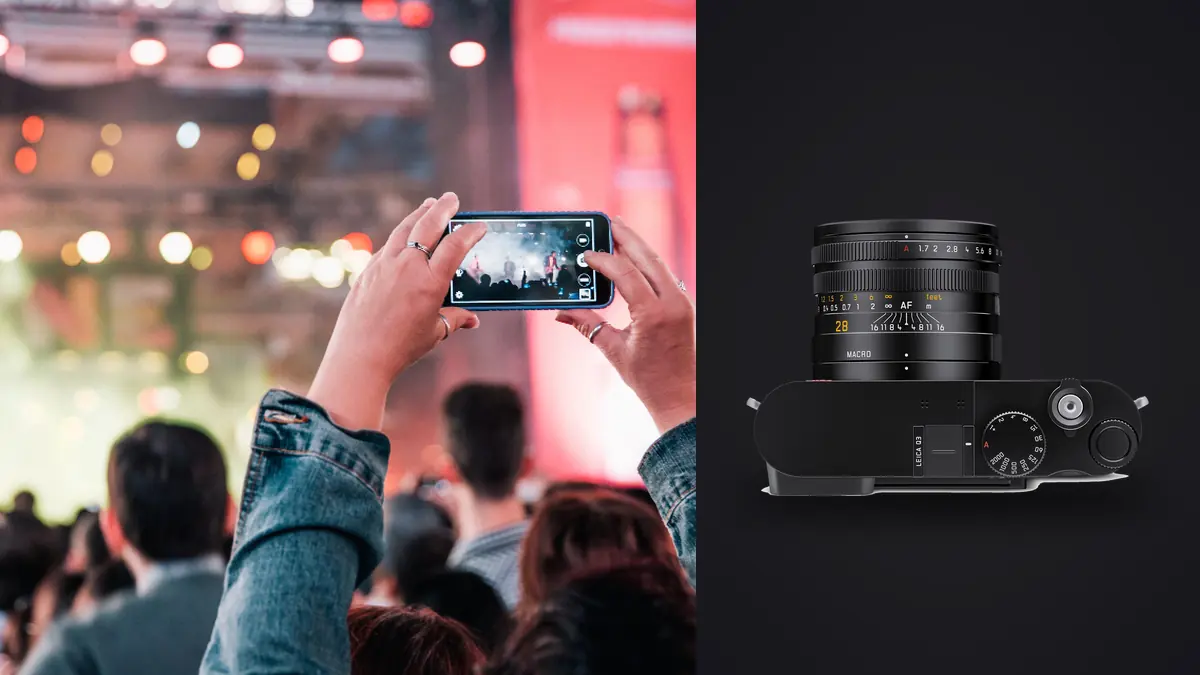
The first time I brought a Leica Q3 to a show, I left my zoom at home almost by accident. I'd been testing the camera for a week of street work and figured I'd shoot the opener with it before switching to a body with real reach. I never switched. Three songs in, I realized the fixed 28mm lens was forcing a kind of shooting I hadn't done in years: get close, commit to the frame, stop hiding behind a telephoto. That's the honest starting point for anyone considering this camera for concert work. It is not a natural fit for the genre in the way a 70-200mm on a fast-focusing mirrorless body is. It rewards a different approach entirely, and once you understand what that approach looks like, the Q3 becomes a genuinely capable tool for certain kinds of live music photography, not all of them.
Why a Fixed 28mm Lens Changes How You Shoot a Show
Most photo pits are built around telephoto glass. You're standing at the barrier, the stage is four to six feet up and several feet back, and a 24-70mm zoom barely gets you a tight headshot of the singer. A fixed 28mm at that same distance gives you the drummer's kit, half the stage, and the crowd's raised arms in the same frame. That's either exactly what you want or completely useless, depending on the shot list. Where the Q3 earns its keep is in small venues: clubs, bars, basements, anywhere the stage is at eye level and three feet away. At that range, 28mm stops being a limitation and starts being the actual language of the photo. You get the guitarist's boots on the monitor, the mic stand in the foreground, the whole physical presence of a room that a longer lens would compress and flatten. I've shot residencies at a 200-capacity room in my city where the Q3 outperformed a 24-70mm zoom on a heavier body, simply because I could move faster and get physically closer without the lens getting in the way.
The f/1.7 maximum aperture matters more here than the focal length does. Most club stages run somewhere between ISO 3200 and ISO 12800 depending on how aggressive the lighting operator is with the haze machine and the color washes. A stop and a third of extra light over a typical f/2.8 zoom is the difference between a clean ISO 6400 file and a noisy ISO 16000 one, and at 60 megapixels, noise shows up fast if you're pixel-peeping later.
Working the Crop Modes as Your Zoom
The Q3's triple resolution technology is the feature that actually makes it viable for anything beyond wide-stage shots. The sensor captures at 60MP, but you can set the camera to record a center crop that simulates 35mm, 50mm, or 75mm framing, and the crop is applied at capture, visible in the viewfinder and on the rear screen before you press the shutter. It is not the same as a real telephoto lens, since you're just using fewer pixels off the same sensor rather than gaining angular resolution, but it's a legitimate way to get tighter shots without carrying a second body.
| Crop setting | Approx. output | Resolution | Best use at a show |
|---|---|---|---|
| 28mm (full frame) | Full sensor width | 60MP | Wide stage, crowd context, band-in-the-room shots |
| 35mm | Light crop | ~36MP | Two-shot of performers, mid-stage framing |
| 50mm | Moderate crop | ~26MP | Single performer, waist-up, still plenty of detail |
| 75mm | Heavy crop | ~18MP | Face and hands, solos, close reaction shots |
The 75mm crop is where I spend most of a set once the band is warmed up and I'm looking for expression shots. Eighteen megapixels still holds up fine for web use and reasonably sized prints, and because the crop is baked into the RAW preview at capture, you're composing for the tighter frame in the viewfinder rather than guessing what you'll crop to later. The tradeoff is that any shake gets magnified the same way it would with an actual longer lens, so shutter speed discipline matters more at 75mm than it does shooting wide. I generally won't drop below 1/250 at the tightest crop setting even with the lens's optical stabilization doing its job, because a singer's head still moves faster than that at the wrong moment.
Autofocus Under Moving Stage Light
Concert lighting is the actual test of any autofocus system, more than resolution or dynamic range. Stages cycle through saturated reds, blues, and ambers, backlights blow out into the lens, and haze scatters everything into low-contrast mush. The Q3's phase-detect autofocus handles steady mid-tempo performers reasonably well, tracking a singer walking the stage or a guitarist shifting weight between verses. Where it struggles, and where any contrast-assisted AF system struggles, is fast lateral movement under a hard color wash, particularly deep red or magenta light, which reads as very low contrast to most sensors. I've had the camera hunt for half a second during a drop when the whole stage went red and the drummer started thrashing, and half a second is long enough to miss the moment. My workaround is simple and not particularly elegant: I switch to single-point AF and place that point on the performer's face or hands before the section I expect to be dramatic, rather than trusting continuous tracking through a lighting change I can see coming. Anyone who's shot a few dozen sets learns to read a setlist and anticipate where the light is going to get difficult. The Q3 rewards that kind of anticipation more than it rewards trusting the algorithm blindly.
Manual focus is available and the focus-by-wire ring is smooth, but I rarely use it live. The one exception is packed, chaotic shows where autofocus keeps grabbing a raised phone or a crowd-surfer's arm instead of the stage. Pre-focusing on a mic stand or amp at a known distance and shooting off that mark has saved more than a few frames in that situation.
RAW Files, Buffer, and What Happens After the Encore
Sixty-megapixel DNGs add up fast. A three-hour headline set with three openers, shot in bursts to catch drum hits and jumps, routinely leaves me with 4,000 to 6,000 frames and somewhere north of 150GB on a card. The buffer clears quickly enough for normal shooting rhythm, a few frames at a time on the beat, but if you hold the shutter down through an eight-second burst chasing a stage dive, you will feel the camera catch up before it's ready for the next sequence. I've learned to shoot in short, deliberate bursts of three to five frames rather than holding the trigger, both to protect the buffer and because it forces me to actually watch the performance instead of spraying and praying.
Getting through that volume of RAW files afterward is where the workflow actually lives or dies, and it's the part nobody mentions when they're talking about lens speed or sensor resolution. After a multi-band bill I'm not opening every file individually to check focus. I run the card through imagic first, which scores sharpness locally on the actual pixel data rather than relying on a thumbnail, and clusters the burst sequences so I'm comparing five frames of the same jump against each other instead of scrolling past all of them one at a time. Everything happens on my laptop with no upload step, which matters when you're backstage on venue wifi that barely handles email, let alone a few hundred gigabytes of DNGs.
Getting the Shot: Pit Access, Crowd Positions, and Practical Angles
If you have a photo pass, the barrier position is straightforward: you're working at 28mm to 75mm effective and you'll want to move along the rail rather than staying planted in one spot, since the fixed field of view means your composition options come from your feet, not your zoom ring. Most pits enforce the standard "first three songs, no flash" rule, and three songs is not a lot of time to work with one focal length equivalent bouncing across four crop settings. I pick a rough shot list before doors: one wide stage shot, one tight solo shot per player if the lineup allows it, and whatever the lighting does that's unrepeatable, then I let priorities shift once the songs actually start. Shooting from the crowd is a different game and, honestly, where the Q3 might be the better tool of the two. Its small, unobtrusive body draws far less attention than a DSLR with a long lens, which matters in a packed room where you're trying not to become the show yourself. Working a support slot from the floor at a small venue, I can get close to the stage between songs, grab a few frames at 28mm or 35mm, and step back without anyone clocking me as "the photographer." That kind of access is worth more than raw reach in rooms where nobody's handing out laminates.
Settings That Actually Hold Up
Every room lights differently, but these are the ranges I actually land in across a typical set, adjusted from what I've logged shooting rooms from 100-cap bars to a couple of theater shows.
| Venue type | Typical ISO range | Shutter speed | Notes |
|---|---|---|---|
| Small club, house lighting only | 6400-12800 | 1/200-1/320 | Wide open at f/1.7, expect visible grain, embrace it |
| Mid-size venue, proper lighting rig | 3200-6400 | 1/250-1/500 | More headroom to stop down slightly for depth |
| Theater or seated venue | 1600-3200 | 1/320-1/640 | Usually brighter, more consistent washes |
| Outdoor festival, daylight fading | Auto-ISO, capped 12800 | 1/500+ | Fast-changing light as sun sets, exposure compensation is your friend |
I shoot aperture priority almost exclusively at f/1.7 to f/2, with auto-ISO capped depending on the room, and I ride exposure compensation down half a stop as a default because stage lighting tends to fool the meter into overexposing skin under a spotlight while the background falls to black.
Editing and Culling After a Three-Hour Set
The gap between what a 60MP DNG can hold and what actually needs editing is enormous. Out of 5,000 frames from a full night, maybe 150 are worth a second look, and of those, 40 to 60 make the final set delivered to a band or venue. Getting from the full card to that shortlist without losing three hours to manual review is the actual bottleneck, more than any camera setting. This is the other place imagic earns its spot in my workflow. Because the crop-mode shooting means some frames are 60MP and others are 18MP depending on what I set mid-set, having software that scores focus locally rather than judging by file size or resolution alone matters. Once I've got a culled shortlist, I lean on the apply_my_style preset, trained on my own past concert edits rather than a generic look, to get a consistent starting grade across a night that swung from red stage wash to white spotlight to nothing but a single blue gel. It's not a substitute for finishing individual hero shots by hand, but it means the 100 frames that just need a quick pass aren't each starting from a flat RAW file. Everything stays on the laptop, nothing leaves the machine to get processed, which is one less thing to think about when you're already exhausted at 1am trying to get a gallery link to a band before they leave town. If you're weighing how a culling step fits into a broader live-music workflow, it's worth reading through how AI photo culling actually works before assuming any tool will save meaningful time, since not every approach handles burst-heavy concert shooting the same way.
Where the Q3 Doesn't Work
Fairness requires saying this plainly: if you're shooting an arena tour from a fixed pit position thirty feet back, or you need reliable tight shots of a horn section across a wide stage, the Q3 is the wrong tool. No crop mode replaces real optical reach, and 75mm equivalent from the back of a large room gets you nothing usable. I keep a longer lens on a second body for anything bigger than a mid-size venue, and I'd tell anyone buying a Q3 specifically for concert work to be honest about which rooms they actually shoot before spending the money. It's a phenomenal tool for the front three rows of a club and a frustrating one for a stadium.
For context beyond the mastering leica q3 for concert live music guide focus in entry 108, continue with photography guide library. These resources connect the subject to a practical local review process.
Frequently Asked Questions
Can the Leica Q3's fixed 28mm lens realistically replace a zoom for concert photography?
Only in specific rooms. In small clubs and bars where you can get within a few feet of the stage, the fixed lens combined with the crop modes covers most of what a zoom would give you. In larger venues with a fixed pit position far from the stage, it can't match a real telephoto and shouldn't be your only camera.
How much do the crop modes actually hurt image quality for tighter shots?
The 75mm crop drops you to roughly 18 megapixels, which is still enough for web galleries and reasonably sized prints, but it's a genuine resolution tradeoff, not a free zoom. Since it's a center crop rather than optical magnification, distant subjects gain no extra detail beyond what the sensor already resolved at that distance.
What ISO can you push the Q3 to before noise becomes a problem at a dark show?
Most of my usable club work sits between ISO 6400 and 12800. Files hold together reasonably well through that range, especially with the aperture wide open at f/1.7. Past ISO 16000 the noise becomes more aggressive, and I'd rather accept a slightly slower shutter than push much higher.
Does shooting hundreds of 60MP RAW files per show create a storage or editing bottleneck?
Yes, and it's the part most people underestimate before buying a high-resolution camera for a burst-heavy genre like live music. A single night can produce well over 100GB of DNGs. Culling software that scores sharpness and groups burst sequences locally, without needing an upload step, is what keeps that volume from turning into hours of manual review after every show.