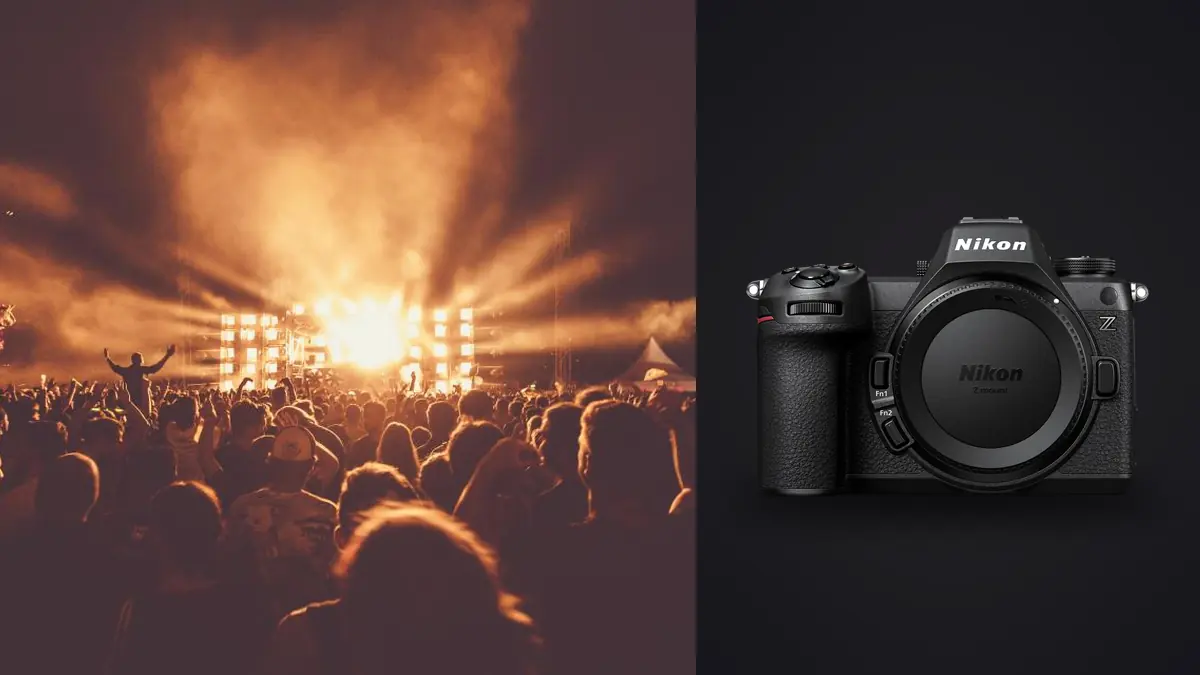
I picked up a Z6 III in early spring mostly because I was tired of my old Z6 II hunting focus the second a singer stepped out of a follow-spot and into the wash of the main rig. Since then I've run it through something like forty shows, everything from a 150-cap basement room with one working par can to a four-thousand-seat theater with a lighting rig that swapped color every four bars. This is what actually mattered for concert and live music work, and what turned out to be spec-sheet noise that never showed up in a real pit.
The sensor readout matters more than the megapixel count
Nikon calls the Z6 III's sensor "partially stacked," which is a strange phrase until you actually shoot with it under moving light. What it buys you is a faster readout than the Z6 II, which means less rolling shutter smear when you pan with a guitarist mid-windmill, and a viewfinder that doesn't black out or lag when you're firing bursts during a chorus. That second part sounds minor until you've missed a jump shot because the EVF froze for a quarter second at the exact wrong moment, which happened to me constantly on older bodies during fast choruses.
The readout speed also changes how usable the electronic shutter is. On the Z6 II I avoided electronic shutter at shows entirely because LED stage fixtures run on PWM dimming, and a slow sensor scan against a flickering light source gives you banding, sometimes a hard black bar across the frame, sometimes just an uneven gradient that ruins skin tones. The Z6 III still isn't immune to banding under badly dimmed cheap LEDs (some club-grade fixtures run PWM frequencies low enough to catch almost any camera), but I get clean electronic-shutter frames from most professional touring rigs now, where I'd have shot mechanical only before.
Autofocus when the only light source is a gel and a strobe
Nikon's 3D-tracking on this body holds onto a singer's face through colored gel light in a way the Z6 II genuinely couldn't. Deep red and magenta washes used to confuse older Nikon AF systems badly enough that I'd switch to manual focus and just ride the focus ring during ballads lit entirely in red, because the camera would rack focus onto the mic stand instead. The Z6 III still isn't perfect under pure red, but it holds the eye far more often than it used to, and it recovers faster when the subject briefly leaves frame and comes back, which happens constantly when a frontman works the stage edge.
Subject switching between band members is the other place this camera earns its keep. With wide-area AF and a decent number of focus points active, I can let the camera pick up whichever musician steps forward without manually repositioning a focus box mid-song, something I used to have to do with a joystick under pressure and usually missed the moment doing it.
Where it still loses the plot
Backlit silhouettes against a bright cyc wall confuse the autofocus regularly, and I don't think any current mirrorless system handles that combination cleanly, it's a contrast problem more than a Nikon problem. Hard strobes during a drop also throw the system for a frame or two, so if a band's lighting designer loves a strobe finale, expect a handful of soft frames mixed into an otherwise sharp burst. And when a crowd surfer's arm reaches into frame during a wide shot, the camera will sometimes grab the hand instead of the face behind it, which is a small annoyance but worth knowing before you trust every frame at full resolution without checking.
Fourteen frames a second sounds like a lot until you count what you keep
The mechanical shutter tops out at 14 fps with full AE/AF tracking, and electronic mode pushes higher, up to 20 fps in 12-bit raw, more if you drop to JPEG. In practice I rarely hold a burst that long during a set. What I actually do is short bursts of four to six frames around a specific moment (a jump, a hair whip, a guitar pick throw) rather than holding the trigger through an entire chorus, because a three-song photo pit session already produces more files than any sane workflow wants to review one by one.
A typical three-song, no-flash pit set for a headliner shoot, shooting two bodies with a wide and a long lens, lands somewhere around 900 to 1,400 frames for me. That number used to genuinely worry me before I started running everything through imagic after the show, since the local sharpness scoring and burst clustering knock that pile down to a shortlist of maybe 60 to 90 keepers in the time it takes to make coffee, without uploading a single RAW file anywhere. For a working photographer turning around gallery selects the same night, that's the difference between sleeping and not.
ISO ceiling: what's usable versus what's technically possible
Native ISO tops out at 64,000 with expansion to 204,800, but I want to be honest about where the useful ceiling actually sits for anything you'd sell or publish. Up through about ISO 12,800 the files clean up nicely in post with reasonable noise reduction and still hold detail in a printed 8x10 or a full-bleed magazine spread. Between 12,800 and 25,600 the files are still very usable for web galleries and social delivery, you just lose some fine texture in fabric and hair. Past 25,600 I'm shooting because the alternative is no photo at all, not because the file will hold up to heavy cropping. The table below is the settings I actually dial in at three venue sizes, not a generic spec chart, this is what's saved in my custom shooting banks on the camera right now.
| Venue type | Typical ISO | Shutter speed | AF area mode | Frame rate | Notes |
|---|---|---|---|---|---|
| Small club / dive bar (under 300 cap) | 6400-12800 | 1/250-1/320 | 3D-tracking, small wide-area as backup | Single, short bursts on movement | Often one overhead key light; watch for green color cast from budget LED cans |
| Mid-size theater / ballroom (800-2000 cap) | 3200-6400 | 1/320-1/500 | 3D-tracking | Mixed single and 4-6 frame bursts | Moving-head fixtures cycle color fast; exposure swings 2+ stops between cues |
| Arena / festival main stage | 800-3200 | 1/500-1/1000 | 3D-tracking with eye-detect | Longer bursts through choruses | LED video walls behind the band pull white balance warm; brighter rig makes strobes harder on the eyes at high fps |
The lenses that actually earn their weight in the pit
My two-body kit is a 24-70mm f/2.8 on one body for stage-wide and crowd-reaction shots, and a 70-200mm f/2.8 on the second for tight face and hand shots from the barrier. The 70-200 is the lens I'd never leave home without for this kind of work; club stages are shallow, but theater and arena pits often put you thirty or more feet back from center stage, and a 24-70 alone leaves you cropping hard in post, which just amplifies noise you were already fighting.
For genuinely tiny club shows where the pit is basically the front row, I'll swap in a fast prime, usually a 35mm f/1.4, because in-body stabilization rated up to 8 stops with the right lens lets me hand-hold slower shutter speeds between numbers when the performer briefly holds still, buying an extra stop or two of ISO headroom I'd otherwise burn through. It does nothing for a moving subject, obviously, VR doesn't freeze motion, but for portraits between songs it's a real advantage over an unstabilized body.
What happens after you leave the venue
Nobody talks about this part enough, but the shoot isn't the hard part of a concert gig, the cull is. Coming home at 1am with 1,200 files and a noon deadline to deliver a gallery to the band's publicist is where most of the actual stress lives. This is where I lean on imagic rather than scrubbing through Lightroom's grid view frame by frame. Its local sharpness and focus scoring flags the soft-focus frames from strobe hits and backlit silhouettes I mentioned earlier, and its burst clustering groups the near-duplicate frames from a six-shot sequence so I'm comparing five similar jump shots against each other instead of against the entire night's take. If you want more detail on how that kind of automated scoring actually works under the hood, I wrote a longer breakdown at how AI photo culling works.
The other piece that's specific to touring photography is the apply_my_style preset, which trains itself on your own past edits rather than applying some generic look-up table. Concert lighting design varies wildly from venue to venue, one night is all cool blues and a cyc wall, the next is warm ambers and haze, and having a preset that's learned my actual color and contrast preferences from edits I've already approved means a first pass across a new gallery lands much closer to my finished look than a stock preset ever does, which cuts real time out of the edit before I even open individual frames.
Offline processing matters more for this genre than most people realize too. A lot of venues run their wifi through a locked-down house network you can't get on, and plenty of tour managers get twitchy about photographers connecting devices to anything backstage. Doing the entire cull and first-pass edit locally on my laptop, no upload step, no cloud dependency, means I'm not stuck waiting on a hotel's slow connection to sync a folder before I can start working the shortlist. If you're trying to tighten up the whole pipeline from card dump to delivered gallery, our faster photo workflow guide covers more of that end of things.
Battery, cards, and getting through a three-band bill
Dual card slots (CFexpress Type B and UHS-II SD) mean you can write raw to the fast card and a JPEG backup to SD for a quick phone transfer if a publicist needs something live during the set, which happens more often than you'd expect for bigger tours with real-time social requirements. Battery life has been solid enough that I've shot a full three-band bill, opener through headliner, on a single battery with power saving EVF settings on, though I always carry a spare because a dead battery mid-encore is not a risk worth taking at a show you can't reshoot.
One small thing that matters more than it should in a crowded pit: the body is light enough to shoot one-handed over your head for a few seconds when you're boxed in by six other photographers all fighting for the same three-song window, which is a real physical constraint on this kind of work that camera reviews almost never mention.
Frequently Asked Questions
Does the Z6 III actually fix the banding problems Nikon bodies had under LED stage lighting?
Mostly, not entirely. The faster sensor readout cuts down banding under most professional touring rigs running electronic shutter, which is a real improvement over the Z6 II. Cheap club-grade LED fixtures running low PWM dimming frequencies can still cause banding on any camera, Nikon included, so I still default to mechanical shutter in small clubs with visibly flickering house lighting and save electronic shutter for bigger, better-equipped venues.
Is a 24-70mm f/2.8 enough, or do I really need a 70-200mm for concert photography?
For genuinely small clubs where the pit is a few feet from the stage, a 24-70 covers most of what you need. Anywhere theater-sized or larger, you'll want the reach of a 70-200mm f/2.8, since pit positions are often thirty-plus feet from center stage and cropping a 24-70 frame that far back just multiplies noise on top of already-high ISO files.
How many photos does a typical three-song pit session actually produce, and how do you get through them fast?
Shooting two bodies through a standard three-song, no-flash set usually lands me somewhere around 900 to 1,400 frames. Rather than reviewing that manually, I run the take through imagic first, which handles local sharpness scoring and clusters near-duplicate burst frames so I'm choosing between the best two or three shots from each moment instead of scrolling the whole night.
What ISO can you actually push on the Z6 III before the files stop being usable?
Up to about ISO 12,800 the files hold up well for print and full-resolution delivery. From 12,800 to 25,600 they're still solid for web and social gallery use with some softening in fine detail. Past 25,600 I'm shooting to have something rather than nothing, and expectations for those frames should be set accordingly.