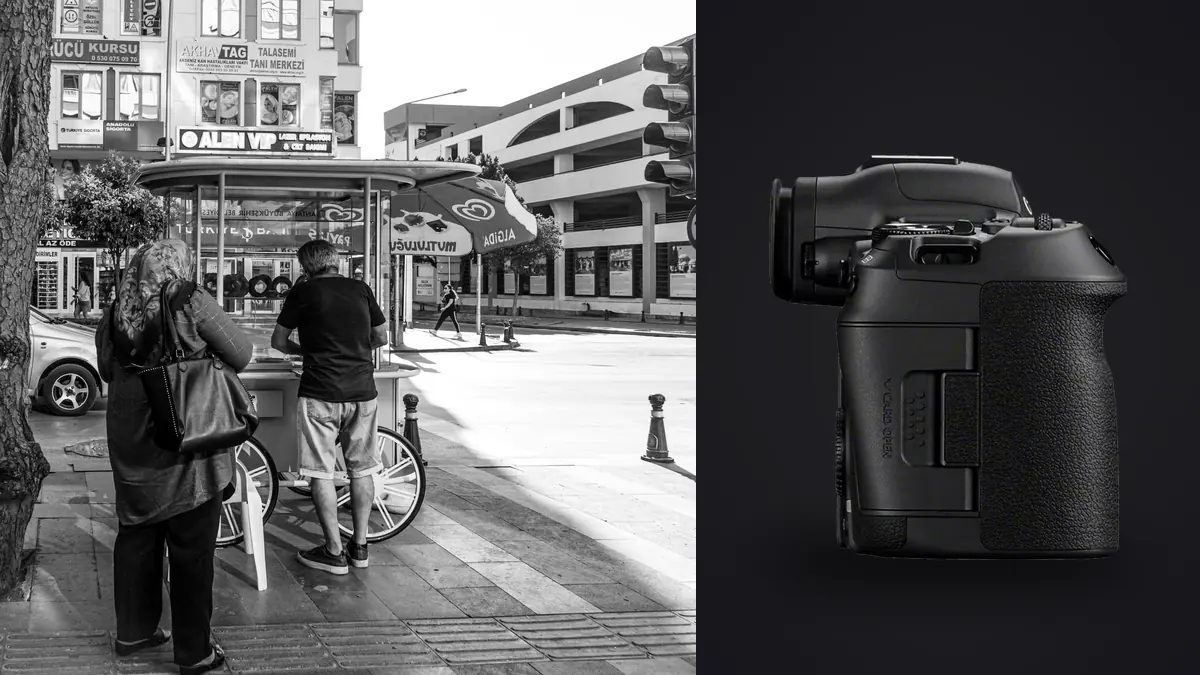
I switched to the R5 Mark II for a documentary project in Naples last winter, mostly because the original R5's autofocus kept losing people in market crowds. Three months and something like 40,000 frames later, the camera has earned a permanent spot in the bag, but not for the reasons Canon's marketing leads with. On the street, the R5 II is less about resolution and more about what happens in the half-second between noticing a moment and the shutter actually firing.
What actually changes on the street versus the studio
Documentary and street work punishes different things than portrait or product photography. Nobody cares about your 45-megapixel files if the subject's eyes are soft because the camera locked onto a shoulder bag instead. Nobody cares about dynamic range if you missed the gesture because the buffer choked mid-sequence. The R5 II's headline upgrades over the original R5, the Digic Accelerator co-processor, eye-controlled AF, and the pre-capture buffer, all map onto exactly the problems that street shooters run into daily. That's not a coincidence. Canon clearly built this refresh with sports and documentary shooters in mind, not landscape photographers.
The stacked 45MP sensor is the same resolution as before, but the readout speed is what matters here. Rolling shutter on the original R5's electronic shutter was bad enough that most street shooters stuck to mechanical for anything with fast lateral movement, like a cyclist cutting across frame. The Mark II's stacked design cuts that skew dramatically, to the point where I now leave it on fully electronic shutter for entire days and don't think about it.
Eye Control AF is not a gimmick for this genre
I was skeptical of eye-controlled autofocus when Canon revived it. It was famously unreliable on the EOS 3 back in film days, and my first calibration attempt on the R5 II produced comically wrong results, the camera keyed on a lamppost while I was looking at a woman feeding pigeons. After running the calibration twice more, in different lighting, it locked in and became genuinely useful for a specific street scenario: pre-framing a scene, holding focus loosely, then flicking my eye to whichever person enters the frame first.
This matters more in documentary work than most reviews give it credit for, because street photography is often about reacting to a scene that's already composed rather than composing around a subject you've already picked. You see the doorway, the light, the wall texture, you raise the camera, and then someone walks into it. Eye Control lets you shift the AF point without your hands leaving the grip or your eye leaving the viewfinder, which keeps you invisible for another half second. That half second is frequently the difference between a natural expression and someone noticing the camera and changing their posture.
The caveat: it needs consistent light on your eye to stay accurate, so it degrades in deep shade or with sunglasses, and I've had it drift during long handheld sessions when the eyecup shifts slightly. I still keep back-button AF as a fallback and don't rely on Eye Control as the only method for anything I can't reshoot.
Pre-capture changes how you think about the decisive moment
Henri Cartier-Bresson didn't have a camera that could reach backward in time, and now, sort of, we do. With Raw burst mode and pre-continuous shooting engaged, the R5 II buffers frames continuously while the shutter is half-pressed and saves roughly half a second of frames from before you fully press it. For street work, this softens the reflex-timing problem that has defined the genre since Cartier-Bresson: your brain registers the peak of a gesture roughly 150 to 200 milliseconds after it happens, and your finger is even slower.
I don't use this as a crutch to spray and pray. It's specifically useful for the kind of documentary moment that has a clear physical peak, a jump, a hand gesture mid-argument, a bird flushing out of a market stall as someone walks past. You still have to anticipate that something is about to happen and half-press in time, the camera doesn't do that part for you. But it forgives the last fraction of a second of human reaction lag, and that fraction is exactly where most "almost" street photos fail.
The tradeoff is file volume. A ten-minute stretch of pre-capture shooting on a market street can leave you with 600 or 700 frames of near-duplicates, which is where a fast cull becomes non-negotiable rather than a nice-to-have. I run these sequences through imagic afterward specifically because its burst clustering groups the pre-capture frames automatically instead of making me scroll through them one by one looking for the sharpest, best-timed shot in each burst.
Handling and discretion
The R5 II is not a small camera, and it's worth being honest about that before anyone buys one expecting Leica-level stealth. Body alone is around 746g, and with an RF 35mm f/1.4 attached you're carrying a rig that draws glances in a way a Fujifilm X100VI or a rangefinder never will. I've had subjects notice the camera and stiffen up in situations where a smaller body would have gone unremarked. If pure discretion is your top priority, this isn't the camera, full stop.
Where it earns its size back is in bad conditions. A rainy evening market in Naples with wet cobblestones and a lot of foot traffic is exactly where a smaller, less weather-sealed body starts to feel risky. The R5 II's sealing held up through a genuinely unpleasant downpour that I would not have trusted a smaller mirrorless body to survive, and the in-body stabilization (up to 8.5 stops with certain RF lenses) let me shoot handheld at shutter speeds I'd normally reserve for a monopod, which matters when you're weaving through crowds and can't plant a tripod anywhere.
The fully silent electronic shutter is a genuine advantage for indoor documentary work, churches, courtrooms, quiet workshops, anywhere a mechanical shutter clack would announce you. I shot an entire glassblowing workshop sequence in near silence and nobody in the room registered when frames were being taken.
Lens choices that actually get used
Three lenses cover almost everything I shoot on the street with this body. The RF 35mm f/1.4 L is the one that stays mounted most days, wide enough for environmental context without the RF 24mm's tendency to include too much dead space in a crowded frame. The RF 28mm f/2.8 STM pancake is what goes on when I want the whole rig to look and feel less like "photographer at work," it's genuinely small and cuts the intimidation factor noticeably. For longer, more compressed documentary framing from across a street or a market aisle, the RF 50mm f/1.2 is excessive on paper but the subject separation at f/1.4 to f/2 in low indoor light has bailed me out more than once.
| Mode | Max frame rate | Sound | Rolling shutter risk | Best street use |
|---|---|---|---|---|
| Mechanical | 12 fps | Audible clack | None | Single decisive-moment frames where fake shutter sound off is fine, or flash sync |
| Electronic 1st curtain | 12 fps | Quiet, slight mechanical tail | Low | General daytime walking, mixed light |
| Full electronic | 30 fps | Silent | Low to moderate (much improved vs. original R5) | Indoor documentary, quiet interiors, discreet moments |
| Raw burst w/ pre-capture | 30 fps | Silent | Moderate | Fast unpredictable gestures, market and crowd action |
Low light, ISO, and the parts of documentary work that happen after dark
A lot of documentary assignments don't stop when the sun does. Evening markets, night processions, backstage before a performance, these are where the sensor's real ceiling shows up. In practice I get clean, usable files up to about ISO 6400, and files I'd still print or publish up to around ISO 12800 with modest noise reduction in post. Past that, into 25600 and beyond, I use it only when the alternative is missing the frame entirely, and I know I'll be leaning on noise reduction hard.
What surprised me more than the noise floor was how the camera's metering handles mixed artificial light sources, string lights next to a fluorescent shopfront next to a phone screen, without the wild color casts I'd gotten used to compensating for on older bodies. It's not magic, white balance still needs correcting in post more often than not, but the baseline exposures are usable straight off the card more often than they used to be.
The part nobody puts in the spec sheet: what happens to 3,000 frames a day
This is the unglamorous truth about documentary and street photography with a fast, high-resolution body: the shooting is the fun part, and the sorting is the part that eats your evening. A single day of walking coverage, pre-capture bursts included, regularly produces 2,000 to 3,500 raw files for me now, up from maybe 800 to 1,200 with an older APS-C body I used to shoot events on. At 45 megapixels each, that's also a lot of disk space and a lot of scrolling.
I've settled into running the day's card through imagic before I open Lightroom at all. The sharpness scoring catches the frames where Eye Control drifted or a subject moved mid-exposure, which is a real problem when you're shooting at f/1.4 in a crowd, and because it runs entirely on the laptop with no upload step, I can do the first pass on a train or in a café between locations without worrying about connectivity or where 40GB of raw files are being sent. For the pre-capture bursts specifically, having the near-duplicate frames grouped automatically instead of manually flicking through eight nearly identical images of the same gesture probably saves me thirty to forty minutes on a heavy shooting day.
The other habit that's changed my workflow: training a custom edit preset on a folder of images I'd already finished editing by hand from a previous project, using imagic's apply_my_style feature, and running new imports through it as a starting point rather than a finished edit. It doesn't replace judgment on a documentary story where tone matters, but it gets flat, mixed-light street files to a reasonable base grade before I touch anything manually, which is a meaningful time save when you're editing on a deadline. If you're trying to get faster generally, our workflow speed guide covers more of this ground beyond just the culling step.
Battery life and cards, because a dead body mid-story is a real risk
Canon rates the LP-E6P battery around 340 shots CIPA, which is conservative in practice, I've regularly gotten 700 to 900 frames per charge shooting mostly stills with the viewfinder rather than the rear screen. Eye Control AF and continuous pre-capture buffering do drain faster than standard shooting, so on a long assignment day I carry two spares rather than relying on one battery lasting a full shift, which it usually won't if you're leaning on pre-capture.
Dual card slots (CFexpress Type B and SD UHS-II) matter more for documentary work than people expect, not for backup paranoia but because CFexpress buffer clearing during a long raw burst sequence is dramatically faster than SD alone. I shoot raw stills to CFexpress and overflow or backup to SD, and on a heavy pre-capture day the difference in buffer recovery time is the difference between missing or catching the next moment thirty seconds later.
Frequently Asked Questions
Is the Canon R5 Mark II too conspicuous for genuine street candids?
It's a full-size mirrorless body and it will get noticed more than a compact camera or a phone. It's not too conspicuous to work with, plenty of documentary photographers shoot bigger rigs than this, but if your priority is total invisibility in tight, close-range street work, a smaller body will serve you better. Where the R5 II wins back the tradeoff is reliability in bad weather and low light, situations where a smaller, less capable body starts to cost you shots.
Does the pre-capture buffer replace good timing?
No. It compensates for the roughly 150 to 200 millisecond gap between your brain registering a peak moment and your finger actually pressing the shutter, but you still need to anticipate that something is about to happen and have the shutter half-pressed in advance. It won't retroactively capture a moment you weren't already tracking.
How much storage should I plan for a multi-day documentary shoot?
At 45 megapixels, expect roughly 50 to 65MB per raw file depending on scene complexity. On a heavy street day with pre-capture bursts I've filled 40 to 50GB, so for a multi-day assignment I'd budget at least a couple of 256GB CFexpress cards and a laptop with enough free space to offload each night, plus time in the evening to cull rather than letting three days of frames pile up unsorted.
Is 45 megapixels overkill for street and documentary work, or does the resolution actually help?
For most street frames you won't need it, and the file sizes are a real tax on storage and culling time. Where it helps is cropping after the fact, a lot of documentary moments happen slightly off from where you're framed, and having enough resolution to crop 30 to 40 percent into a frame and still print or publish it cleanly has saved shots I would have otherwise discarded as poorly composed.